Choosing the perfect staircase chandelier size requires methodology beyond standard room chandelier sizing because stairwells include vertical openness, changing sight lines, and multi-level viewing positions. This complete guide covers the staircase sizing formula (stairwell length + width = chandelier width baseline), body height by ceiling height (8 ft to 22 ft cathedral), hang position safety, sizing by stair type (straight, curved, two-story foyer), and designer staircase chandelier picks for modern and contemporary applications. A staircase chandelier does much more than fill empty space — it defines stairwell scale, shapes first visual impressions, and supports safe stairwell circulation.
Quick Staircase Sizing Snapshot
Use these baseline rules before moving into style, finish, or bulb details.
| Planning Area | Starting Rule | Why It Matters |
|---|---|---|
| Fixture width | Add the visible stairwell length and width in feet, then use that number in inches as the starting chandelier width | Creates a practical baseline for the opening |
| Fixture body height | For 8-foot ceilings, begin around 20 to 24 inches tall, then add about 3 inches for each additional foot of ceiling height | Helps the chandelier keep pace with vertical volume |
| Bottom clearance | Keep the lowest point safely out of the walking path, with strong clearance above head height (7+ ft minimum) | Improves comfort, safety, and visual openness |
| Fixture form | Use compact shapes for tighter stairwells and longer or cascading forms for tall open voids | Aligns the chandelier with the architecture |
On this page
- Why Staircase Chandelier Size Matters
- Visual Planning Map
- How to Measure Your Staircase Correctly
- How to Calculate the Right Chandelier Width
- How to Choose the Right Chandelier Body Height
- Choosing the Hanging Position Safely
- Best Chandelier Styles by Stair Type
- Chandelier for Vaulted Ceiling Stairwell
- Two-Story Foyer Staircase Sizing
- Lighting Performance Considerations
- Common Staircase Sizing Mistakes
- Installation & Long-Term Maintenance
- Frequently Asked Questions
Why Staircase Chandelier Size Matters
In a staircase, scale is noticed quickly because the chandelier is rarely seen from just one angle. It may be visible from the foyer, from the lower floor, from the stairs themselves, from the landing, and even from adjacent hallways. This makes sizing errors easier to detect than in many other rooms. If the staircase chandelier is too small, the stairwell can feel visually unfinished and top-heavy, with too much empty space above the fixture. If it is too large or too low, the stair area can feel tight and awkward instead of open and well planned.
Stairwells also have a different relationship to architecture than a standard room. In many homes, the staircase chandelier becomes part of the stairwell structure rather than a simple decorative light. That is especially true in open foyers, double-height entry zones, and staircases that connect directly to large ceiling voids. In those cases, some buyers get a better size direction by also reviewing fixtures designed for high ceiling rooms, since those styles often carry the stronger body height and vertical expression that staircase spaces need.
Another reason staircase chandelier size matters is lighting performance. A staircase chandelier often needs to balance atmosphere with function. It should help the stairwell feel bright enough to move through comfortably while still working as a decorative focal point. When the size is wrong, the light distribution usually suffers as well. A fixture that is too small can leave the stair opening feeling dim or visually weak, while an oversized chandelier can create too much concentration in one zone without supporting the rest of the stairwell properly. If you are beginning with the main collection, our staircase chandeliers collection offers the strongest starting point before you narrow the right width, height, and hanging position.
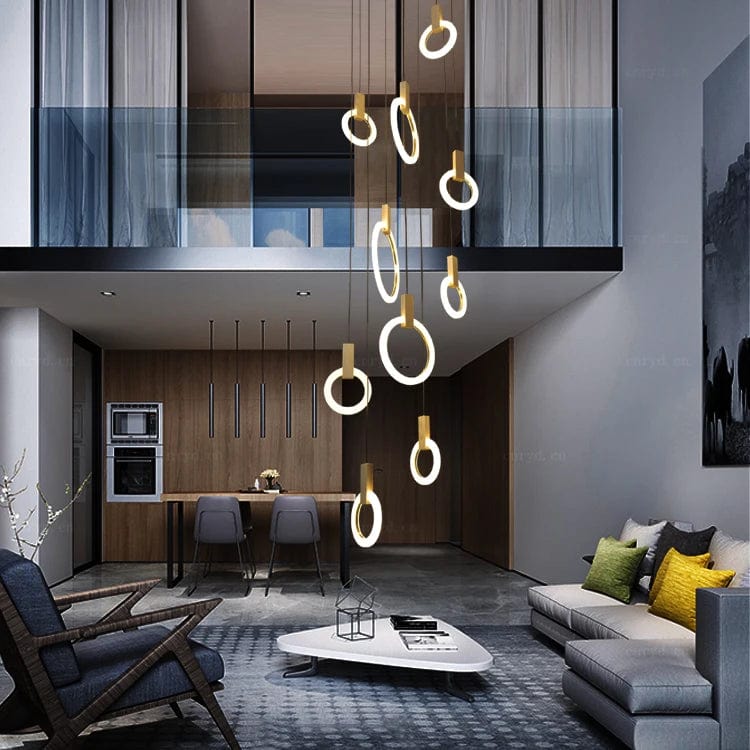
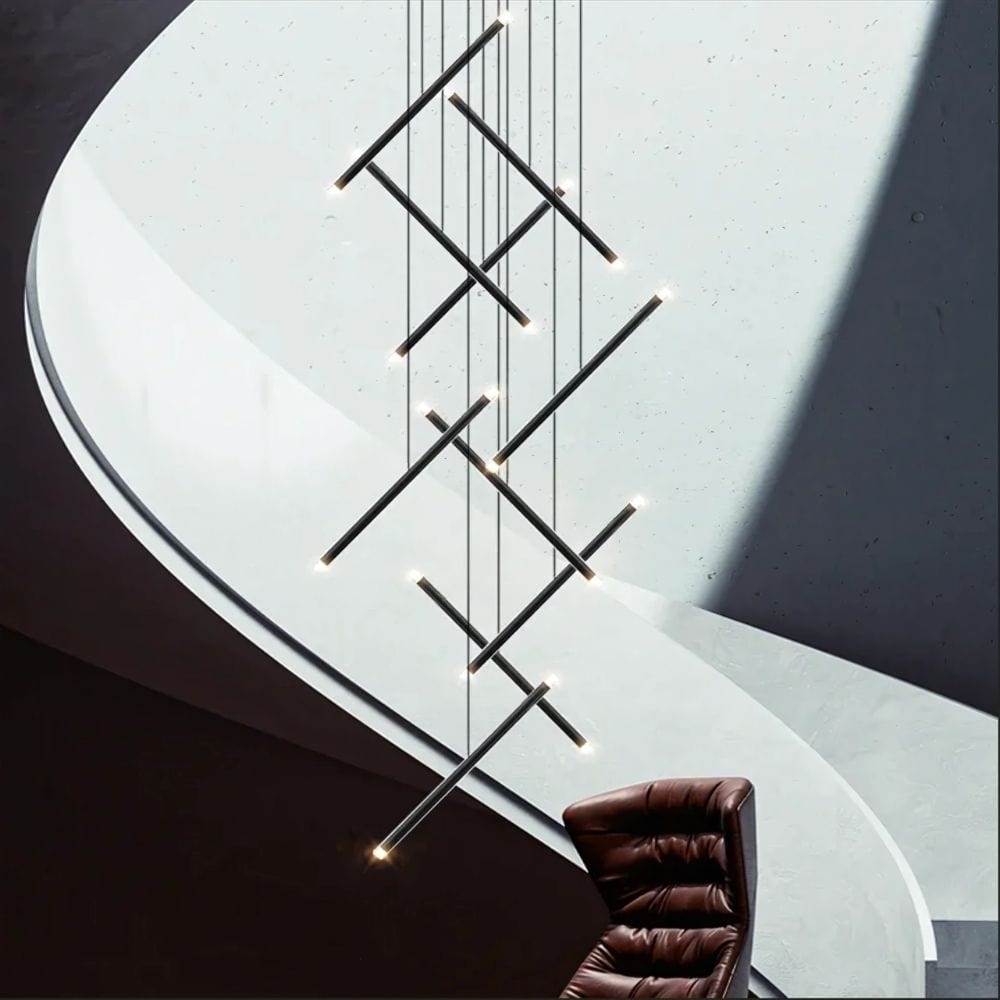
Visual Planning Map for Staircase Chandelier Size
1. Measure the Opening
Use the visible stairwell opening, not only the floor below, to build the first size estimate.
2. Read the Vertical Volume
A chandelier can have enough width and still feel too weak if the body height is too shallow.
3. Protect the Stair Path
The fixture should support the stairwell visually without cutting into movement space.
4. Match the Stairwell Shape
The right form depends on the stair opening, not only on the finish or material.
How to Measure Your Staircase Correctly
Before choosing a staircase chandelier, measure the part of the staircase that people actually see. Start with the visible length of the stairwell opening. Then measure the width at the widest useful point of the opening, foyer void, or stairwell cutout. Finally, measure the vertical distance from the lower floor or the visual center of the staircase to the ceiling above. These three numbers help define the chandelier's likely width, body height, and safe hanging position.
This step is important because staircase sizing is often thrown off by measuring only the stair tread or one narrow section of the stairs. The staircase chandelier should relate to the full spatial opening, not only the run of the steps. In a curved staircase, a centered measurement across the visible opening is usually more useful than following each turn of the stair. In a two-story entry stairwell, the chandelier should usually be measured against the larger visible void rather than the lower foyer floor alone.
It also helps to think about where the chandelier will be viewed from most often. In some homes, the strongest view is from the entry door. In others, the key angle is from the upper landing or from the living space across from the stairwell. Those sight lines matter because they change how large or small the chandelier feels once it is installed.
How to Calculate the Right Chandelier Width for a Staircase
A helpful starting rule for staircase chandelier size is to add the stairwell length and width in feet, then convert that total into inches to estimate chandelier width. This method gives a practical first reference and can help prevent buying a chandelier that disappears in the opening or overwhelms the stairwell too quickly. It works best as a baseline, not as the only decision maker.
For example, if the visible opening measures 10 feet by 5 feet, the combined number is 15. That suggests a chandelier around 15 inches wide as a compact starting point. In a tighter stairwell with a narrow run, that may be close to the final answer. In a broader open entry with more vertical volume, the final chandelier may need to size up from that initial figure, especially if the fixture has an open frame or a slim body that reads visually lighter than its actual dimensions.
This is where staircase sizing differs from a flat ceiling room. The opening might say one thing, but the architecture can justify a modest size increase if the chandelier still keeps the stairwell open and proportionate. In larger entry-connected staircases, it is often useful to compare the stairwell with nearby foyer and entryway chandelier styles, since those layouts often share the same visual void and first-view perspective.
| Visible Stairwell Size | Starting Width Formula | Suggested Direction |
|---|---|---|
| 8' × 4' | 12" | Compact chandelier or narrow cluster |
| 10' × 5' | 15" | Slim vertical form or smaller statement piece |
| 12' × 6' | 18" | Moderate chandelier with stronger presence |
| 14' × 8' | 22" | Larger fixture or layered composition |
| 16' × 10' | 26" | Statement layered or cascading fixture |
| 20' × 12' | 32" | Multi-tier or vertical cascade architectural statement |
Why Width Alone Is Not Enough for Staircase Chandelier Size
One of the most common staircase sizing mistakes is choosing a chandelier by width alone. Width helps determine how the chandelier relates to the opening, but stairwell spaces also need the correct body height and hanging depth. A wide chandelier with a shallow body can still look too weak in a tall stairwell, while a narrower chandelier with stronger vertical shape may feel far more appropriate once it is installed.
This is especially true in homes with tall walls, stacked windows, or two-story voids. In those spaces, the chandelier needs enough vertical substance to keep the upper portion of the stairwell from looking empty. That is why a staircase chandelier should be read as a three-dimensional object, not just as a width number on a product page.
How to Choose the Right Staircase Chandelier Body Height
Body height often matters even more than width in a staircase because stairwells usually carry strong vertical openness. A practical starting point for an 8-foot ceiling is a chandelier body around 20 to 24 inches tall. From there, adding roughly 3 inches of fixture height for each additional foot of ceiling height helps the chandelier keep pace with the architecture above it.
This does not mean every staircase needs a very tall chandelier. In tighter stair openings, compact forms with a clear silhouette can work well. But when the space opens into a tall foyer or a double-height stairwell, a taller body, a layered structure, or a cascading profile often creates a stronger result than a flat fixture that stays too close to the ceiling plane.
In especially open staircases, the chandelier needs to feel complete from both below and above. That is why longer forms and elongated silhouettes often perform well in these spaces. For readers comparing those shapes more directly, our article on long chandeliers for staircase spaces expands on the kinds of layouts that benefit most from extra vertical length.
| Ceiling Height | Suggested Fixture Body Height | Best Use |
|---|---|---|
| 8 feet | 20" to 24" | Lower stair openings and tighter circulation zones |
| 9 feet | 23" to 27" | Standard staircase ceilings with a little more openness |
| 10 feet | 26" to 30" | Entry staircases and more decorative focal fixtures |
| 12 feet | 32" to 36" or more | Open stairwells and two-story visual volume |
| 14 feet | 36" to 42"+ | Long-drop or more architectural staircase statements |
| 16-18 feet (Cathedral) | 42" to 60"+ | Cathedral stairwells with cascading multi-tier composition |
| 20-22 feet (Two-Story Foyer) | 50" to 72"+ | Two-story foyer staircases with vertical cascade architectural statement |
Choosing the Hanging Position Safely
The hanging position should protect the stair path first and the visual effect second. A staircase chandelier should feel present, but it should never hang low enough to interrupt movement or make the stairwell feel compressed. As a general planning baseline, the lowest point should stay comfortably above the walking path, and in most open circulation areas homeowners often work from a minimum clearance mindset of around 7 feet above the route people use most.
That baseline is only the beginning. Staircases often include angled treads, changing landings, or sloped ceiling conditions, so the final hanging point should be checked from several positions. In a compact staircase, the chandelier usually needs to sit a little higher and stay more controlled. In a tall two-story foyer stairwell, the fixture can hang lower visually, as long as the bottom still clears the path and remains comfortably above head level.
Another important factor is the visual center of the stairwell. Some chandeliers look best when centered to the void, while others feel more natural when aligned to the stair run or the midpoint between lower and upper sight lines. The right answer depends on how the staircase is actually used and viewed in daily life.
Safety Snapshot for Staircase Chandelier Hanging
- Keep the lowest point clear of the stair walking path
- Check views from the lower floor, stair midpoint, and upper landing
- Reconfirm the final drop after assembly, especially on sloped or angled ceilings
- Do not prioritize dramatic drop if it reduces comfort or usable clearance
- Maintain minimum 7 ft floor clearance above main walking path


Best Chandelier Styles for Different Staircase Types
Not every staircase needs the same chandelier shape. A narrow straight-run staircase often looks better with a slimmer vertical fixture or a compact design that keeps the line of the stairs clean. A broad open staircase with a taller void usually benefits from a longer, layered, or cascading fixture that fills the space more naturally without looking lost.
A curved staircase often pairs well with chandeliers that have flow or staggered structure because the fixture can echo the movement of the stairs rather than fighting it with a rigid silhouette. In a two-story foyer staircase, multi-level chandeliers or fixtures with stronger body height usually feel more settled because they hold the larger opening better from a distance.
Material and finish change the perceived size too. Reflective pieces often feel richer and fuller, which is why buyers seeking a more formal staircase focal point often compare crystal chandelier options. Cleaner open-arm silhouettes usually read lighter and more architectural, which often makes them a stronger fit for homeowners leaning toward modern chandelier styles. For modern chandelier lights for staircase applications, our staircase chandeliers collection features formats specifically designed for stairwell architecture.
| Staircase Type | Best Fixture Direction | Why It Works |
|---|---|---|
| Straight staircase | Slim vertical or compact centered chandelier | Keeps the visual line clean and controlled |
| Curved staircase | Cascading or softly layered fixture | Follows the motion of the stair more naturally |
| Two-story foyer staircase | Taller multi-level chandelier or vertical cascade | Fills the vertical opening and reads well from distance |
| Compact stair opening | Low-profile or narrow-body fixture | Protects openness and keeps the stairwell comfortable |
| L-shape staircase | Centered cluster or compact statement | Sits above the landing center, visible from both runs |
| Spiral staircase | Vertical cascade or elongated narrow form | Follows the vertical axis of the spiral structure |
Staircase Chandelier for Vaulted Ceiling Stairwells
Vaulted ceiling stairwells present unique sizing challenges because the angled ceiling creates more vertical volume than a flat ceiling at the same nominal height. A chandelier appropriate for a flat 14 ft ceiling stairwell will often look undersized in a vaulted ceiling stairwell at the same height because the vault adds 3-6 ft of additional vertical reading. For vaulted ceiling stairwell applications, increase chandelier body height 20-30% beyond standard ceiling-height formulas suggest.
Vaulted ceiling stairwells typically work best with statement scale cascading chandeliers, multi-tier crystal compositions, or vertical biomorphic forms that fill the angled vault. Hang the chandelier from the highest point of the vault using extended chain or rod, with the fixture body distributed throughout the vault's vertical reading. For broader vaulted ceiling chandelier methodology, see our high ceiling chandeliers guide for additional cathedral-scale application direction.
Two-Story Foyer Staircase Sizing
Two-story foyer staircases — where the staircase opens directly into a double-height entry — require the most demanding staircase chandelier sizing methodology. These applications combine: (1) very tall vertical volume (16-22+ ft from entry floor to ceiling), (2) multi-level viewing positions (entry, mid-stair, upper landing, second-floor hallway), (3) connection to first-view positioning (the chandelier is typically the first thing visitors see), and (4) integration with foyer lighting design language.
| Two-Story Foyer Detail | Sizing Direction |
|---|---|
| Ceiling height 16-18 ft | Chandelier 40-50+ inch body height; 32-44 inch diameter |
| Ceiling height 18-22 ft | Chandelier 50-72+ inch body height; 36-50 inch diameter |
| Cathedral vault 20+ ft | Chandelier 60-90+ inch cascade body height; 40-56+ inch diameter |
| Foyer connection | Match metal finish to foyer hardware throughout the home |
| First-view positioning | Chandelier serves as primary architectural focal point from entry |
For two-story foyer staircase chandeliers, browse the staircase chandeliers collection for vertical cascade formats and the high ceiling chandeliers collection for cathedral-scale options designed specifically for tall vertical applications.
Lighting Performance Considerations
A staircase chandelier should not only fit the space visually. It also needs to light the stairwell in a useful and comfortable way. LED light sources, dimming capability, and a balanced color temperature help the fixture adapt from daytime circulation to evening use. In many homes, the chandelier performs best when it works alongside wall lighting or another supportive layer instead of trying to carry the full stairwell alone.
This is one reason fixture selection should balance form and output. A chandelier that looks perfect but leaves the stairs feeling underlit will not perform well in daily life. A fixture that is bright but poorly placed can feel harsh and visually awkward. The most complete result usually comes from a proportional chandelier supported by thoughtful hanging height and layered light planning. For homeowners who want another reference point on drop and clearance across multiple rooms, our light fixture height chart can help reinforce the hanging logic used here. Layered light with wall sconces supporting the chandelier improves stairwell function significantly.
Common Staircase Chandelier Sizing Mistakes
- Measuring only one part of the stairs: Stairwell chandeliers should relate to the visible opening, vertical void, and circulation path together — not just the stair tread width.
- Choosing only by width: Body height is often just as important because tall voids need stronger vertical scale.
- Underestimating upper landing views: A chandelier can feel balanced from the lower floor but look weak or poorly centered from above. Verify from all viewing positions.
- Hanging too low for visual drama: The chandelier may look strong in photos but crowds the stair path or compresses the space.
- Forgetting fixture density effects: Dense crystal pieces and darker compact fixtures tend to read larger than open glass or slim metal forms with similar width measurements.
- Ignoring stair type architecture: Straight staircases need different formats than curved or two-story foyer staircases. Match chandelier form to staircase architecture.
- Skipping vaulted ceiling adjustment: Vaulted ceiling stairwells need 20-30% more body height than flat ceiling stairwells at the same nominal height.
- No connection to foyer lighting: In open-plan homes where staircase connects to foyer, the chandeliers should coordinate in finish, scale, and style direction.
Installation and Long-Term Maintenance
Installation quality matters even more in staircase spaces because of height, access difficulty, and the visibility of the chandelier from different levels. The ceiling support should match the chandelier weight, the hanging point should be verified from all major sight lines, and the final drop should be checked only after the full fixture body is assembled. Small adjustments in staircase spaces can make a large difference in the way the chandelier feels.
Maintenance should also be part of the buying decision. If the stairwell is tall and the chandelier includes many bulbs, glass pieces, or crystal elements, cleaning access becomes a real planning factor. A visually strong chandelier is much easier to live with when its upkeep is realistic for the space. This is especially important in very tall entry stairwells where future bulb changes or cleaning may require extra equipment or professional help. For complete care methodology, see our chandelier maintenance guide.
Frequently Asked Questions
How big should a staircase chandelier be?
A practical starting point is to add the visible stairwell length and width in feet, then use that number in inches as the beginning width estimate. After that, adjust based on ceiling height, fixture shape, and the openness of the stairwell. For two-story foyer staircases, scale up 20-30% above the baseline formula for proportional architectural presence.
What size chandelier for a staircase?
For a staircase chandelier size, add the visible stairwell length and width in feet — the total in inches gives baseline chandelier width. A 10×5 ft stairwell calls for 15-inch baseline; a 14×8 ft stairwell calls for 22-inch baseline. Adjust body height by ceiling height (20-24" for 8 ft; 26-30" for 10 ft; 32-36" for 12 ft; 36"+ for cathedral).
How low should a staircase chandelier hang?
It should stay well clear of the stair walking path and comfortably above head height. In many open circulation areas, homeowners use about 7 feet of minimum clearance as a baseline, then refine the final drop based on the exact stair geometry. Two-story foyer staircases can hang lower visually as long as the bottom maintains 7+ ft clearance above the entry floor.
What type of chandelier works best for a tall stairwell?
Tall stairwells often need fixtures with stronger body height, more layering, or a cascading shape so the chandelier does not look too small inside the vertical volume. Multi-tier crystal, vertical cascade, and biomorphic forms with extended drop all work well in tall stairwell applications.
Can a staircase chandelier be too small?
Yes. A chandelier that is too small can leave the stair opening feeling empty, especially in tall or open entry spaces where the fixture is viewed from several directions. Apply the formula (length + width = baseline width in inches) and scale up rather than down for stairwell applications.
Should a staircase chandelier match foyer lighting?
In homes where the staircase opens directly into the entry, the chandelier should feel related to the foyer lighting in finish, shape, or overall visual weight so the front-facing spaces feel connected. Match metal finish across staircase and foyer chandeliers for coordinated interior reading.
Is chandelier width more important than chandelier height in a stairwell?
No. Width is important, but body height is often just as important because staircase spaces usually carry stronger vertical openness than flat ceiling rooms. In two-story foyer staircases, body height becomes the primary sizing consideration.
What chandelier for a vaulted ceiling staircase?
For a vaulted ceiling staircase, choose a chandelier with strong vertical body height (32-50+ inches) and cascading or multi-tier composition. The chandelier should be hung from the highest point of the vault. Increase body height 20-30% beyond standard flat ceiling formulas because vaulted ceilings create more vertical volume than nominal height suggests.
How to choose a staircase chandelier for two-story foyer?
For two-story foyer staircase chandeliers, choose vertical cascade or multi-tier fixtures with 50-72+ inch body height for 18-22 ft ceilings. The chandelier should serve as primary architectural focal point from the entry; match metal finish to foyer hardware. Browse vertical cascade formats in the dedicated staircase chandeliers collection.
How to hang chandelier in staircase?
Hang the staircase chandelier from the highest accessible point of the stairwell ceiling using appropriately rated chain, rod, or cable. Maintain minimum 7 ft floor clearance above main walking path. Verify hanging position from lower floor, stair midpoint, and upper landing sight lines before final installation. For complete hanging methodology, see our light fixture height chart.
What's the best modern chandelier for staircase?
The best modern chandelier for staircase depends on stairwell architecture: straight runs work with slim vertical modern fixtures; curved staircases work with cascading modern forms; two-story foyers work with multi-tier modern statement chandeliers. Yana Modern, Apex Modern, and Noir Modern represent established direction. Browse modern formats in the staircase chandeliers collection.
How wide should a staircase chandelier be for a 10x5 stairwell?
For a 10 ft × 5 ft stairwell opening, the baseline chandelier width is 15 inches (10 + 5 = 15). Adjust upward 10-20% for open-frame or slim-body fixtures (16-18 inches); scale up 30% for two-story foyer applications (18-22 inches). Body height should be 20-30 inches depending on ceiling height.
Bringing the Staircase Together
The best staircase chandelier size comes from width, body height, clearance, and fixture form working together. Start with the visible opening, use ceiling height to shape the vertical scale, then refine the final drop so the chandelier reads clearly without interfering with the stair path. A staircase chandelier should feel like part of the architecture, not a decorative object forced into the space. When those proportions line up — particularly in vaulted ceiling stairwells and two-story foyer applications where staircase chandelier size affects the entire entry impression — the chandelier becomes one of the strongest visual features in the home and supports the staircase in a way that feels balanced from every angle.