Mixing metal finishes used to be an advanced designer move. In 2026, it is the default. Aged brass paired with matte black, antique bronze with clear crystal, polished nickel accents on warm-metal frames — coordinated mixed finishes now appear on nearly every major lighting brand's new releases. The rules are simpler than they look once you understand the underlying logic. This guide covers exactly how to mix metals in lighting fixtures without clashing, with specific 2026-aligned pairings and real product examples for every common combination.
Key Takeaways
- The 70/30 Rule: One metal finish should dominate (70% of visible fixtures), the other accents (30%). Anything more balanced reads as indecisive.
- Two finishes is the sweet spot for most rooms; three is the maximum before mixing becomes visual noise.
- Best 2026 combinations: Aged brass + matte black, champagne bronze + warm gold, antique bronze + clear crystal, polished nickel + matte black.
- Avoid: Mixing chrome with warm metals (brass, bronze) — temperature mismatch is the most visible clash.
- Coordinate across sightlines: Fixtures visible from each other should share at least one finish; fixtures on separate floors can vary more.
- Hardware matters: Cabinet hardware, faucets, and door handles factor into the metal mix too — count them in the 70/30 split.
- Match undertone, not just color: Two "gold" finishes can clash if one is yellow-gold and the other is rose-gold.
- Texture coordinates with finish: Hammered, brushed, and polished textures read differently — combine with intention, not by accident.
On this page
- Why Mixed Metals Replaced Matching Sets
- The 10 Metal Finishes Defining 2026
- The Core Mixing Rules
- Best Metal Combinations
- Combinations to Avoid
- Room-by-Room Mixing Guide
- Coordinating with Cabinet Hardware
- Sightline & Open-Plan Coordination
- Featured Mixed-Metal Fixtures
- Common Mixing Mistakes
- Frequently Asked Questions
Why Mixed Metals Replaced Matching Sets
For two decades, the rule was simple: pick one finish and stick to it. Brass everywhere, or chrome everywhere. The "matching set" approach made coordination automatic. It also made every room read as flat and showroom-staged.
The 2026 shift toward mixed metals reflects how high-end designers have always worked — and how the rest of the industry has now caught up. Matching one finish across an entire home creates monotony. Mixing finishes intentionally adds depth, signals personality, and makes a space feel collected rather than catalog-shopped. The risk used to be that mixing looked accidental. The current rule set eliminates that risk by giving each combination a clear logic.
Lightovation 2026 — the industry's flagship lighting show — confirmed the shift. Nearly every major brand released fixtures with two or three coordinated finishes built into the same piece (brass arms with matte black canopies, antique bronze sockets on warm gold frames, chrome accents punctuating champagne bronze bodies). For full 2026 trend context, see our 2026 lighting trends guide.
The 10 Metal Finishes Defining 2026
Before mixing, you have to recognize what you're mixing. The 2026 lighting market revolves around ten finish families. Each has a distinct undertone, texture profile, and pairing character.
Warm vs. Cool Metals
The single most useful concept in metal coordination is temperature. Each finish reads as warm, neutral, or cool — and the warm-cool distinction governs which combinations work and which clash.
| Temperature | Finishes | Pairs Well With | Clashes With |
|---|---|---|---|
| Warm | Aged brass, polished brass, champagne bronze, warm bronze, aged bronze, copper, gold | Other warm metals; black; charcoal; warm woods | Polished chrome; cool icy silver |
| Neutral | Matte black, charcoal, iron | Anything — these are universal connectors | Nothing categorically |
| Cool | Polished chrome, brushed nickel, polished nickel | Other cool metals; black; cool whites; smoked grays | Brass; bronze; copper; warm yellows |
The Core Mixing Rules
Five rules govern every successful mixed-metal lighting plan. Follow these and almost any combination will read as intentional.
Rule 1: 70/30 Dominance
Pick one metal as the dominant finish (~70% of visible fixtures and hardware). The second metal accents (~30%). A 50/50 split reads as indecisive — the eye can't tell which metal is the "main" one.
Example: Aged brass on the dining chandelier, kitchen pendants, and entry sconce; matte black on the foyer chandelier and stair sconces.
Rule 2: Two Finishes Maximum (Per Sightline)
Within a single sightline (one open room or two connected rooms visible from each other), use two finishes. Three is possible only if one is matte black or charcoal, which acts as a connector.
Example: Living room visible from dining: warm brass + matte black. Adding a third polished chrome fixture in this view would clash.
Rule 3: Same Temperature OR Anchor with Black
Mix only within the same temperature family (warm + warm, cool + cool), or use matte black/charcoal as a neutral anchor that allows mixing across temperatures.
Example: Aged brass + champagne bronze (warm + warm) ✓. Aged brass + polished chrome ✗. Aged brass + matte black + polished chrome ✓ (black anchors).
Rule 4: Match Undertone, Not Just Color
Two "gold" finishes from different brands can clash if one has a yellow-gold undertone and the other has a rose-gold or green-gold undertone. Always check fixtures against each other before installing — a single product photo lies about undertone.
Solution: Order one fixture, view it in your space's natural light, then order the second.
Rule 5: Texture Reinforces Finish
Hammered, brushed, and polished textures read differently. Mixing textures within one finish family (brushed brass + hammered brass) can work or clash depending on the room. Mixing texture across temperatures (brushed nickel + hammered brass) almost always reads chaotic.
Safe default: Same finish texture across all fixtures of one metal family.
Rule 6: Count Hardware Too
Cabinet pulls, faucets, door handles, and bathroom fixtures count in the 70/30 split. A kitchen with chrome cabinet hardware cannot easily accept a brass-only chandelier — it forces a 50/50 split that reads off-balance.
Audit: Walk the room. Count every metallic surface, including those you'd typically ignore.
Best Metal Combinations for 2026
Six combinations dominated 2026 launches and consistently work in residential interiors. Each is paired here with its ideal application.
Combination 1: Aged Brass + Matte Black
The single most-released pairing of 2026. Aged brass carries the warmth; matte black provides structural anchor and visual contrast. Works across virtually every interior style — modern, transitional, modern farmhouse, contemporary, traditional with updates. Almost no clash risk.
Best for: Kitchens, dining rooms, entryways, open-plan living spaces
Pairs with: Walnut wood, white oak, stone countertops, warm-white paint
Combination 2: Champagne Bronze + Warm Gold
A soft, monochrome-warm combination. Both finishes sit close on the warm spectrum but differ enough in saturation that the pairing reads layered rather than flat. Ideal for formal living rooms, primary bedrooms, and powder rooms where understated warmth is the goal.
Best for: Bedrooms, formal living, powder rooms, elegant dining
Pairs with: Cream paint, blush textiles, light wood, alabaster details
Combination 3: Antique Bronze + Clear Crystal
Bronze returned in 2026 with stronger black undertones than the muddy bronze of the early 2000s. Pairing it with clear crystal produces formal warmth without traditional heaviness — a notable improvement over the all-bronze fixtures of past decades.
Best for: Formal dining, traditional foyers, transitional living rooms
Pairs with: Walnut, leather, deep paint colors, oil-rubbed metals
Combination 4: Polished Nickel + Matte Black
A cool combination that still works in 2026 — polished nickel reads as modern luxury rather than dated chrome, especially when paired with matte black accents. Often appears in primary bathrooms and modern kitchens that lean cool rather than warm.
Best for: Primary bathrooms, cool-modern kitchens, contemporary master suites
Pairs with: White marble, cool whites, soft grays, smoked glass
Combination 5: Matte Black + Warm Gold Accent
Black-dominant with a small gold accent. Modern minimalist interiors consistently use this pairing to add warmth without losing structural clarity. The accent gold typically appears as fixture sockets, knurling on stem joints, or as a single visible bracket.
Best for: Modern minimalist interiors, industrial-modern, urban contemporary
Pairs with: Concrete, dark wood, cognac leather, smoked glass
Combination 6: Aged Brass + Walnut Wood
Not strictly a metal-on-metal combination, but the most-cited "modern vintage" pairing of 2026. The wood substitutes for a second metal as a tonal complement — the warm wood and warm metal together create exactly the modern-farmhouse vocabulary dominating residential interiors.
Best for: Modern farmhouse, transitional, biophilic, Scandinavian-influenced
Pairs with: Linen textiles, natural stone, warm-white paint, plants
Combinations to Avoid
Some combinations clash for clear reasons — temperature mismatch, undertone fight, or visual category collision. Avoid these unless you specifically want a chaotic, intentionally mismatched look.
| Combination | Status | Why |
|---|---|---|
| Aged brass + polished chrome | AVOID | Temperature mismatch — warm meets cool with no anchor |
| Bronze + polished silver | AVOID | Same temperature mismatch problem |
| Polished brass + brushed nickel (no black anchor) | AVOID | Reads inconclusive — eye can't decide warm or cool |
| Aged brass + brushed nickel (with black anchor) | CAUTION | Possible with substantial matte black presence as connector |
| Three warm metals (brass + bronze + copper) | CAUTION | Risk of looking dated — only works in genuinely traditional interiors |
| Hammered brass + polished brass | CAUTION | Texture mismatch within same finish reads accidental |
| Aged brass + matte black | GO | Most replicated 2026 pairing |
| Champagne bronze + polished nickel | GO | Soft warm + cool with shared luminosity |
| Matte black + warm gold accent | GO | Black anchors any warm accent reliably |
| Polished nickel + matte black | GO | Cool + neutral combination, modern luxury |
Room-by-Room Mixing Guide
Different rooms tolerate different mixing strategies. The kitchen, with the most metal surfaces of any room (cabinet hardware, faucet, appliances, lighting), demands stricter coordination. The powder room, with minimal hardware, allows more freedom.
Kitchen
The kitchen is the strictest room for metal mixing. Cabinet hardware, faucet, range, hood, lighting, and often appliances all carry visible metal finishes. Stay with two finishes maximum, with matte black or aged brass typically dominant. Stainless appliances function as a neutral that doesn't count against the 70/30 split.
- Strong 2026 combo: Aged brass faucet and cabinet pulls + matte black pendant lights or linear chandelier
- Alternative: Matte black hardware + warm gold accent on pendants or bar lights
- Avoid: Mixing chrome appliances with warm-metal lighting and warm-metal hardware
Dining Room
Dining rooms allow more freedom because they have fewer metal surfaces — usually just the chandelier and any wall sconces. Use this freedom for intentional warmth. Aged brass + matte black or antique bronze + clear crystal both dominate 2026 dining releases.
Featured chandelier and dining-specific sizing detail: 12 modern chandeliers for dining rooms.
Living Room
Living rooms benefit from a single dominant finish on the chandelier (or main fixture) and accent finishes on table lamps, floor lamps, and decorative objects. The chandelier sets the temperature — table and floor lamps follow.
Bedroom
Bedrooms work well with monochrome-warm pairings (champagne bronze + warm gold, aged brass + walnut). Cool combinations (polished nickel + matte black) work in modernist interiors but should be paired with warm bedding to avoid clinical reads.
Bathroom
Bathrooms typically benefit from a tighter palette — one finish on faucets and shower hardware, the same or one accent finish on lighting and cabinet pulls. Mixing chrome and warm metals in a bathroom almost always fails because the wet conditions amplify the temperature mismatch visually.
Foyer / Entryway
Entryways often serve as the introduction to a home's metal vocabulary. Pick the dominant finish here — it should appear on at least 70% of visible metal in the foyer and continue into the rooms visible from the entry.
Coordinating with Cabinet Hardware
Cabinet hardware, faucets, and door handles are the most-overlooked metal coordination point. They count against the 70/30 split, and they outnumber lighting fixtures in most rooms. Walk through a kitchen and count: 30+ cabinet pulls, 1 faucet, 2-3 light fixtures. The pulls dominate the metal vote.
Sightline & Open-Plan Coordination
The two-finish-maximum rule applies per sightline, not per room. In an open-plan kitchen-dining-living, all three rooms share a single sightline. The combined three-room space should still use only two finishes.
On separate floors or in rooms not visible from each other, finish freedom expands significantly. The upstairs bathroom can use polished nickel even if the main floor uses aged brass. The upstairs hallway can introduce a third metal that doesn't appear downstairs. The rule is purely about what the eye sees together.
For more on whole-home coordination: chandelier placement guide. For individual finish recommendations: best chandelier colors and finishes.
Featured Mixed-Metal Fixtures from the Catalog
Six fixtures from our catalog that demonstrate successful built-in metal mixing — fixtures designed with two coordinated finishes already integrated.

Matte Black + Warm Gold: Misty Black Crystal Pendant
Textbook example of the 2026 black-dominant-with-gold-accent format. Matte black frame carries the structural weight; warm gold catches the eye at sockets and crystal mounts. Crystal prisms add a third material layer (translucent) that doesn't compete with the metal mix.
Best rooms: Modern dining, contemporary living, transitional foyers
Pairs with: Black or charcoal cabinetry, walnut wood, warm-white paint

Champagne Bronze + Warm Gold: Alvin Gold Ring Chandelier
Three-ring linear configuration in soft warm-gold finish — the kind of monochrome-warm pairing that defines elegant 2026 interiors. The crystal drops introduce a transparent third element without disrupting the warm-metal logic.
Best rooms: Long dining tables, grand kitchen islands, formal entries
Pairs with: Cream paint, light wood, walnut accents

Aged Brass Anchor: Aura Modern Brass Chandelier
A single-finish fixture that serves as the dominant 70% in mixed-metal plans. Pair this aged brass body with matte black hardware, sconces, or kitchen accents to execute the most-replicated 2026 combination — aged brass + matte black.
Best rooms: Dining, kitchen islands, foyers
Pairs with: Matte black sconces, black cabinet pulls, walnut floors

Matte Black Anchor: 12-Light Black Iron Chandelier
An industrial-style matte black fixture that anchors any warm-metal mix. Place this in a foyer or grand dining room and let it serve as the structural metal voice while warm brass or champagne bronze handles the supporting roles.
Best rooms: Modern farmhouse foyers, industrial-modern dining, transitional grand spaces
Pairs with: Aged brass sconces, brass cabinet pulls, warm wood furniture
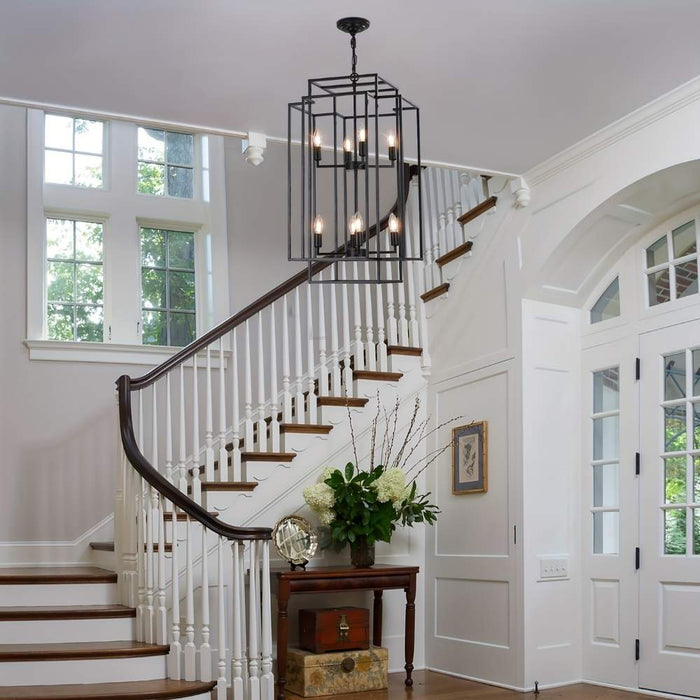
Bronze Comeback: Tyra Lantern Pendant
Warm brass-to-bronze finish with visible hand-craftsmanship — the modern bronze comeback finish of 2026, with stronger black undertones than the muddy bronze of past decades. Pairs naturally with crystal accents or matte black canopies.
Best rooms: Entryways, hallways, above kitchen islands, formal dining
Pairs with: Crystal sconces, walnut wood, leather accents

Aged Brass + Walnut: Zeal Wood Linear Chandelier
The wood-and-metal pairing that defines 2026 modern farmhouse and biophilic interiors. The natural walnut substitutes for a second metal as a tonal complement, working alongside aged brass to create exactly the warm, organic vocabulary defining residential lighting this year.
Best rooms: Modern farmhouse dining, transitional kitchens, biophilic living rooms
Pairs with: Stone countertops, linen, plants, warm-white paint
Common Metal Mixing Mistakes
- 50/50 splits. Two metals in equal proportion read as indecisive rather than designed. Always make one dominant.
- Three or more finishes within one sightline. Three finishes only work if matte black or charcoal serves as the connector. Without that anchor, the eye can't process the mix.
- Matching photos but mismatched undertones. Two "gold" finishes from different sources can clash on undertone alone. Always test in person before installing both.
- Ignoring cabinet hardware in the count. 30 cabinet pulls outnumber 2 chandeliers in any visual audit. Hardware leads, lighting follows.
- Mixing across temperature without an anchor. Warm + cool needs matte black or charcoal as the bridge. Skip the bridge and the mix reads as accidental.
- Texture chaos. Hammered + brushed + polished + smooth in one room loses any sense of intentional craft. Pick a primary texture and let it dominate.
- Forgetting to coordinate with stainless appliances. Stainless reads as "neutral cool" and doesn't kill warm-metal mixes, but it does shift the room's overall temperature toward cooler.
- Following trends without context. Aged brass + matte black is the dominant 2026 pairing — but if your existing kitchen is heavily chrome, swap one major fixture rather than forcing the whole room into a fight.
Frequently Asked Questions
Can you mix metal finishes in lighting fixtures?
Yes — and in 2026, mixed metals are the default rather than the exception. The rules are simple: pick one dominant metal (about 70% of visible fixtures), one accent metal (about 30%), and stay within the same temperature family or use matte black as a neutral anchor when crossing temperatures.
What is the 70/30 rule for mixing metals?
One metal finish dominates approximately 70% of visible fixtures and hardware in a room or sightline; a second finish accents the remaining 30%. A 50/50 split reads as indecisive — the eye cannot determine which metal is the "main" finish. The 70/30 ratio creates clear hierarchy.
What metals can you mix in lighting?
Best 2026 combinations: aged brass + matte black, champagne bronze + warm gold, antique bronze + clear crystal, polished nickel + matte black, matte black + warm gold accent, aged brass + walnut wood. These work consistently across most interior styles.
Can I mix brass and chrome in the same room?
Generally no, unless matte black or charcoal serves as a neutral anchor between them. Brass is warm; chrome is cool. Without a connecting finish, the temperature mismatch reads as accidental rather than intentional.
How many metal finishes should I use in one room?
Two is the safe default. Three is possible only if one of them is matte black or charcoal — these neutral finishes act as connectors that allow other metals to coexist. Four or more finishes almost always reads chaotic regardless of how they're arranged.
What is the best metal finish for lighting in 2026?
Aged brass leads as the dominant 2026 lighting finish, followed by champagne bronze, matte black, and the returning bronze finish with black undertones. Polished chrome and icy silver are noticeably retreating.
Should I match my chandelier finish to my cabinet hardware?
They should coordinate, not necessarily match. The dominant finish in cabinet hardware should match either your chandelier's primary finish or its accent finish. Total mismatches between hardware and lighting create the most-noticed coordination errors.
Can I mix brass and matte black?
Yes — this is the single most-replicated 2026 lighting combination. Aged brass paired with matte black appears in almost every major brand's new releases this year. The combination works because matte black acts as a neutral that complements warm brass without competing with it.
Is mixing metals out of style in 2026?
The opposite — mixing metals is now the default rather than the exception. Matching one finish across an entire home was the rule of the 2010s; coordinated mixed finishes define 2026.
What metals should I avoid mixing?
Avoid pairing warm metals (brass, bronze, copper) with cool metals (chrome, polished silver) without a matte black or charcoal anchor between them. Also avoid mixing three or more warm metals (brass + bronze + copper) — this combination reads as dated rather than coordinated.
How do I mix metals across an open-plan home?
Treat the entire open sightline as one room. Use only two finishes across the connected spaces (kitchen + dining + living visible from each other), with one dominant. Different floors or fully separate rooms can introduce additional finishes, but anything visible from the same vantage point must share the two-finish discipline.
Does fixture finish need to match faucet finish?
In bathrooms and kitchens, yes — the faucet and lighting should share at least one finish family. Mismatched faucet and lighting in wet rooms is the most-noticed coordination error. In other rooms (dining, living, bedroom), faucet match is not a concern.
Can I mix gold and silver lighting?
Generally no, unless matte black, charcoal, or smoked glass acts as a neutral connector. Gold (warm) and silver (cool) need a bridge finish to coexist without clashing. This is the same warm-cool rule that governs all metal mixing.
What metals work with stainless steel appliances?
Stainless reads as "neutral cool" — it doesn't strictly clash with warm metals like brass or bronze, but it shifts the room's overall temperature cooler. Aged brass, matte black, polished nickel, and brushed nickel all coordinate well with stainless. Pure warm-bronze fixtures can clash with very modern stainless appliances.
Should outdoor and indoor lighting metals match?
If they're visible from each other (e.g., entry porch fixture seen from the foyer chandelier through windows), yes. If not, no. Most indoor-outdoor coordination questions resolve to whether the two fixtures occupy the same sightline.
How do textures affect metal mixing?
Texture is part of the finish identity. Hammered brass and polished brass read differently even though both are "brass." Mixing textures within one finish family can work or clash depending on the room — the safer default is one primary texture across all fixtures of one metal family.
Mixed Metals, Done Right
The shift from matching sets to coordinated mixed metals is the single biggest change in residential lighting design over the past decade. Done right, mixed metals add depth, signal personal taste, and make a space feel collected rather than catalog-shopped. Done wrong, they read as accidental and cluttered. The 70/30 rule, two-finish discipline, and temperature-or-anchor logic eliminate almost every common mistake.
Browse fixtures by finish category to start building your mixed-metal plan: gold chandeliers, black chandeliers, copper and brass chandeliers, silver chandeliers, iron chandeliers, and modern chandeliers.