A 60-year-old eye receives roughly a third of the light a 20-year-old eye does at the same brightness, because the lens thickens and the pupil admits less. The same room genuinely is dimmer — it is not a matter of preference.
But more light alone makes it worse. The aging lens also scatters light more, so a brighter bare lamp produces more glare rather than more usable vision. Diffusion matters as much as output.
Three things do most of the work: higher total output from several diffused sources, CRI 90+ so colors and edges stay distinct, and light on vertical surfaces so the room's boundaries are readable.
Stairs, thresholds and level changes are the safety priority — and they want angled light that casts a shadow at each step edge, not flat overhead light that erases it.
Vision changes with age in ways that are measurable and specific, and lighting is the single most effective thing a home can do about them. The usual advice is "add more light," which is half right and can make things worse on its own — because the same changes that reduce how much light reaches the retina also increase sensitivity to glare. This guide covers what actually changes, why brightness and comfort pull in opposite directions, the numbers for each room, and the fixture choices that serve an older household without making the house look institutional.
On this page
What Changes, and Why It Matters
Four changes matter for lighting, and they compound rather than acting independently.
- Less light reaches the retina. The pupil admits less and the lens becomes denser, so a room at a given brightness is physically dimmer to an older eye than a younger one.
- The lens scatters more light. Instead of passing cleanly through, light bounces inside the eye — which is what turns a bright source into a veil of glare rather than useful illumination.
- The lens yellows. It filters blue wavelengths, which shifts color perception and makes blues and violets harder to distinguish from one another.
- Adaptation slows. Moving from a bright room to a dark hallway takes longer to adjust to, which is why abrupt transitions between light levels are a practical hazard.
The Brightness Paradox
Two people in the same room can have opposite complaints: one says it is too dim to read, the other says the light is uncomfortable. Both are describing the same fixture, and both are right.
A single bright source produces a small area of high brightness surrounded by relative darkness. For an eye that scatters light, that bright point becomes a haze across the whole visual field — so the dark parts get harder to see, not easier. The room's average brightness went up and its usability went down.
Several moderate sources solve what one bright source cannot. The total output is higher, no single point is uncomfortable, and the shadows between zones disappear. This is the standard layered approach, and it happens to be exactly what aging vision needs — which means the fix is good lighting design rather than specialist equipment.
For an eye that scatters light, a single bright source reduces usable vision rather than increasing it
Four Things That Work
1. More sources, not brighter ones. Replace one ceiling fixture doing everything with a ceiling fixture plus table lamps plus wall lighting. Total output rises, peak brightness at any one point falls, and shadows between zones close up.
2. Diffuse everything. Opal glass, shaded fixtures and stone all hide the lamp while passing light. Exposed bulbs and clear glass with visible filaments are the formats to avoid entirely — they put a high-brightness point directly in the field of view.
3. CRI 90 or better. Color rendering is not cosmetic here. Distinguishing a step edge from the tread, a dark rug from a dark floor, or one medication bottle from another all depend on color and contrast being rendered honestly. Low-CRI light flattens exactly those distinctions.
4. Light the walls, not just the floor. Lit vertical surfaces tell the eye where a room's boundaries are. A room lit only from above leaves its edges in shadow, which makes judging distance and finding doorways harder than it needs to be.
Output Targets by Room
| Room | General household target | Suggested for aging vision | Priority |
|---|---|---|---|
| Living room | 2,000-4,000 lm | 3,500-6,000 lm across 3+ sources | Reading positions, perimeter walls |
| Dining room | 2,000-4,000 lm | 3,000-5,000 lm, CRI 90+ | Food visibility, faces |
| Kitchen | 4,000-8,000 lm | 6,000-10,000 lm | Under-cabinet task light is essential |
| Bathroom | 2,000-4,000 lm | 3,000-5,000 lm | Side-lit mirror, no overhead-only |
| Bedroom | 1,000-2,000 lm | 2,000-3,000 lm on a dimmer | Bedside control, low night setting |
| Hallway | 1,000-2,500 lm | 2,000-3,500 lm, even along its length | No dark patches between fixtures |
| Stairs | Varies | Lit at both ends plus the run | Highest safety priority |
These are starting points rather than prescriptions — individual needs vary considerably, and someone with a specific eye condition may need something different from someone with ordinary age-related change. A dimmer on everything is what makes a single installation serve both a bright-light requirement and a comfortable evening.
Diffused Fixture Picks (3 Designs)
Hidden sources and even output. The common property: you cannot see the lamp from any normal position in the room.
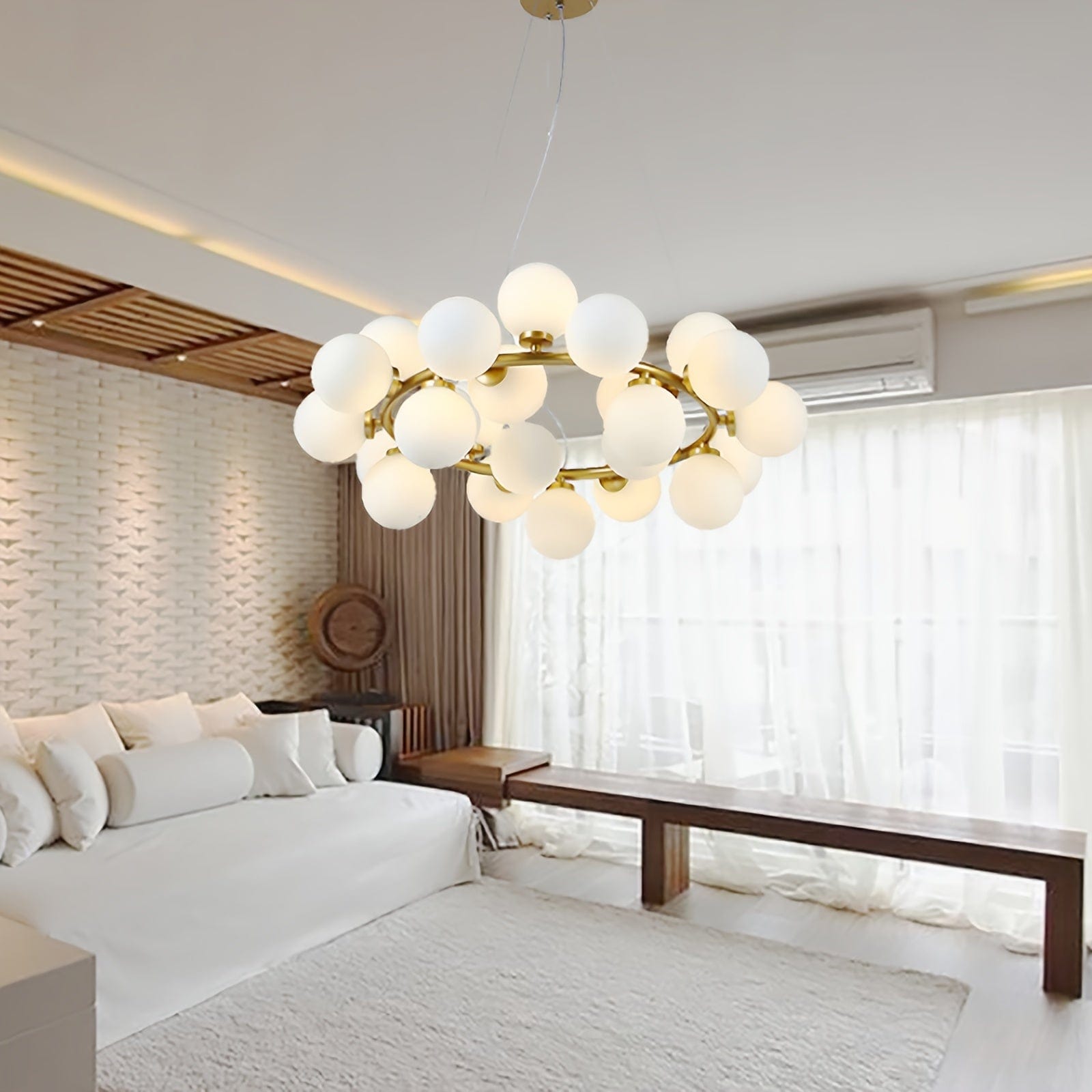
1Holly Milk Glass Chandelier
Opal · The Combination That Matters HereOpal glass is the one diffuser that delivers both halves of what aging vision needs: it hides the lamp completely so there is no bright point to scatter, and it still transmits most of the output so the room is genuinely brighter. Multiple shades also spread the source across the fixture, which lowers peak brightness at any single point.
Multiple shades: Lowers peak brightness per point
Lamps: CRI 90+ with good R9
Add: A dimmer for evening comfort
Related: Glass chandeliers
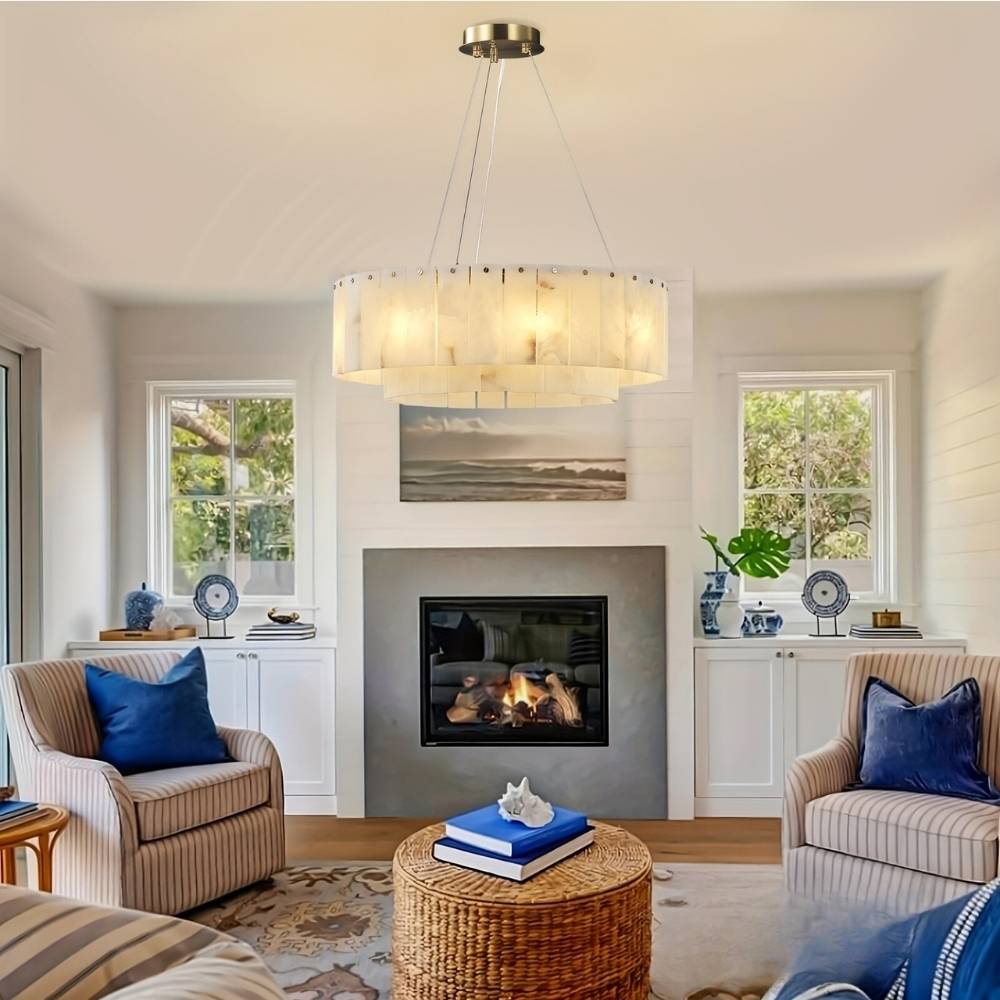
2Angie Alabaster Round Chandelier
Stone · Zero Glare From Any AngleStone produces the gentlest light available — no visible source from any position, no hot spot, no hard edge to the glow. The trade is output: it absorbs a substantial share, so it should be one layer of several rather than a room's only fixture. In a bedroom or a sitting area where comfort matters more than task brightness, that trade is the right one.
Trade: Lower output — pair with lamps
Best in: Bedrooms, sitting areas, evening rooms
Not for: A room's only light source
Related: Alabaster & marble

3Asty Modern Ring LED Chandelier
Integrated · No Lamp Changes on a LadderTwo advantages converge here. The emitters sit in a channel rather than as point sources, which spreads brightness along the ring instead of concentrating it. And integrated LED removes lamp changes for decades — which matters in a household where climbing a ladder is the thing to avoid. Check the dimming depth before buying, since low evening settings are part of the requirement.
Removes: Ladder work for lamp changes
Check: Dimming depth — low settings matter
Ask: CRI figure and driver serviceability
Related: Ring chandeliers
Stairs and Level Changes
This is the safety priority, and it is a contrast problem rather than a brightness one.
A step is visible because its edge casts a shadow. Overhead light falling straight down lights the treads and the risers almost equally, which flattens the staircase into a single surface — exactly the condition in which a step is misjudged. Angled light from the side throws a small shadow under each nosing, and that shadow line is what the eye reads as "step here."
- Wall sconces along the run, mounted 60-66 in measured from each tread nose rather than from a single floor level, spaced every 3-4 treads.
- Light both ends of the flight. The top and bottom steps are where level changes are misjudged most often.
- Three-way switching from both floors. A stair light that can only be switched from the bottom gets left off.
- Avoid gloss floor finishes under stair lighting, which reflect the source and create glare on the surface being judged.
- Mark thresholds and level changes elsewhere in the house the same way — a sunken room, a step into a garden, a raised threshold.
Night Lighting
Slower dark adaptation makes the middle-of-the-night route the single most useful lighting intervention in an older household.
The principle is low, continuous and never full output. Going from darkness to a bright overhead light is uncomfortable and leaves the eye adapting for a minute or more — which is exactly the wrong moment on the way to a bathroom. A low-level path instead keeps the eye in one adaptation state the whole way.
Practical versions: a dimmer left at the bottom of its range, low-level plug-in lights along the route, motion-activated fixtures at thresholds, and a bedside control that reaches the bedroom light without crossing the room. Warm color temperature throughout — 2700K — since cool light at night is both uncomfortable and alerting.
Wall and Task Picks (3 Designs)
Wall lighting does more for an aging household than any ceiling fixture — lit vertical surfaces, angled light on stair edges, and no bright point overhead.

42-Pack Marble Sconce Wall Light
Wall Pair · Lights the BoundariesWall fixtures do the two things a ceiling fixture cannot: they light vertical surfaces so the room's boundaries are readable, and they put light across a space at eye level rather than down into it. Stone diffusion also means no visible source at the exact height someone walking past would look — which is where glare does the most harm.
Mount at: 60-72 in to center
Glare: None — stone hides the source
Sold as: A matched pair
Related: Wall sconces
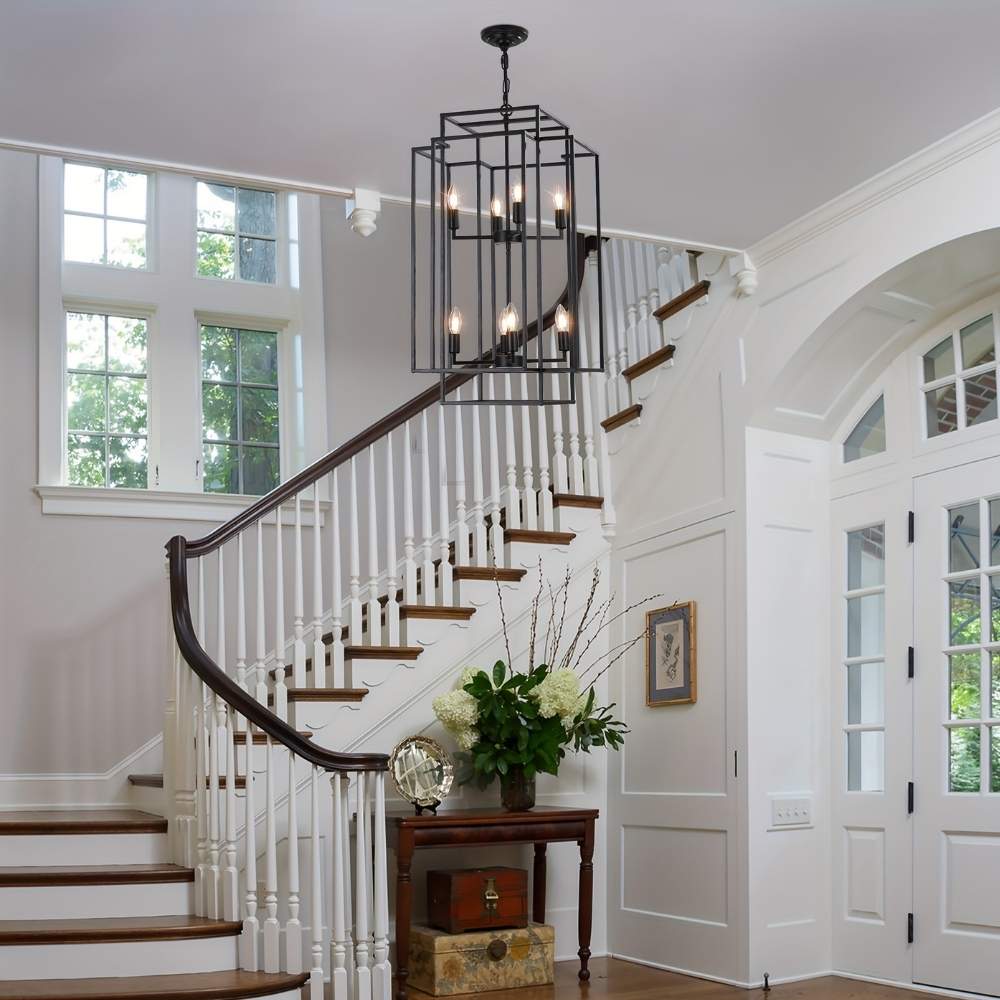
5Tyra Lantern Pendant Light Fixture
Enclosed · Hallways and LandingsHallways and landings are where someone walks toward a fixture at head height, which makes an enclosed body worth having. A lantern conceals the lamp from every approach, so the fixture is a soft glowing object rather than a bright point in the path. Space them along a hallway so no dark patches sit between — even spacing matters more than total output here.
Spacing: Even, no dark patches between
Priority: Continuity of light along the route
Color: Warm white 2700-3000K
Related: Pendant lights
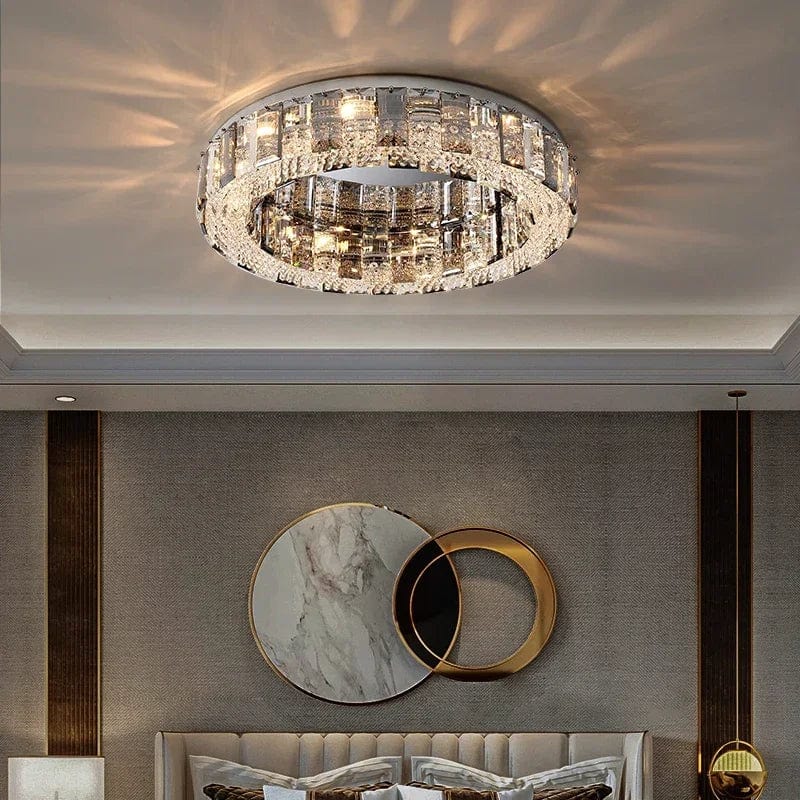
6Rina Crystal Ceiling Chandelier
Close Mount · Nothing to Walk IntoA practical consideration in a household adapting for age: a suspended fixture in a circulation route is something to be aware of, and a close-mount one is not. Crystal also spreads light sideways through refraction rather than concentrating it downward, which helps a hallway or landing read evenly rather than as a pool with dark ends.
Crystal: Spreads light sideways by refraction
Suits: Hallways, landings, low ceilings
Buy: Wider than instinct suggests
Related: Flush mount chandeliers
Browse diffused and wall lighting
Opal, stone and wall fixtures for comfortable, even light.
Glass → Wall Sconces → Flush Mount →Doing It Without an Institutional Look
The reason good lighting for aging vision often gets refused is that the obvious version of it looks like a care facility: cool white, flat, bright, uniform. None of that is necessary, and most of it is actively counterproductive.
Warm, not cool. 2700-3000K throughout. Cool white above 4000K is what makes a room read institutional, and it has no benefit here — the yellowing lens filters blue anyway, so the extra blue content largely does not arrive.
Decorative fixtures, not utility ones. An opal glass chandelier and a bare utility fitting can produce identical light. There is no reason to choose the second, and a room that looks good is one people are more willing to light properly.
Dimmers everywhere. They are what let one installation serve a bright-light requirement during the day and a comfortable evening — and they remove the argument between household members who want different levels.
Add lamps rather than rewiring. Floor and table lamps need no electrician, can be positioned exactly where light is needed, and raise total output without touching the ceiling. For most rooms this is the fastest and least disruptive improvement available.
Common Mistakes
- One brighter bulb in the same fixture. Increases glare faster than usable vision. More sources, not a brighter one.
- Exposed lamps and clear glass with visible filaments. A high-brightness point in the field of view is the specific thing to avoid.
- Cool white for "brightness". It reads institutional and the yellowing lens filters much of the blue content anyway.
- Overhead-only stair lighting. It flattens the steps. Angled light from the side creates the shadow line that marks each edge.
- Measuring stair sconces from the floor. Heights step up with the stair — measure 60-66 in from each tread nose.
- Ignoring CRI. Distinguishing edges, surfaces and objects depends on color rendering, not just quantity of light.
- Leaving walls dark. Lit vertical surfaces are how the eye reads a room's boundaries and judges distance.
- Abrupt transitions between light levels. Slower adaptation makes a bright room next to a dark hallway a practical hazard.
- Full output at night. Going from darkness to bright light leaves the eye adapting for a minute — the wrong moment on a night route.
- No dimmers. They are what let one installation meet both requirements.
Frequently Asked Questions
How much more light do older eyes need?
Substantially more — a 60-year-old eye receives roughly a third of the light a 20-year-old eye does at the same brightness, because the pupil admits less and the lens is denser. As a planning figure, aim for 1.5 to 2 times the general household target, delivered from several diffused sources rather than one bright one.
Why does more light sometimes make it harder to see?
Because the aging lens scatters light inside the eye. A single bright source becomes a haze across the whole visual field, so the darker parts of the room get harder to see rather than easier. Several moderate diffused sources raise total output without creating that bright point.
What color temperature is best for older adults?
Warm white, 2700-3000K. Cool white above 4000K reads institutional and offers little benefit, since the yellowing lens filters much of the blue content before it reaches the retina. Consistency across the house matters more than the exact figure.
Does CRI matter for aging vision?
Yes, more than for most households. Distinguishing a step edge from a tread, a dark rug from a dark floor, or one object from another depends on color and contrast being rendered honestly. CRI 90 or better is the target wherever those distinctions matter.
What is the best lighting for stairs?
Wall sconces along the run rather than overhead light alone. Overhead light flattens the staircase by lighting treads and risers equally; angled light from the side throws a shadow under each nosing, and that shadow line is what marks the step edge. Mount at 60-66 inches from each tread nose.
How should I light a route for getting up at night?
Low, continuous and never full output. Going from darkness to a bright overhead light leaves the eye adapting for a minute or more. A dimmer left low, plug-in path lights, or motion-activated fixtures at thresholds keep the eye in one adaptation state.
Should I avoid chandeliers in a home for older adults?
No — the format is not the issue, the diffusion is. An opal glass or stone chandelier produces soft, even light with no visible source. What to avoid is exposed lamps and clear glass with visible filaments, in any fixture type.
What is the easiest improvement to make?
Adding floor and table lamps. They need no electrician, can be placed exactly where light is wanted, and raise total output while lowering peak brightness at any one point. For most rooms it is the fastest meaningful change available.
Does lighting the walls really help?
Yes. Lit vertical surfaces are how the eye reads a room's boundaries and judges distance. A room lit only from above leaves its edges in shadow, which makes finding doorways and judging space harder than it needs to be.
Are dimmers necessary?
Close to it. They let one installation serve a bright-light requirement during the day and a comfortable low level in the evening, and they settle the common disagreement between household members who need different levels at different times.
Will brighter lighting make a home look clinical?
Only if it is specified that way. Warm color temperature, decorative diffused fixtures and dimmers produce high output without the cool, flat uniformity that reads institutional. An opal chandelier and a utility fitting can give identical light.
When should I see a professional about vision changes?
Any noticeable change in vision is worth discussing with an optometrist, since several age-related conditions are treatable and lighting is a complement to that rather than a substitute. This guide covers lighting design, not medical advice.
More Sources, Softer Each
The instinct is to fit a brighter bulb, and it is the one change that can make things worse. Raise total output by adding sources rather than intensity, diffuse every one of them, specify CRI 90 and 2700-3000K, and put light on walls and stair edges rather than only on floors. Done that way the house gets easier to live in without looking like anything other than a well-lit home.
Browse the range: glass chandeliers, wall sconces, flush mount chandeliers.