Stone behaves differently on a wall than on a ceiling. A sconce sits in the normal field of view all day, so how the material reads switched off matters as much as how it glows switched on — and stone is the only diffuser that reads as an object rather than as a fitting.
Mount at 60-72 in from the floor, or 60-66 in flanking a bathroom mirror with 28-36 in between a pair. Hallway runs space 6-8 ft apart.
Panel thickness decides the glow. Around 1.4 cm of genuine marble transmits enough light to show veining from behind while staying opaque enough to hide the source entirely.
Interior use only unless the fixture is specifically rated otherwise. Unsealed stone absorbs moisture, and the electrical components behind it are not built for it.
Stone lighting is usually discussed as a ceiling material — alabaster chandeliers, marble pendants, fixtures seen from below at a distance. On a wall the conditions change completely: the fixture is at eye level, within arm's reach, and visible in daylight for most of the day. That shifts which properties of the material actually matter. This guide covers how stone behaves at close range, the mounting numbers by position, what panel thickness and veining do to the light, and where stone sconces belong.
On this page
- Why Eye Level Changes Everything
- Marble, Alabaster, Travertine and Onyx
- Panel Thickness and the Glow
- Mounting Heights by Position
- Stone Sconce Picks
- Veining: Why No Two Match
- Stone Fixtures Across the House
- Where Stone Sconces Belong
- Care and the Moisture Rule
- Common Mistakes
- Frequently Asked Questions
Why Eye Level Changes Everything
A ceiling fixture is seen from eight or ten feet away, mostly when it is on, and mostly as a silhouette. A wall sconce is none of those things.
It is within arm's reach. Material quality that disappears at ceiling distance is fully visible here — the grain of the stone, the edge where a panel meets its frame, the depth of the veining. This is where genuine stone separates from printed resin, and where it earns its price.
It is seen switched off for most of the day. A ceiling fixture at rest is a dark shape against a pale ceiling. A wall sconce at rest sits in the normal field of view against a wall you look at constantly. Stone reads as material when unlit — a pale object with visible grain — where glass reads as an empty vessel and metal as hardware.
Marble, Alabaster, Travertine and Onyx
| Material | Translucency | Character | Best used as |
|---|---|---|---|
| Marble | Low to moderate | Sharp veining, dense pattern | Panels — glow at the edges, pattern in the face |
| Alabaster | High — the most translucent | Cloudy, soft, warm | Diffusers — the whole body glows |
| Travertine | Low | Porous, matte, earthy | Structure — light escapes around it |
| Onyx | High, strongly banded | Dramatic colour bands | Statement panels, backlit |
The distinction that matters most on a wall: alabaster diffuses, marble frames. An alabaster sconce glows across its whole surface. A marble sconce typically emits around and through thin sections while the face stays as pattern — which produces a sharper, more architectural result. Neither is better; they are different effects and worth knowing before ordering.
Travertine is the outlier. It is largely opaque, so it works as a sculptural body with light escaping above and below rather than through — the up-and-down cylinder format that suits exterior and Mediterranean-leaning interiors. Full material detail in our real stone versus resin guide.
Panel Thickness and the Glow
This is the specification that decides how a stone sconce actually performs, and it is almost never stated.
Around 1.4 cm is the working thickness for marble panels. At that depth the stone transmits enough light to reveal its veining from behind — the pattern lights up rather than disappearing — while remaining opaque enough to hide the lamp completely. Thinner and the source starts to show through as a bright patch; thicker and the veining stops reading when lit.
Two related points. Output is modest by design: a pair of marble sconces producing roughly 1,200-1,300 lumens between them is normal and correct for the format — this is an atmosphere layer, not a task light. And split-panel construction, where the stone is divided rather than one continuous face, lets light escape at the seams and produces a defined line of light alongside the diffused glow.
Mounting Heights by Position
| Position | Height to centre | Spacing | Note |
|---|---|---|---|
| General room / hallway | 60-72 in | 6-8 ft apart | Eye level for a standing adult |
| Flanking a bathroom mirror | 60-66 in | 28-36 in apart | Side placement fills facial shadows |
| Beside a bed | Roughly 60 in, or 30-36 in above the mattress | Bed width plus a foot each side | Frees the nightstand entirely |
| Flanking art or a mirror | 60-66 in | Frame the object, do not crowd it | 2-4 in clear wall each side |
| Dining buffet or sideboard | 60-66 in | Matched pair, equal from the centre | Symmetry is visible in one glance |
Projection matters as much as height on stone sconces, because the material has physical depth that a flat metal plate does not. In a corridor, check how far the fixture stands off the wall — anything beyond about 5 in in a passage becomes something people brush against, and stone does not forgive that as readily as metal.
Stone Sconce Picks (3 Designs)
Wall-mounted stone in the three formats the material takes: panel pairs, single accents and cylinders. All interior-rated — see the moisture rule below.

12-Pack Marble Sconce Wall Light
Matched Pair · Spanish Marble, 1.4 cm PanelsSold as a pair, which solves a real problem: stone varies between pieces and two sconces flanking a mirror are seen in a single glance, so ordering separately risks a visible mismatch in veining and tone. The 1.4 cm panel thickness is the working depth — enough to light the veining from behind, enough to hide the lamp. Split-panel construction also releases a defined line of light at the seam alongside the diffused glow.
Output: ~1,200-1,320 lm across the pair, max 12W
Source: Integrated LED, G9 included
Mount at: 60-72 in general, 60-66 in at a vanity
Rated: Indoor only — see the moisture rule below

2Teal Modern Marble Wall Sconce
Single Accent · One Wall, One FixtureNot every stone sconce position wants a pair. A single fixture suits a hallway where a run would be too much, a bedroom side wall, or an architectural detail that deserves marking rather than framing. At eye level a single piece is also read as an object in its own right — which is where the material earns its place over a painted metal plate.
Suits: Hallway accents, bedroom side walls
Mount at: 60-72 in to centre
Reads as: An object, not a fitting, when unlit
Related: Wall sconces

3Orlisse Marble Cylinder Wall Sconce
Cylinder · Up-and-Down WashThe cylinder format works differently from a panel: light escapes above and below rather than through the face, so the stone reads as a solid sculptural body and the wall above and beneath it carries the light. At 2700K the output is at the warmest residential end, which suits the material — stone warms what passes through it, and a cooler lamp fights that.
Stone reads as: A solid body, not a diffuser
Colour: Warm light 2700K — suits the material
Effect: Grazes the wall surface above and below
Related: Wall lights
Veining: Why No Two Match
This is the most common cause of disappointment with stone lighting, and it is avoidable by knowing what to expect.
Natural stone varies, and that variation is the product. A marble panel is cut from a block that formed over geological time; the veining, the tone and the translucency differ piece to piece and sometimes across a single panel. A product photograph shows one example, not a template. A fixture that arrives with different veining is not a defect — it is what buying natural stone means.
- Order pairs together, from one supplier, at one time. Pieces cut from the same batch share more character than pieces ordered months apart.
- Expect translucency to vary too. Denser sections of the same panel transmit less light, which produces an uneven glow — and on alabaster especially, that unevenness is the effect people buy the material for.
- Where uniformity genuinely matters, resin and printed composites reproduce exactly. They are the right answer for a long run of matched fixtures; they are the wrong answer where the material should read as material.
- Ask whether photographs are of the actual piece on higher-value items. Some suppliers photograph each unit; most use a representative image.
Stone Fixtures Across the House (4 Designs)
Where the wall sconces set the direction, these carry it to other positions. Keep the stone family consistent — marble beside alabaster beside travertine reads as accumulation rather than scheme.
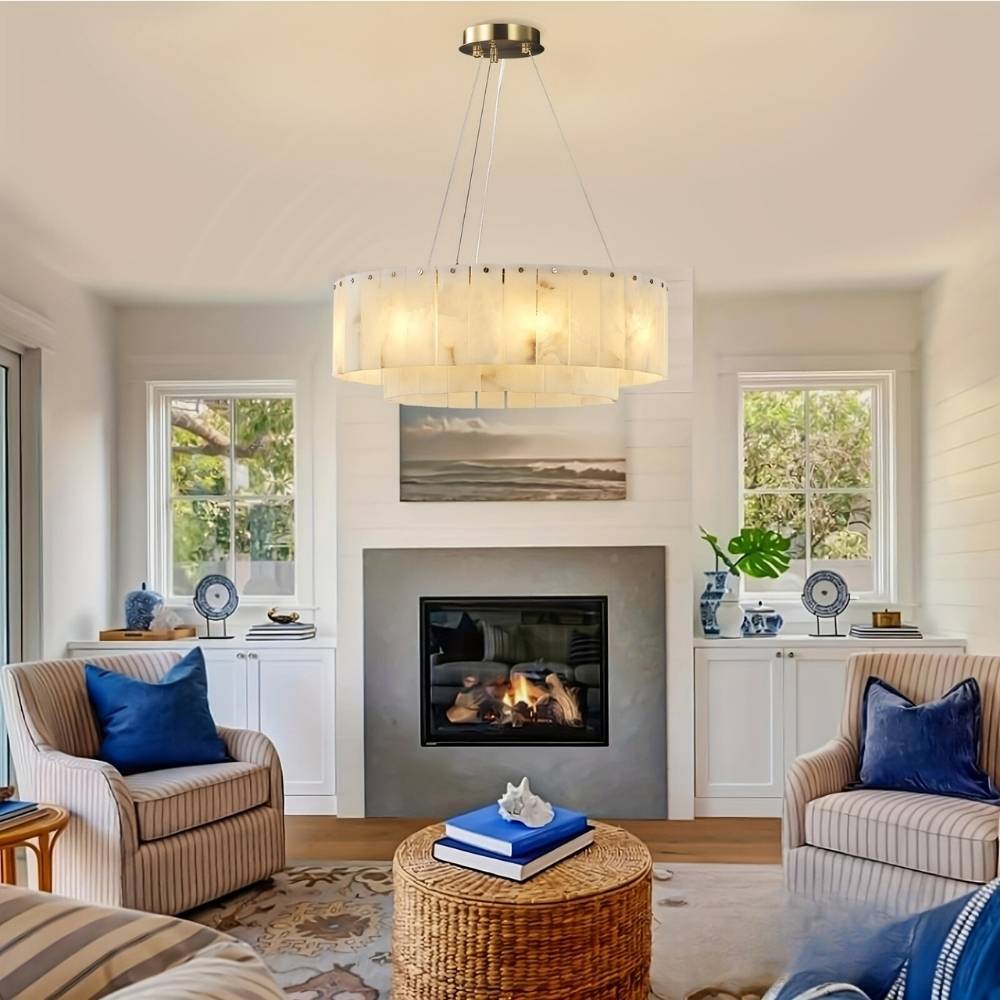
4Angie Alabaster Round Chandelier
Alabaster · The Translucent EndWhere marble frames light, alabaster transmits it — the whole body glows rather than the edges. Pairing an alabaster ceiling fixture with marble sconces in the same room works because both are stone, but understand the two will read differently: one as a glowing object, the other as a lit pattern.
Effect: Whole body glows, no visible source
Pairs with: Marble sconces — same family, different read
Output: Atmosphere layer — plan other lighting
Related: Alabaster & marble
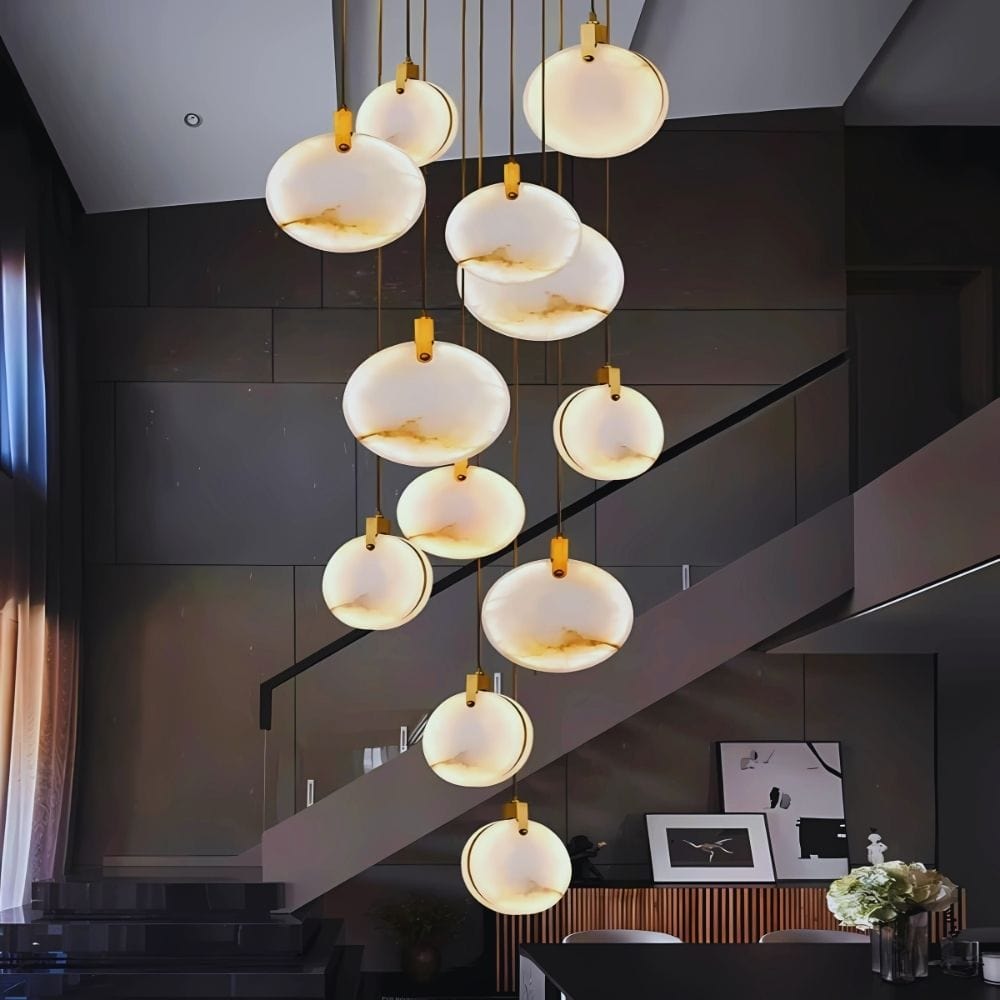
5Gaia Marble Staircase Chandelier
Marble · Stairwell ScaleA stairwell is the one vertical position where a wall sconce and a ceiling fixture are seen together, which makes material consistency visible. Marble in both keeps the two reading as one decision. Stone also eliminates glare on the upper treads, where a fixture sits near eye level as people climb.
Why stone here: No glare at eye level on upper treads
Consistency: Marble above, marble on the wall
Maintenance: Dry cleaning only — lowest demand
Related: Staircase chandeliers
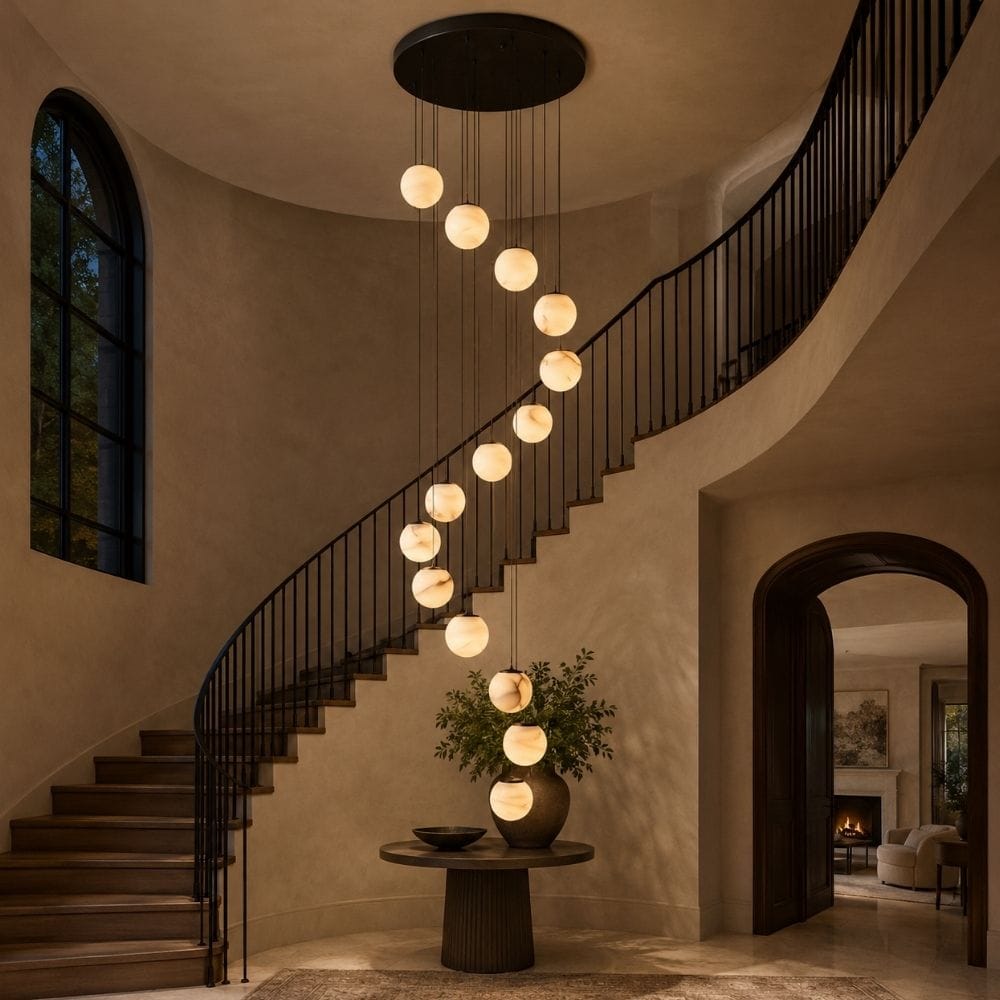
6Anne Staircase Alabaster Chandelier
Stone and Metal · Matching the Sconce FrameStone fixtures almost always pair the material with a metal frame, and the metal is what ties a scheme together across rooms. Where marble sconces use brass, a gold-framed stone ceiling fixture continues the line; a black frame breaks it deliberately. Decide which before ordering the second fixture.
Why it matters: Metal ties stone across rooms
Stone: Alabaster panels, no visible source
Decide: Frame finish before the second fixture
Related: Alabaster & marble

7Tiva Travertine Outdoor Wall Light
Travertine · The Rated ExceptionThe one place stone goes outside. Interior marble and alabaster sconces are indoor-rated because unsealed stone absorbs moisture and the components behind it are not built for weather. A purpose-built exterior stone fixture is a different product — and travertine, being porous and matte, is the material that suits exterior conditions best.
Why travertine: Porous and matte — suits weather
Never substitute: An interior stone sconce outdoors
Colour: Warm light 3000K
Related: Outdoor wall lights
Browse stone lighting
Marble and alabaster sconces, pendants and chandeliers.
Wall Sconces → Alabaster & Marble →Where Stone Sconces Belong
Flanking a bathroom mirror is the strongest application. Side placement fills the facial shadows an overhead fixture creates, and stone's complete absence of glare matters at a mirror more than anywhere — you are looking directly toward the fixture while using it. Verify damp rating before specifying, since most interior stone sconces are not rated for it.
Beside a bed, stone frees the nightstand entirely and produces a glow with no visible source from a reclining position. Mount at roughly 60 in from the floor or 30-36 in above the mattress.
Hallways suit stone because the fixture is passed within inches, which is where material quality is actually perceived. Space 6-8 ft apart and check projection — a passage is unforgiving of anything standing far off the wall.
Dining rooms and buffets take a matched pair flanking a sideboard or artwork. And stairwells are where stone sconces and a stone ceiling fixture are seen together, which makes material consistency worth planning.
Care and the Moisture Rule
Stone is the lowest-maintenance material in lighting and the least forgiving of one specific mistake.
Dry microfiber only. Not a damp cloth, not glass cleaner, not a mild soap solution. Unsealed stone absorbs liquid and the mark that leaves cannot be removed — which is the opposite of glass, where a damp cloth is routine. Dust it and nothing else.
Interior use only, unless the fixture is a purpose-built exterior product. This appears on product pages as a restriction and it is a genuine one: moisture reaches both the stone and the electrical components behind it. Bathrooms need the fixture to be specifically damp-rated, not merely marketed as suitable.
Beyond that there is nothing to do. No polish, no treatment, no annual maintenance. A stone sconce dusted twice a year looks the same in fifteen years as it did on day one, which is a claim no painted or plated finish can make. Full technique across materials is in our cleaning guide.
Common Mistakes
- Any liquid on the stone. Unsealed marble and alabaster absorb it and the mark is permanent. Dry microfiber only.
- Using an interior stone sconce outdoors or in a wet zone. Moisture reaches the stone and the components behind it.
- Ordering a pair separately. Natural veining varies; two fixtures seen in one glance make any difference obvious.
- Expecting the product photograph. Stone varies piece to piece. The image is representative, not a template.
- Expecting task-level output. A pair producing 1,200-1,300 lumens between them is normal for the format. This is an atmosphere layer.
- Cool white lamps. Stone warms what passes through it, and a lamp above 3000K fights the material's own character.
- Ignoring projection in a corridor. Stone has physical depth and does not forgive being knocked.
- Mixing stone types in one room. Marble beside alabaster beside travertine reads as accumulation rather than scheme.
Frequently Asked Questions
What is the difference between marble and alabaster sconces?
Alabaster is significantly more translucent, so the whole body glows and the source disappears entirely. Marble transmits less, so it tends to frame light rather than diffuse it — the veining lights up while the face reads as pattern. Alabaster is softer and warmer; marble is sharper and more architectural.
How high should marble wall sconces be mounted?
60-72 in to centre for general rooms and hallways, 60-66 in flanking a bathroom mirror with 28-36 in between the pair, and roughly 60 in or 30-36 in above the mattress beside a bed. Hallway runs space 6-8 ft apart.
How thick should a marble lighting panel be?
Around 1.4 cm is the working depth for marble. At that thickness the stone transmits enough light to reveal its veining from behind while staying opaque enough to hide the lamp. Thinner and the source shows through; thicker and the veining stops reading when lit.
Can marble sconces go in a bathroom?
Only if specifically damp-rated. Most interior stone sconces are indoor-rated because unsealed stone absorbs moisture and the components behind it are not built for it. Where rated, flanking the mirror is the strongest application there is — stone produces no glare at a position you look directly toward.
Why does my stone sconce look different from the photo?
Natural stone varies. A panel is cut from a block that formed geologically, so veining, tone and translucency differ piece to piece. The product image is representative rather than a template — that variation is what buying natural stone means.
How much light does a marble sconce give?
Modest by design. A pair producing roughly 1,200-1,300 lumens between them is normal for the format. Stone absorbs a substantial share of the lamp output, which is exactly what makes it glare-free — plan it as an atmosphere layer with other lighting alongside.
How do you clean a marble or alabaster sconce?
Dry microfiber only. No damp cloth, no glass cleaner, no soap. Unsealed stone absorbs liquid and the resulting mark cannot be removed. Beyond dusting there is nothing to do — no polish, no treatment, no annual maintenance.
Should I buy stone sconces as a pair?
Where they will flank something, yes — and ideally as a sold pair rather than two separate orders. Pieces cut from one batch share more character, and two fixtures seen in a single glance make veining and tone differences obvious.
What colour temperature suits stone lighting?
2700-3000K. Stone warms what passes through it, so a warm lamp works with the material while anything above 3000K fights it. 2700K is the better match on marble and alabaster.
Is travertine the same as marble in lighting?
No. Travertine is largely opaque and porous, so it works as a sculptural body with light escaping above and below rather than through it — the up-and-down cylinder format. Marble and alabaster transmit light; travertine shapes it.
Can I mix marble sconces with an alabaster ceiling fixture?
Yes, and it works because both are stone — but expect them to read differently. The alabaster will glow across its whole body while the marble frames light at its edges. Keep the metal frames consistent, since the metal is what ties the two together.
Are stone sconces worth the price over resin?
At eye level, yes. Material quality that disappears at ceiling distance is fully visible within arm's reach, and stone reads as an object when switched off where resin reads as a surface. Where a long run of perfectly matched fixtures is needed, resin is the correct answer instead.
Judge It Switched Off
A ceiling fixture is judged lit, from a distance. A wall sconce is judged unlit, from three feet away, for most of the day — and that is the test stone passes that no other diffuser does. Mount at 60-72 in, order pairs together, keep every liquid away from it, and expect the veining to be its own.
Browse the range: wall sconces, alabaster & marble, wall lights.