A stairwell fixture is seen against three different backgrounds in one climb — the ceiling from below, the wall from the treads, the floor from the landing above. Black is the only finish that reads strongly against all three, because it works by contrast rather than by reflection.
Against a pale stairwell wall, a black silhouette is at maximum legibility. Stairwells are usually white or light for daylight reasons, which gives dark fixtures the strongest background they will find anywhere in the house.
Black reads larger than its measurement, so in a narrow well take the smaller diameter and spend the budget on drop length instead.
The one thing that defeats it: a dark stairwell wall or ceiling. Black needs contrast to register, and against charcoal it disappears.
Most finish advice assumes a fixture seen from one angle in one room. A stairwell fixture is not that — it is viewed from below, at eye level, and from above, against a different backdrop each time. That changes which finishes hold up, and black holds up better than any of them. This guide covers why the geometry favours dark finishes, how matte, gloss and textured black differ at height, the sizing correction that applies in a vertical space, and where black is the wrong answer.
On this page
The Three-Background Problem
No other fixture in a house is viewed the way a stairwell chandelier is, and the difference is not the height — it is the number of backgrounds.
| Viewing position | Background behind the fixture | What a finish must do |
|---|---|---|
| From the hall below | The stairwell ceiling, usually pale | Read as silhouette against light |
| From the treads, mid-climb | The opposite wall, at close range | Hold definition without glare |
| From the landing above | The floor below, usually darker | Read from the top down too |
| From an adjoining room | Whatever the doorway frames | Work in partial view |
A polished or reflective finish changes appearance at each of these. Chrome mirrors whatever is behind it, so it looks different from the hall than from the landing. Warm metals return light in the amber band, which reads richly against a pale wall and disappears against a warm-toned one. Neither is wrong, but both are inconsistent across the climb.
Why Black Solves It
Black works by absorption rather than reflection, which means it does not change with its surroundings — it only depends on whether there is contrast behind it.
Three consequences follow. The silhouette carries the whole design, which suits stairwell fixtures because they are chosen for vertical composition rather than surface detail. Detail stays legible at distance — the spacing between tiers, the taper of a drop, the exact curve of a cascade — where a reflective finish would flatten them. And the fixture reads consistently from the hall, the treads and the landing, which no reflective finish manages.
Matte, Gloss and Textured at Height
Black is sold as one finish and behaves as three, and the differences matter more at stairwell distance than they would across a dining table.
- Matte black absorbs almost completely, producing the flattest, most graphic silhouette. At distance this is the strongest reading — the fixture is a drawn shape with nothing breaking it up. It also hides dust shadows better than gloss, which matters when the fixture is cleaned twice a year rather than monthly.
- Gloss and semi-gloss keep a highlight along curved surfaces, which restores dimensionality. In a stairwell this cuts both ways: the highlight adds depth up close on the treads, but from the hall below it can read as a bright spot rather than as form.
- Textured and hammered black scatters light unevenly at close range and reads as material rather than coating. At stairwell distance the texture largely disappears and it behaves like matte — so the texture is worth paying for only if the fixture is passed closely on the treads.
For a tall well where the fixture is mostly seen from a distance, matte is the safe specification. For a modest well where people pass within arm's reach on the upper flight, textured earns its place.
The Sizing Correction in a Vertical Space
Black reads larger than its measurement, because a dark outline against a pale background has maximum contrast and the eye registers the whole shape at once. That correction applies everywhere, but in a stairwell it applies to width only.
The drop is set by the well — total height minus 84 in of clearance above the highest tread — and that number does not change with finish. What changes is the diameter. In a narrow well, take the smaller diameter in black than you would in glass, and put the difference into drop length. A slim tall black composition reads substantial; a wide one in the same well reads crowded.
Where the well is genuinely wide — a grand or double staircase — the correction matters less and a black fixture can take the full calculated diameter. Full measurement guidance is in our long chandeliers for staircases guide.
Modern Black Picks (4 Designs)
Clean geometry and vertical composition. Configure the light count to your measured drop rather than ordering the configuration shown in the photograph, which is usually the largest.
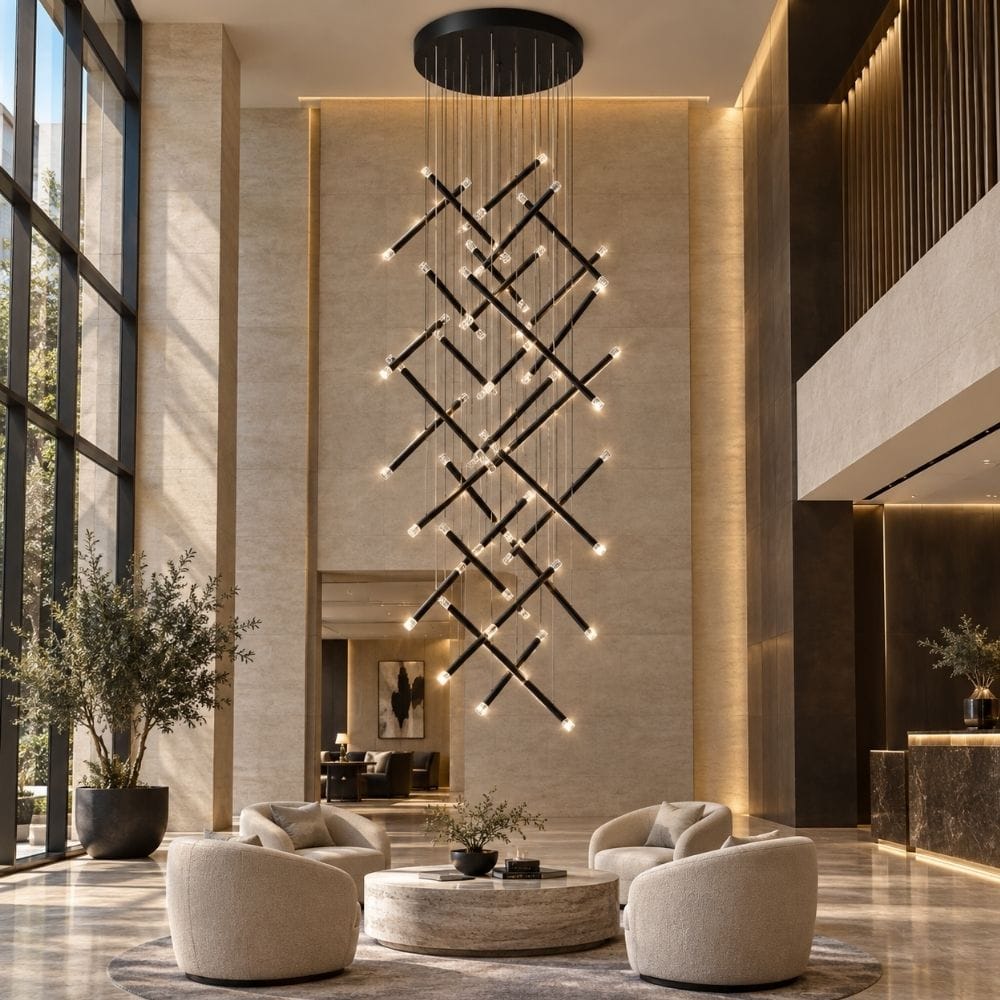
1Apex Modern Staircase Chandelier
Matte Black · Configurable DropThe straightforward case. Clean geometry in matte black gives the flattest, most graphic silhouette against a pale stairwell wall, which is the strongest reading available at distance. Configurable light count means the composition can be matched to a measured drop rather than to a photograph — the single most useful feature in a stairwell fixture.
Configure: Light count to your measured drop
Also in: Gold, white and one more
Sizing: Narrow well — take the smaller diameter
Related: Black chandeliers
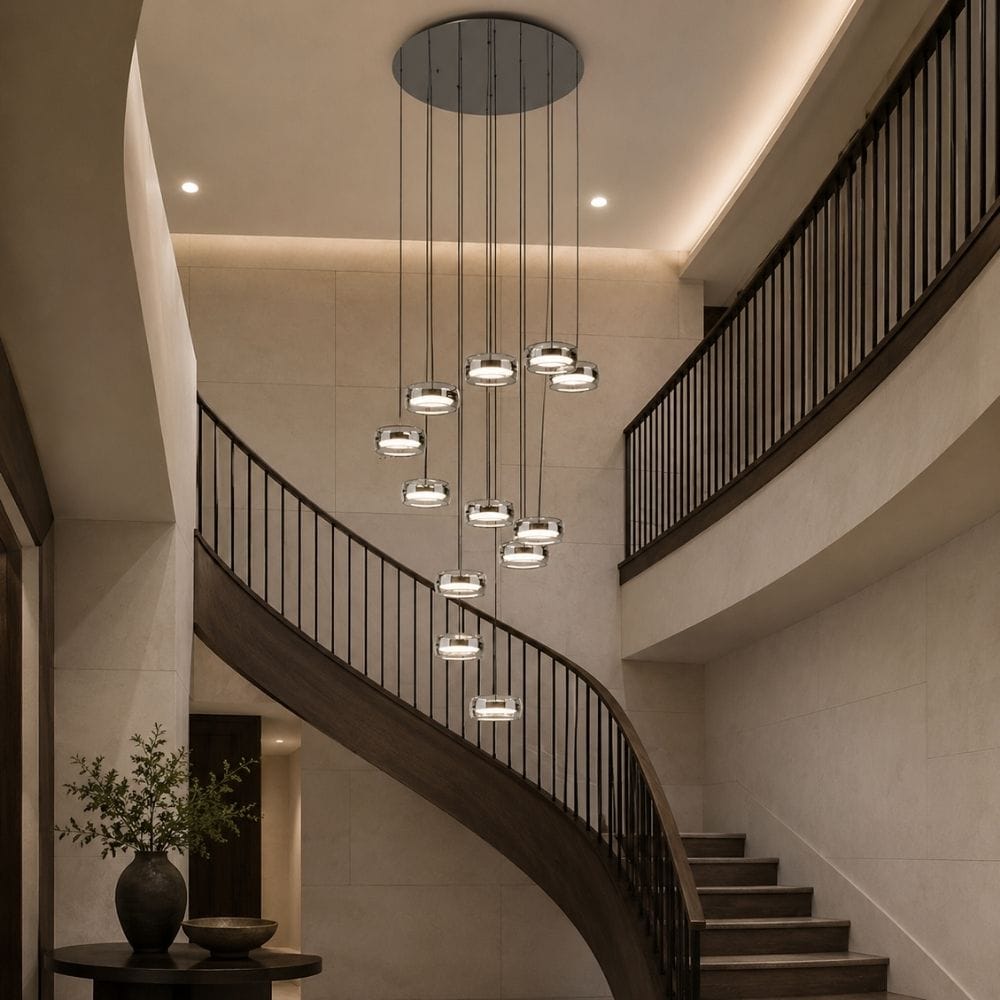
212-Light Modern Staircase Chandelier
12 Lights · Presence Without DensityTwelve light points distributed vertically fill a well the way a solid mass cannot — the eye reads the rhythm of the points rather than a block. In black that rhythm is especially clear, since each element is a distinct dark note against the pale wall. Buy twelve matched spare lamps at purchase and change them as a group when access is set up.
Why black helps: Each point reads distinctly
Buy: 12 matched spares at purchase
Finishes: Black or silver
Related: Staircase chandeliers

3Grace Spiral Staircase Chandelier
Spiral · Reads From Above TooA spiral form is the one composition specifically designed for the third viewing angle — looking down from the landing. In black the helix reads as a continuous drawn line from above rather than as a set of separate elements, which is exactly the view a reflective finish handles worst.
In black: Helix reads as one continuous line
Suits: Curved and spiral stairs
Also in: Gold
Related: Chandelier by staircase shape
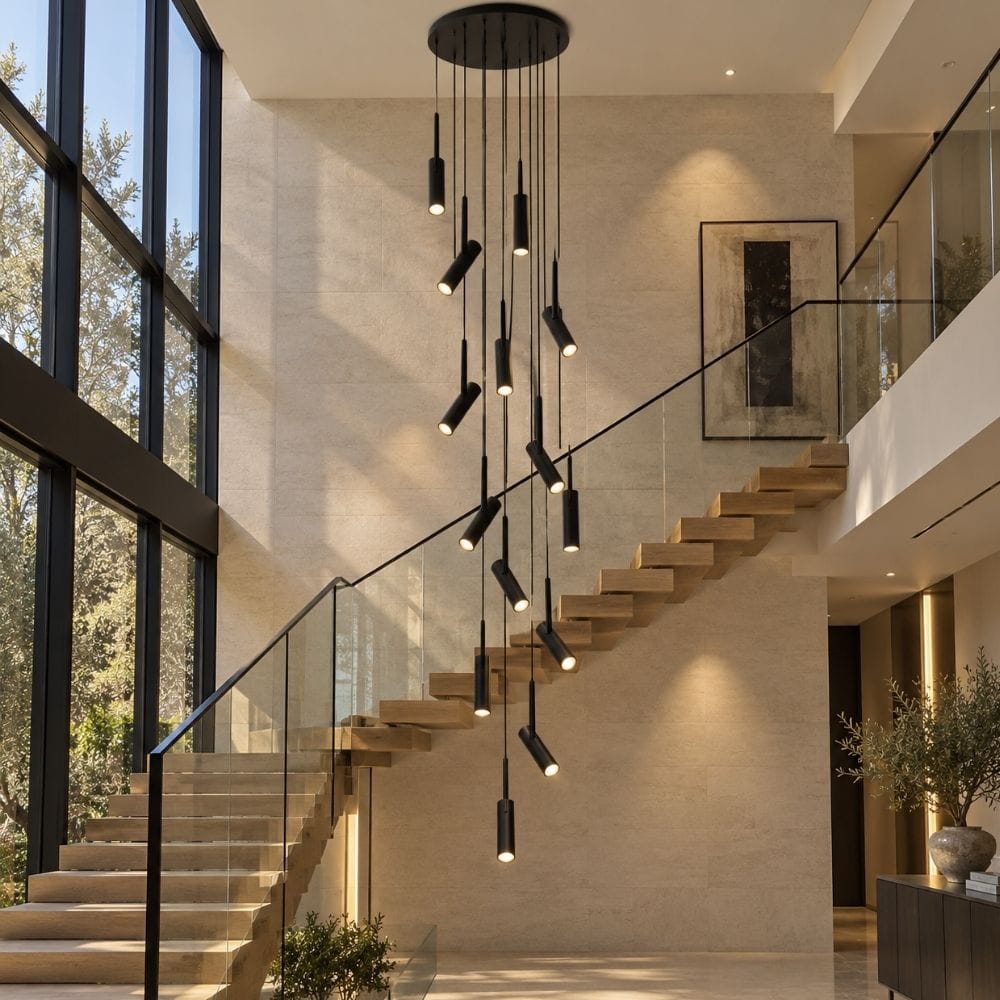
4Contemporary Staircase Long Chandelier
Scales Down · Narrow WellsUseful where the sizing correction bites hardest. In a narrow well a black fixture should be slimmer than its glass equivalent, and a design that scales from a single element upward lets that be an actual choice rather than a compromise. Four finishes, which matters when the fixture hangs close to the wall it is seen against.
Scales: From a single element upward
Finishes: Black, gold, white and one more
Rule: Slim and tall over wide and short
Related: Staircase chandeliers
Black With Crystal, Stone and Wood
Black is a finish rather than a material, and in a stairwell the pairing decides whether the fixture reads graphic or warm.
- Black and crystal is the strongest contrast available in lighting, and a stairwell amplifies it. A dark frame against a pale wall with bright refraction moving across it reads dramatically from below — and crystal's refraction multiplies any daylight from a stair window, which is a stairwell-specific advantage
- Black and stone is the quiet version. Alabaster or marble panels in a black frame glow rather than sparkle, and glare is eliminated entirely — which matters on upper treads where the fixture sits near eye level
- Black and clear glass lets the frame recede into shadow while the glass carries light, so the fixture appears to float in the well. Effective where the stairwell architecture should stay quiet
- Black and wood supplies warmth against the graphic frame — the farmhouse and rustic-modern direction, and the one that suits timber stairs and handrails directly
- Black and brass works because black reads as a line rather than as a metal, so it does not count as the second metal. This is the pairing for a stair with brass handrail fittings
Mixed-Material Black Picks (4 Designs)
Where the dark frame carries another material. Check the listed weight against the junction box rating before ordering — stone and crystal push a stairwell fixture past standard limits sooner than metal alone.
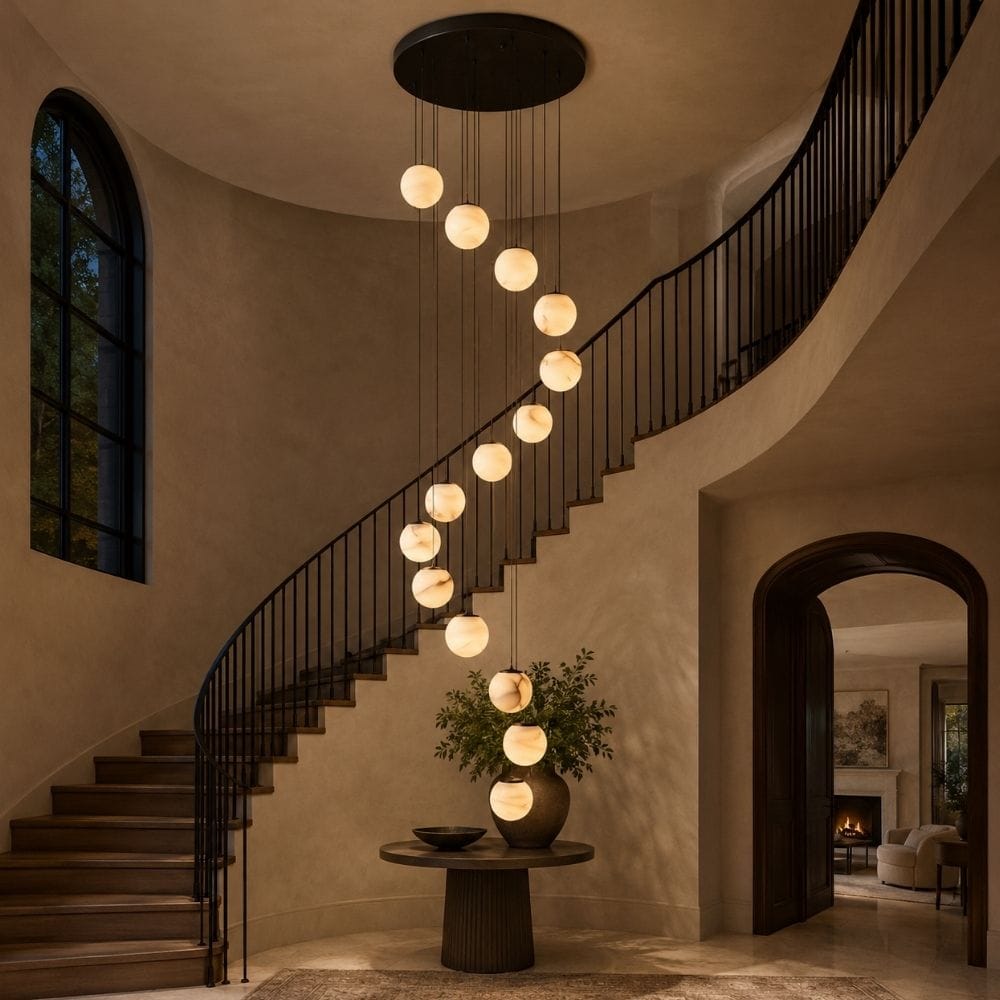
5Anne Staircase Alabaster Chandelier
Black and Stone · No Glare on Upper TreadsThe quiet version of black in a stairwell. Stone panels in a dark frame glow rather than sparkle, and the source is hidden from every angle — which matters specifically on the upper treads, where the fixture sits near eye level and people look toward it while climbing. Also the lowest-maintenance combination in the category, since stone is dry-cleaned.
Solves: Glare at eye level on upper treads
Maintenance: Dry cleaning only — lowest in category
Also in: Gold
Related: Alabaster & marble
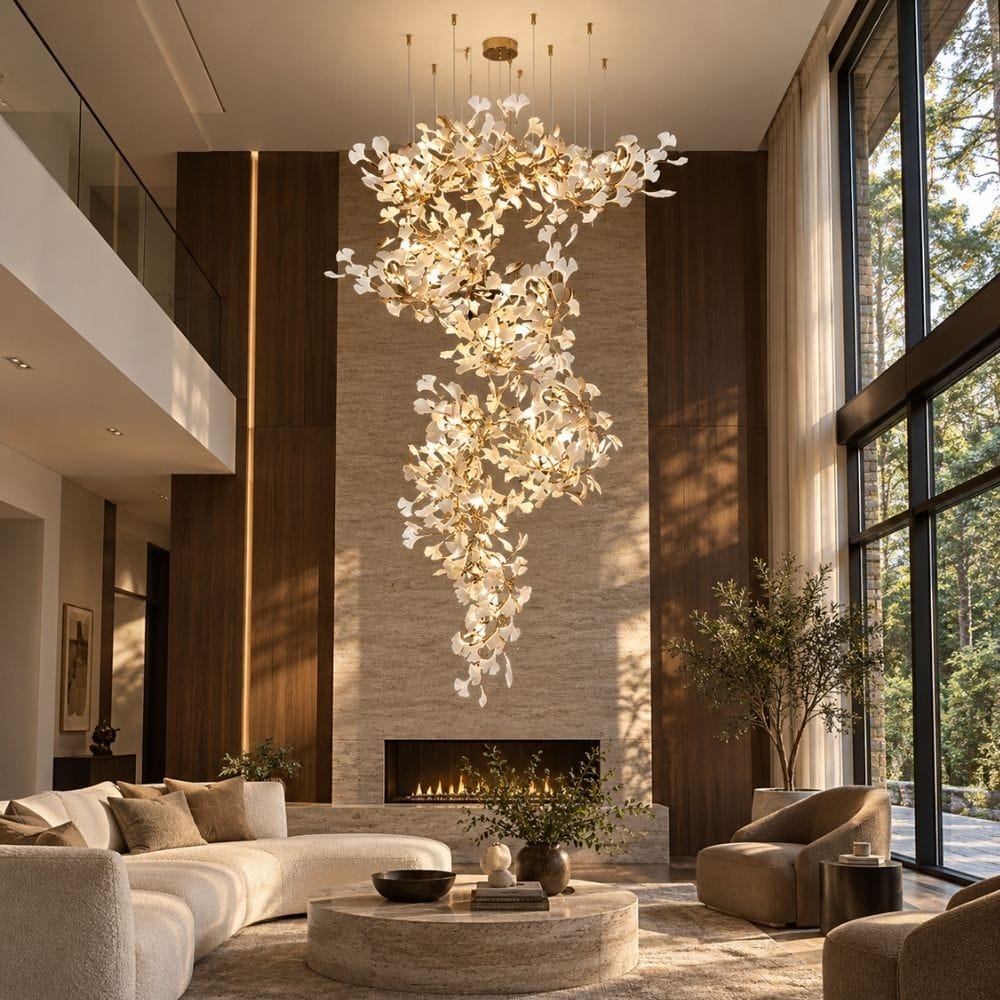
6Alba Branch Staircase Chandelier
Branch in Black · Organic Against ArchitectureBranch compositions in black are the sharpest reading in the category, because every twig is a distinct dark line against the pale wall — the form's complexity becomes legible rather than muddy. Four sizes to 78.74 in, and the black option is one of seven finishes, so the same form can go warm if the stair wants it.
Sizes: Four, to H78.74" (200 cm)
Finishes: Black, gold, copper, silver and more
Cleaning: Soft brush between elements
Related: Branch chandeliers
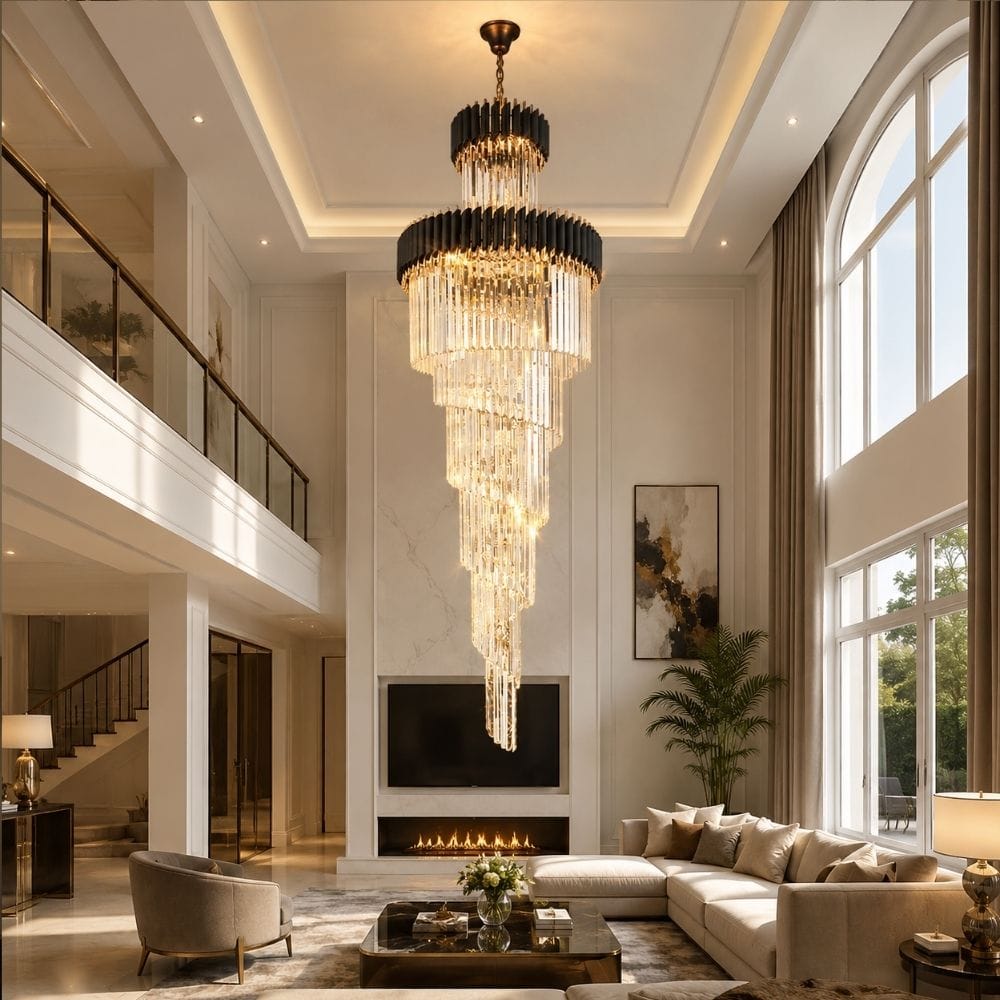
7Beth Extra Large Crystal Chandelier
Black and Crystal · Maximum ContrastThe most dramatic combination a stairwell can hold. A dark frame against a pale wall with bright refraction moving across it reads strongly from the hall below — and in a stairwell with a window, the crystal multiplies daylight as well as lamplight. Five sizes from 59 in, so the drop can be matched to the measured well.
Daylight bonus: Crystal multiplies stair-window light
Sizes: Five, from H59.06" (150 cm)
Check: Weight against the box rating
Related: Crystal chandeliers
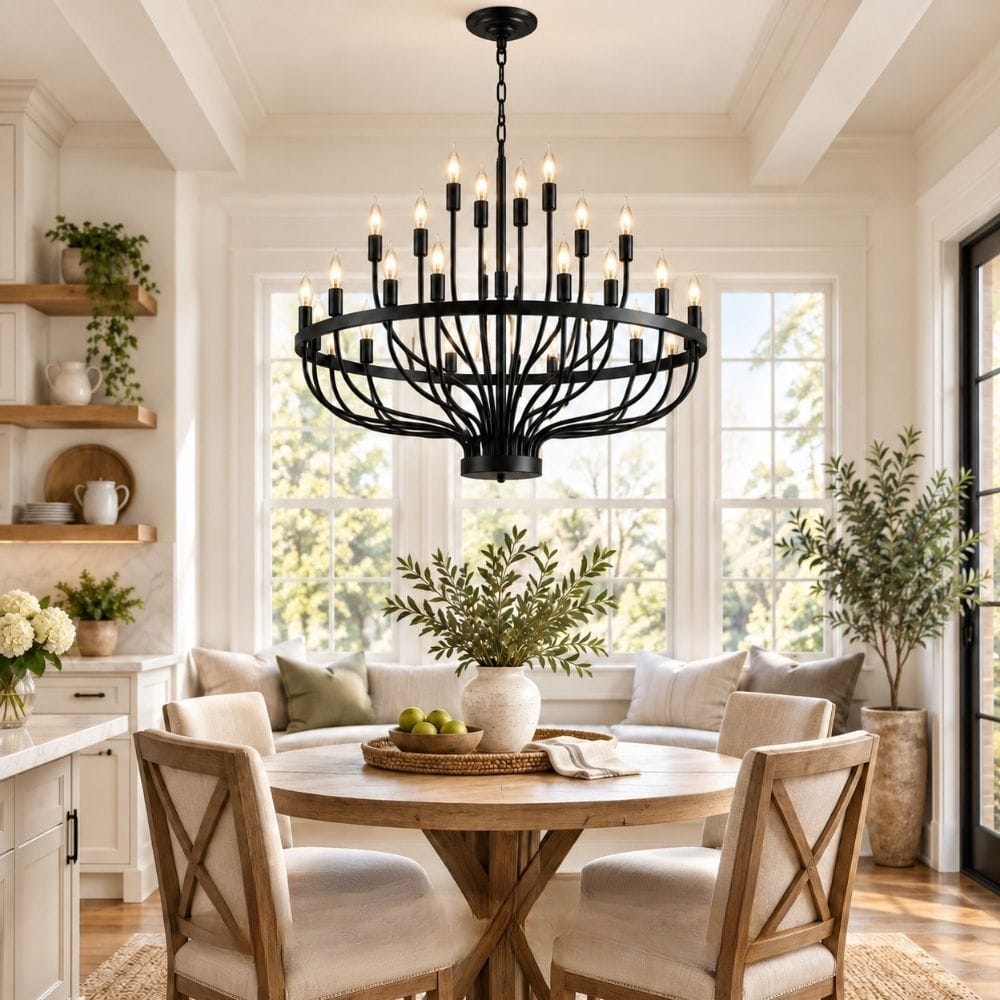
8Aldric Large Black Candle Chandelier
Candle Arms in Black · Period Without the PeriodThe bridge between directions. Candle-arm geometry carries traditional associations; black finish removes the period signal, which produces a fixture that suits a classical stair and a renovated one equally. In a stairwell that flexibility matters, because the stair is often the one part of a house that keeps its original character while the rooms change.
Suits: Period stairs in updated houses
Sizes: Three, from D39" (99 cm)
Lamps: Low-output decorative LED — arms are visible
Related: Traditional staircase chandeliers
Browse dark-finish stairwell lighting
Black staircase fixtures in metal, crystal, stone and branch forms.
Staircase Chandeliers → Black Chandeliers →When Black Is the Wrong Answer
Three situations where a dark finish works against the space rather than for it.
A dark stairwell. Black needs contrast to register at all. Against charcoal walls, a dark ceiling or heavily panelled timber, the fixture disappears — which is occasionally the goal but rarely what someone buying a stairwell chandelier wants. In those wells, warm metal or stone does the work black cannot.
A stairwell with no daylight. Windowless internal stairs rely entirely on the fixture, and black contributes no reflected light of its own. A pale or reflective finish bounces more of the output around a dark shaft. Where the stair has no window, weigh output above silhouette.
A strongly period interior. Black candle arms bridge the gap, but a stair with original ornate plasterwork, a carved balustrade and period joinery usually reads better with warm metal or classic crystal — the direction covered in our traditional staircase guide.
Lamps and Output
Because black contributes no reflected warmth, the lamps carry the stairwell's whole character — and a stairwell has a specific requirement other rooms do not.
Warm white at 2700-3000K keeps the stair consistent with the rooms it connects, which matters because a stairwell is seen from both floors. Cool white above 4000K with a dark graphic frame is the combination that makes an interior read commercial, and in a stairwell the effect is amplified by the volume.
A dimmer switched from both floors is close to essential. A stair needs full output for cleaning and carrying, and a very low level as a night path — and a three-way circuit is what makes the low setting actually get used. Where the stairwell has a window, the fixture is redundant for much of the day, so the evening setting is the one that matters.
Integrated LED earns its premium here more than anywhere, because lamp changes in a stairwell require equipment. The access argument is covered in our stairwell access guide.
Common Mistakes
- Black against a dark stairwell. The finish needs contrast. Against charcoal or heavy timber it simply disappears.
- Full calculated diameter in a narrow well. Black reads wider than its measurement. Take the smaller diameter and spend the budget on drop.
- Ignoring the view from above. A fixture designed only for the view from below looks unresolved from the landing. Spiral and tiered forms handle all three angles.
- Gloss black in a tall well. The highlight reads as a bright spot from a distance rather than as form. Matte is the safer specification at height.
- Paying for texture that cannot be seen. Hammered and textured finishes disappear at stairwell distance. Worth it only where the fixture is passed closely.
- Cool white lamps. With a dark graphic frame, above 4000K reads commercial — amplified by the stairwell volume.
- Liquid cleaners on matte black. Residue shows against a uniform dark surface, and correcting it at stairwell height is a second access event.
- Not checking the weight. Black crystal and black stone push past standard junction box limits sooner than metal alone.
Frequently Asked Questions
Do black chandeliers work in a stairwell?
Better than in most rooms. A stairwell fixture is seen against three backgrounds in one climb, and black is the only finish that reads consistently across all of them because it works by contrast rather than reflection. Stairwells are also usually finished light, which gives dark fixtures their strongest background.
What size black staircase chandelier should I choose?
Set the drop from the well — total height minus 84 in above the highest tread — then take a smaller diameter than you would in glass. Black reads wider than its measurement, so in a narrow well spend the budget on drop length rather than width.
Is matte or gloss black better for stairs?
Matte, in most wells. It gives the flattest graphic silhouette, which is the strongest reading at distance, and hides dust shadows better — useful when the fixture is cleaned twice a year. Gloss adds a highlight that reads as form up close but as a bright spot from below.
Will a black chandelier make a stairwell feel dark?
Not if the walls are pale and the fixture produces adequate output. The finish absorbs rather than reflects, so it contributes no light of its own — which matters in a windowless internal stair, where a paler finish bounces more output around the shaft.
Does black work with a white staircase?
It is the ideal combination. White or pale stairwell walls give a dark silhouette maximum contrast, and that contrast holds from the hall below, from the treads, and from the landing above.
Can I use black with brass handrail fittings?
Yes. Black reads as a line rather than as a metal, so it does not count as the second metal in a space. That makes it the safe choice where the stair hardware is brass, mixed, or may change.
What pairs well with a black frame in a stairwell?
Crystal for maximum contrast and daylight multiplication from a stair window; stone for a glare-free glow on upper treads; clear glass so the frame recedes and the fixture appears to float; wood for warmth against timber stairs and handrails.
Which black stairwell fixture is easiest to maintain?
Black with stone panels, cleaned dry, and integrated LED so there are no lamps to change. Matte finishes also hide dust shadows better than gloss, which matters when access is limited to twice a year.
Are black chandeliers only for modern staircases?
No. Candle-arm geometry in black carries traditional form without the period signal, which suits a classical stair and a renovated one equally. That flexibility is useful in a stair, which often keeps original character while the rooms around it change.
What bulbs suit a black staircase chandelier?
Warm white at 2700-3000K on a dimmer switched from both floors. Because black contributes no reflected warmth, the lamps carry the whole character — and cool white above 4000K with a dark frame reads commercial, amplified by the stairwell volume.
How do you clean a black stairwell chandelier?
Dry microfiber from the highest accessible point, power off at the breaker. Avoid liquid cleaners on matte black — residue shows against the uniform dark surface, and correcting it at stairwell height means a second access event.
When should I avoid black in a stairwell?
Against dark walls or a dark ceiling, where it disappears for lack of contrast. In a windowless internal stair, where a reflective finish distributes limited output better. And in a strongly period interior with original ornate detail, where warm metal usually reads better.
Contrast Is the Whole Argument
A stairwell gives a dark fixture the best background it will find in a house — pale walls, daylight, and three viewing angles that all favour silhouette over shine. Set the drop from the well, take a slimmer diameter than you would in glass, choose matte for a tall well, and check that the walls are light enough to give the finish something to read against.
Browse the range: staircase chandeliers, black chandeliers.