Over a dining table the low-ceiling problem largely disappears. The 84 in walkway clearance rule does not apply above a table, because nobody walks there. A fixture hung 30-36 in above the tabletop on an 8 ft ceiling leaves roughly 30 in of ceiling space — enough for most pendants and many chandeliers.
The arithmetic: 96 in ceiling − 30 in table height − 30 in clearance = about 36 in of usable fixture depth. Most people assume they have 12 in and rule out fixtures they could actually use.
Go wide rather than deep. A 60 in wide fixture with a 12 in body reads far more substantial on a low ceiling than a 24 in one with a 20 in drop — and it still leaves the full 84 in of walkway clearance.
Where the table is off to one side of a walkway, the 84 in rule returns for the walkway portion — and that is when flush and semi-flush formats become the answer.
Low ceilings are the most common reason people believe they cannot have a proper dining room fixture, and in most cases the belief is wrong. The clearance rule everyone quotes applies to walkways, not to the space above a table — and that single distinction typically frees up two feet of fixture depth that had been ruled out. This guide covers the actual arithmetic for an 8 ft ceiling, which formats work and which do not, how to gain visual presence without vertical space, and the specific situations where a low ceiling genuinely does restrict the choice.
On this page
Can a Chandelier Work With a Low Ceiling?
The rule people remember is 84 in of clearance from the floor. It is correct, and it does not apply above a dining table.
Clearance rules exist so that people do not walk into fixtures. Above a table there is a table, so the reference changes from the floor to the tabletop — and the standard becomes 30-36 in above the surface. That is not a relaxed version of the walkway rule; it is a different measurement for a different situation.
96 in ceiling − 30 in table − 30 in clearance leaves roughly 36 in of fixture depth
Which Light Fixtures Work With an 8 Foot Ceiling?
| Format | Typical depth | Over a table at 8 ft | Over a walkway at 8 ft |
|---|---|---|---|
| Flush mount | 4-12 in | Works, and can be wide | The safe choice |
| Flush branch / spreading | 12 in, up to 60 in wide | Works — maximum width | Works — clears 84 in |
| Semi-flush | 8-14 in | Works well | Usually works — check the number |
| Ring chandelier | 4-12 in | Ideal — wide and shallow | Often works |
| Linear chandelier | 8-18 in | Works over long tables | Rarely |
| Single pendant | 10-20 in body | Works | No |
| Drum shade | 10-16 in | Works well | Marginal |
| Tiered chandelier | 20-40 in | Only shallow tiers | No |
| Cascade or spiral | 36 in and up | No | No |
The pattern: anything that achieves presence horizontally suits a low ceiling, and anything that achieves it vertically does not. Rings, drums, linear bars and wide shallow chandeliers all belong in the first group. Tiered, cascading and spiral compositions belong in the second, and no amount of careful measurement changes that.
Gain Width, Not Depth
Presence in a fixture comes from occupying visual space, and there are two directions to do that in. On a low ceiling only one is available — which is a constraint rather than a loss, because horizontal presence works perfectly well.
A 34 in wide fixture with an 8 in body reads more substantial than a 24 in one with a 20 in drop, and it occupies less than half the vertical space. Both are "big enough"; only one is possible at 8 ft. Run the standard sizing formula — room length plus width in feet, read as inches — and then, on a low ceiling, take the upper end of the range rather than the lower.
Over a table the table rule governs instead: one-half to two-thirds of the table's width. On a low ceiling, go to two-thirds rather than one-half. A 48 in round table takes 32 in rather than 24 in, and the wider fixture makes the ceiling read higher rather than lower — a horizontal element draws the eye across rather than down.
Fixture Picks for 8 ft Dining Rooms (8 Designs)
Wide and shallow rather than compact and deep. Over a table, hang 30-36 in above the tabletop and size to two-thirds of the table's width; where the table adjoins a walkway, the flush and close-mount options below keep the 84 in clearance.
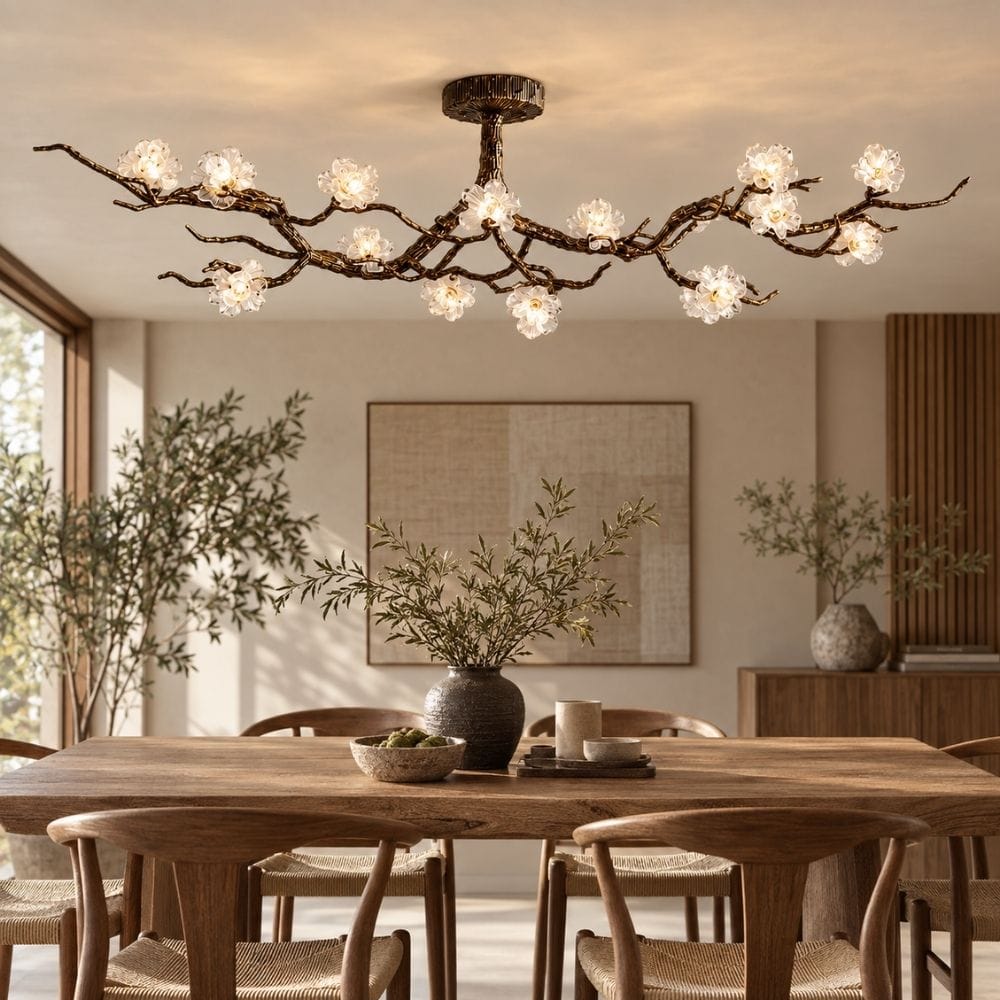
1Atita Flush Mount Branch Chandelier
60 in Wide · 12 in DeepThis entire guide's argument in one fixture. It spreads 60 in (152 cm) across the ceiling while standing only 12 in (30 cm) tall — which leaves a full 84 in of clearance on an 8 ft ceiling, so it clears walkways as well as tables. Eighteen hand-blown glass flowers on bark-textured branches also give it the decorative register a plain flush mount cannot, at roughly 3,600-4,000 lumens.
Clearance at 8 ft: 84" — clears walkways too
Output: 18 blooms, ~3,600-4,000 lm
Chain option: For 10 ft+ ceilings or lower over a table
Needs: Rooms 12 ft wide and up — custom widths available

2Vita Crystal Flush Mount Chandelier
Linear or Round · Six SizesThe answer for a long table in a low room. Linear configurations run to 47.24 in (120 cm), distributing light along the table's axis at flush-mount depth — presence gained lengthways rather than downward. Round versions cover square and circular tables, so one design and finish can serve both a dining table and an adjoining space.
Gains presence: Along the axis, not downward
Sizes: Six — land on ⅔ of the table's length
Finishes: Gold or silver
Related: Linear chandeliers
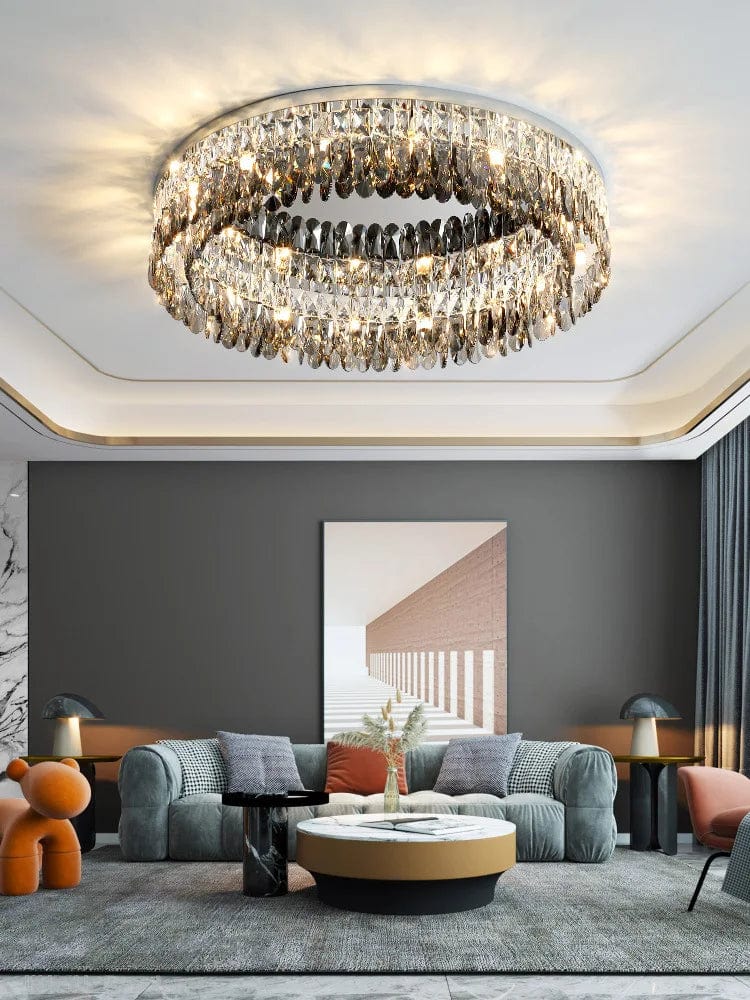
3Cara Crystal Flush Mount Chandelier
Crystal at Flush DepthFor the hardest version of the problem: a table that sits against a route through the room, where the 84 in rule applies after all and roughly 12 in of depth is all there is. Crystal held tight to the ceiling still throws refracted light sideways across the plane, which does more for a low room than a downward-only fixture of the same depth.
Depth: Flush — inside the 12" budget
Why crystal: Moves light sideways, not only down
Also suits: Small dining rooms and breakfast areas
Related: Flush mount chandeliers
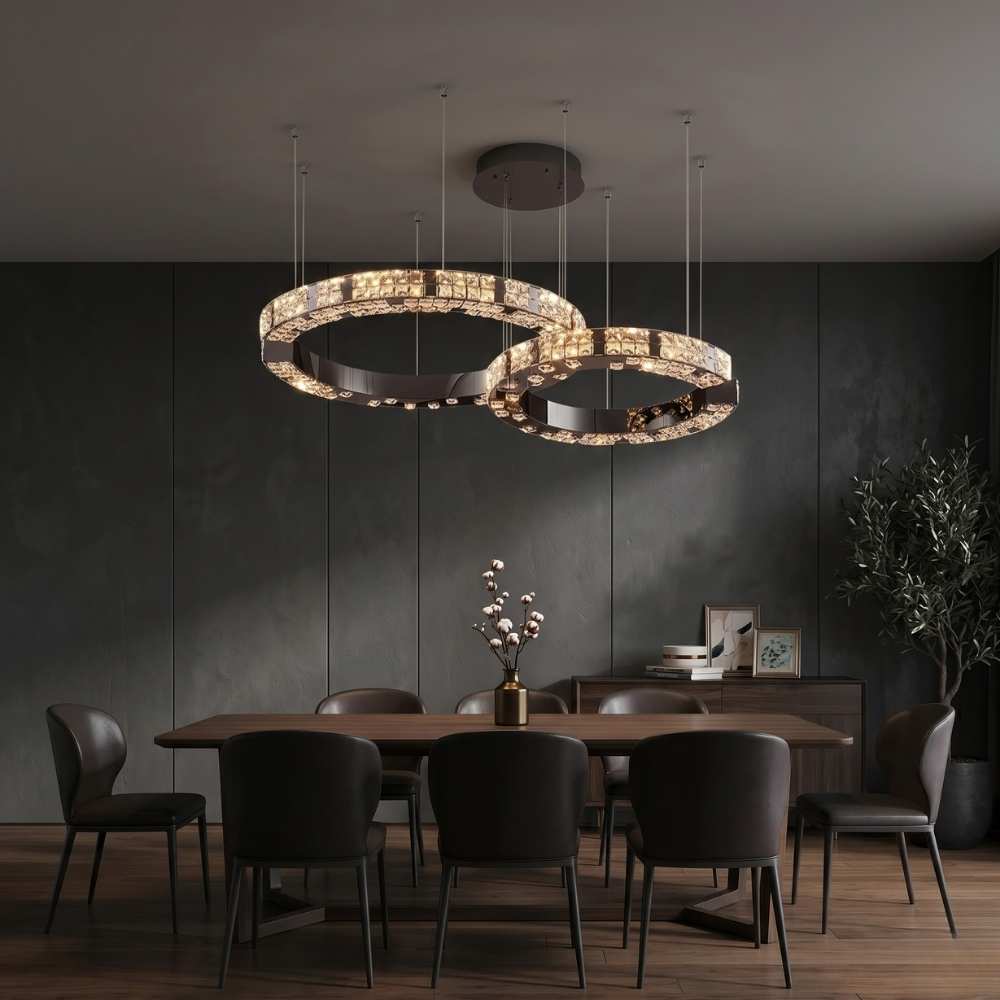
4Arven Modern Crystal Ring Chandelier
Round Tables · Wide and ShallowThe ideal low-ceiling geometry over a round or square table: a ring occupies width without depth, and the open centre lets the ceiling show through so the fixture does not press down. Hung 30-36 in above the tabletop it sits comfortably inside the roughly 36 in a standard ceiling allows.
Suits: Round and square tables
Size to: ⅔ of the table's width on a low ceiling
Colour: Warm white 2700K, dimmer essential
Related: Ring chandeliers

5Aurelle Contemporary Round Chandelier
Contemporary · Horizontal PresenceWhere the room wants a contemporary silhouette rather than a period one. Round forms have no orientation, which suits a dining room entered from more than one direction, and a shallow round body gains its presence across the ceiling rather than down into the room — the trade a low ceiling requires.
Form: Round — works from any approach
Check before ordering: Total depth against your ceiling
Size to: ⅔ of the table's width
Related: Contemporary chandeliers

6Carol Branch Bubble Chandelier
Branch Spread · Glass GlobesBranch compositions spread outward by nature, which makes them structurally suited to low ceilings even though they read as elaborate. Glass globes at the tips also add visual depth within a shallow envelope — interest without dimension — and the clear glass keeps the ceiling visible through the fixture rather than blocked by it.
Adds: Visual depth in a shallow envelope
Clear glass: Ceiling shows through
Check before ordering: Overall drop and spread
Related: Branch chandeliers

7Elvara Marble Linear Pendant Light
Long Tables · Stone DiffusionA linear body over a rectangular table, with stone rather than glass doing the diffusion. Marble absorbs a share of the output and warms what passes through, giving a glow with no glare at any angle — which matters more at 8 ft than at 10, because the fixture sits closer to seated eye level for the whole meal. Plan other lighting alongside it.
Diffusion: Stone — no glare at close range
Trade: Lower output — pair with other layers
Size to: ½ to ⅔ of the table's length
Related: Alabaster & marble
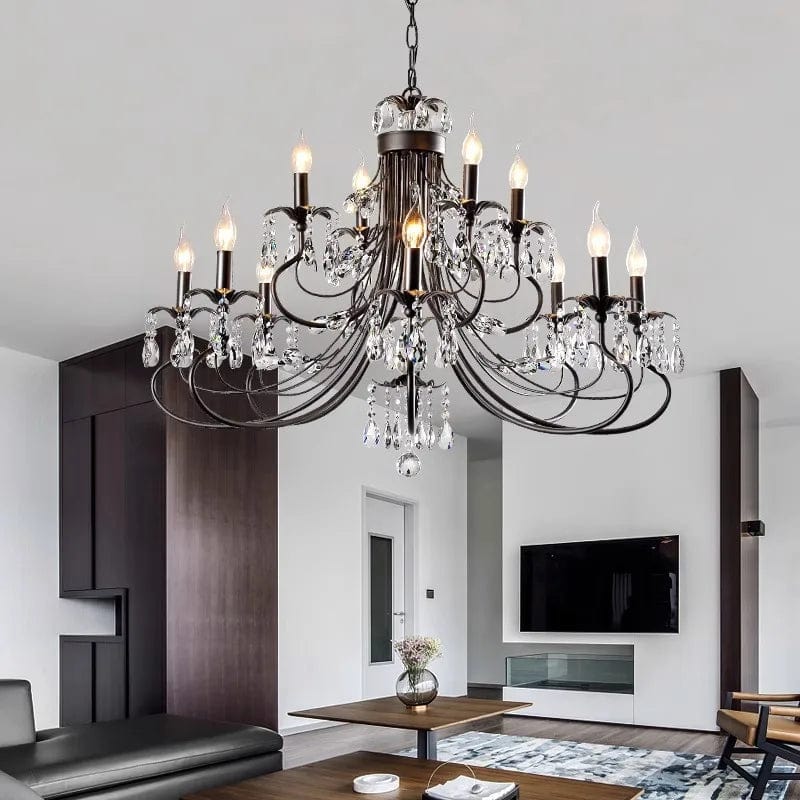
8Black Wrought Iron Chandelier
Traditional · Open FrameThe traditional option that still works at 8 ft, because an open iron frame lets the ceiling show through and presses down far less than a solid mass of the same dimensions. Two cautions specific to this choice: black reads larger than its measurement, so do not oversize; and iron passes standard junction-box weight limits sooner than glass, so read the marked rating first.
Caution 1: Black reads larger — do not oversize
Caution 2: Check the box weight rating
Lamps: Low-output LED — semi-visible at 8 ft
Related: Iron chandeliers
Browse low-ceiling options
Flush, semi-flush and shallow-profile dining fixtures.
Flush Mount → Ring → Dining Room →When the Walkway Rule Returns
Three situations bring the 84 in requirement back, and they are worth identifying before shopping rather than after.
The table sits against a walkway. In open-plan rooms and narrow dining spaces, the route through the room passes close enough that a fixture over the table's edge is also over a path. Measure where people actually walk, not where the table is.
The table gets moved. Extending tables and dining spaces used flexibly mean the fixture is sometimes over a table and sometimes over open floor. If the table's position is not permanent, treat the space as a walkway.
The fixture is off-centre from the table. Where a ceiling box does not align with the table's centre, part of the fixture may overhang open floor. This is common and worth checking with a tape measure before ordering, since the answer changes the format entirely.
Four Ways to Make the Ceiling Feel Higher
- Uplight. A fixture that throws some output onto the ceiling makes the surface visible, and a visible ceiling reads as further away than a dark one. Up-and-down designs do this while still lighting the table.
- Go wider. A horizontal element draws the eye across the room rather than down, which is why a wide shallow fixture makes a low room feel taller and a compact deep one makes it feel shorter.
- Add wall lighting. Sconces light vertical surfaces, and lit walls read taller than dark ones. This does more for perceived height than any ceiling fixture choice.
- Keep the fixture open. A frame the ceiling shows through — a ring, an open cage, a clear glass cluster — presses down far less than a solid mass of the same dimensions.
Light Quality in a Low Room
Two specifications matter more at 8 ft than they would at 10 or 12.
Glare control comes first. The fixture sits closer to seated eye level, and diners look at it for the length of a meal rather than glancing at it in passing. Exposed lamps that are perfectly comfortable at 10 ft become uncomfortable at 8 ft over a table. Diffused, shaded and opal designs are the safe specification; exposed-filament designs need a dimmer and low-output decorative lamps.
A dimmer is close to mandatory. A dining room needs bright light for setting a table and much lower light for eating, and in a low room the difference between the two is more pronounced because the source is closer. Aim for 2,000-4,000 lumens total across the room with CRI 90 or better — colour rendering matters over a dining table more than raw brightness does.
Common Mistakes
- Applying the walkway rule above a table. The single most common error here, and it rules out fixtures unnecessarily. Above a table, measure from the tabletop.
- Choosing a compact fixture. Small does not read as appropriate for a low ceiling — it reads as too small. Go wide and shallow instead.
- Rounding down on diameter. On a low ceiling, take the upper end of the sizing range. Width is the dimension available.
- Tiered fixtures with shallow tiers. Stacked geometry emphasises vertical space, which is what a low room has least of.
- Exposed lamps over a low table. Comfortable at 10 ft, uncomfortable at 8 ft through a whole meal.
- Ignoring where people walk. The 84 in rule returns if the table sits against a route through the room.
- A solid fixture where an open one would do. A frame the ceiling shows through presses down far less.
- No dimmer. More noticeable in a low room, since the source is closer to the table.
Frequently Asked Questions
Can a chandelier work with a low ceiling?
Over a dining table, yes — and more easily than most people expect. On a 96 in ceiling, subtracting a 30 in table height and 30 in of clearance leaves roughly 36 in of usable fixture depth. The 84 in clearance rule applies to walkways, not to the space above a table.
How low can a light hang over a dining table with an 8 ft ceiling?
30-36 in above the tabletop, the same as any ceiling height. The table sets the reference, not the floor, because nobody walks beneath it.
What size chandelier for a dining room with a low ceiling?
Size to the table at two-thirds of its width rather than one-half — a 48 in round table takes about 32 in. On a low ceiling, width is the dimension available, and a wider fixture makes the ceiling read higher rather than lower.
What is a low profile light fixture?
One that achieves presence horizontally rather than vertically: flush mounts at 4-8 in deep, semi-flush at 8-14 in, and shallow rings and drums. The defining characteristic is a wide diameter relative to a shallow body.
Are flush mounts the only option for low ceilings?
Only over walkways. Above a dining table, semi-flush fixtures, rings, drums, linear designs and most single pendants all fit within the roughly 36 in available on an 8 ft ceiling.
Which fixture types do not work at 8 feet?
Anything that gains presence vertically — tiered chandeliers beyond shallow tiers, cascading compositions, spiral designs. These typically need 20-40 in or more of depth, which is not available even above a table.
How can I make a low ceiling feel higher?
Use a fixture that throws some light onto the ceiling, choose wide over deep, add wall sconces so vertical surfaces are lit, and pick an open frame the ceiling shows through rather than a solid mass.
What if the dining table sits next to a walkway?
Then the 84 in rule applies to the walkway portion, which leaves about 12 in of fixture depth. That is the situation flush and close-mount fixtures exist for. Measure where people actually walk rather than where the table is.
Should I use exposed bulbs in a low dining room?
Only with a dimmer and low-output decorative lamps. At 8 ft the fixture sits close to seated eye level and diners look at it for a whole meal — exposed lamps that are comfortable at 10 ft are not at 8.
Does a bigger fixture make a low ceiling look worse?
A deeper one does; a wider one does the opposite. A horizontal element draws the eye across the room rather than down. The dimension to be careful with is drop, not diameter.
Can I use a pendant over a dining table with a low ceiling?
Yes. Most single pendants have bodies of 10-20 in, which fits comfortably within the roughly 36 in available above a table on an 8 ft ceiling. Check the total drop including any fixed rod.
What about a low ceiling in a kitchen rather than a dining room?
The same logic applies over an island, where nobody walks beneath: 30-36 in above the counter, measured from the counter surface. Over the walking areas of a kitchen, the 84 in rule and flush formats apply as elsewhere.
Measure From the Table, Then Go Wide
The rule that rules out fixtures on a low ceiling is the walkway rule, and above a dining table it does not apply. Measure 30-36 in from the tabletop, take the roughly 36 in that leaves you on a standard ceiling, and spend it on diameter rather than drop.
Browse the range: flush mount chandeliers, ring chandeliers, dining room chandeliers.