Illuminance falls off with the inverse square of distance, so a fixture at 18 ft delivers roughly a quarter of what the same fixture gives at 9 ft. That single physical fact is why one chandelier never lights a vaulted room, whatever its diameter or wattage, and why the answer is more sources rather than a brighter fixture.
Plan four layers, each on its own dimmed circuit. A statement fixture for presence with 84-90 in of clear floor beneath it. Adjustable recessed or track for coverage, aimed vertically rather than perpendicular to the slope. Wall sconces at 60-72 in to center. Floor and table lamps at the seating. The chandelier is the top layer of a scheme, not the scheme itself.
Light the vault itself, and keep it dim. Downlights aim away from the ceiling and the chandelier hangs below it, so the planes that make the room architectural disappear after dark. Uplighters in corners, up-and-down wall fixtures or cove lighting all restore it — and a lit ceiling reads as farther away than an unlit one.
Size the statement fixture generously: room length plus width in feet read as inches, plus about 3 in of diameter per foot of ceiling above 12 ft. Under-sizing is the dominant error, because a fixture viewed from thirty feet reads substantially smaller than it measures.
One color temperature throughout — 2700-3000K — and dimmers on everything. A tall open volume shows several sources at once, so mixed Kelvin reads as a mismatch rather than as zoning. Dark beams or a dark ceiling absorb a substantial share of the output and need more of it budgeted.
A vaulted ceiling is usually a room's best architectural feature and its hardest lighting problem, and the two are connected: the same height that makes the space impressive puts every ceiling fixture a long way from where people actually are. This guide covers why a single fixture cannot work, the four layers that do, what to do when beams or a slope complicate the plan, and how to light the vault itself so the architecture survives after dark.
On this page
Why One Fixture Is Never Enough
The reason is physical rather than aesthetic, and once it is clear the rest of the plan follows from it.
Two consequences follow. The ceiling fixture should be chosen for presence rather than output, because it cannot deliver meaningful task light from that height regardless of its lumens. And the working light has to come from closer to the people — recessed fixtures aimed down, wall lighting at head height, and lamps at seating.
Doubling the distance quarters the light, which no increase in fixture size corrects
The Four Layers
| Layer | Fixture | Height | Does | Switch |
|---|---|---|---|---|
| 1. Statement | Chandelier or long-drop fixture | 84-90 in clear floor | Presence, scale, marks the room | Dimmer, own circuit |
| 2. Coverage | Recessed or track | At the ceiling plane | Even floor-level light | Dimmer, own circuit |
| 3. Wall | Sconces | 60-72 in to center | Light at human height, reads as space | Dimmer |
| 4. Task | Floor and table lamps | At seating | Reading and working light | Local switches |
| Optional: uplight | Uplighters or cove | Aimed at the vault | Makes the architecture read at night | Dimmer |
A vaulted room that has only layers 1 and 2 — a chandelier plus recessed downlights — is the most common configuration and reads flat. Everything comes from overhead, nothing lights the walls, and the volume feels like a large dim box with a bright object in it. Layers 3 and 4 are what make it feel inhabited.
Layer 1: The Statement Fixture
This is the fixture everyone starts with, and the one that should be chosen for how it looks rather than how much it gives.
Size it generously. Run the room formula — length plus width in feet, read as inches — then add roughly 3 in of diameter per foot of ceiling above 12 ft. A 16 x 20 ft room at 18 ft gives 36 + 18, so around 54 in. Under-sizing is the dominant error here, because a fixture viewed from thirty feet reads substantially smaller than its measurement.
Favour body length over chain. Above about 14 ft, a compact fixture suspended on sixty inches of visible cable reads improvised while a tall fixture on short suspension reads designed. Buy the height rather than adding it.
Decide the access route before ordering. A fixture at the peak of a vaulted room needs a platform or scaffold every time anything is touched. Integrated LED removes lamp changes for decades, which in this position matters more than in almost any other.
Statement Fixture Picks (3 Designs)
Scale and body length for a tall volume. Each fills the height with its own composition rather than a long run of visible cable.
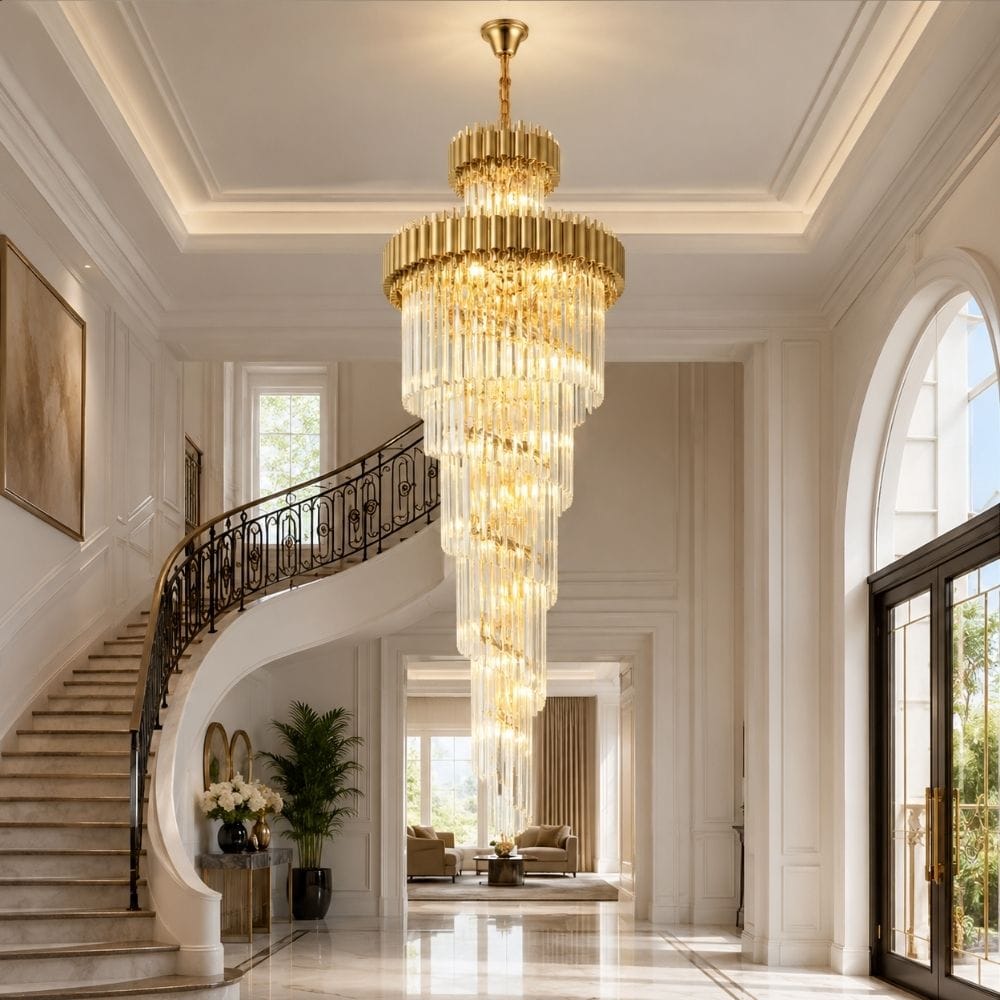
1Beth Extra Large Crystal Chandelier
59 in Body · Fills Height Without ChainAt 59 in the composition occupies the vertical space on its own terms, which is what separates a designed installation from a compact fixture hung low on cable. Crystal also earns its place in a vaulted room specifically — refraction scatters light sideways across the ceiling planes, which is the one direction a downlight cannot cover.
Vaulted bonus: Refraction lights the ceiling planes
Sizes: Five, from H59.06" (150 cm)
Plan: Access route before ordering
Related: High ceiling chandeliers
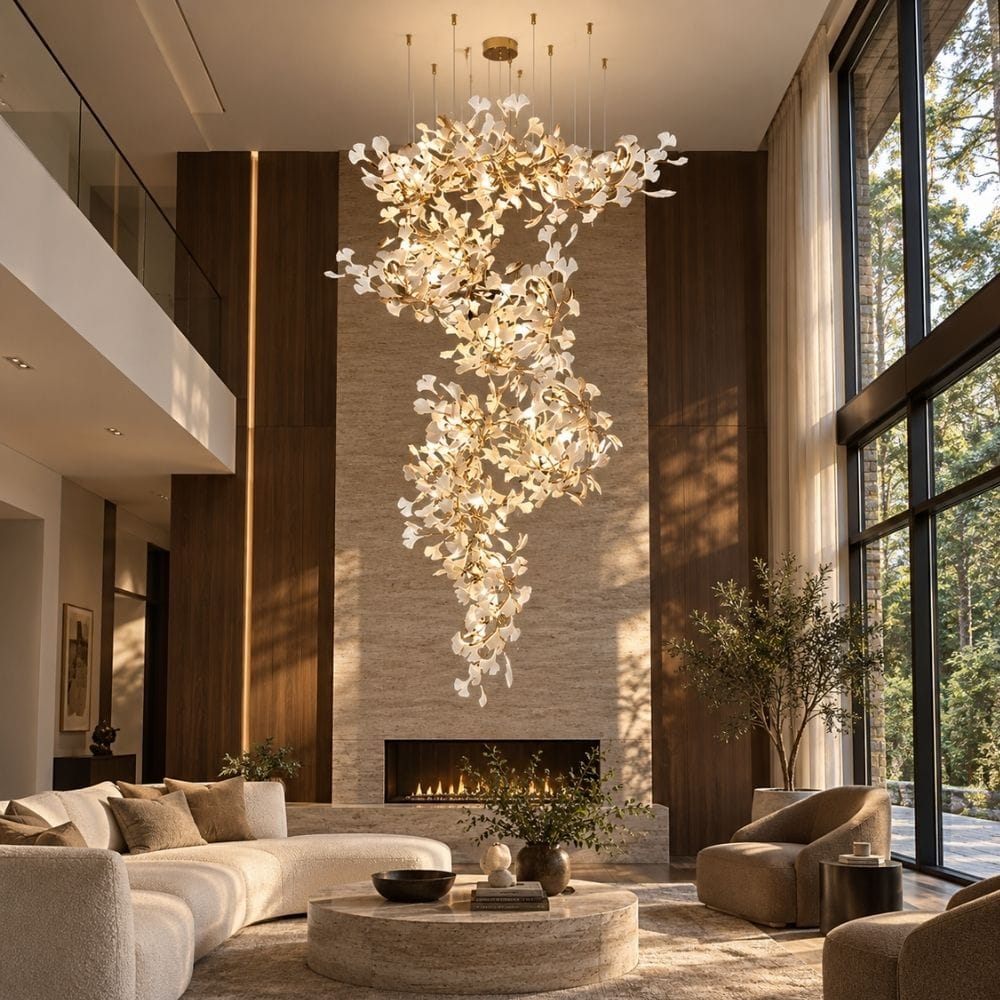
2Alba Branch Staircase Chandelier
78 in · Irregular Form Suits a SlopeA vaulted room gives the eye a strong reference line in the ceiling's own angle, which makes any geometric fixture's alignment obvious. A branch composition has no straight edge to read against that line, so it sits comfortably under a slope where a rigid form would need to be exactly right. Four sizes to 78.74 in.
Sizes: Four, to H78.74" (200 cm)
Confirm: Chain or cable suspension before ordering
Finishes: Seven
Related: Branch chandeliers

3Asty Modern Ring LED Chandelier
Integrated LED · No Platform for Lamp ChangesAccess is the hidden recurring cost of a vaulted room, and integrated LED removes most of it — no lamp changes for decades means the only reason to bring a platform in is cleaning. Multi-ring configurations also let the vertical presence be tuned to the ceiling height independently of the diameter.
Ask first: Is the driver serviceable?
Configure: Ring count to the height
Confirm: Sloped-ceiling compatibility
Related: Ring chandeliers
Layer 2: Recessed and Track
This layer does the work the statement fixture cannot, and in a vaulted room it needs two adjustments over a flat-ceiling installation.
Use adjustable fixtures, not fixed downlights. On a sloped plane a fixed downlight aims perpendicular to the ceiling, which means it throws light at an angle across the room rather than down at the floor. Adjustable gimbal trims let each one be aimed vertically, and on a vault that is not optional.
Space them tighter than you would at normal height. Because output falls off with distance, a vaulted room needs more fixtures at closer spacing to reach the same floor level — and they want a narrower beam angle so the light arrives where it is aimed rather than spreading out over the extra distance.
- Narrow beam angles — the longer the throw, the more the beam spreads before it lands.
- Aimed at surfaces, not at the floor center. A downlight hitting empty floor does less than one washing a wall or a seating area.
- Track is the practical alternative where recessed is impossible — a cathedral ceiling with no void above it, or an existing room where cutting is not realistic. Track heads adjust, which suits a slope.
- Keep them off the statement fixture's circuit. The two layers do different jobs and want different levels at different times.
- Put them on a dimmer too, since full coverage lighting in the evening is rarely what the room wants.
Layer 3: Wall Lighting
This is the layer most vaulted rooms skip, and the one that changes how the room feels more than any other addition.
A room reads as large as its visible boundaries. In a vaulted space lit only from above, the walls fall into shadow at their lower half — which is exactly where the eye looks for a room's edges. The volume reads as a dim box rather than a tall space, and the usual response is adding more ceiling light, which does not help because the problem is direction rather than quantity.
Sconces at 60-72 in to center put light at human height, light the walls directly, and give the lower half of a tall room something to read. In a vaulted living room this is the difference between a space that photographs well and one that is comfortable to sit in.
Where walls are glazed or unavailable, floor lamps aimed at walls do a similar job with no electrical work — and in a room where furniture may be rearranged, they have the advantage of moving with it.
Lighting the Vault Itself
Three ways to do it, in ascending order of cost:
- Uplighting floor fixtures placed in corners or behind furniture, aimed at the ceiling planes. No wiring, moveable, and the cheapest route by far.
- Up-and-down wall fixtures that wash the wall in both directions. These do layer 3 and the uplighting at once, which makes them efficient in a tall room.
- Cove lighting along a beam line or a ledge, if the architecture provides one. The most effective and the most expensive, since it usually means building the cove.
Keep it dim. Uplighting works at a low level — the goal is making the ceiling visible, not lighting it brightly. At full output it flattens the vault's shape and draws attention away from everything below it.
Supporting Layer Picks (3 Designs)
Layers 3 and 4 — wall lighting and the fixtures that put light where people actually are.

42-Pack Marble Sconce Wall Light
Wall Pair · Gives the Room Its EdgesWall fixtures do the one thing a vaulted room's overhead lighting cannot: they light the lower half of the walls, where the eye looks for the room's boundaries. Sold as a pair, which matters since two sconces on one wall are seen in a single glance and natural stone varies between separately ordered pieces.
Mount at: 60-72 in to center
Glare: None — stone conceals the source
Sold as: A matched pair
Related: Wall sconces
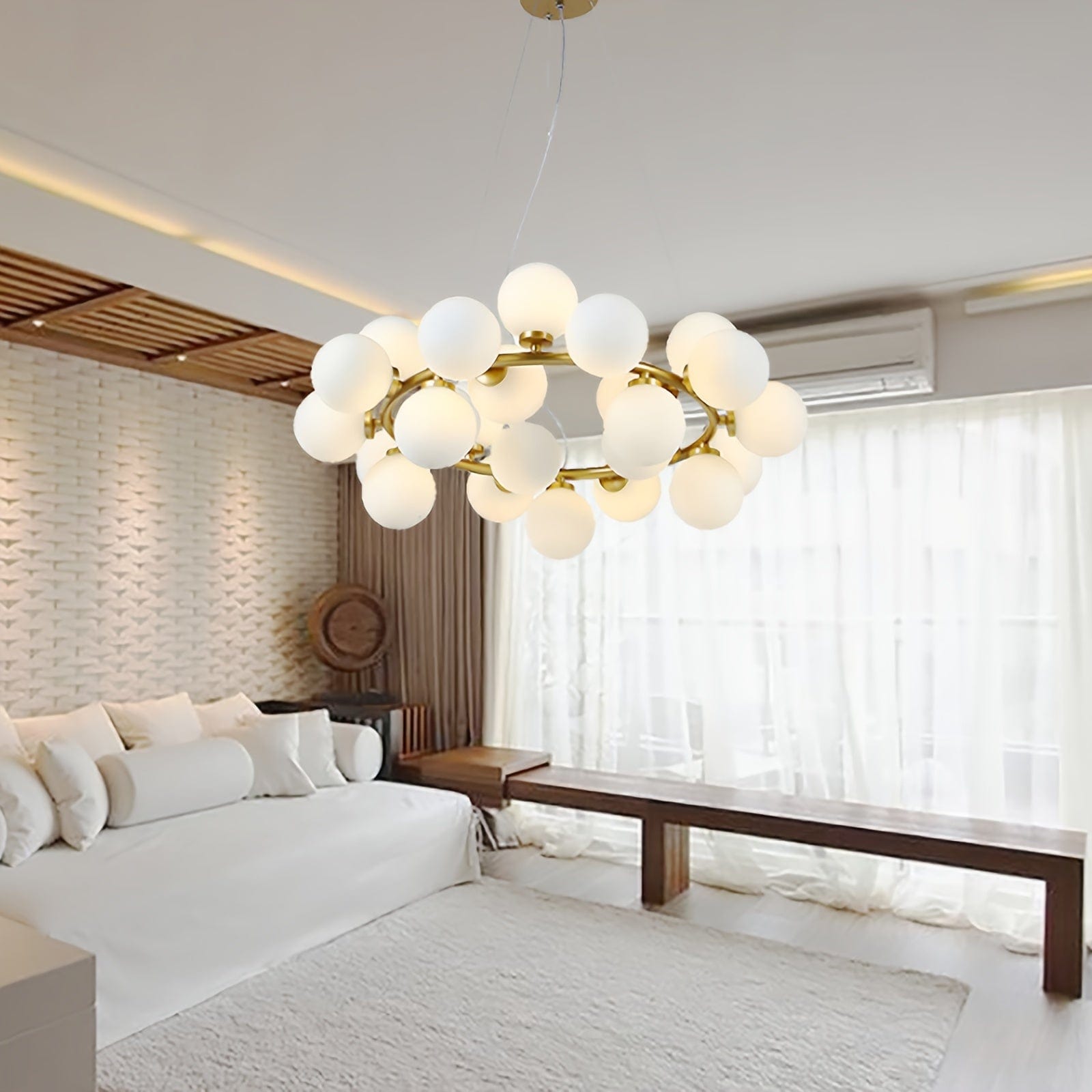
5Holly Milk Glass Chandelier
Opal · Secondary Fixture in a Long RoomVaulted rooms are often long as well as tall, and a single central fixture leaves both ends underserved. A second fixture over the far zone — a dining area, a reading corner — covers what the main one cannot. Opal glass is the right diffuser here because this one is doing real work rather than only marking a position.
Why opal: Real output, no visible source
Match: Finish family to the statement fixture
Clearance: 84-90 in over walking areas
Related: Glass chandeliers
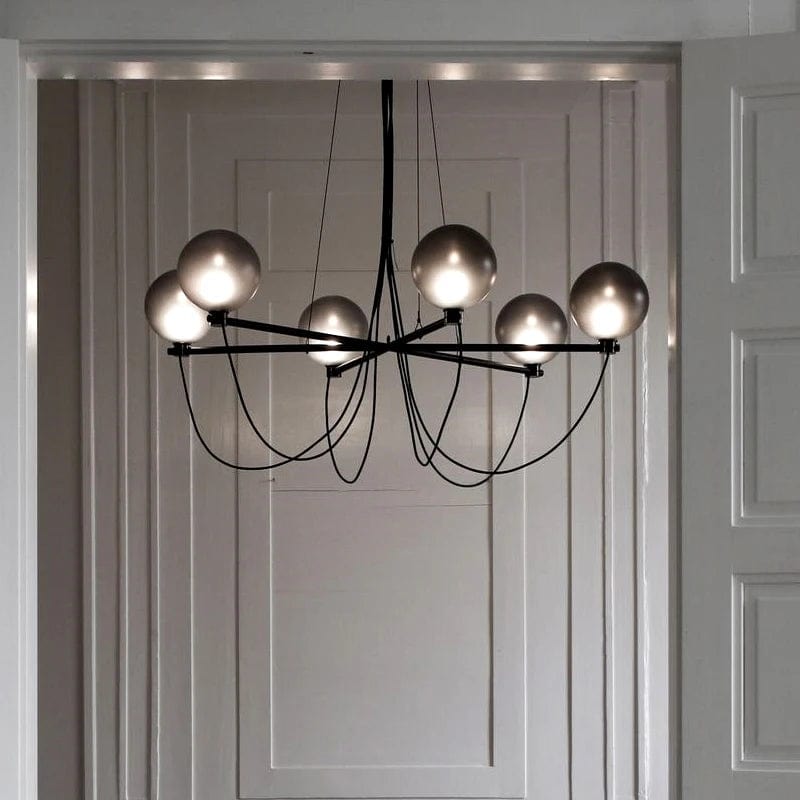
6Arc Modern Black Chandelier
Open Frame · Lets the Vault Show ThroughIn a room where the ceiling is the feature, a fixture that blocks it works against the architecture. An open frame keeps the vault visible through the composition, so the fixture reads as an object in the volume rather than as a lid over it. One caution: black needs pale ceiling planes to register, and against dark-stained timber it disappears.
Caution: Needs pale ceiling planes for contrast
With dark timber: Choose warm metal instead
Sizes: Two, from 31.50" (80 cm)
Related: Black chandeliers
Browse tall-room lighting
High ceiling chandeliers, wall sconces and secondary fixtures.
High Ceiling → Wall Sconces → All Chandeliers →Room by Room
| Room | Statement fixture | Coverage | Priority addition |
|---|---|---|---|
| Living room | Over the seating group, not the room | Adjustable recessed, aimed at seating | Table lamps — the biggest single gain |
| Great room / open plan | One per zone, matched finish | Recessed grid, narrow beam | Zone separation by brightness, one Kelvin |
| Dining area | Over the table, 30-36 in above it | Recessed around the perimeter | Dimmer on the table fixture |
| Primary bedroom | Centered on the room, not the bed | Minimal — avoid overhead glare | Bedside sconces or lamps |
| Kitchen | Island pendants or linear | Recessed over work areas | Under-cabinet — essential here |
| Entry / foyer | Long-drop at the second-floor line | Minimal | Sconces at 60-66 in |
| Converted attic / shed roof | Where the ceiling is highest | Track — often no void for recessed | Floor lamps for the low side |
Two patterns run across the table. The statement fixture always centers on the furniture rather than the room, since in a tall volume a fixture over empty floor reads as even more misplaced than it would at normal height. And the priority addition is almost always at human height — lamps, sconces, under-cabinet — because that is the part a tall ceiling makes hardest.
When There Are Beams
Exposed beams change the plan in three ways, and all three are worth knowing before fixtures are positioned.
Beams dictate where boxes can go. A fixture has to mount between beams or onto one, which usually means the ideal position and the available position are not the same. Establish where mounting is actually possible before choosing a fixture.
Beams cast shadows across the ceiling. A downlight near a beam throws a hard shadow line that reads as a mistake. Aim fixtures away from beams, or use the beams themselves as the mounting line for track, which turns the obstacle into the organising structure.
Dark-stained beams absorb a great deal of light and make the room noticeably dimmer than its lumen figure suggests. Budget more output than the room's size alone would indicate, and avoid black fixtures — they disappear against dark timber, which is the one condition where black fails completely.
Mounting to a beam is often the simplest answer, since a beam is structural and takes weight a drywall ceiling would need a brace for. Mounting detail, sloped adapters and chain length are covered in our sloped and vaulted ceiling installation guide.
Common Mistakes
- One chandelier as the whole scheme. At 18 ft it delivers roughly a quarter of what it would at 9 ft. More sources, not a brighter fixture.
- Fixed downlights on a sloped plane. They aim perpendicular to the ceiling, which throws light across the room rather than down. Use adjustable trims.
- Skipping wall lighting. The lower half of the walls stays dark, and the room reads as a dim box however bright the ceiling layer is.
- Leaving the vault unlit. The architecture disappears after dark, and an unlit ceiling reads lower than a lit one.
- Uplighting at full output. It flattens the vault's shape. Keep it low.
- Under-sizing the statement fixture. Add roughly 3 in of diameter per foot above 12 ft.
- Centering on the room rather than the furniture. In a tall volume this reads worse than at normal height.
- Black fixtures against dark beams. The one condition where black disappears entirely.
- Mixed color temperatures. In a tall open volume several sources are seen at once and the mismatch is obvious.
- Choosing replaceable lamps without an access plan. Every failure becomes a platform event.
Frequently Asked Questions
How do you light a vaulted ceiling room?
In four layers: a statement fixture for presence, adjustable recessed or track for floor-level coverage, wall sconces at 60-72 in for light at human height, and lamps at the seating. A fifth optional layer aims light upward at the vault so the architecture is visible after dark.
Why is my vaulted room so dim with a big chandelier?
Because light falls off with the square of the distance. A fixture at 18 ft delivers roughly a quarter of what the identical fixture would at 9 ft, so no increase in size or lumens compensates. The working light has to come from closer to the people.
How many recessed lights for a vaulted ceiling?
More, and closer together, than a standard ceiling needs — the extra distance means less light arrives. Use adjustable gimbal trims so each can be aimed vertically rather than perpendicular to the slope, and choose narrower beam angles for the longer throw.
Should I light the ceiling itself?
Yes, if the vault is a feature. Downlights aim away from it and the chandelier hangs below it, so the ceiling planes become a dark void after dark. Uplighters in corners, up-and-down wall fixtures or cove lighting all work — and all want to be kept dim.
What size chandelier for a vaulted ceiling?
Room length plus width in feet read as inches, then add roughly 3 in of diameter per foot of ceiling above 12 ft. A 16 x 20 ft room at 18 ft points to around 54 in. Favour body length over a long run of visible chain.
Can I use track lighting on a vaulted ceiling?
Yes, and it is often the practical answer where there is no void above the ceiling for recessed fixtures — common in cathedral ceilings and converted attics. Track heads adjust, which suits a sloped plane, and beams can serve as the mounting line.
Where should the chandelier go in a vaulted living room?
Over the seating group rather than the room's geometric center. In a tall volume a fixture over empty floor reads as misplaced even more than it would at normal height, because there is more space for the discrepancy to show.
Do exposed beams change the lighting plan?
In three ways: they dictate where boxes can go, they cast hard shadow lines if a downlight sits too close, and dark-stained timber absorbs a lot of light. Budget more output, aim fixtures away from beams, and avoid black fixtures against dark timber.
What color temperature for a vaulted room?
2700-3000K across every layer. A tall open volume shows several sources at once, so mixed Kelvin is more visible here than in a conventional room — it reads as a mismatch rather than as zoning.
How many lumens does a vaulted room need?
More than its floor area suggests, because the volume is larger and the throw is longer. Start from the normal figure for the room's size, add for the extra height, and add again if the ceiling or beams are dark — dark surfaces absorb a substantial share.
Should every layer be on a dimmer?
Yes, and on separate circuits. The statement fixture, the coverage layer and the uplighting all want different levels at different times, and one switch controlling everything means the room ends up permanently at one unsatisfying setting.
Can I light a vaulted room without recessed fixtures?
Yes. Track covers the same job and needs no ceiling void, and floor lamps plus wall sconces handle the human-height layers entirely without wiring. A scheme of statement fixture, sconces and lamps works well in a room where cutting into the ceiling is not realistic.
Height Costs Light, So Spread the Sources
Doubling the distance quarters what arrives, which is why a vaulted room needs four layers rather than one impressive fixture. Choose the statement piece for presence, let adjustable recessed do the coverage, put sconces and lamps at human height, and aim something at the vault so the reason you wanted the room survives after dark.
Browse the range: high ceiling chandeliers, wall sconces, all chandeliers.