A chandelier on a sloped ceiling must hang plumb, not follow the pitch. That needs a sloped ceiling adapter — a swivel canopy between the ceiling plate and the fixture — unless the fixture hangs by chain or cable, which adapts naturally.
Rod-hung fixtures are the problem. A rigid downrod on an angled ceiling sticks out at the ceiling's angle unless a swivel joint is fitted. Check for one before ordering, not after.
A chandelier swivel canopy is not a ceiling fan slope adapter. They look similar and are not interchangeable.
Height is measured from the floor, not the ceiling peak — and on a slope the two diverge fast. Keep 84 in of clearance over walking areas, 30-36 in above a tabletop.
Vaulted and sloped ceilings are among the most common architectural conditions in American homes and among the most common reasons a chandelier ends up hanging wrong. The fixture tilts, the canopy leaves a gap, two pendants hang at visibly different heights, or the whole thing sits too close to the peak. Every one of those is avoidable, and most of them are decided before the fixture is ordered rather than during installation. This guide covers what adapters do, which fixtures need them, the chain-length maths that catches people out on a slope, and how to set the height correctly.
On this page
- The One Rule: Hang Plumb
- Ceiling Types and What Each Needs
- Adapters: What They Are and Are Not
- Which Fixtures Work on a Slope
- Slope-Friendly Picks
- The Chain-Length Problem on a Slope
- Setting the Height
- Picks for Tall Vaulted Rooms
- What to Tell Your Electrician
- Common Mistakes
- Frequently Asked Questions
The One Rule: Hang Plumb
A chandelier hangs vertically because gravity says so. On a flat ceiling that is automatic. On a sloped one it is not — the mounting plate sits at the ceiling's angle, and anything rigidly attached to it points at that angle rather than straight down.
Chain and cable solve this by themselves. Flexible suspension lets the fixture find vertical regardless of what the ceiling is doing above it. The canopy may need a cover to close the gap neatly, but the fixture hangs correctly.
Rigid rods do not. A downrod bolted to an angled plate projects at the slope, which is both wrong visually and a structural issue — it puts lateral load on the mounting hardware rather than straight-down load. That is what a swivel adapter exists to correct.
Ceiling Types and What Each Needs
| Ceiling type | Shape | Typical pitch | What it needs |
|---|---|---|---|
| Vaulted | Two planes rising to a ridge | 20-35° | Swivel adapter, or chain/cable hung |
| Cathedral | Follows the roof pitch, often higher | 25-45° | Swivel adapter plus extended drop |
| Shed / single slope | One plane, low to high | 15-30° | Swivel adapter; heights vary across the room |
| A-frame | Steep, meeting at a sharp ridge | 45°+ | Check the adapter's maximum angle |
| Tray / coffered | Recessed center, angled perimeter | Flat at center | Mount on the flat center — no adapter |
| Beamed, flat between beams | Flat planes with structure | Flat | No adapter; beams dictate box position |
Two notes. Coffered and tray ceilings do not need an adapter despite looking angled — the recessed center is flat and that is where the fixture goes. And adapters have a maximum angle, commonly around 45 degrees; a steep A-frame can exceed it, which is a thing to check before ordering rather than after delivery.
Chain and cable find vertical on their own; a rigid rod needs the swivel joint to do it
Adapters: What They Are and Are Not
A sloped ceiling adapter — also sold as a swivel canopy, ball joint or hang-straight kit — sits between the ceiling plate and the fixture's suspension and allows the fixture to pivot to vertical.
- Not universal. An adapter has to match the fixture's rod diameter, connection type, weight rating and the ceiling angle. Buying one generically and hoping is how installations stall on the day.
- Not interchangeable with a ceiling fan adapter. They look alike. Fan slope adapters are engineered for rotating load and different hardware; a chandelier swivel canopy is not a substitute, and the reverse is equally true.
- Has a maximum angle, commonly around 45 degrees. Steep A-frames can exceed it.
- Must cover the existing ceiling opening. On an angled surface a round canopy meets the plane as an ellipse, so the coverage needs checking rather than assuming.
- Needs room to move. The swivel has to pivot without fouling the canopy or the trim.
- Finish matching is the practical headache. Aftermarket adapters rarely match a fixture's finish exactly. Where the manufacturer offers one for that model, it is worth the premium.
Slope-Friendly Picks (3 Designs)
Chain and cable suspension adapts to an angled ceiling without a swivel joint. These are the formats that give the fewest surprises on installation day.
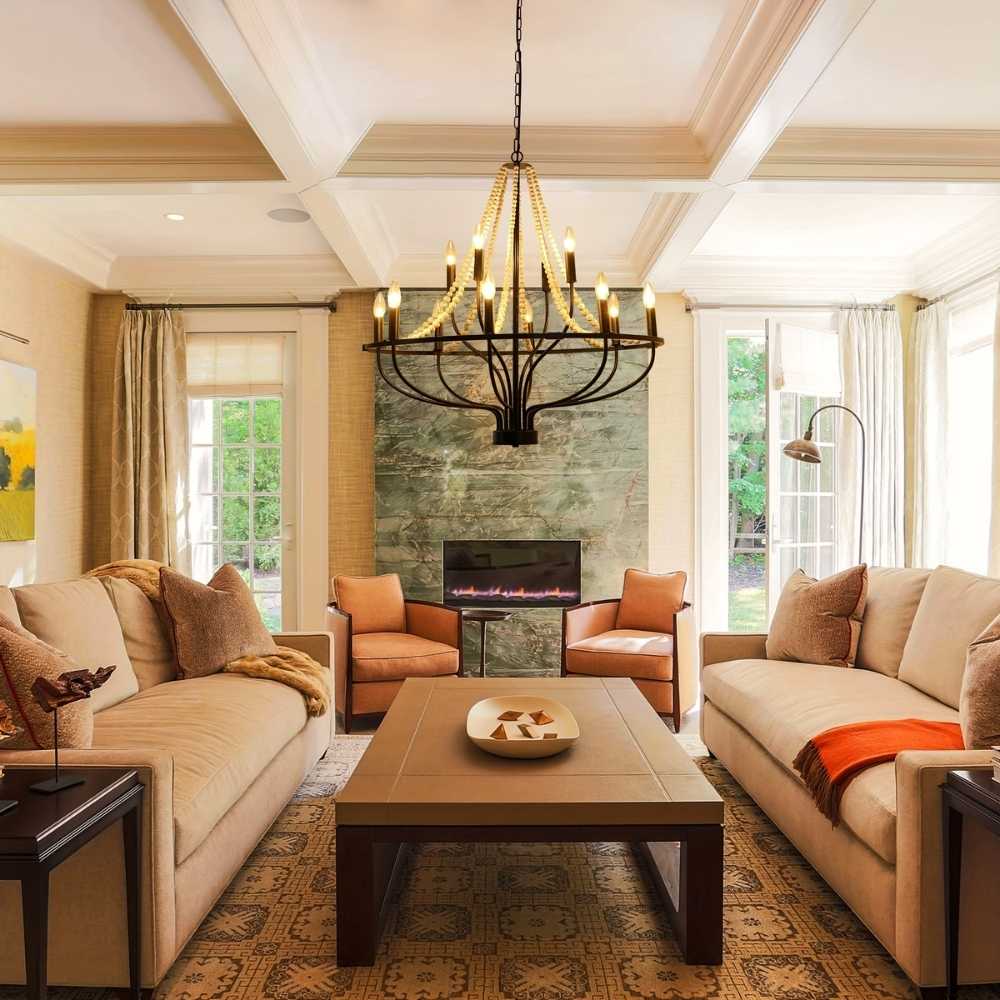
112-Light Black Iron Chandelier
Chain Hung · Finds Vertical ItselfChain suspension is the simplest answer to a sloped ceiling: the fixture hangs plumb because the chain cannot do anything else. No swivel joint, no adapter compatibility question, no finish-matching problem. One caution specific to iron — check the listed weight against the box rating, since iron reaches standard limits sooner than glass at the same diameter, and an angled mount puts the fixture further from the plate.
No adapter needed: Gravity does the work
Check: Weight against the box rating
Canopy: May need a cover for the angled gap
Related: Iron chandeliers
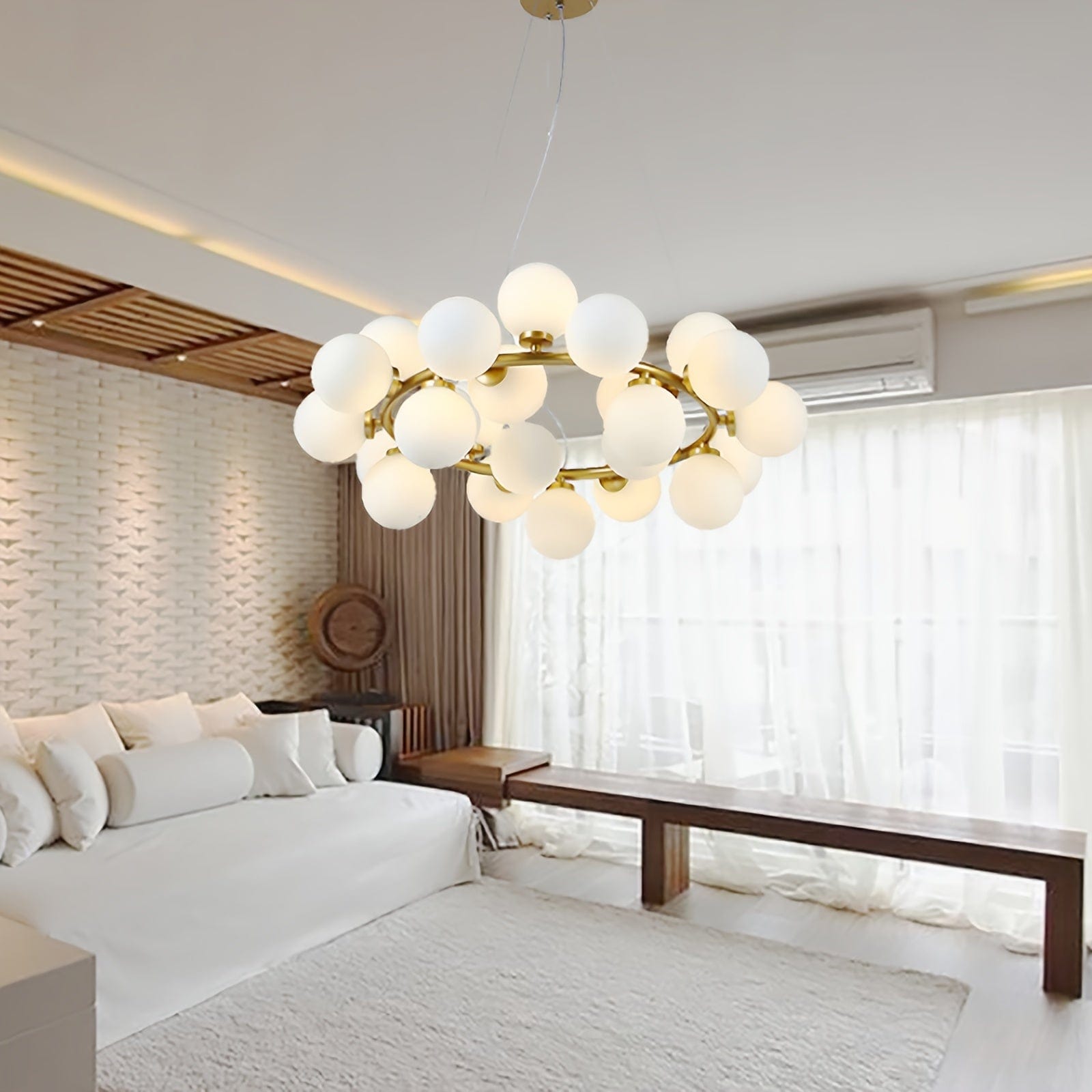
2Holly Milk Glass Chandelier
Opal · Vaulted Rooms Need OutputVaulted rooms have more volume than their floor area suggests, so a fixture that looks adequate in a flat-ceilinged room of the same footprint can under-light a cathedral version of it. Opal glass transmits most of the lamp output while hiding the source, which is what makes a decorative fixture able to carry a tall room rather than only decorate it.
Opal: Full output, no visible source
Check: Suspension type — chain adapts, rod needs a swivel
Plan: Wall or recessed lighting alongside
Related: Glass chandeliers
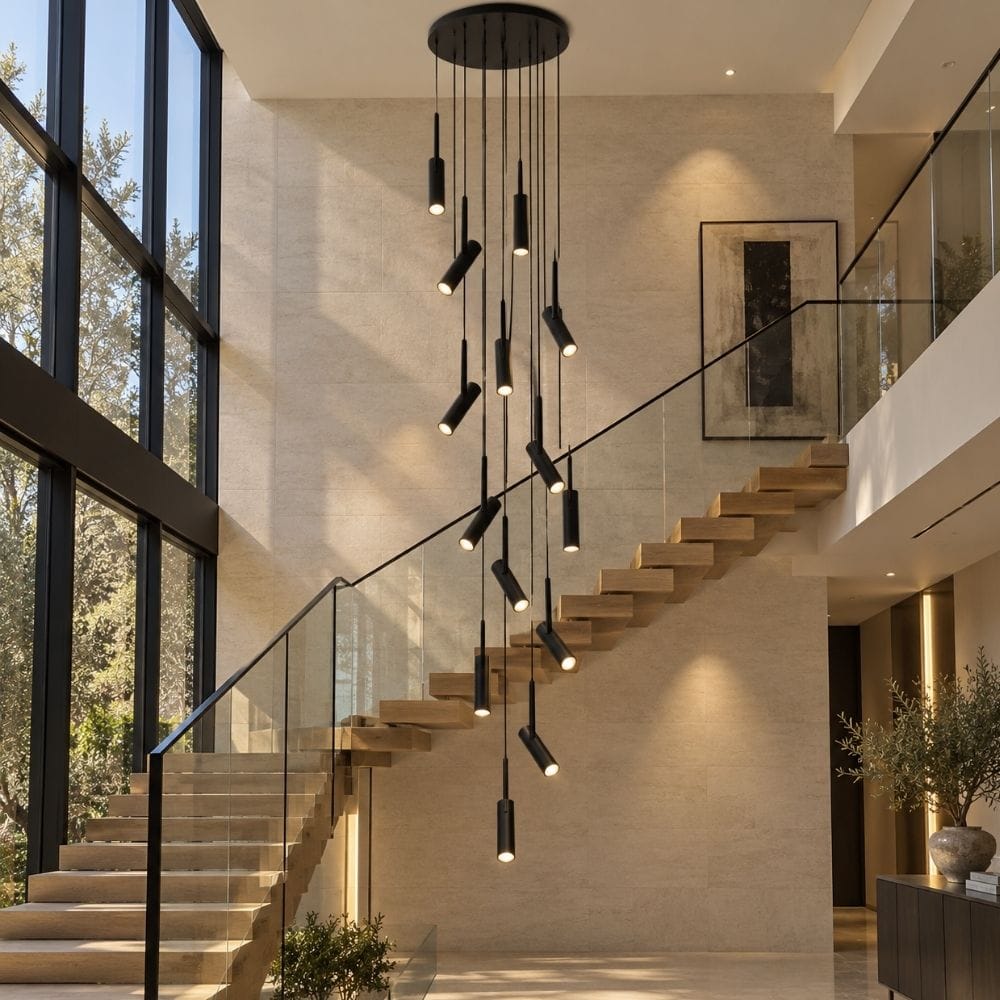
3Contemporary Staircase Long Chandelier
Cable Hung · Length to the RidgeCathedral ceilings need more drop than standard fixtures carry, and a cable-hung design sold by configurable length solves both problems at once — it adapts to the slope by hanging freely, and the element count sets the drop rather than a long run of visible suspension. Measure to the mounting point on the slope, not to the ridge.
Length: Set by element count, not added chain
Measure from: The actual mounting point on the slope
Finishes: Four
Related: High ceiling chandeliers
The Chain-Length Problem on a Slope
This is the part that catches out even careful planners, and it only appears when there is more than one fixture.
On a flat ceiling, two pendants with identical chain hang at identical heights. On a slope they do not. The ceiling rises between them, so the fixture at the higher mounting point needs more chain to reach the same level as its neighbor — and over a pitched ceiling, two positions only a foot apart can require noticeably different lengths.
A practical check before ordering: confirm the fixture ships with enough chain for the highest mounting point, not the average. Extending chain afterwards means ordering matching chain and supply cable, and finishes vary between batches. Full chain arithmetic is in our chain and drop length guide.
Setting the Height
The rules are the same as any ceiling. What changes is where you measure from.
| Position | Height | Measured from | Slope-specific note |
|---|---|---|---|
| Over a dining table | 30-36 in above the tabletop | Table surface | Unchanged by the ceiling |
| Over a walkway | 84 in of clear floor space | Finished floor | Not from the ceiling peak |
| Over a kitchen island | 30-36 in above the counter | Counter surface | Each pendant measured individually |
| Over a stair | 84 in from the highest tread beneath | Tread, not floor | Two variables at once — measure carefully |
| Open vaulted room | 84 in minimum, scaled to the volume | Finished floor | Resist hanging it near the peak |
The temptation to resist in a vaulted room is pushing the fixture up toward the ridge. It is the most dramatic-looking position and usually the wrong one — the fixture ends up disconnected from the furniture below, lights nothing useful, and reads as decoration stuck to the roof. Height is determined by what is beneath the fixture and by floor clearance, not by how much ceiling is available above it.
One sizing adjustment: above roughly 12 ft, add about 3 in of diameter per additional foot. A fixture viewed from further away reads smaller than its measurement, and a vaulted room puts more distance between the eye and the fixture than its floor area suggests.
Picks for Tall Vaulted Rooms (3 Designs)
Where the ridge is high, the fixture needs scale and drop as well as slope compatibility. Size up by roughly 3 in of diameter per foot above 12 ft.
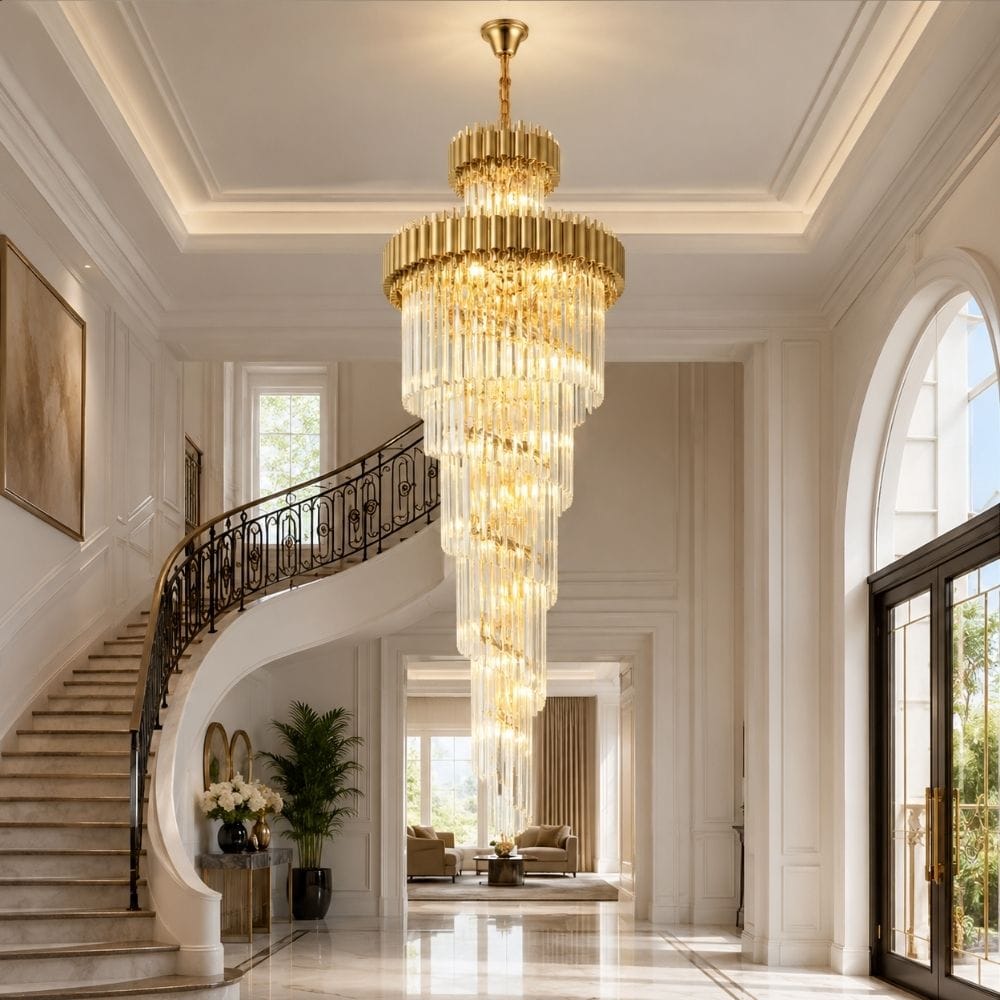
4Beth Extra Large Crystal Chandelier
59 in Body · Drop Without Long ChainIn a cathedral room a long run of visible chain above a compact fixture reads as improvised. A tall fixture body fills the same distance and reads as designed — and it reduces the chain length that has to be matched to the slope. Five sizes from 59 inches, so the body can be scaled to the ridge height rather than the floor area.
Why it matters on a slope: Less chain to match
Sizes: Five, from H59.06" (150 cm)
Above 12 ft: Add ~3 in diameter per extra foot
Related: High ceiling chandeliers
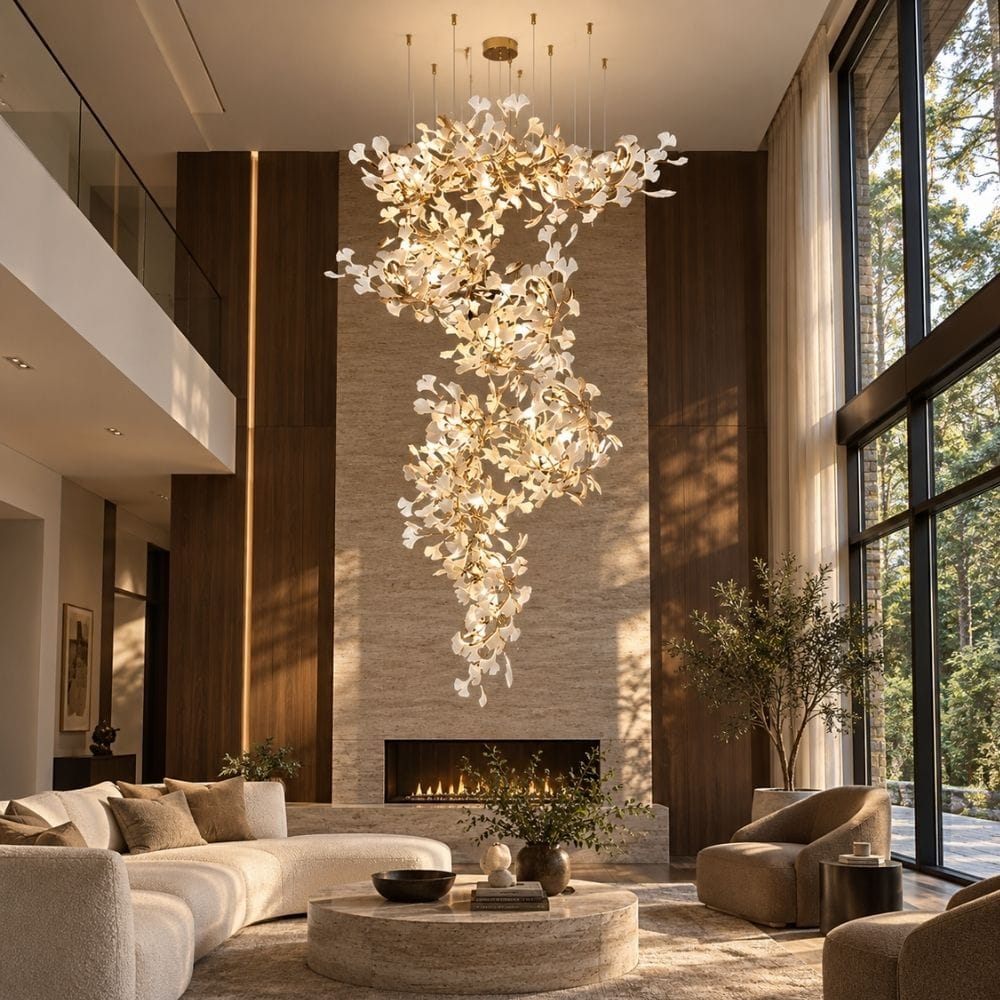
5Alba Branch Staircase Chandelier
78 in · Irregular Form Forgives the AngleA branch composition has a useful property on a sloped ceiling: its silhouette is irregular, so the eye has no straight edge to compare against the ceiling line. A small deviation from plumb that would be obvious on a geometric fixture is far less visible here — which does not excuse a bad install, but does make the result more forgiving.
Sizes: Four, to H78.74" (200 cm)
Suspension: Confirm chain or cable before ordering
Finishes: Seven
Related: Branch chandeliers

6Asty Modern Ring LED Chandelier
Integrated LED · No Ladder ReturnsAccess is the hidden cost of a vaulted room. A fixture at the peak of a cathedral ceiling needs a tall ladder or a platform every time a lamp fails, and on a sloped floor beneath, even that is awkward. Integrated LED removes the reason to go back up for decades — which matters more here than in almost any other position.
Ask first: Is the driver serviceable?
Configure: Ring count to fill the volume
Confirm: Sloped-ceiling compatibility before ordering
Related: Ring chandeliers
Browse for vaulted rooms
Chain and cable-hung fixtures with the drop a tall room needs.
High Ceiling → Staircase → All Chandeliers →What to Tell Your Electrician
A short conversation before installation day prevents most of what goes wrong. Five things to have ready:
- The approximate ceiling angle. "About 25 degrees" or "standard vaulted, not steep" is enough. It determines whether the adapter can handle it.
- The fixture's weight and suspension type — chain, cable or rigid rod. The last one is the only one that needs an adapter.
- Whether an adapter is included, and if not, who is sourcing it. This is the single most common reason an installation stops halfway.
- The finished height you want, measured from the floor or the surface below — not a chain length.
- Whether the existing box is rated for the weight and secured to framing. On a slope, a box fixed only to drywall is a worse problem than on a flat ceiling.
Sloped installations sit at the point where a confident homeowner job becomes an electrician's. Working overhead at an angle, often at height, with a fixture that must end up plumb, is a different proposition from a flat-ceiling swap. Our installation and safety guide covers the thresholds.
Common Mistakes
- Buying a rod-hung fixture without checking for a swivel. It will point at the ceiling's angle, and not every canopy accepts an aftermarket adapter.
- Using a ceiling fan slope adapter on a chandelier. They look similar and are engineered for different loads and hardware.
- Cutting all chains to one length. On a slope, each mounting point sits at a different height. Measure every drop separately to the same finished level.
- Measuring from the ceiling. There is no level reference up there. Measure from the floor or the surface below.
- Hanging the fixture near the ridge. It looks dramatic and lights nothing. Height comes from what is beneath it.
- Assuming a coffered ceiling needs an adapter. The recessed center is flat — mount there.
- Ignoring the adapter's maximum angle. Commonly around 45 degrees; a steep A-frame can exceed it.
- Forgetting canopy coverage. On an angled plane a round canopy meets the surface as an ellipse and may not cover the opening.
- Under-sizing in a tall vaulted room. Add roughly 3 in of diameter per foot above 12 ft.
- Not planning lamp access. A fixture at cathedral height needs a platform every time a lamp fails.
Frequently Asked Questions
Can you hang a chandelier on a sloped ceiling?
Yes. Chain and cable-hung fixtures adapt on their own because flexible suspension finds vertical. Rigid rod-hung fixtures need a sloped ceiling adapter — a swivel canopy — so the fixture hangs plumb rather than following the ceiling angle.
What is a sloped ceiling adapter?
A swivel canopy, ball joint or hang-straight kit fitted between the ceiling plate and the fixture's suspension, allowing it to pivot to vertical. It must match the fixture's rod size, connection type, weight and the ceiling angle — they are not universal.
Can I use a ceiling fan slope adapter for a chandelier?
No. They look similar but are engineered for different loads and hardware. A fan adapter handles rotating load; a chandelier swivel canopy does not substitute for one, and the reverse is equally true.
Should a chandelier hang straight or follow the ceiling angle?
Straight down, always. A vaulted room gives the eye a strong reference line, so even two or three degrees off plumb is visible — the ceiling's angle exaggerates the mismatch rather than hiding it.
Do two pendants need different chain lengths on a sloped ceiling?
Yes, and this is the most common oversight. The ceiling rises between them, so the higher mounting point needs more chain to reach the same finished level. Decide the finished height first, then measure each drop separately from its own mounting point.
How high should a chandelier hang in a vaulted room?
By what is beneath it, not by the ceiling peak. 84 inches of clear floor space over walking areas, 30-36 inches above a tabletop. Resist pushing the fixture toward the ridge — it reads as decoration stuck to the roof and lights nothing useful.
What is the maximum ceiling angle for a chandelier adapter?
Commonly around 45 degrees, though it varies by product. Steep A-frame ceilings can exceed it, which is worth confirming before ordering. Chain and cable suspension has no such limit.
Does a coffered or tray ceiling need a sloped adapter?
No. The recessed center section is flat and that is where the fixture mounts. The angled perimeter is not where the box goes, so no adapter is required despite the ceiling looking angled.
What size chandelier for a vaulted ceiling?
Start with the room formula — length plus width in feet read as inches — then add roughly 3 inches of diameter per foot above 12 ft. A vaulted room puts more distance between the eye and the fixture than its floor area suggests, so it reads smaller than measured.
Why is there a gap behind my canopy on a sloped ceiling?
Because a round canopy meets an angled plane as an ellipse rather than a circle. A sloped-ceiling adapter or a canopy cover designed for angled surfaces closes it. Do not overtighten the screws to force contact — that bends the canopy permanently.
Can I install a sloped-ceiling chandelier myself?
This is where a confident homeowner job usually becomes an electrician's. Working overhead at an angle, often at height, with a fixture that must end up plumb and a box that must be rated for the weight, is a different proposition from a flat-ceiling swap.
What should I check before ordering for a vaulted ceiling?
The suspension type (chain, cable or rigid rod), whether an adapter is included or available for that model, the adapter's maximum angle against your ceiling, whether the supplied chain reaches the highest mounting point, and the box's weight rating.
Check the Suspension Before the Style
Chain and cable hang plumb on their own; a rigid rod needs a swivel adapter matched to the fixture and the angle. Measure every drop from the floor rather than the ceiling, give each position its own chain length, and set the height from what sits beneath the fixture rather than from how much ceiling is above it.
Browse the range: high ceiling chandeliers, staircase chandeliers, all chandeliers.