A bathroom needs two fixture types doing different jobs. Vanity lighting makes a face evenly lit; ceiling lighting makes the room usable. One cannot do both, and most bathrooms are fitted with only the second.
Side-mounted sconces flanking the mirror beat anything above it, because light from both sides fills the shadows under eyes, nose and chin that a downward fixture creates.
Where only an over-mirror bar is possible, choose one at least 24 in wide with a diffuser, mounted 75-80 in from the floor.
Damp rating is the non-negotiable. Anywhere within reach of shower spray needs a wet-rated fixture; the rest of a bathroom needs damp-rated at minimum.
Bathroom lighting is the one category where the common installation is actively wrong rather than merely suboptimal: a single ceiling fixture, directly overhead, doing a job it is physically incapable of. The result is the face everyone recognises from a hotel bathroom — shadowed eyes, hard lines, and a mirror that is useless for anything precise. This guide separates the fixture types by what each actually does, gives the mounting numbers, and covers the ratings that decide what is allowed where.
On this page
Two Jobs, Two Fixtures
A bathroom asks lighting to do two unrelated things, and no single fixture does both well.
Task lighting at the mirror has to light a face evenly from the front. That is a specific optical requirement: light arriving from both sides at roughly face height, so nothing casts a shadow across anything else. Shaving, makeup and anything else done at a mirror depends on it.
Ambient lighting has to make the room usable — the shower, the floor, the storage. That wants overhead light spread across the space, which is exactly the wrong geometry for a face.
The problem is the direction of the light, not the quantity of it
Fixture Types Compared
| Fixture type | Position | Does | Does not |
|---|---|---|---|
| Side sconces, flanking | Either side of the mirror | Even face lighting — the best option | Light the room |
| Over-mirror bar | Above the mirror | Acceptable face lighting if wide and diffused | Eliminate under-eye shadow fully |
| Backlit mirror | Behind the mirror | Soft glow, no glare | Enough output for precise tasks alone |
| Ceiling flush mount | Room center | General room light | Any useful face lighting |
| Recessed downlights | Spread across ceiling | Even ambient, shower coverage | Face lighting — worst for it |
| Shower fixture | Over the shower | Shower visibility | Anything else |
| Decorative pendant or chandelier | Over a tub or center | Atmosphere, a focal point | Task work |
The minimum workable combination is vanity lighting plus one ambient source. A small powder room can occasionally manage with a well-chosen over-mirror fixture alone; a full bathroom cannot, because the shower and the floor need light the mirror fixture does not reach.
Why Side-Mounted Wins
Sconces flanking a mirror are the best vanity lighting available, and the reason is geometric rather than aesthetic.
Light arriving from both sides at face height fills shadows rather than creating them. The left fixture lights what the right side of the face would shade and the other way round, so no feature casts a shadow over any other. This is the same principle portrait photographers use, for the same reason.
- Mount at 60-66 in to center, which puts the source at roughly eye level for most people.
- Space 28-36 in apart, which usually means immediately outside the mirror's edges on a standard vanity.
- Use diffused fixtures, not exposed lamps. At eye level a bare bulb is directly in the field of view while you use it.
- Match them exactly and run them on one switch — uneven light from two sides is worse than even light from one.
- Where the mirror is too wide to flank, a wide over-mirror bar is the fallback rather than a narrow one above the center.
Where side mounting is impossible — a mirror wall to wall, a window beside the vanity, no space — an over-mirror fixture works provided it is wide. At least 24 in, ideally close to the mirror's width, with a diffuser. The width is what matters: a narrow fixture above the center reproduces the ceiling fixture's problem in a lower position.
Vanity and Mirror Picks (3 Designs)
Diffused fixtures for the mirror position. Check the damp rating on every one before specifying — most decorative wall fixtures are not rated for a bathroom.

12-Pack Marble Sconce Wall Light
Matched Pair · The Ideal Vanity FormatSold as a pair, which matters here more than anywhere: two sconces flanking a mirror are seen in one glance, so natural stone variation between separately ordered pieces would be obvious. Stone also eliminates glare completely, which is the specific requirement at a mirror — you look directly toward the fixture while using it. Verify the damp rating before specifying for a full bathroom.
Glare: None — stone hides the source
Sold as: A matched pair — veining matches
Verify: Damp rating for a full bathroom
Related: Bathroom wall lights

2Vita Crystal Flush Mount Chandelier
Linear · Wide Over-Mirror OptionWhere flanking is impossible, width is what rescues an over-mirror fixture. A linear design to 47.24 in spans most vanity mirrors, which spreads the source horizontally and softens the downward shadow a narrow fixture creates. Not a substitute for side lighting, but a substantially better fallback than a compact fixture above the center.
Why width matters: Spreads the source horizontally
Linear: To 47.24" (120 cm)
Mount at: 75-80 in from the floor
Related: Bathroom lighting

3Teal Modern Marble Wall Sconce
Powder Rooms · Single AccentA powder room is the one bathroom where a single fixture can be enough, because nobody shaves or applies makeup in one. That changes the brief from task lighting to atmosphere, and a single stone sconce beside the mirror does more for the room than a bright overhead would. A powder room with no shower is generally a dry location, which widens the options considerably.
Why one works here: No precise task use
Rating: Powder rooms are usually dry locations
Mount at: 60-72 in to center
Related: Wall sconces
Mounting Heights and Spacing
| Fixture | Height | Spacing | Note |
|---|---|---|---|
| Flanking sconces | 60-66 in to center | 28-36 in apart | Roughly eye level |
| Over-mirror bar | 75-80 in from floor | 24 in wide minimum | Center on the mirror, not the vanity |
| Ceiling fixture | Center of the room | — | Not over the vanity |
| Recessed over vanity | Ceiling | Set forward of the mirror | Pulls light onto the face, not the top of the head |
| Shower fixture | Ceiling | Centered in the shower | Wet-rated required |
| Over a freestanding tub | 84 in above the floor | Centered on the tub | Check local rules for fixtures above a tub |
One detail that changes the result disproportionately: recessed downlights over a vanity should sit forward of the mirror rather than directly above it. A downlight tight against the mirror lights the top of the head; one set 12-18 in forward throws light onto the face at an angle. Same fixture, different position, completely different outcome.
Damp, Wet and Where Each Goes
This is the part that is not a preference. Fixtures carry a location rating and using the wrong one is both a safety issue and a code issue.
- Dry rated: for interior spaces with no moisture exposure. Acceptable in a powder room with no shower or tub; not acceptable in a full bathroom.
- Damp rated: built for humidity and condensation but not direct water. The correct minimum for most of a full bathroom — vanity sconces, ceiling fixtures outside the shower zone.
- Wet rated: built for direct water contact. Required inside a shower enclosure, directly above a tub, and anywhere within reach of spray.
- The zones are defined by local code, and the boundaries differ by jurisdiction. The general principle is consistent: the closer to water, the higher the rating.
- Most decorative fixtures are dry rated and do not say so prominently. If a listing does not state a damp or wet rating, assume dry and ask.
Where a fixture you want is not rated for the position, the practical options are moving it further from the water or choosing a rated alternative. Modifying a fixture or installing it outside its rating is not an option — and it is the kind of thing that surfaces at a property inspection. Our installation and safety guide covers the general requirements.
Ceiling and Ambient Picks (3 Designs)
For the second half of the job — making the room usable. Confirm the damp rating for a full bathroom on all of these.
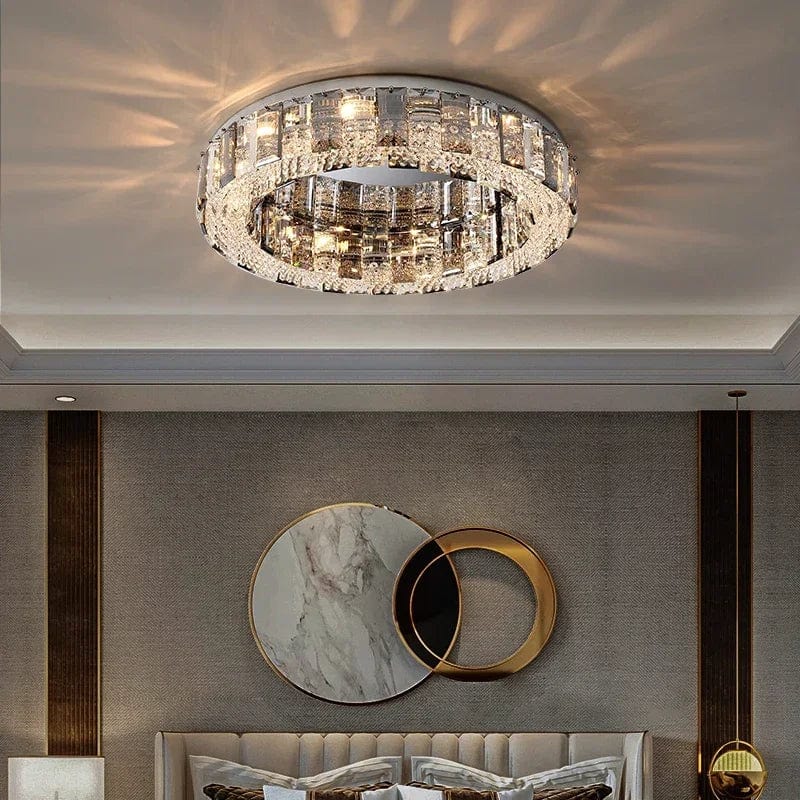
4Rina Crystal Ceiling Chandelier
Close Mount · Standard Bathroom CeilingsBathrooms usually have standard or low ceilings and the 84 in clearance rule applies across the walking area, which makes close-mount the default format. Crystal spreads light sideways through refraction rather than only downward, which helps a small bathroom read evenly rather than as a bright pool with dark corners.
Refraction: Spreads light into corners
Position: Room center, not over the vanity
Confirm: Damp rating before specifying
Related: Bathroom lighting
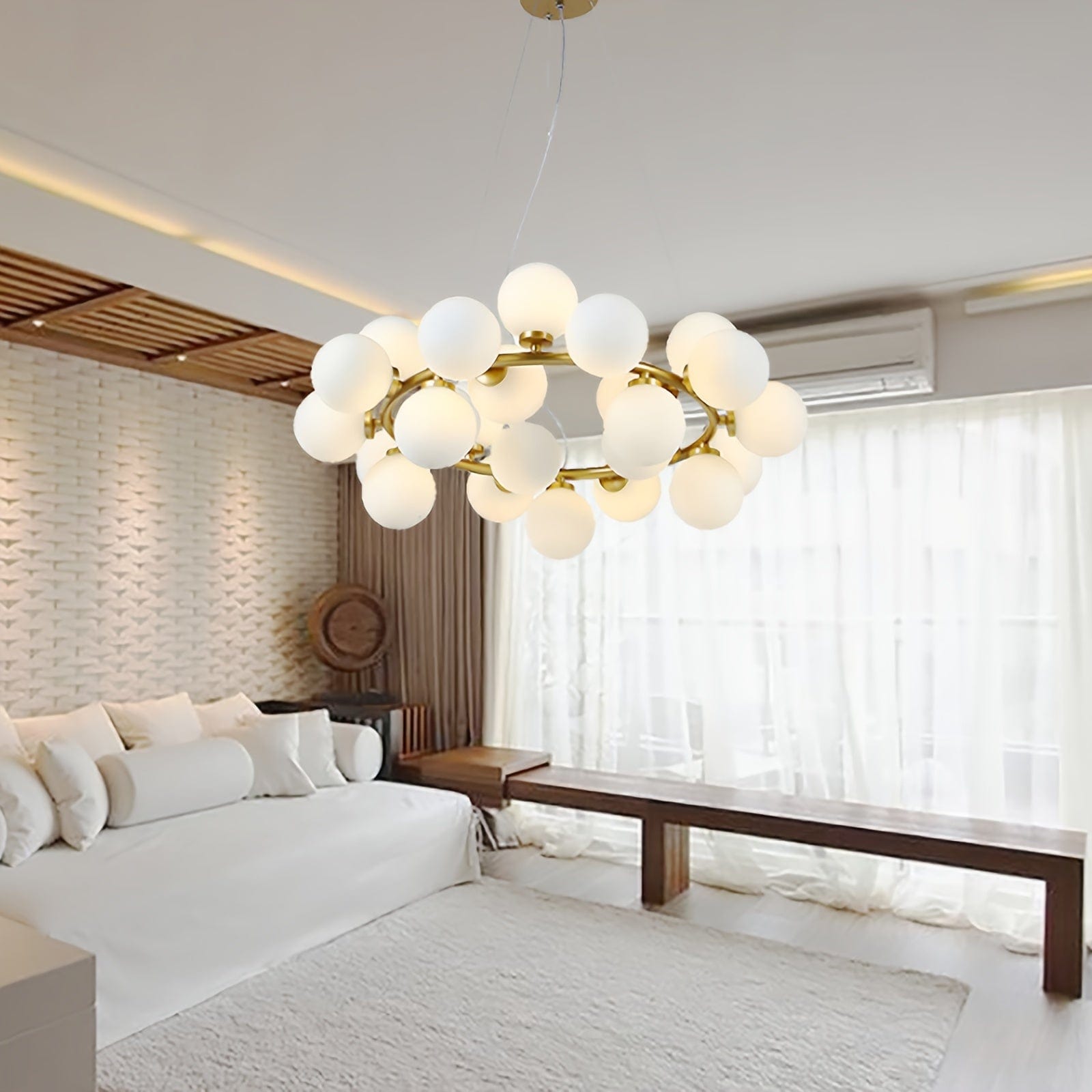
5Holly Milk Glass Chandelier
Large Bathrooms · Real OutputA large bathroom needs 3,000-5,000 lumens and opal glass is the diffuser that delivers it without a visible source. In a bathroom with a high enough ceiling for a suspended fixture, this covers the ambient half of the job properly — leaving the vanity sconces to do only what they are good at.
Output: High — covers the ambient requirement
Clearance: 84 in over the walking area
Confirm: Damp rating; keep clear of the shower zone
Related: Glass chandeliers
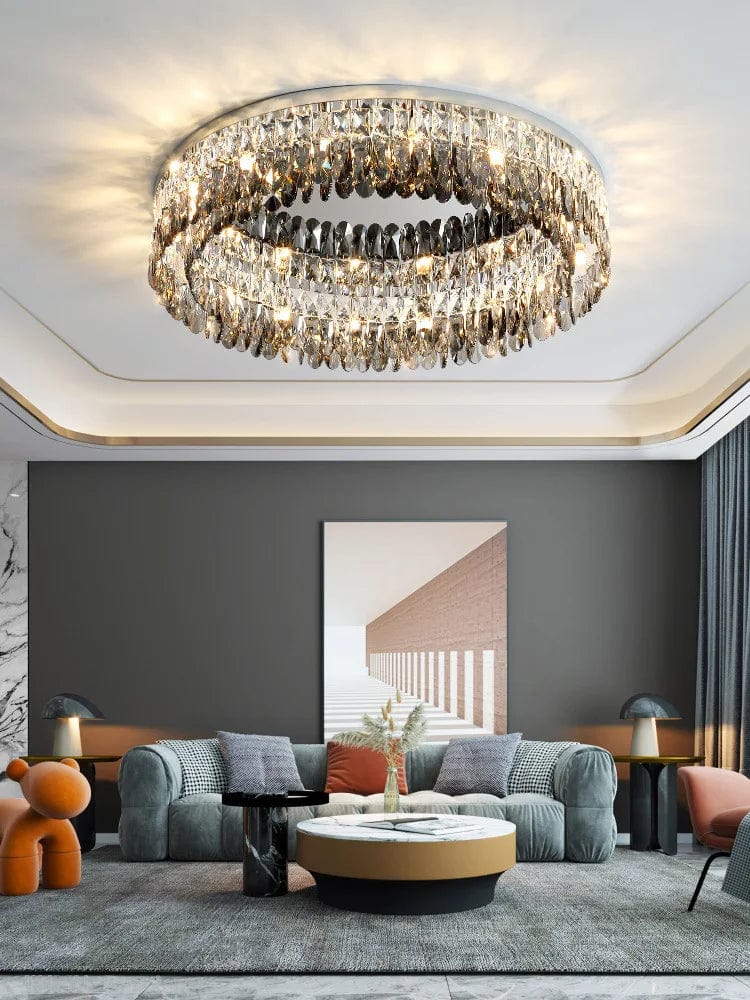
6Cara Crystal Flush Mount Chandelier
Powder Rooms · Small FootprintAt 15.75 in this suits a powder room or a compact bathroom where the room formula gives 10-14 in. Small bathrooms are also where a decorative fixture earns most, since the room is small enough that one good object changes the whole impression — and a powder room's dry-location status usually widens what is possible.
For: Powder rooms and compact bathrooms
Specify: Warm white — crystal reads cold at 4000K+
Rating: Check against the location
Related: Flush mount chandeliers
Browse bathroom lighting
Vanity sconces, ceiling fixtures and bathroom wall lights.
Bathroom Lighting → Bathroom Wall Lights → Wall Sconces →Scheme by Bathroom Type
The fixture mix changes with the bathroom, and a powder room genuinely does not need what a primary bathroom does.
| Bathroom | Vanity | Ambient | Extra | Rating |
|---|---|---|---|---|
| Powder room | One sconce, or a wide over-mirror | Often not needed | Decorative fixture is the point | Usually dry |
| Compact bathroom | Flanking sconces or wide bar | One close-mount | Shower fixture if enclosed | Damp; wet in shower |
| Family bathroom | Flanking sconces | Ceiling fixture plus recessed | Separate shower light | Damp; wet in shower |
| Primary bathroom | Flanking sconces per basin | Ceiling plus recessed grid | Decorative over the tub, night level | Damp; wet above tub and shower |
| Windowless | Flanking sconces, CRI 90+ | More than you expect | No daylight to correct against | Damp minimum |
A windowless bathroom deserves particular attention on colour rendering, because there is no daylight to check anything against. Everything judged in that room — makeup, skin, the colour of a towel — is judged under the fixtures alone, which makes CRI 90 or better less of a refinement and more of a requirement.
Lumens, Kelvin and CRI
Three numbers, and the third is the one that decides whether the mirror is actually useful.
Output: roughly 2,000-4,000 lumens total for a standard bathroom and 3,000-5,000 for a large one, split between vanity and ambient. The vanity should carry a substantial share — it is doing the precise work.
Color temperature: 3000-3500K at the vanity. Warmer than 2700K makes it hard to judge anything precisely; cooler than 3500K reads clinical and makes skin look drained. Keep the ceiling fixture at the same temperature — a mismatch between them is visible every time you look up.
CRI 90 or better, with good R9 — and this is the specification that matters most in a bathroom. Makeup applied under low-CRI light looks wrong in daylight, because the light it was judged under was not rendering skin tones honestly. Skin depends heavily on the red end of the spectrum, which is precisely where cheap lamps fall short.
Common Mistakes
- One ceiling fixture as the whole scheme. It cannot light a face. Overhead light casts every feature's shadow onto whatever is beneath it.
- A narrow fixture above the mirror center. Reproduces the ceiling problem lower down. At least 24 in wide, ideally close to the mirror's width.
- Exposed lamps at the vanity. At eye level a bare bulb sits directly in the field of view while you use the mirror.
- Ignoring the damp rating. Most decorative fixtures are dry rated and do not say so. Assume dry and ask.
- Recessed downlights tight against the mirror. They light the top of the head. Set them 12-18 in forward.
- Mixing color temperatures. A vanity at 3000K under a ceiling at 4000K is visible every time you look up.
- Ignoring CRI. Makeup judged under low-CRI light looks wrong in daylight.
- Cool white for "brightness". It reads clinical and drains skin tone. 3000-3500K at the vanity.
- No dimmer. A bathroom needs full output in the morning and much less at night.
Frequently Asked Questions
What is the best lighting for a bathroom?
Two types doing different jobs: sconces flanking the mirror for face lighting, and a ceiling fixture for the room. One fixture cannot do both — light from directly above casts every facial feature's shadow onto whatever is beneath it, which no amount of brightness fixes.
Should bathroom lights be above or beside the mirror?
Beside, where possible. Light arriving from both sides at face height fills shadows rather than creating them. Where flanking is impossible, a wide over-mirror fixture of at least 24 in is the fallback — width is what makes it work.
How high should vanity lights be mounted?
Flanking sconces at 60-66 in to center, spaced 28-36 in apart, which is roughly eye level. An over-mirror bar sits at 75-80 in from the floor, centered on the mirror rather than the vanity.
What is the difference between damp rated and wet rated?
Damp rated is built for humidity and condensation but not direct water — the correct minimum for most of a full bathroom. Wet rated is built for direct water contact and is required inside a shower, above a tub, and anywhere within reach of spray.
Can I use a regular light fixture in a bathroom?
In a powder room with no shower or tub, generally yes — it is usually a dry location. In a full bathroom, no. Most decorative fixtures are dry rated and do not state it prominently, so assume dry and ask before specifying.
How many lumens does a bathroom need?
Roughly 2,000-4,000 for a standard bathroom and 3,000-5,000 for a large one, split between vanity and ambient. The vanity should carry a substantial share since it does the precise work.
What color temperature for bathroom lighting?
3000-3500K at the vanity. Warmer makes precise work difficult; cooler reads clinical and drains skin tone. Keep the ceiling fixture at the same temperature, since a mismatch is visible every time you look up.
Why does my makeup look different outside?
Usually low CRI at the vanity. Skin depends heavily on the red end of the spectrum, which is where cheap lamps fall short — so makeup judged under them was never seen accurately. CRI 90 or better with good R9 fixes it.
Can I put a chandelier in a bathroom?
Yes, with the right rating and position. It serves as the ambient layer rather than the vanity lighting, needs to be damp rated at minimum, and must sit outside the shower zone with 84 in of clearance over the walking area. Local rules on fixtures above a tub vary.
Where should recessed lights go over a vanity?
12-18 in forward of the mirror rather than tight against it. A downlight directly above the mirror lights the top of the head; one set forward throws light onto the face at an angle. Same fixture, different result.
Is a backlit mirror enough on its own?
Rarely. Backlit mirrors give a soft glow with no glare, which is comfortable, but they usually do not deliver enough directed light for precise tasks. Treat one as a layer alongside sconces rather than as a replacement for them.
Do bathroom lights need a dimmer?
They benefit from one considerably. A bathroom wants full output in the morning and much less at night, and the difference is more noticeable there than in most rooms because of the hard reflective surfaces.
Two Fixtures, Not One
Light the face from both sides at 60-66 in, light the room from the ceiling, and keep them at the same color temperature with CRI 90 or better. Check the damp or wet rating against the position before anything else, and add a dimmer — a bathroom is used at two very different times of day.
Browse the range: bathroom lighting, bathroom wall lights, wall sconces.