Natural materials split into two groups by what they do with light. Stone transmits it and glows; wood and rattan block it and shape it. That single difference decides which one suits a room before style enters the conversation.
Wood and rattan need other light sources. They cast patterns and direct output downward, so they work as one layer rather than as a room's only fixture.
Stone can carry a room but at reduced output, because it absorbs a share of what passes through it. Plan lamps alongside either way.
Each has a different failure mode: wood warps in humidity, rattan traps dust, stone marks permanently if cleaned wet. Match the material to the room's conditions, not just its look.
Natural materials in lighting are usually grouped together as a style — organic, biophilic, warm — which obscures that they behave in completely different ways. Oak and alabaster have nothing in common optically. Rattan and travertine have nothing in common in a damp room. This guide separates them by what they actually do with light, where each belongs, how they age, and what each one asks of the rooms around it.
On this page
The Split: Transmit or Block
Every natural material in lighting falls on one side of a single line, and it predicts almost everything else about how the fixture behaves.
| Material | Light behaviour | Can it carry a room? | Signature quality |
|---|---|---|---|
| Alabaster | Transmits — the whole body glows | Yes, at reduced output | Soft glow, zero glare |
| Marble | Transmits partially — veining lights up | Partially | Pattern becomes visible when lit |
| Onyx | Transmits, strongly banded | Partially | Dramatic color bands |
| Travertine | Blocks — light escapes around it | No | Matte sculptural mass |
| Wood | Blocks — directs light downward | No — needs other layers | Warmth, grain, structure |
| Rattan / woven | Blocks but leaks — casts patterns | No | Shadow patterns on walls |
| Bamboo | Blocks — similar to rattan | No | Linear texture |
Wood: Oak, Walnut and Finishes
Timber in lighting is structure rather than diffusion. It frames, it directs, and it supplies the warmth that metal cannot — and the species matters less than most listings imply, while the finish matters more.
- Light oak and ash read Scandinavian and contemporary, and they keep a fixture visually light. They suit pale rooms where a dark timber would read as a heavy object.
- Walnut and dark-stained timber read warmer and more traditional, and they read larger — the same correction black needs. Size down a step in a small room.
- Reclaimed and distressed carries the farmhouse and rustic direction, and it has a practical advantage: variation hides handling marks and dust that a uniform finish shows.
- Matte finishes keep the grain readable; gloss reflects and starts behaving like a painted surface, which defeats the reason for choosing timber.
- Solid versus veneer matters at close range and almost not at all on a high ceiling. Specify solid where the fixture is passed within reach.
The pairing rule: timber fixtures nearly always combine wood with metal, and the metal is what ties the fixture to the room's hardware. Black reads as a line and suits any hardware; brass commits the room to a warm direction. The timber itself is neutral in that decision.
Wood and Woven Picks (3 Designs)
Materials that block and direct light. Each needs other layers in the room — plan a lamp or sconces alongside rather than expecting these to carry a space.

1Orvenza Curved Wood LED Chandelier
Curved Timber · Integrated LEDCurved timber is a manufacturing signal as much as a style one — bending wood to a consistent radius is harder than cutting it straight, and the result reads as a made object rather than an assembled one. Integrated LED also suits timber fixtures specifically: no sockets interrupting the form, and no visible lamps competing with the grain.
Source: Integrated LED, no sockets in the form
Sizing: Dark timber reads larger — size down
Plan: Other layers — wood blocks light
Related: Wood chandeliers

2Nadia Rustic Branch Chandelier
Rustic Branch · Variation Hides WearDistressed and textured finishes have a practical advantage over uniform ones in a fixture that gets cleaned twice a year: variation hides handling marks and dust where a smooth surface shows both. Branch forms also spread horizontally, which makes them suit lower ceilings better than their visual complexity suggests.
Form: Spreads horizontally — suits lower ceilings
Cleaning: Soft brush between elements, dry
Style: Rustic, farmhouse, transitional
Related: Branch chandeliers

3Piper Rattan Pendant Light
Woven · Pattern Is the PointRattan does something no other material does: it leaks light through the weave, casting a pattern onto the ceiling and walls around it. That pattern is the reason to choose it — and it is also why the fixture needs a dimmer, since at full output the pattern washes out and at 40-60% it resolves clearly.
Best at: 40-60% dimmer output
Caution: Woven fibre traps dust — brush, never wet
Avoid: Humid rooms — fibre absorbs moisture
Related: Pendant lights
Rattan and Woven Fibres
Woven materials are the only natural category that produces a pattern rather than just a glow or a shadow, which is both their appeal and their constraint.
The pattern depends entirely on the weave's density and the lamp. An open weave with a bare lamp throws sharp, defined shapes; a tight weave with a frosted lamp produces a soft texture. Neither is better, but they are different effects and worth knowing which one a listing's photograph is showing.
Three practical limits. Woven fibre traps dust in a way smooth surfaces do not, and it can only be brushed or vacuumed — never dampened. It absorbs moisture, so bathrooms, covered porches and humid kitchens are poor positions. And it is the most fragile material in this comparison; a knock that would dent metal breaks a weave.
Stone: Alabaster, Marble and Travertine
Stone is the natural material that can actually light a room, and the three types behave distinctly enough that they are not interchangeable.
Alabaster is the most translucent. The whole body glows, the source disappears completely, and the light has a warmth that glass does not reproduce. It is the softest light available in any material, and the trade is output — it absorbs a substantial share.
Marble transmits less and frames more. At the right panel thickness — around 1.4 cm — the veining lights up from behind while the face reads as pattern. The effect is sharper and more architectural than alabaster's diffuse glow.
Travertine is largely opaque and works as a sculptural body with light escaping above and below rather than through. It is also the only stone in this group that appears in purpose-built exterior fixtures, since it is porous and matte by nature.
Stone Picks (3 Designs)
Materials that transmit light. These can serve as a room's main fixture, at lower output than their wattage implies — plan a lamp or two alongside.
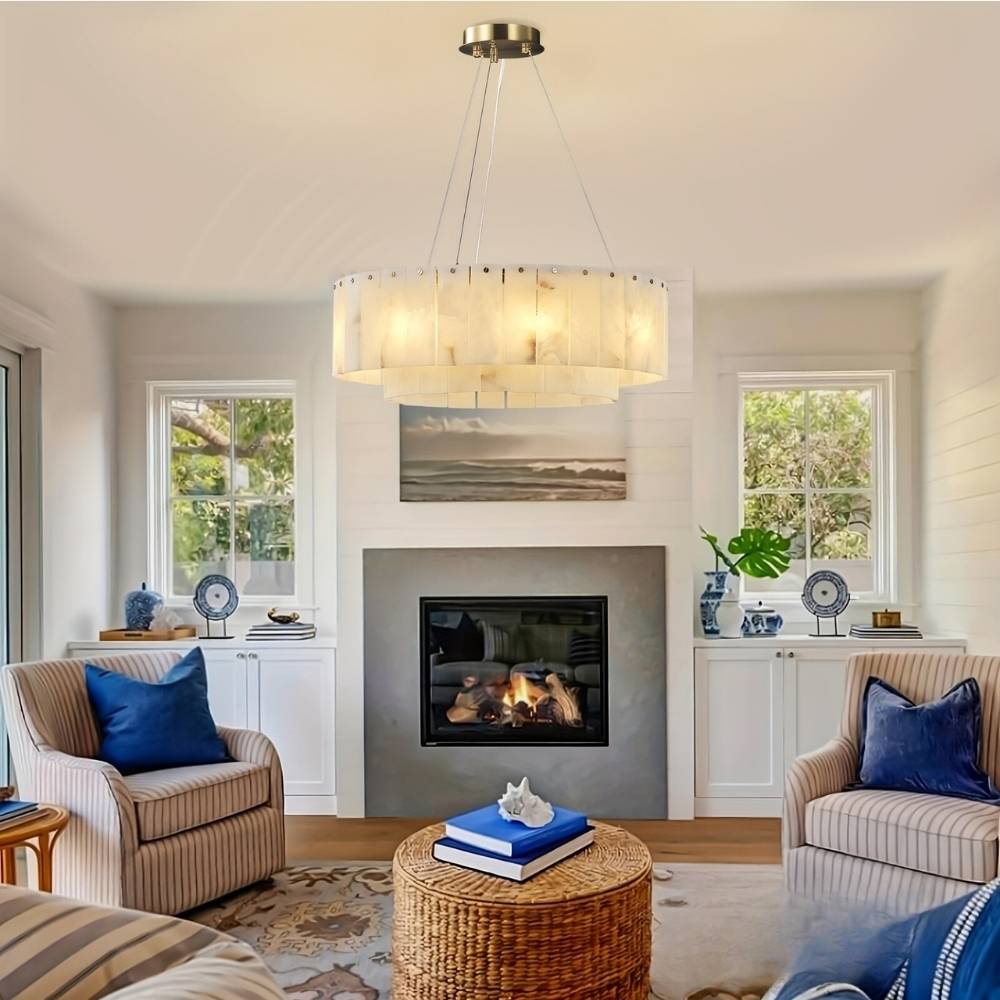
4Angie Alabaster Round Chandelier
Alabaster · The Softest Light AvailableThe most translucent stone and the gentlest light in any material — the whole body glows, the source is invisible from every angle, and the transmitted light carries a warmth glass cannot reproduce. Where comfort matters more than brightness, nothing else does this. Dry cleaning only; unsealed stone absorbs liquid and the mark is permanent.
Glare: None from any angle
Trade: Lower output — plan other layers
Cleaning: Dry microfiber only, never damp
Related: Alabaster & marble
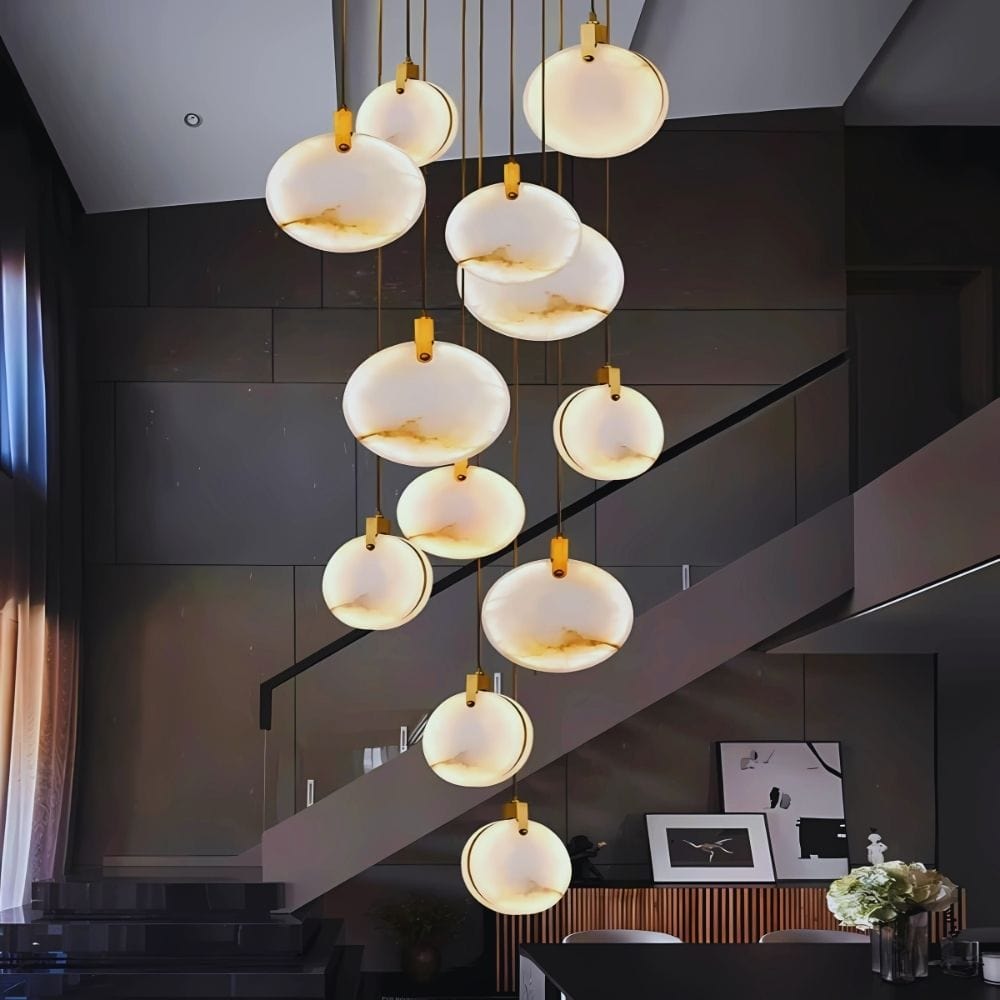
5Gaia Marble Staircase Chandelier
Marble · Veining Lights From BehindMarble frames light where alabaster diffuses it. At the working panel thickness the veining illuminates from behind while the face stays readable as pattern — a sharper, more architectural result than a uniform glow. It also hides dust better than crystal does, because there is no sparkle to dull.
Versus alabaster: Sharper, more architectural
Hides dust: No sparkle to dull
Expect: Veining to differ from the photograph
Related: Alabaster & marble

6Tiva Travertine Outdoor Wall Light
Travertine · The Only One That Goes OutsideTravertine blocks light rather than transmitting it, so the fixture reads as a solid body with light escaping above and below. That opacity and its porous matte surface are also what make it the one stone suited to exterior conditions — in a purpose-built rated fixture. Never substitute an interior stone fixture outdoors; unsealed stone absorbs moisture and the components behind it are not weather-rated.
The exception: Purpose-built exterior stone fixture
Never: Interior stone fixtures outdoors
Color: Warm light 3000K
Related: Outdoor wall lights
Browse natural materials
Wood, stone and woven fixtures across every room.
Wood → Alabaster & Marble → Branch →Which Room Takes Which
| Room | Best natural material | Why | Avoid |
|---|---|---|---|
| Dining room | Stone or wood | Glare-free over a table; timber matches the table | Open-weave rattan over food |
| Kitchen island | Wood with glass | Needs real output — stone alone is too dim | Rattan near cooking — grease and steam |
| Bedroom | Alabaster | Softest light, no visible source from a pillow | Nothing — all work here |
| Living room | Wood or rattan | Decorative layer; lamps do the output | Stone as the only source |
| Bathroom | Stone, damp-rated | Suits the material palette | Wood and rattan — moisture |
| Entry | Any — stone or wood | Decorative position, short dwell time | Fragile weaves in a passage |
| Stairwell | Stone | No glare at eye level on upper treads | Rattan — dust, and hard to clean at height |
| Covered porch | Rated travertine only | Purpose-built exterior stone | All interior natural materials |
Mixing Natural Materials
More than two natural materials in one room reads as accumulation rather than as a scheme, and the reason is that each brings its own color and texture rather than being neutral.
Wood and stone together work when one is clearly the fixture and the other is architectural — a timber chandelier in a room with a stone floor, or stone sconces in a room with timber beams. Both as fixtures in the same room competes.
Rattan with either is the harder pairing, because woven texture is visually busy and reads against both the grain of timber and the pattern of stone. It works best as the only natural element in an otherwise plain room.
The metal ties it together. Natural-material fixtures almost all include a metal frame, and keeping that consistent across a house is what makes different materials read as one decision. Black is neutral to all three; brass warms wood and alabaster and fights travertine's cooler gray.
Care and Aging
| Material | Cleaning | How it ages | Fails from |
|---|---|---|---|
| Wood | Dry microfiber; no polish on matte | Darkens slightly with light exposure | Humidity — warping and splitting |
| Rattan / woven | Soft brush or vacuum; never damp | Yellows gradually, dries brittle | Moisture, impact, trapped dust |
| Alabaster | Dry microfiber only | Essentially unchanged | Any liquid — permanent marking |
| Marble | Dry microfiber only | Essentially unchanged | Liquid, acidic cleaners |
| Travertine | Dry brush; soft, porous | Patinas slowly outdoors | Acidic cleaners |
The common rule across every natural material here: dry cleaning only. Not a damp cloth, not glass cleaner, not mild soap. Unsealed stone absorbs liquid permanently, timber swells and lifts, and woven fibre holds moisture and goes brittle. This is the opposite of glass and metal, where a damp cloth is routine — and it is the single most common way a natural fixture gets damaged.
Common Mistakes
- Expecting wood or rattan to light a room. They block light by construction. Plan lamps or sconces alongside.
- Any liquid on any of them. Stone marks permanently, timber swells, woven fibre goes brittle. Dry microfiber only.
- Rattan or wood in a bathroom or covered porch. Both absorb moisture. Only purpose-built rated stone goes outside.
- Expecting stone to match the photograph. Natural stone varies piece to piece. That variation is the product.
- Three natural materials in one room. Reads as accumulation. Two at most, with one clearly leading.
- Rattan at full output. The pattern washes out. It resolves at 40-60% on a dimmer.
- Sizing dark timber like light timber. Walnut and dark stains read larger. Size down a step in a small room.
- Gloss finishes on wood. They reflect and the grain stops reading, which defeats the point of choosing timber.
- Rattan near cooking. Grease and steam are absorbed by the weave and cannot be cleaned out.
- Treating travertine as translucent. It blocks light. It is a sculptural body, not a diffuser.
Frequently Asked Questions
What is the difference between wood and stone chandeliers?
Optically, everything. Stone transmits light so the material itself glows and the source disappears; wood blocks it and directs output downward. That means a stone fixture can be a room's main light at reduced output, while a wood fixture is a decorative layer that needs other sources alongside it.
Can a wood chandelier light a whole room?
No. Timber blocks light and directs it downward, so the fixture illuminates what is beneath it and leaves the rest of the room darker. Plan lamps, sconces or recessed lighting alongside — a wood fixture is one layer, not a scheme.
What kind of wood is used in chandeliers?
Oak and ash read light and contemporary; walnut and dark stains read warmer and more traditional. Reclaimed and distressed timber carries the farmhouse direction and hides handling marks better. The finish matters more than the species — matte keeps the grain readable, gloss does not.
Are rattan light fixtures a good idea?
In the right room, yes — rattan is the only material that casts a pattern through its weave, which is the reason to choose it. It needs a dimmer, since the pattern resolves at 40-60% and washes out at full output. Avoid humid rooms and anywhere near cooking.
Which natural material gives the softest light?
Alabaster. The whole body glows, the source is invisible from every angle, and the transmitted light has a warmth glass does not reproduce. The trade is output — it absorbs a substantial share of the lamp.
What is the difference between alabaster and marble in lighting?
Alabaster is significantly more translucent, so it diffuses and the whole body glows. Marble transmits less and frames instead — the veining lights up from behind while the face reads as pattern. Alabaster is softer; marble is sharper and more architectural.
Can natural material fixtures go in a bathroom?
Stone can, if the fixture is specifically damp-rated. Wood and rattan should not — both absorb moisture, and timber warps while woven fibre goes brittle. Check the rating rather than assuming, since most decorative stone fixtures are indoor-rated.
How do you clean a wood or rattan chandelier?
Dry only. Microfiber for timber, a soft brush or vacuum for woven fibre. Never a damp cloth on either — wood swells and lifts, and rattan holds moisture and goes brittle. This applies to stone too; liquid marks unsealed stone permanently.
Why does my stone fixture look different from the photo?
Natural stone is cut from blocks that formed geologically, so veining, tone and translucency vary piece to piece. The product image is representative rather than a template — that variation is what buying natural stone means.
Can I mix wood and stone fixtures in one room?
Yes, when one is clearly the fixture and the other is architectural — a timber chandelier in a room with a stone floor, for instance. Two natural materials both as fixtures in the same room compete. Keep the metal frames consistent, since that is what ties them together.
Do natural material fixtures work in modern interiors?
Yes — the warmth is what keeps a minimal room from reading cold, which is why these materials appear so consistently in contemporary work. Light oak and alabaster suit modern schemes most directly; heavily distressed timber and open rattan lean rustic.
Which natural material needs the least maintenance?
Stone. Dusted dry twice a year and it looks the same in fifteen years — no polish, no treatment, nothing to degrade. Woven fibre needs the most, since it traps dust and cannot be dampened to remove it.
Ask What It Does With Light
Natural materials are grouped by look and divided by physics. Stone transmits and can carry a room at reduced output; wood and rattan block and need company. Decide which behaviour the room needs first, keep every one of them dry when cleaning, and let the metal frame rather than the material tie the house together.
Browse the range: wood chandeliers, alabaster & marble, branch chandeliers.