Quick Answer
Four numbers tell you before you buy: lamp count, lumens per lamp, what the diffuser absorbs, and what the room needs. Multiply the first two, subtract the third, compare to the fourth. A 6-lamp fixture at 800 lm each behind opal glass delivers roughly 4,000 usable lumens; behind alabaster it delivers closer to 2,000.
Rough room targets: bedroom 1,000-2,000 lumens, dining room 2,000-4,000, living room 2,000-4,000, kitchen 4,000-8,000 across all sources.
The material matters more than most people expect. Opal glass transmits most of a lamp's output. Stone, heavy crystal and woven fibre absorb a substantial share — which makes them excellent atmosphere layers and poor primary sources.
Decorative is not a criticism. Where recessed lighting or lamps already exist, a low-output fixture is the correct choice. The error is expecting one fixture to do both jobs when its specifications say it cannot.
The most common lighting disappointment is not an ugly fixture. It is a beautiful one that leaves the room dim — and the frustrating part is that this outcome is entirely predictable from the product page. Lamp count, diffuser material and light direction are all published or askable before ordering, and together they tell you whether a fixture will carry a room or contribute atmosphere to one. This guide covers the four checks that answer it, what each material absorbs, room-by-room targets, and what to do when the fixture you want is the low-output one.
On this page
Four Checks Before You Buy
All four work from a product page, and together they turn a guess into an estimate.
- 1. Lamp count. Published on nearly every listing. Multiply by output per lamp — a standard decorative LED runs 400-800 lm, a brighter one up to 1,000. Six lamps at 700 lm is 4,200 lm before anything absorbs it.
- 2. Diffuser material. The step most people skip and the one that changes the answer most. See the table below — the range runs from almost no loss to roughly half.
- 3. Light direction. Downward-facing designs put their output on the surface below. Upward and all-round designs spread it across the room at lower intensity. Same lumens, different usefulness.
- 4. What the room needs. Compare the result to the targets further down. A 2,000 lm fixture is generous in a bedroom and inadequate in a kitchen.
What Each Material Absorbs
Every diffuser trades output for comfort. The ones that remove glare best also remove the most light, which is the fundamental tension in decorative lighting.
| Diffuser | Roughly transmits | Glare | Suits |
|---|---|---|---|
| Exposed lamp, no shade | Nearly all | High — source visible | Decorative only, on a dimmer |
| Clear glass | Most | High — filament visible | Rooms where sparkle is the point |
| Opal / milk glass | Most, source hidden | None | Primary lighting — the efficiency benchmark |
| Frosted glass | High | Low | General purpose |
| Smoked / tinted glass | Reduced | Low | Atmosphere, moody interiors |
| Fabric shade | Moderate, mostly downward | None | Bedrooms, reading positions |
| Cut crystal | Moderate, scattered | Low, but bright points | Atmosphere with movement |
| Dense crystal cluster | Substantially reduced | Low | Decorative layer only |
| Alabaster / stone | Substantially reduced | None | Atmosphere — the softest available |
| Woven rattan / rope | Reduced, dappled | Low | Texture and pattern, not brightness |
| Solid metal shade | Blocks sideways, directs down | None | Task light over a surface |
The pattern is consistent: the materials that feel most comfortable to sit under produce the least usable light. Alabaster and dense crystal are the gentlest options available and the weakest primary sources. Opal glass is the exception that resolves the tension — it hides the lamp completely while transmitting most of its output, which is why it dominates fixtures designed to actually light rooms.
Direction Decides Where It Lands
Two fixtures with identical output and identical diffusers still perform differently if they aim their light differently.
Downward concentrates output onto the surface beneath — a table, an island, a desk. Efficient for task work, and it leaves walls and corners dark, which can make a room feel smaller at night. All-round spreads output in every direction, filling a room at lower intensity. Upward bounces off the ceiling and returns softened, which is the gentlest result and the least efficient, since some light is lost to the ceiling surface. Up and down together splits the difference and is the most forgiving for general room lighting.
One practical consequence: a fixture rated at 3,000 lumens aimed downward over a table is bright at the table and contributes little elsewhere. The same 3,000 lumens spread all-round lights the whole room moderately and the table less. Neither is wrong — but they answer different questions, and the product page rarely says which one it is.
Room Targets
| Room | Total ambient target | From the main fixture | Notes |
|---|---|---|---|
| Bedroom | 1,000-2,000 lm | Most of it | Lowest of any room; a dimmer matters more than output |
| Dining room | 2,000-4,000 lm | Most of it | CRI 90+ matters here more than raw brightness |
| Living room | 2,000-4,000 lm | Half or less | Lamps and sconces carry the rest |
| Kitchen | 4,000-8,000 lm | A fraction | Under-cabinet and recessed do the real work |
| Bathroom | 2,000-4,000 lm | Vanity fixtures | Side placement matters more than total |
| Entry / hallway | 1,000-2,500 lm | Most of it | Often the only fixture in the space |
| Two-story entry | 2,500-5,000 lm | Most of it | Volume, not floor area, drives the number |
Read the third column carefully — it is where the decorative-versus-functional question actually lives. In a bedroom or entry the ceiling fixture is expected to carry the room, so its output matters. In a kitchen it contributes a fraction and its output barely matters at all, which is why a decorative fixture over a kitchen table is a perfectly good decision and the same fixture as a bedroom's only light is not.
Fixtures That Can Carry a Room (4 Designs)
Higher lamp counts, efficient diffusion, or integrated LED sized for real output. These work where there is no recessed lighting to fall back on.
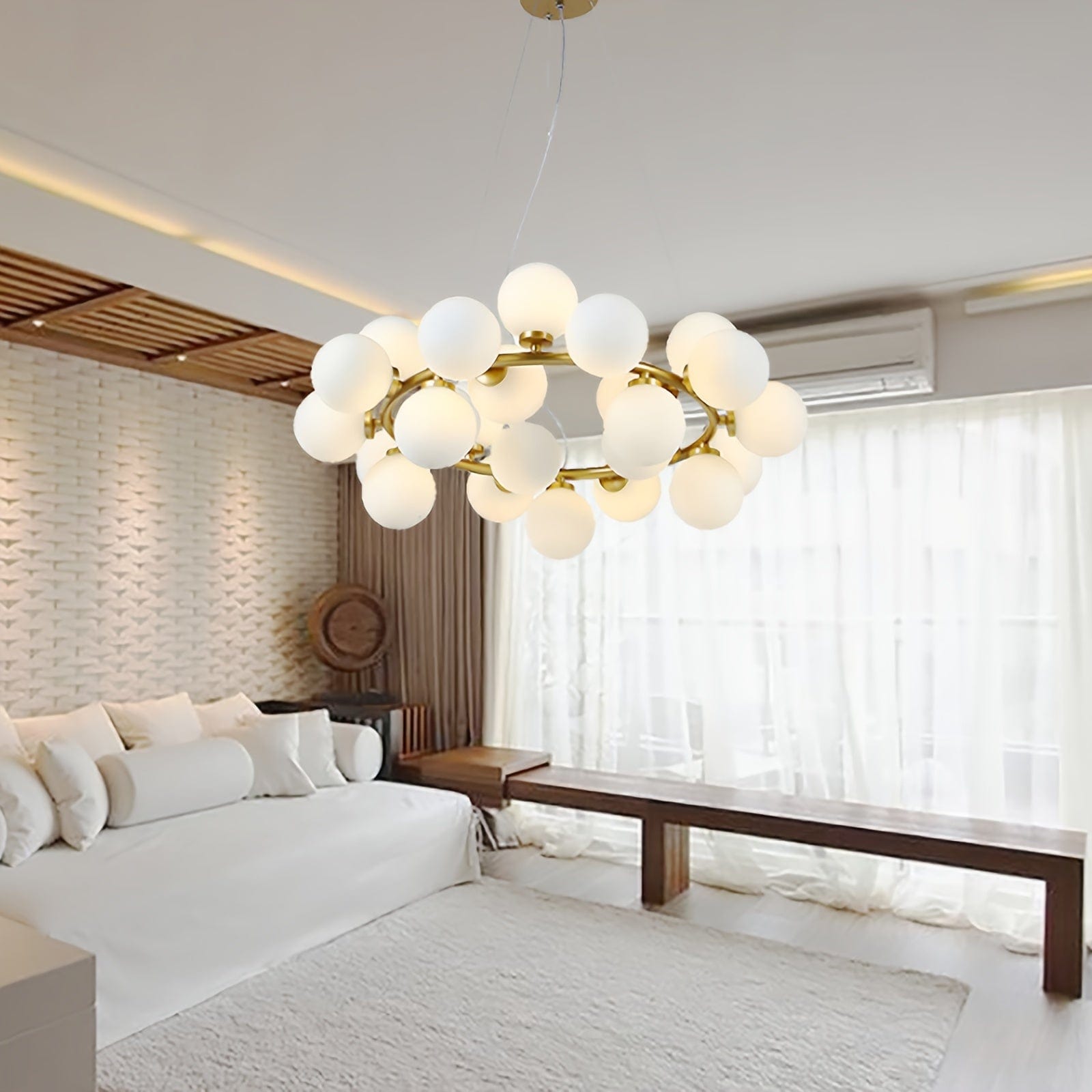
1Holly Milk Glass Chandelier
Opal Glass · The Efficiency BenchmarkThe material that resolves the output-versus-comfort tension. Opal hides the lamp completely while transmitting most of its light — no other diffuser does both. Combined with several shades, this is the configuration that genuinely carries a dining room or a bedroom without a second layer behind it.
Glare: None — source fully hidden
Best where: No recessed lighting exists
Estimate: Lamp count × 700 lm × high transmission
Related: Glass chandeliers

2Asty Modern Ring LED Chandelier
Integrated LED · Published OutputIntegrated LED designs have one clear advantage for this question: the output is a fixed specification rather than a variable depending on which lamps you buy. What the listing says is what you get. Multi-ring configurations also increase emitter length rather than adding lamp points, which raises output without adding visual clutter.
Scaling: More rings = more emitter length
Check: Dimming depth — the source cannot be swapped
Configurations: One to three rings
Related: Ring chandeliers
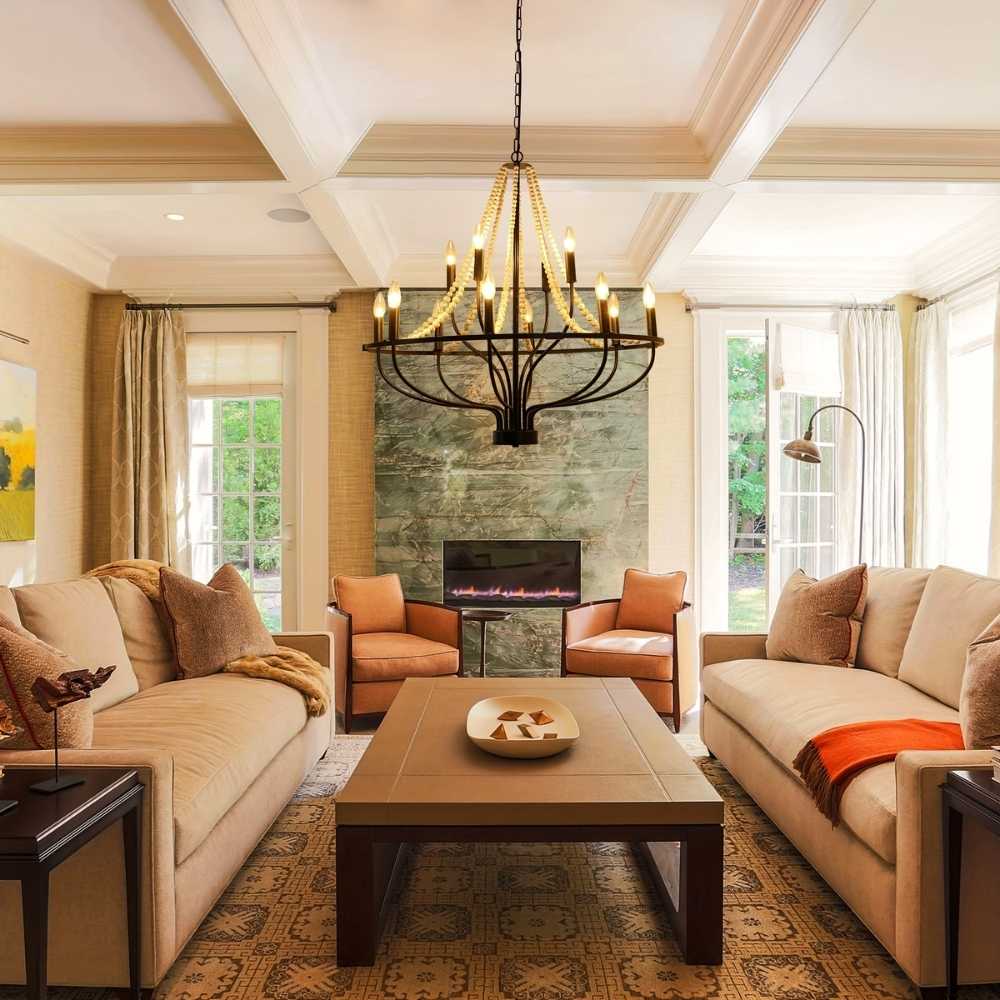
312-Light Black Iron Chandelier
12 Lamps · Output Through CountThe straightforward route: more lamps, more light. Twelve at 500 lm each is 6,000 lm at the source, and with no heavy diffuser most of it reaches the room. Candle-style designs leave lamps semi-visible, so use low-output decorative LEDs and a dimmer — twelve bright points in open view is uncomfortable regardless of the total.
Rough total: 12 × 400-600 lm
Essential: Dimmer — semi-visible lamps at full output
Lamps: Low-output decorative LED, all matched
Related: Iron chandeliers
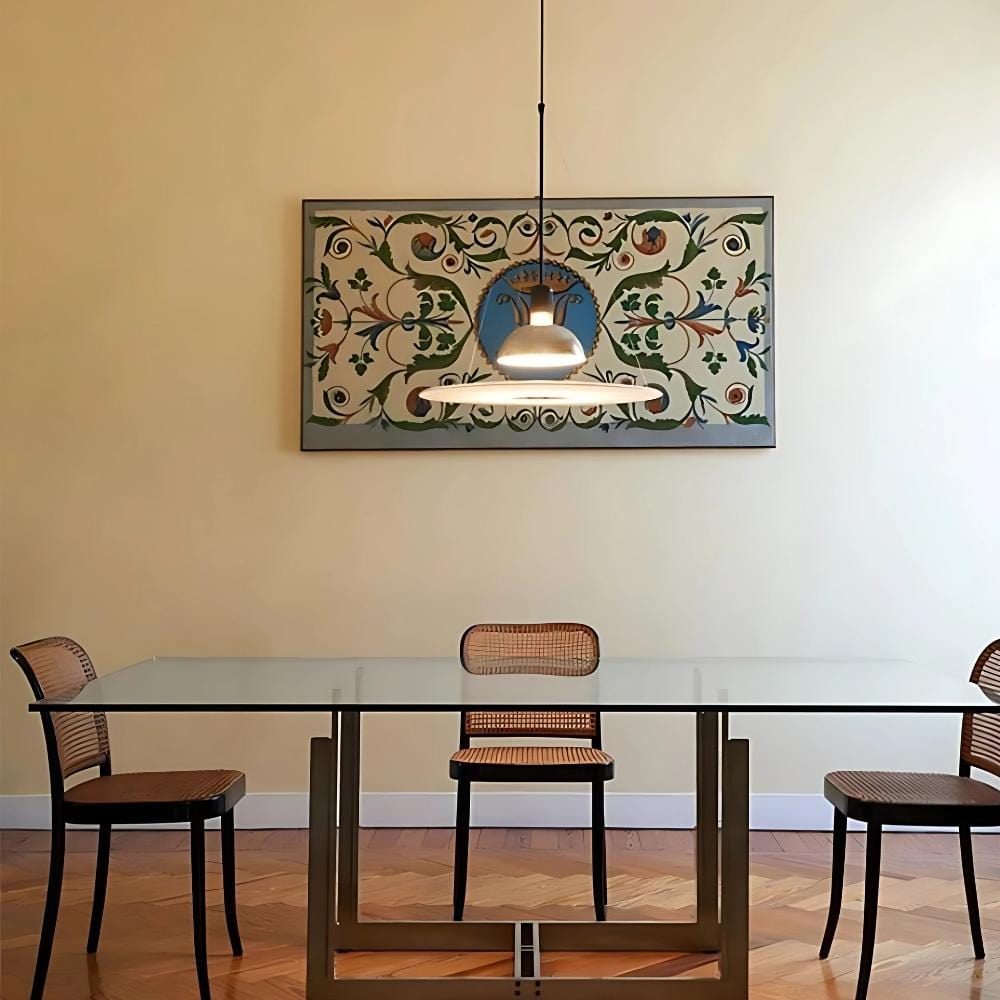
4Chiara Scandinavian Pendant Light
Directed Down · Task-CapableDirection rather than raw output. A shaded body blocks sideways spill and concentrates everything onto the surface below, which makes a single modest lamp genuinely useful over a counter or a small table. Repeated in a run, three of these deliver more usable task light than one larger all-round fixture at higher total lumens.
Best over: Counters, islands, small tables
In a run: One per 24-30 in of length
Height: 30-36 in above the surface
Related: Pendant lights
Fixtures That Contribute Atmosphere (4 Designs)
Lower output by design, and correct where other lighting exists. Each of these trades brightness for a quality no efficient fixture produces.
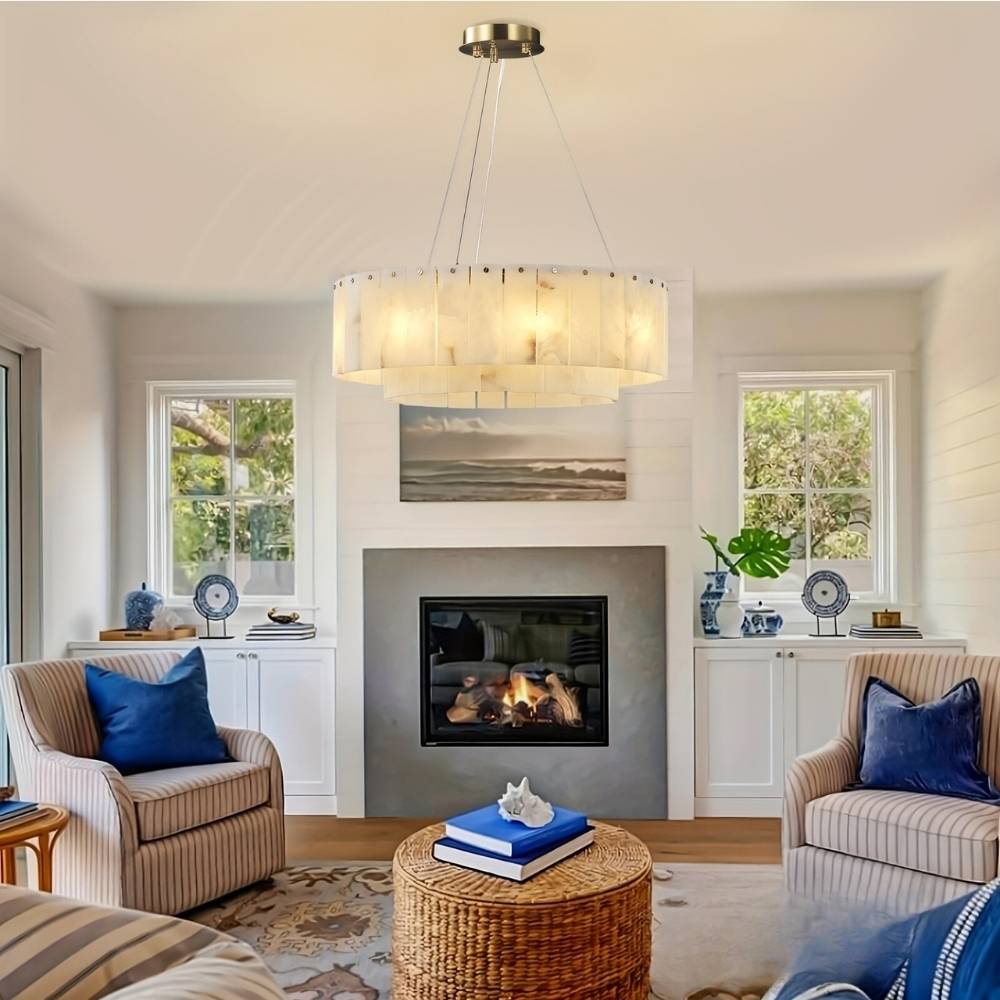
5Angie Alabaster Round Chandelier
Stone · Softest Output AvailableThe clearest example of the trade. Stone absorbs a substantial share of what the lamps produce and warms what passes through, giving a glow with depth that no glass reproduces — and almost no glare at any angle. Excellent beside a bed or above a dining table with other lighting present; inadequate as a bedroom's only source.
Glare: None — the gentlest available
Pair with: Recessed, lamps or sconces
Also gains: Reads as material when switched off
Related: Alabaster & marble

6Aureli Crystal Spiral Chandelier
Dense Crystal · Movement Over BrightnessDense crystal scatters light rather than transmitting it cleanly, which reduces usable output and produces something no efficient fixture can: moving points of refracted light on surrounding surfaces. That effect is strongest at 30-60% dimmer output, not at full — so brightness was never what this format was optimising for.
Best at: 30-60% dimmer output, not full
Pair with: Recessed or perimeter lighting
Note: Real crystal weighs — check the box rating
Related: Crystal chandeliers

7Piper Rattan Pendant Chandelier
Woven · Pattern Rather Than BrightnessWoven fibre blocks a share of the output and lets the rest through the gaps, which throws a dappled pattern onto nearby walls and ceilings. That pattern is the product — it is what the fixture is for. Useless as a task light, and genuinely good in a bedroom, hallway or reading corner where the effect is seen at close range.
Effect: Dappled light on nearby surfaces
Best in: Bedrooms, hallways, reading corners
Lamps: LED — cooler, protects the fibre
Related: Rustic pendant lights

8Elise Sputnik Bubble Chandelier
12 Heads · Count Offsets DiffusionAn instructive middle case. Twelve glass globes each diffuse their lamp, which costs output per head — but twelve heads recovers most of it through count. This is how radial and cluster formats stay usable: not by efficient diffusion, but by having enough sources that the losses stop mattering.
Heads: 12 — order that many lamps plus spares
Glare: Low — globes conceal the lamps
Dimmer: Worth it — 12 sources at full is a lot
Related: Bubble chandeliers
Browse by what the room needs
Efficient diffusers for primary lighting, soft materials for atmosphere.
Glass → Alabaster & Marble → All Chandeliers →When Decorative Is the Right Answer
A guide that treated low output as a fault would be wrong. Four situations where the decorative fixture is the correct purchase:
- Recessed lighting already exists. The ceiling is handled. The decorative fixture's job is character, and choosing an efficient one wastes the opportunity.
- The room is used in the evening. Dining rooms and bedrooms rarely need full brightness. A soft fixture on a dimmer suits how the room is actually used.
- The fixture hangs where it is examined closely. Above a table, beside a bed, in an entry passed within arm's reach — material quality and glare-free light matter more than lumens.
- The room is small. A compact bedroom or powder room needs far less than the targets above, and an efficient fixture there is simply bright.
The error is not choosing a decorative fixture. It is choosing one for a room with no other lighting and expecting a different result than the specifications predict.
Three Ways to Fix a Dim Room
If a fixture is already installed and the room is darker than expected, three routes exist before replacement.
Change the lamps. The cheapest fix and the most often overlooked. Many fixtures ship with modest lamps, and moving from 400 lm to 800 lm per socket doubles the output without touching the fixture. Check the fixture's maximum wattage rating first, and replace all lamps together so colour temperature stays consistent.
Add a second layer. Floor and table lamps need no wiring and can be positioned where the ceiling fixture does not reach — corners, reading positions, behind seating. This is faster and cheaper than any electrical work and usually solves the problem completely.
Add wall lighting. Sconces light vertical surfaces and faces, which is exactly what a dim room is missing. It needs an electrician and a box, but it addresses the shortfall more precisely than a brighter ceiling fixture would — our wall sconces collection covers the format.
What to Ask a Supplier
Three questions answered before ordering remove almost all of the uncertainty, and all three are routinely answered when asked even where the listing does not state them.
- What is the total lumen output, or the maximum wattage per socket? Either answers the arithmetic. Integrated-LED fixtures should state total output directly.
- Is the light directed downward, all-round, or up and down? This decides where the output lands and is almost never on a product page.
- What is the CRI? 90 or better keeps food, wood and skin tones true. It matters most over a dining table and at a bathroom mirror, and it is a specification cheap fixtures quietly omit.
Common Mistakes
- Judging brightness by fixture size. A large stone fixture can produce less usable light than a small opal one. Lamp count and material decide it, not diameter.
- Ignoring the diffuser. Two fixtures with identical lamp counts can differ by half depending on what sits in front of the lamps.
- Expecting one fixture to light a kitchen. Kitchens need 4,000-8,000 lumens across all sources. No single decorative fixture delivers that.
- Buying brighter instead of buying layered. A very bright ceiling fixture in an under-lit room is uncomfortable. Two moderate sources beat one intense one.
- Skipping the dimmer. The fix for "too bright sometimes, too dim other times" is not a different fixture.
- Exposed lamps at high output. Bright points in open view are uncomfortable regardless of total lumens. Low-output decorative LEDs on a dimmer.
- Assuming integrated LED means bright. It means the output is fixed — which could be 1,200 lm or 4,000. Check the specification.
- Overlooking CRI. A high-lumen fixture at CRI 70 makes a dining room look worse than a dimmer one at CRI 90.
Frequently Asked Questions
How do I know if a chandelier will be bright enough?
Multiply lamp count by lumens per lamp — typically 400-800 for decorative LED — then reduce for the diffuser. Opal glass transmits most of it; stone and dense crystal absorb a substantial share. Compare the result to the room target: bedroom 1,000-2,000 lumens, dining 2,000-4,000, kitchen 4,000-8,000 across all sources.
What is the difference between decorative and functional lighting?
Functional fixtures are specified for output — higher lamp counts and efficient diffusion. Decorative fixtures trade output for a quality no efficient fixture produces: the depth of stone glow, the movement of crystal refraction, the pattern of woven fibre. Neither is better; they answer different briefs.
Which diffuser material gives the most light?
Opal or milk glass. It hides the lamp completely while transmitting most of its output, which no other diffuser does. Stone, dense crystal and woven fibre sit at the other end — comfortable to sit under, weak as primary sources.
How many lumens does a room need?
Roughly: bedroom 1,000-2,000, dining room 2,000-4,000, living room 2,000-4,000, kitchen 4,000-8,000, bathroom 2,000-4,000, entry 1,000-2,500. These are totals across all sources, not from one fixture — in a kitchen the ceiling fixture contributes a small fraction.
Can an alabaster or crystal chandelier light a room alone?
Rarely. Both absorb a substantial share of the lamp output, which is what makes them comfortable to sit under and weak as primary sources. Plan recessed lighting, sconces or lamps alongside them.
My new fixture is too dim — what can I do?
Three options before replacing it: change to higher-output lamps within the fixture's wattage rating, add floor or table lamps where the ceiling fixture does not reach, or add wall sconces. Changing lamps is the cheapest and most overlooked.
Does a bigger chandelier mean more light?
Not necessarily. A large stone or heavily crystal fixture can produce less usable light than a compact opal one. Lamp count and diffuser material decide output; diameter decides visual scale.
What does light direction change?
Where the output lands. Downward concentrates it on the surface below and leaves walls dark. All-round spreads it across the room at lower intensity. Up and down splits the difference and is the most forgiving for general room lighting.
Is integrated LED brighter than lamps?
Not inherently. What integrated LED gives you is a fixed, published output rather than one that varies with whichever lamps you buy. That could be 1,200 lumens or 4,000 — check the specification rather than assuming.
What is CRI and does it matter?
Colour rendering index, measuring how accurately a light source shows colour. CRI 90 or better keeps food, wood and skin tones true. It matters most over a dining table and at a bathroom mirror — a high-lumen fixture at CRI 70 makes a room look worse than a dimmer one at CRI 90.
Should every fixture be on a dimmer?
Every decorative one, yes. Most rooms need different levels at different times, and the fix for that is a dimmer rather than a different fixture. Crystal in particular reads best at 30-60% output rather than full.
How do I estimate output if the listing does not say?
Use the maximum wattage per socket, which listings almost always state for safety reasons. An LED at that wattage typically produces 400-800 lumens. Multiply by socket count and reduce for the diffuser. Or ask — suppliers answer this routinely even when the page does not state it.
Do the Arithmetic Before You Order
Lamp count times output per lamp, reduced for what the diffuser absorbs, compared to what the room needs. Four numbers, two minutes, and the disappointment is avoided. And where the answer comes out low, that is only a problem if the room has nothing else — because a fixture chosen for depth, movement or texture was never trying to be bright.
Browse the range: glass chandeliers, alabaster & marble, pendant chandeliers, all chandeliers.