Crystal reads larger than its measurement. Faceted surfaces catch light from every angle, so a 20 in crystal fixture occupies more visual space than a 20 in plain one. In a compact room, size down one step from the formula rather than up.
For most small rooms that means 16-24 in. A 10 x 12 ft bedroom calculates to 22 in; in crystal, 18-20 in is the better number.
Density decides more than diameter. A sparse frame with a few drops at 24 in reads lighter than a dense tiered piece at 18 in — count the elements, not just the width.
Small rooms put crystal within reach, which changes both the cleaning burden and the quality threshold: faceting that passes at ceiling distance does not pass at arm's length.
Crystal is usually discussed at scale — grand entries, double-height stairwells, dining rooms with room to spare. The more common situation is a bedroom, a small entry, a powder room or a compact dining space, where the same material behaves differently and the standard sizing advice overshoots. This guide covers why crystal reads large, the numbers for small rooms, how density changes the answer, and what to check when the fixture is close enough to touch.
On this page
Why Crystal Reads Larger
Two fixtures of identical diameter can occupy very different amounts of a room, and crystal is at the far end of that range.
Faceted surfaces return light in every direction. A plain metal frame is seen as an outline; a crystal one throws points of light outward, onto the ceiling and walls around it. The fixture's visual footprint extends past its physical edge, which is the whole appeal of the material — and the reason it overwhelms a room that would take a plain fixture of the same size comfortably.
Density compounds it. A fixture carrying two hundred drops presents two hundred bright points. The eye reads accumulated detail as mass, so a densely dressed 18 in fixture can feel heavier in a room than a sparse 26 in one.
Sizes for Small Rooms
| Room | Formula says | In crystal, use | Note |
|---|---|---|---|
| Powder room 5 x 6 ft | 11 in | 10-12 in | Flush or semi-flush; 84 in clearance |
| Small entry 6 x 8 ft | 14 in | 12-16 in | Seen at close range — quality matters |
| Bedroom 10 x 10 ft | 20 in | 16-18 in | Not over the bed — see below |
| Bedroom 10 x 12 ft | 22 in | 18-20 in | The most common small-crystal position |
| Bedroom 12 x 14 ft | 26 in | 22-24 in | Room for a tiered piece if the ceiling allows |
| Compact dining, 42 in table | Table rule: 21-28 in | 21-24 in | Size to the table, not the room |
| Compact dining, 48 in table | Table rule: 24-32 in | 24-28 in | Lower end in crystal |
| Hallway | Width-based | 12-16 in, spaced 6-8 ft | Check projection and head clearance |
One exception worth stating: over a dining table the table rule overrides the room formula, and the crystal correction applies within it — take the lower end of one-half to two-thirds rather than dropping below it. Full table sizing is in our dining table sizing guide.
Density Beats Diameter
Diameter is the number on the listing. Density is the one that decides how the fixture behaves in a small room, and it is never stated.
| Construction | Visual weight | Suits a small room? |
|---|---|---|
| Open ring with spaced drops | Light | Yes — can take the upper size |
| Single-tier frame, sparse | Light to moderate | Yes |
| Beaded strands, open center | Moderate | Yes, at the lower size |
| Dense single tier | Heavy | Size down two steps |
| Multi-tier, fully dressed | Very heavy | No — needs a larger room |
| Cascade or waterfall | Heavy and tall | Only in a stairwell or void |
The test from a product photograph: can you see through the fixture to the ceiling behind it? If yes, it is an open construction and reads light. If the crystal forms a continuous surface, it reads as mass regardless of what the diameter says — and in a compact room that is the specification that matters.
Compact Crystal Picks (3 Designs)
Open constructions at small diameters. All read lighter than their measurement, which is what lets crystal work in a room that would not take a dense piece.
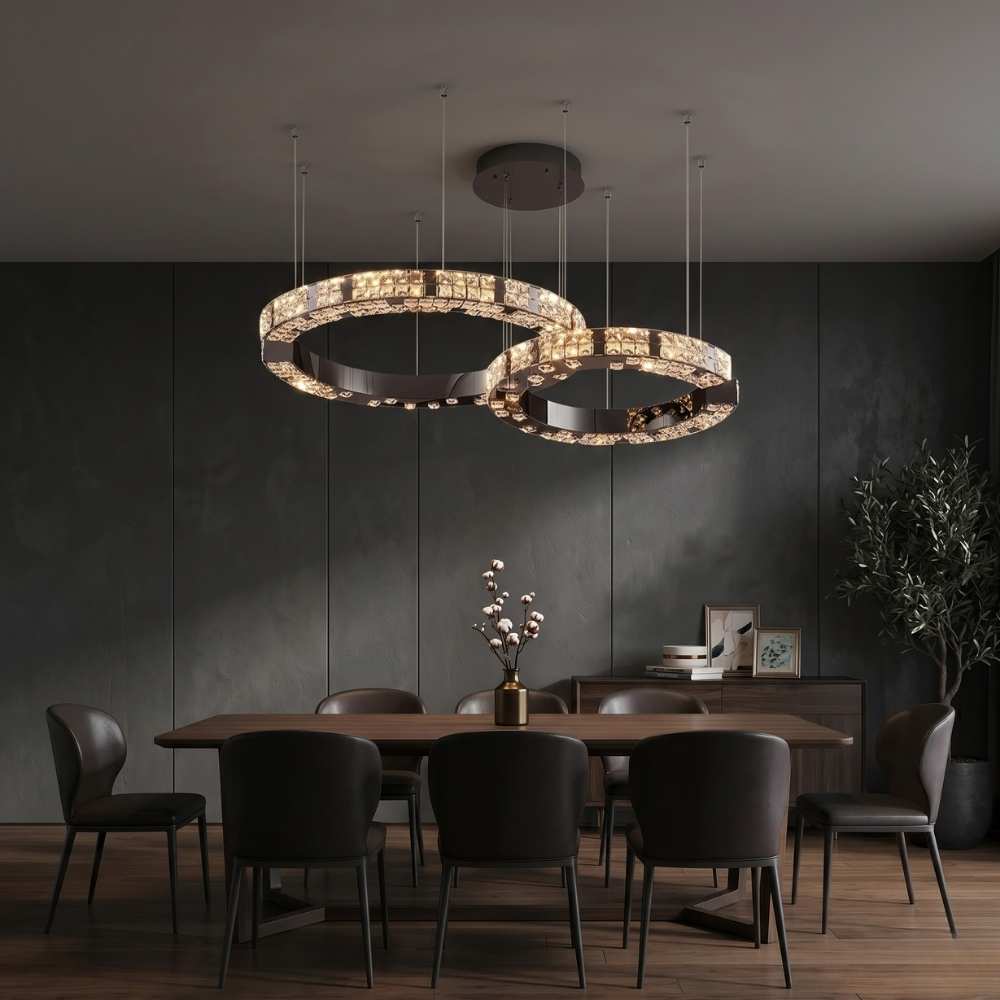
1Arven Modern Crystal Ring Chandelier
Open Ring · The Lightest Crystal FormatA ring frame carrying spaced crystal is the construction that makes the material possible in a small room. The open center lets the ceiling show through, so the fixture reads as a line with light on it rather than as a mass — which means it can take the upper end of the size range where a dense piece would need two steps down.
Sizing: Can take the upper end of the range
Best at: 30-60% dimmer output for refraction
Color: Warm white 2700K
Related: Crystal chandeliers
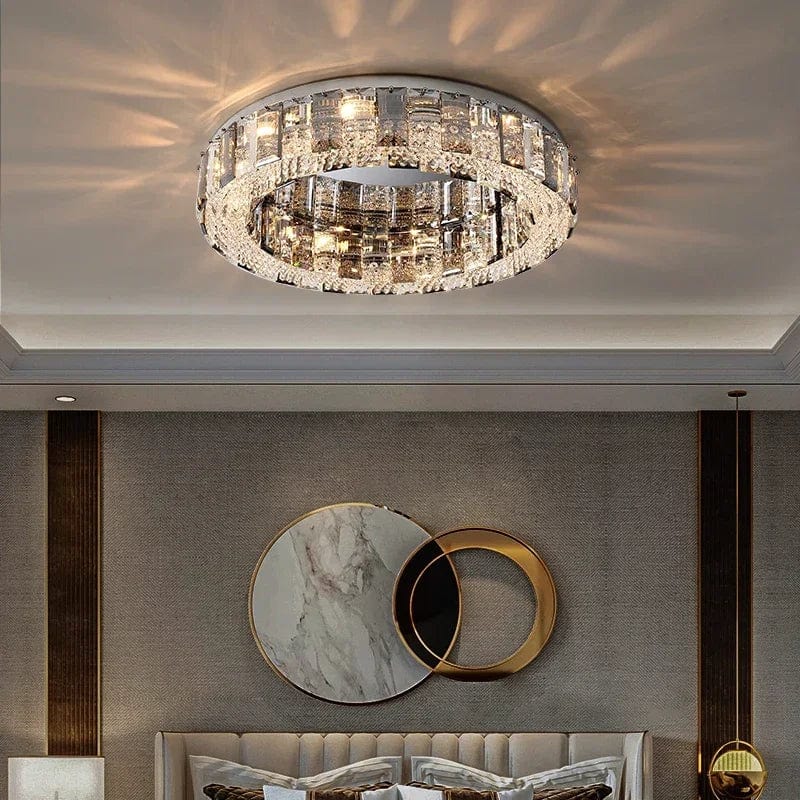
2Rina Crystal Ceiling Chandelier
Close Mount · Powder Rooms and Low CeilingsSmall rooms frequently have standard or low ceilings, and a powder room or small entry at 8 ft leaves about 12 in of fixture depth once the 84 in clearance is taken. Close-mount crystal keeps the decorative quality at that depth, and refraction spreads light sideways across the ceiling — which makes a small space read wider than a downward-only fixture would.
Refraction: Spreads light sideways in a tight space
Suits: Powder rooms, small entries, hallways
Buy: Wider than instinct — small reads as a fitting
Related: Flush mount chandeliers
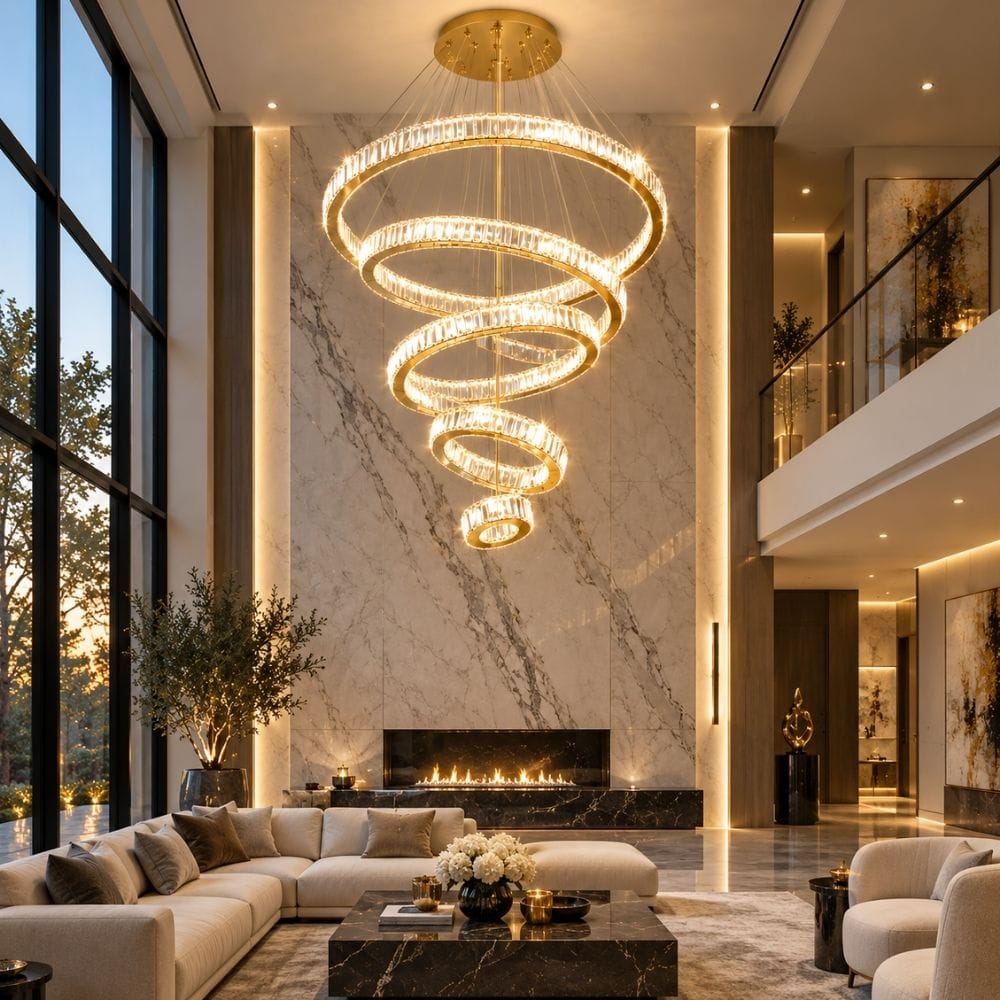
3Bily LED Crystal Ring Chandelier
Integrated LED · No Lamps Visible Close UpIn a small room the fixture is close enough that visible lamps are in the field of view rather than above it. Integrated LED removes them entirely — the light appears to come from the fixture itself rather than from bulbs inside it, which is the difference between a crystal piece that reads refined at arm's length and one that reads as a frame holding bulbs.
Also: No lamp changes in a tight space
Check: Dimming depth — crystal reads best dimmed
Finishes: Gold or chrome
Related: Ring chandeliers
Room by Room
Bedrooms are the most common small-crystal position and the one with a placement rule of its own: not directly over the bed. A crystal fixture above a pillow is in the field of view of anyone lying down, and refracted points are distracting rather than restful from that angle. Center it on the room, or on the foot of the bed, and keep clearance measured from the mattress top rather than the floor — a mattress and base raise the effective floor by 20-25 in.
Small entries are where crystal does its best work in a compact space, because an entry is passed through rather than occupied. The fixture gets noticed and then left behind, which suits a material chosen for impact. Clearance is the constraint — 84 in minimum, and entries are where people carry things.
Powder rooms take the smallest sizes, 10-12 in, usually flush or semi-flush. Verify the damp rating; a powder room with no shower is generally a dry location, but a fixture in a full bathroom is not.
Compact dining rooms follow the table rather than the room, at the lower end of one-half to two-thirds. A 42 in table takes 21-24 in in crystal where a plain fixture could go to 28.
Hallways need the projection check as much as the diameter one — a crystal fixture in a narrow passage is something people walk past closely, and crystal does not forgive being knocked.
What Changes at Close Range
A crystal fixture in a 25 ft stairwell is judged from forty feet away. The same fixture in a bedroom is judged from six. That difference changes what matters about it.
- Faceting quality becomes visible. Cut precision, edge sharpness and clarity all read at arm's length and disappear at distance. A fixture specified for a small room is worth more attention on this than one for a tall void.
- Mold lines and seams show. Pressed and molded elements have them; they are invisible from below in a stairwell and obvious in a bedroom.
- Weight and feel register. People touch a fixture they pass closely. Higher-density crystal feels substantially different from lightweight glass in the hand.
- Dust shows sooner. Crystal signals dust as lost sparkle rather than as visible film, and at close range that dullness reads before it would at distance.
- Lamp quality matters more. Low-CRI light flattens refraction, and at six feet the difference between a well-lit crystal piece and a poorly lit one is obvious.
The upside is that a small room makes crystal easy to maintain — a step ladder reaches it, dusting takes minutes, and the twice-yearly routine that is a project in a stairwell is a small job here. Technique by material is in our cleaning guide.
Bedroom and Entry Picks (3 Designs)
Configurable light counts, so a small room can have a crystal fixture at the scale it actually needs rather than the scale the product photograph shows.
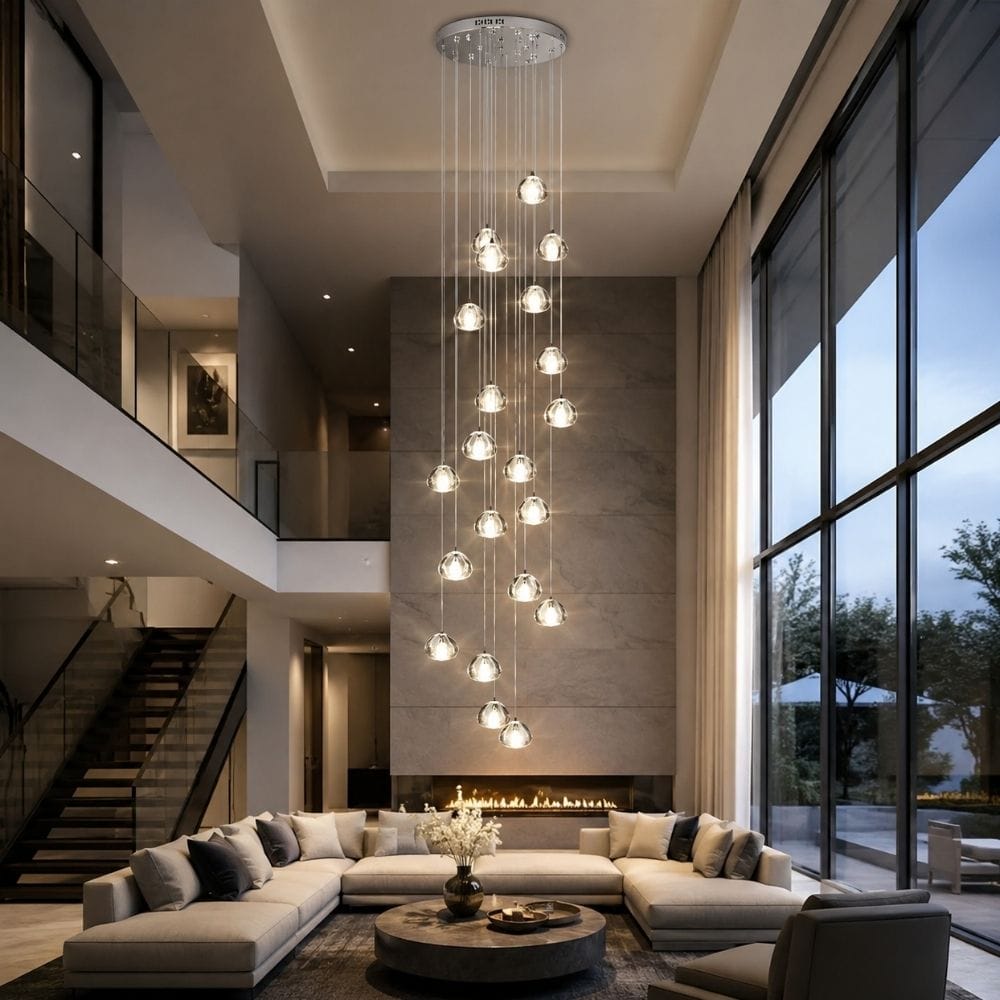
4Emma Crystal Staircase Chandelier
Configurable Count · Buy the Small VersionLight count is the lever that scales a crystal design down. Fewer lights means a shorter, sparser composition from the same family — so a design shown in its largest configuration can still suit a bedroom at its smallest. Order to your measurement rather than to the photograph, which is almost always the biggest version.
Order by: Your room, not the photograph
Suits: Bedrooms, entries, compact dining
Color: Warm white 3000K on a dimmer
Related: Crystal chandeliers

5Vita Crystal Flush Mount Chandelier
Six Sizes · Land on the Right NumberSmall-room sizing is often a specific figure rather than a range — 18 in for one bedroom, 22 in for another — and a wide size range is what makes hitting it possible instead of rounding to the nearest available. Linear versions also suit narrow entries and hallways where a round fixture would crowd the walls.
Formats: Round and linear
Linear suits: Narrow entries and hallways
Finishes: Gold or silver
Related: Flush mount chandeliers
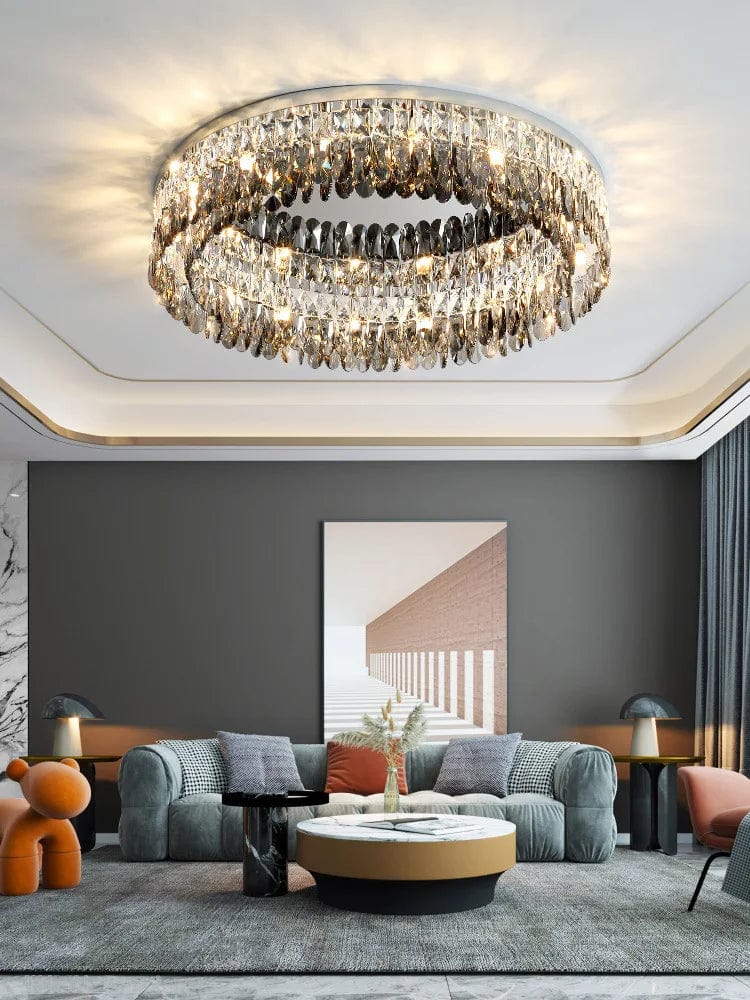
6Cara Crystal Flush Mount Chandelier
15.75 in · Powder Rooms and Small EntriesAt the smallest end of the category, where the question is whether crystal is possible at all. A flush crystal fixture fits a powder room or a small entry at standard ceiling height with the 84 in clearance intact, and keeps the decorative register a plain dome would lose. Specify warm white rather than cool — crystal reads cold under 4000K.
Fits: Powder rooms, small entries at 8 ft
Specify: Warm white — crystal reads cold at 4000K+
Check: Damp rating for full bathrooms
Related: Crystal chandeliers
Browse crystal lighting
Compact, flush and ring crystal fixtures for small rooms.
Crystal Chandeliers → Flush Mount → Bedroom →Light Output in a Small Room
Crystal has a specific relationship with output that matters more at small scale, because a compact room often has only one fixture.
Crystal redirects light rather than absorbing it, unlike stone or heavy fabric. That means a crystal fixture can be the main light in a small room where an alabaster one could not — but the redirected light goes sideways and upward as well as down, so the room feels bright while the surface directly beneath is less lit than the lumen figure suggests.
A small bedroom wants roughly 1,500-2,500 lumens and a small entry 1,000-2,000, both on a dimmer. The dimmer is not optional with crystal: refraction reads best at 30-60% output, and at full brightness the individual points merge into glare rather than resolving as sparkle.
Warm white, 2700-3000K. Crystal under cool light reads as cut glass rather than as crystal — the warmth is part of what makes the material look expensive. Above 4000K it looks clinical regardless of quality.
Common Mistakes
- Applying the room formula without the crystal correction. The material reads larger than its measurement. Size down one step.
- Judging by diameter alone. A dense 18 in piece can feel heavier than a sparse 26 in one. Look at whether the ceiling shows through.
- A multi-tier fixture in a small room. Stacked tiers are mass. They need a room that can hold them.
- Crystal directly over a bed. Refracted points are distracting from a reclining position. Center on the room instead.
- Measuring bedroom clearance from the floor. A mattress and base raise the effective floor by 20-25 in.
- Cool white lamps. Crystal reads as cut glass above 4000K. Warm white is what makes the material look right.
- No dimmer. Refraction resolves at 30-60% output; at full brightness the points merge into glare.
- Ignoring faceting quality because it is a small fixture. The opposite applies — close range is where cut precision and mold lines show.
- Ignoring projection in a hallway. Crystal passed closely is crystal that gets knocked.
Frequently Asked Questions
What size crystal chandelier for a small room?
Run the room formula — length plus width in feet, read as inches — then take one size down for crystal. A 10 x 12 ft bedroom calculates to 22 in; in crystal, 18-20 in is the better choice. Over a dining table, use the table rule at its lower end instead.
Why does crystal look bigger than its measurement?
Faceted surfaces return light in every direction, so the fixture's visual footprint extends past its physical edge onto the ceiling and walls. Density compounds it — the eye reads accumulated detail as mass, so a heavily dressed fixture feels larger than a sparse one of the same diameter.
Can you put a crystal chandelier in a bedroom?
Yes, and it is the most common small-crystal position. One placement rule applies: not directly over the bed, since refracted points are distracting from a reclining position. Center on the room or the foot of the bed, and measure clearance from the mattress top rather than the floor.
What size crystal chandelier for a bedroom?
16-18 in for a 10 x 10 ft room, 18-20 in for 10 x 12 ft, and 22-24 in for 12 x 14 ft. These are one step below what the room formula gives, which is the correction crystal needs.
Is crystal too much for a small space?
Not if the construction is open. A ring with spaced drops or a sparse single tier reads light and works in a compact room; a multi-tier fully dressed piece reads as mass and does not. The test from a photograph is whether you can see the ceiling through it.
What is the smallest practical crystal chandelier?
Around 10-12 in for a powder room, and 15-16 in for a small entry or bedroom. Below that the fixture starts reading as a fitting rather than a chosen piece, which defeats the reason for choosing crystal.
Does crystal quality matter more in a small room?
Yes. Faceting precision, edge sharpness and mold lines are all visible at arm's length and invisible from a stairwell. A fixture specified for a bedroom deserves more attention on cut quality than one for a tall void.
What color temperature for a crystal chandelier?
Warm white, 2700-3000K. Crystal under cool light reads as cut glass rather than crystal, and above 4000K it looks clinical regardless of the quality of the material. The warmth is part of what makes it look expensive.
Do crystal chandeliers need a dimmer?
Close to essential. Refraction resolves into distinct sparkle at roughly 30-60% output; at full brightness the individual points merge into a single bright mass that reads as glare rather than as crystal.
Can a crystal chandelier be the only light in a room?
In a small room, often yes — crystal redirects light rather than absorbing it, unlike stone. But the redirected light goes sideways and upward as well as down, so the surface directly beneath is less lit than the lumen figure suggests. Plan a lamp alongside for task light.
Is crystal hard to clean in a bedroom?
Easier than anywhere else, which is the compensation for being seen closely. A step ladder reaches it and dusting takes minutes, where the same job in a stairwell needs equipment. Dry microfiber twice a year is the routine.
Can crystal go in a powder room or bathroom?
A powder room with no shower is generally a dry location and takes a standard fixture. A full bathroom needs a damp-rated one — check the rating rather than assuming, since most decorative crystal fixtures are not rated for it.
One Size Down, and Check the Density
Crystal occupies more of a room than its measurement says, so the formula that works for plain fixtures overshoots here. Take one size down, judge density by whether the ceiling shows through, keep it off the area directly above a bed, and specify warm white on a dimmer — the material only resolves as sparkle below full output.
Browse the range: crystal chandeliers, flush mount, bedroom lighting.