Quick Answer
A chandelier is one fixture with multiple light points spread across a frame. A pendant is one fixture with one light point on a single drop. That structural difference decides output, how the light spreads, how many ceiling boxes you need, and which room geometries each suits.
Chandeliers spread light outward; pendants concentrate it downward. A chandelier fills a room from a central position. A pendant lights what sits directly beneath it, which is why islands and long tables use runs of them rather than one large fixture.
Ceiling boxes decide more than taste does. One chandelier needs one box. Three pendants over an island need three, positioned before the drywall goes up — which makes the format decision a construction-stage decision, not a shopping one.
Pendant chandeliers sit between them: a single suspension point carrying chandelier-level detail. One box, decorative presence, moderate output.
These two words get used interchangeably in shopping and describe genuinely different objects. The confusion is understandable — both hang from a ceiling, both can be decorative, and both appear in the same rooms. But the structural difference between them changes what each one can do, and choosing the wrong format for a room produces a result that no amount of style selection fixes. This guide covers what actually separates them, how each distributes light, the installation reality, and where the hybrid format between them belongs.
On this page
What Actually Separates Them
The distinction is structural rather than stylistic, and once it is clear the rest follows.
A chandelier has multiple light points distributed across a frame. Arms, rings, tiers or clusters carry several lamps, spread horizontally. The frame exists to hold them apart and to carry power to each one. Because the light sources are separated, the fixture illuminates in every direction from a single position.
A pendant has one light point on a single drop. A cord or rod carries one lamp inside one shade. There is no frame to spread across, so the fixture is compact and its light comes from one place.
How Each Distributes Light
This is where the structural difference becomes a practical one.
A chandelier fills a room. Light leaves from several points at once, travelling outward as well as down, so walls and corners receive some of it. That makes a chandelier capable of serving as a room's primary light — not always, but the format allows it.
A pendant lights a zone. Output comes from one point and, in most designs, is directed downward by the shade. It produces a defined pool of light beneath itself and contributes little beyond that. This is a limitation in an open room and an advantage over a work surface, where a defined pool is exactly what you want.
| Behaviour | Chandelier | Pendant |
|---|---|---|
| Light sources | Multiple, spread across a frame | One, on a single drop |
| Spread | Outward and down | Down, into a defined pool |
| Reaches walls and corners | Partly | Rarely |
| Typical output | Higher — several lamps | Lower — one lamp |
| Can serve as primary light | Often | Only in small rooms |
| Ceiling boxes needed | One | One per fixture |
| Typical use | Room centre, above a table | Over a surface, or repeated in a run |
Room Geometry Decides
Where the two formats genuinely diverge is in how they handle shape. A room's geometry, not its style, should make this decision.
- A round or square table wants a chandelier. The table has a centre, the fixture has a centre, and light spreads outward to every seat equally. Size it at one-half to two-thirds of the table's width.
- A long table or island wants pendants. A single round fixture above a 96 in table lights the middle seats and leaves the ends dim. A run of pendants distributes light along the axis — roughly one per 24-30 in of length.
- An open room with no surface beneath wants a chandelier. Nothing needs a defined pool of light; the room needs filling, which is what spread sources do.
- A narrow space — hallway, stairwell landing, small entry — wants a pendant. A compact single drop fits where a spreading frame would not.
- A room entered from several directions favours a chandelier, since radial forms have no front or back.
The one case where a linear chandelier competes with a pendant run is a long table. Both work; the difference is that a linear fixture needs one box while a pendant run needs several. Where the boxes are already in place, that usually settles it.
The Ceiling Box Reality
This is the constraint most shopping guides skip, and it is frequently the one that makes the decision.
Ceiling boxes go in before drywall. A chandelier needs one, positioned at the fixture's centre. A run of three pendants needs three, spaced to match the island's final length — which means the island dimensions have to be settled before the electrician arrives. Where boxes were placed before the layout was final, the result is pendant spacing that cannot be corrected without opening the ceiling.
Chandelier Picks: When Spread Matters (4 Designs)
For room centres, round tables and spaces that need filling rather than a defined pool. Size at one-half to two-thirds of a table's width, or use the room formula — length plus width in feet, read as inches.
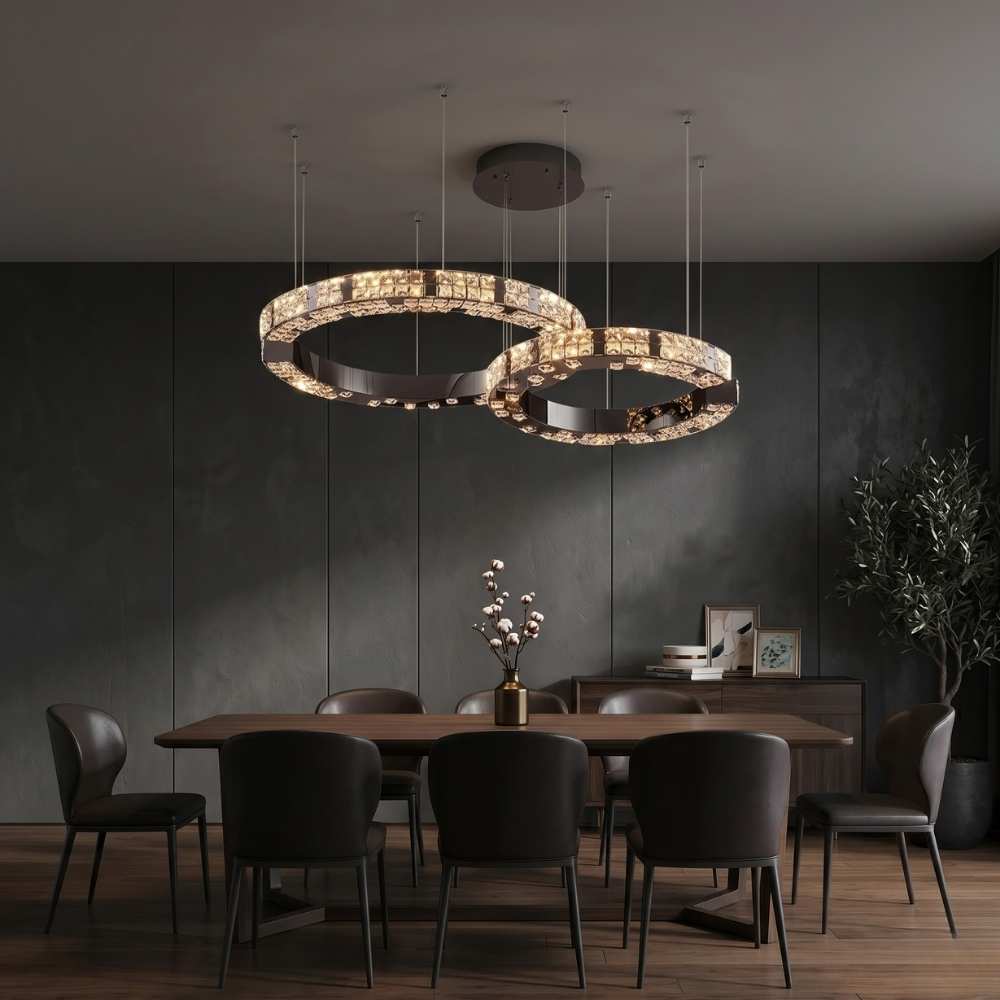
1Arven Modern Crystal Ring Chandelier
Round Tables · Radial SpreadThe geometry argument in one fixture: a ring has a centre and no front, so it matches a round or square table exactly and reads the same from every seat. Multiple sources around the circumference spread light outward rather than concentrating it, which is what separates this from a single large pendant of the same diameter.
Suits: Round and square tables, rooms with no front
Size to: ½ to ⅔ of the table's width
Boxes needed: One
Related: Ring chandeliers
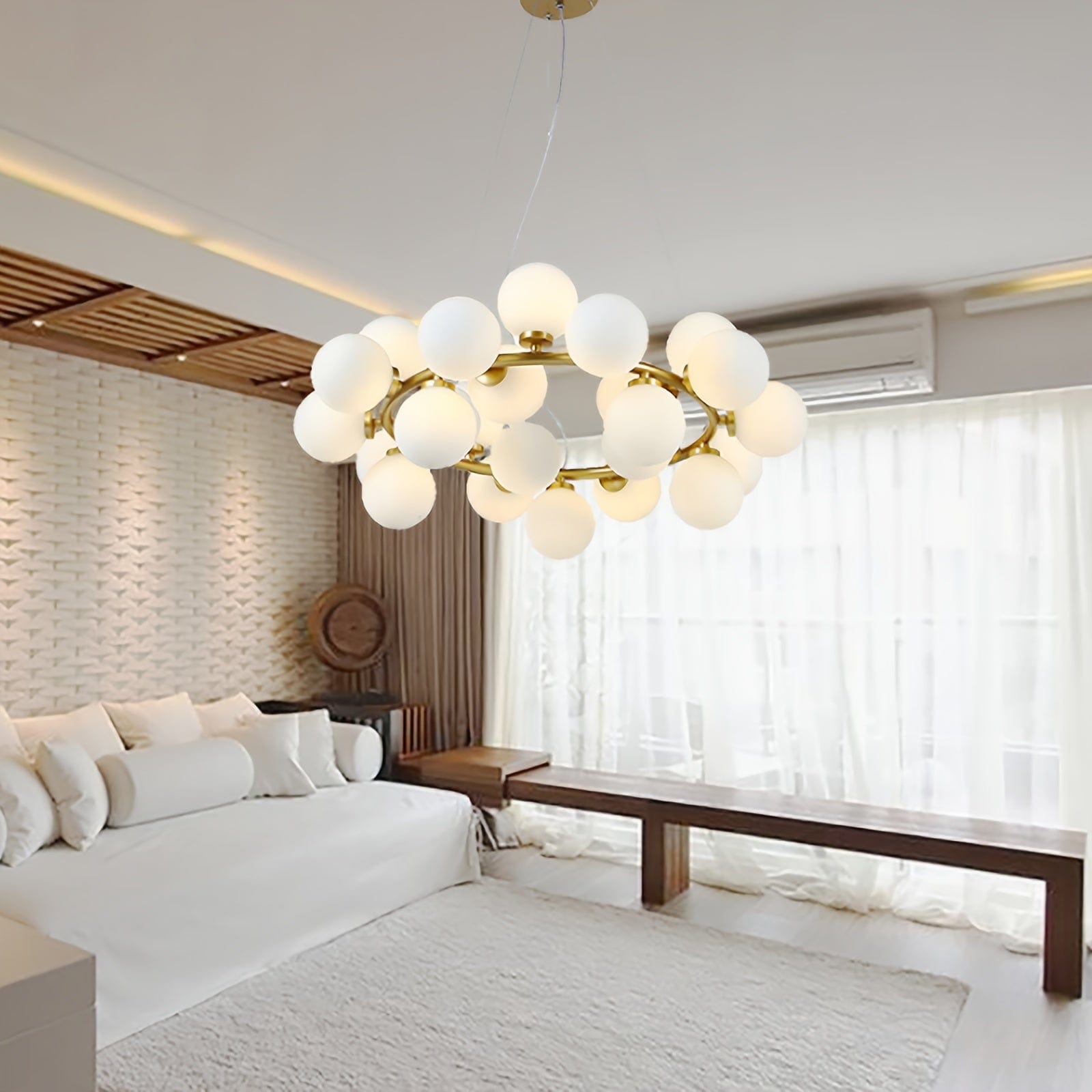
2Holly Milk Glass Chandelier
Primary Light · Multiple Opal ShadesWhere a chandelier genuinely serves as a room's main source rather than a decorative layer. Several opal shades produce both spread and real output — opal transmits more of a lamp's light than any other diffuser while still hiding the source completely. This is the configuration to look for when there is no recessed lighting to fall back on.
Glare: None — lamps fully concealed
Best where: No secondary lighting exists
Cleaning: Damp cloth acceptable on glass
Related: Glass chandeliers
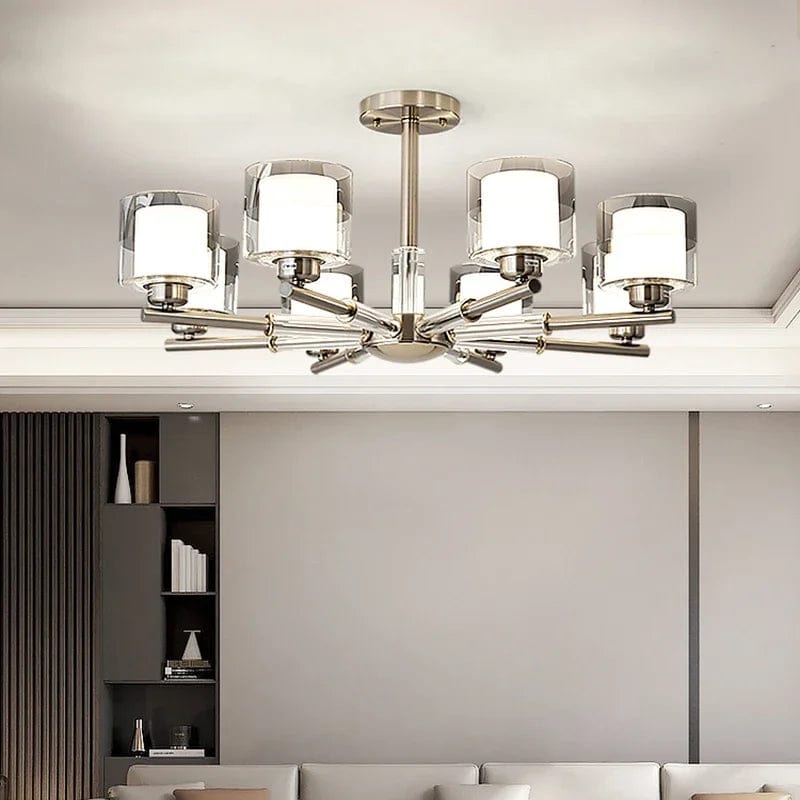
3Amanda Modern Silver Chandelier
Long Tables · One Box Instead of ThreeThe direct alternative to a pendant run. A linear chandelier distributes light along a table's axis exactly as three pendants would, but from a single ceiling box — which matters when the box is already in place and the island length was decided afterwards. Available in round as well, so one finish can serve a rectangular table and a seating group.
Size to: ½ to ⅔ of the table's length
Width rule: Under ⅓ of the table's width
Formats: Linear and round
Related: Linear chandeliers
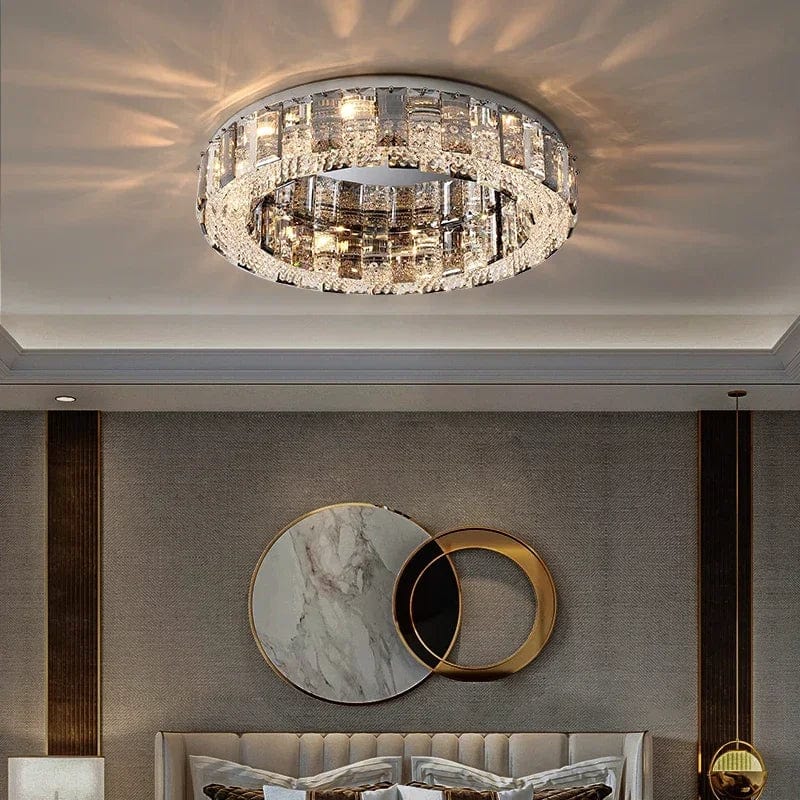
4Rina Crystal Ceiling Chandelier
Low Ceilings · Spread Without DropWhere a pendant cannot go at all. On an 8 ft ceiling the 84 in clearance rule leaves roughly 12 in of vertical space over walking areas — too little for a suspended pendant, but adequate for a close-mount chandelier that spreads horizontally instead of hanging down. Crystal also compensates for lower output by moving light around the room.
Spreads: Horizontally rather than dropping
Clearance: Meets the 84 in rule where pendants cannot
Crystal: Distributes light through refraction
Related: Flush mount chandeliers
Pendant Picks: When a Defined Pool Matters (4 Designs)
For work surfaces, islands, bedsides and narrow spaces. Repeat one per 24-30 in of counter length, hung 30-36 in above the surface.
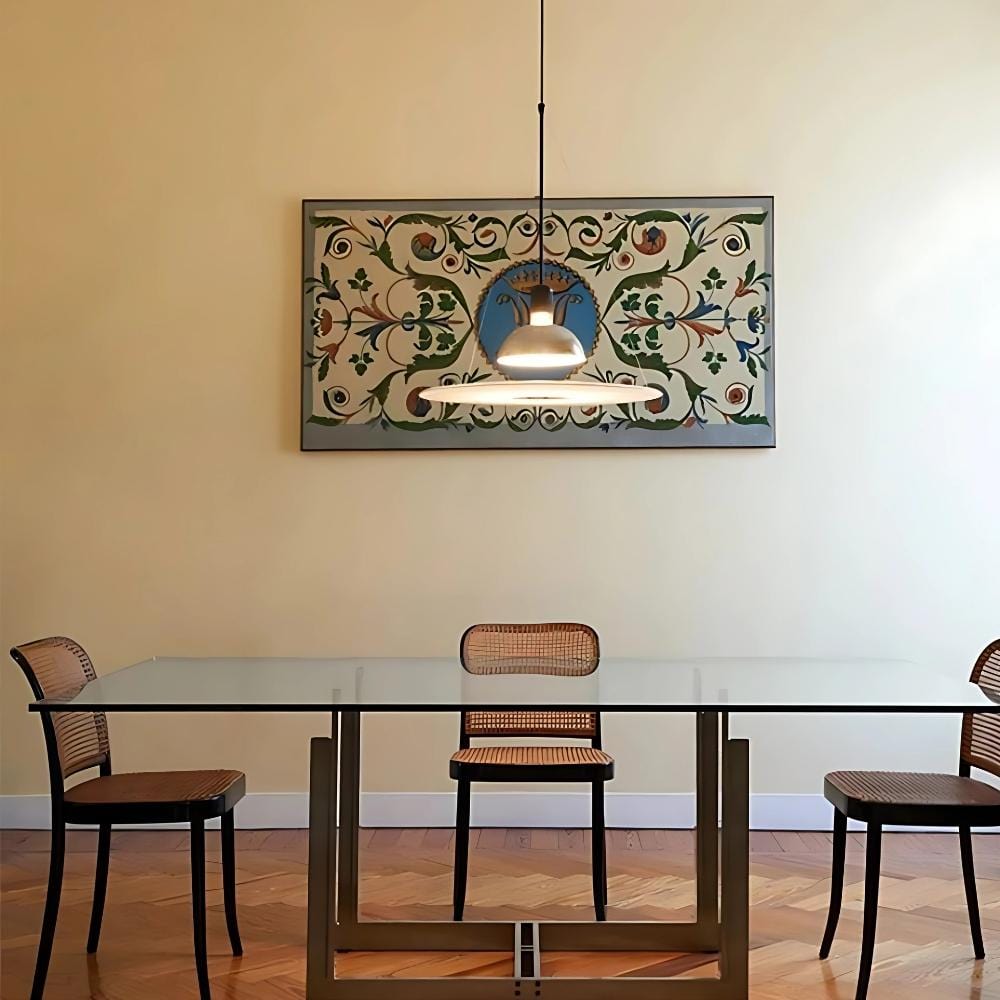
5Chiara Scandinavian Pendant Light
Island Runs · Reads as a LineThe pendant case at its clearest. Low visual weight per fixture is what allows three of them to read as one line rather than three separate objects — the practical test for any run repeated more than twice. A shaded body also directs output downward onto the counter rather than spreading it, which is the whole reason to use pendants over a work surface.
Spacing: One per 24-30 in of island length
Height: 30-36 in above the counter
Repeats well: Low visual weight per unit
Related: Pendant lights

6Iris Gold Glass Pendant Light
Single Drop · Warm MetalA pendant used alone rather than in a run — over a breakfast bar, a small round table, or beside a stairwell landing. One fixture, one box, and a defined pool of light beneath it. Warm gold suits rooms whose cabinet pulls and tap are already brass, since hardware is the element a fixture is seen alongside.
Match to: Brass or warm gold hardware
Glass: Softens output at close range
Boxes needed: One
Related: Glass pendant lights
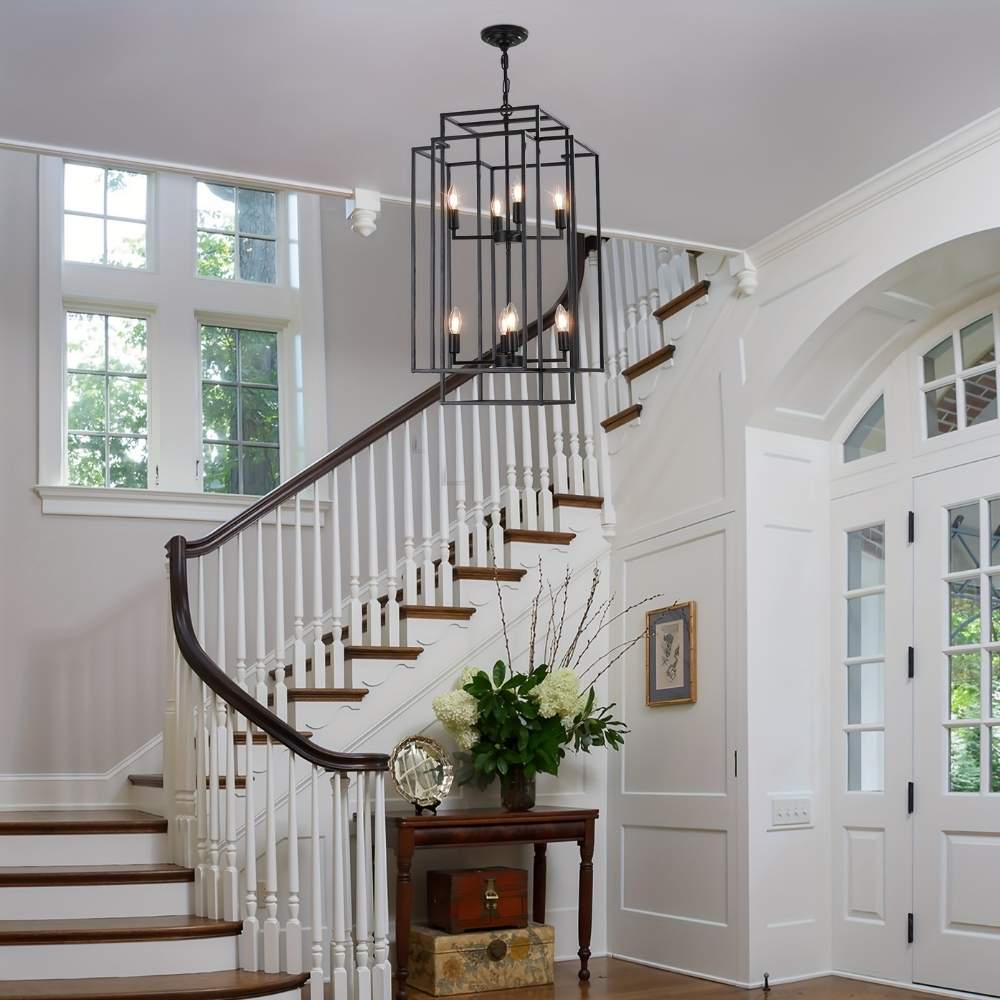
7Tyra Lantern Pendant Light Fixture
Enclosed · Safe Above Gloss SurfacesLantern forms enclose the lamp on every side, which is what a polished counter needs — an exposed bulb above a mirror-finish surface shows as a bright reflected spot from every seat. The enclosed body also softens what would otherwise be a hard downward pool, which suits a pendant hung at eye level in a hallway or entry.
Why: Lamp enclosed — no mirrored reflection, no glare
Style fit: Transitional, shaker, farmhouse
Also suits: Hallways, entries, stair landings
Related: Modern pendant lights
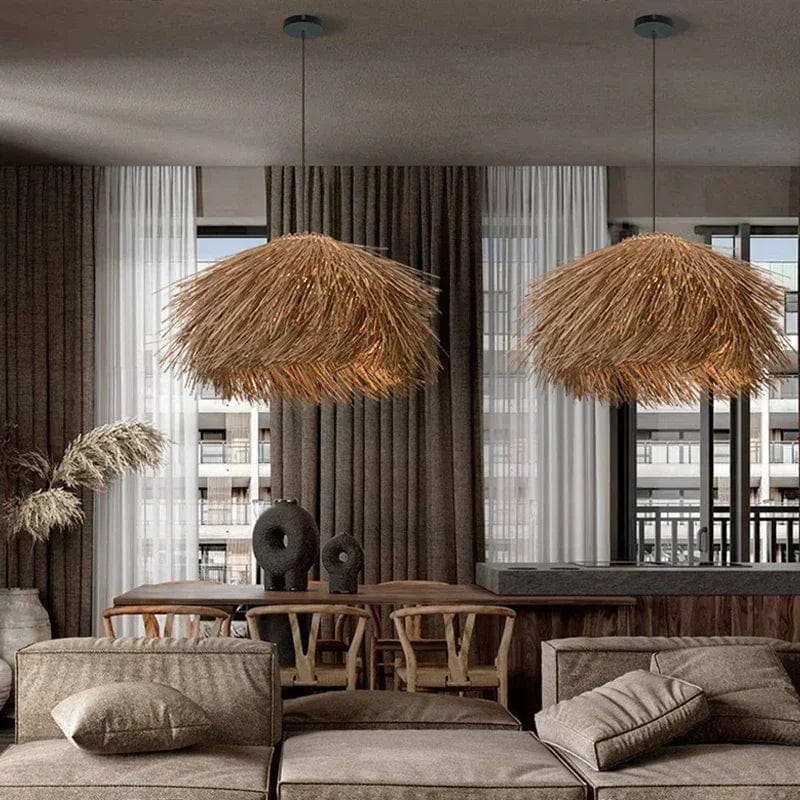
8Piper Rattan Pendant Chandelier
Compact · Where a Frame Will Not FitThe narrow-space case. At 15.75 in a compact pendant fits positions a spreading chandelier frame cannot — a hallway, a small entry, above a bedside table. Woven shades also throw dappled light through the weave onto surrounding surfaces, which adds interest a plain shade does not. Keep them clear of the hob, since fibre cannot be wet-cleaned.
Size: 15.75" (40 cm) — compact footprint
Effect: Dappled light through the weave
Placement note: Away from cooking — no wet cleaning
Related: Rustic pendant lights
Browse both formats
Multi-source chandeliers, single-drop pendants, and the format between them.
Chandeliers → Pendant Lights → Pendant Chandeliers →The Format Between Them
A third category resolves the trade-off, and it is the one most people have not heard named: the pendant chandelier.
Structurally it is a pendant — one suspension point, one ceiling box, a compact footprint. Visually it is a chandelier — crystal, layered glass, multiple elements, the detail level of a fixture several times its size. It occupies a size band conventional chandeliers largely skip, typically 12 to 28 in across.
Where it earns its place: rooms with one existing box that want more presence than a plain pendant delivers; ceiling heights that will not take a spreading frame; and positions examined at close range, where detail matters more than reach. The pendant chandeliers collection covers the format, and two designs illustrate it directly.
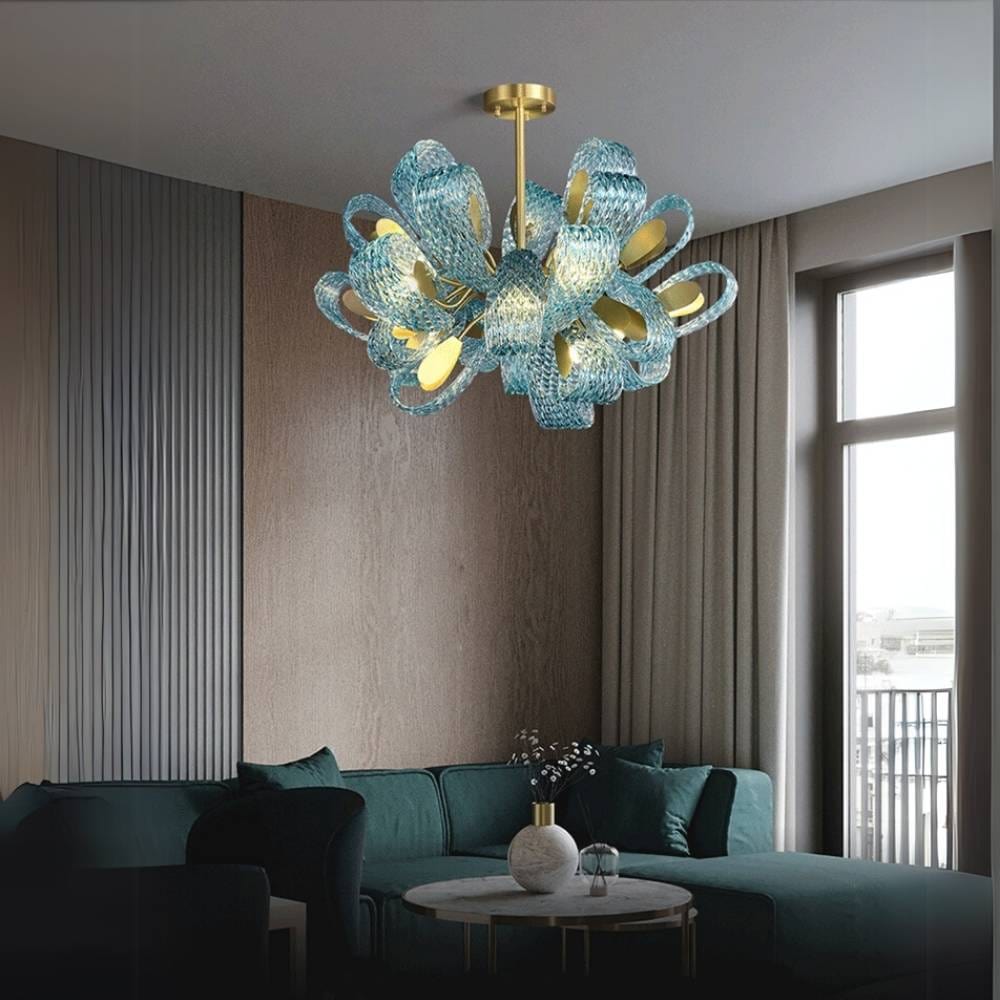
9Pia Contemporary Pendant Chandelier
Hybrid · Chandelier Presence, One BoxChandelier-level presence from a single suspension point. This is the answer where the ceiling has one box, the room wants more than a plain shade, and adding boxes would mean opening the ceiling. The single point also helps a complex form read clearly — nothing spreads across the ceiling competing for attention.
Visually: Chandelier — layered, detailed
Solves: One box, wants presence
Size: 39.37" (100 cm)
Related: Pendant chandeliers

10Leda LED Pendant Chandelier
Integrated LED · Hard-to-Reach PositionsThe hybrid format with the maintenance question removed. Integrated LED means no lamps to change for decades, which matters most in exactly the positions this format suits — stairwell landings, high entries, above stairs. Check the dimming depth before buying, since the source cannot be swapped later.
Removes: Lamp access in awkward positions
Check first: Dimming depth, driver serviceability
Boxes needed: One
Related: Integrated LED guide
Output Compared
The output difference is arithmetic rather than mysterious: more lamps produce more light. What varies is how much of it reaches the room.
| Configuration | Typical lamps | Rough total output | Can carry a room? |
|---|---|---|---|
| Single pendant, shaded | 1 | 400-800 lm | Small rooms only |
| Single pendant, opal glass | 1-3 | 800-1,600 lm | Small to medium rooms |
| Run of three pendants | 3 | 1,200-2,400 lm | Over a surface, yes |
| Pendant chandelier | 3-8 | 1,000-2,500 lm | Medium rooms, partly |
| Chandelier, 6-8 lamps | 6-8 | 2,400-4,800 lm | Usually yes |
| Chandelier, 12+ lamps | 12+ | 4,000-8,000 lm | Yes, with a dimmer |
Two adjustments matter more than the lamp count. Diffuser material changes how much output escapes — opal glass transmits most of it, stone and heavy crystal absorb a substantial share. And direction decides where it lands: a downward-facing fixture puts its output on the surface below, while an upward or all-round design spreads it across the room at lower intensity. Roughly, a bedroom needs 1,000-2,000 lumens of ambient light, a dining room 2,000-4,000, and a kitchen 4,000-8,000 across all sources.
Using Both in One Home
Most houses use both, and the arrangement that works is straightforward: chandeliers where rooms need filling, pendants where surfaces need lighting.
A dining room takes a chandelier over a round table or a linear one over a long table. The adjoining kitchen takes a pendant run over the island. An entry takes a chandelier or a pendant chandelier depending on ceiling height. Bedrooms take either, with bedside pendants replacing table lamps where the nightstand is small.
Two rules keep the mix from reading accidental. Keep the finish family consistent across a floor — the same metal across rooms ties them together while different formats keep each room readable as its own space. And match colour temperature everywhere, particularly in open plans where a kitchen and living area are seen at once. Mixed Kelvin between adjoining zones is the most visible lighting error in a modern house.
Common Mistakes
- Choosing the format by style rather than geometry. A round table wants spread, a long one wants a run. The room decides before taste does.
- A single round fixture over a long table. It lights the middle seats. This is the most common and most visible format error.
- Expecting one pendant to light a room. One lamp, directed downward, produces a pool rather than ambient light. Plan other layers.
- Deciding the format after the ceiling closes. Box count then decides for you, and adding boxes is drywall work.
- Placing pendant boxes before the island length is final. Spacing that cannot be corrected without opening the ceiling.
- Pendants too close together in a run. One per 24-30 in of counter length, kept inside the counter's ends.
- A suspended pendant on an 8 ft ceiling over a walkway. The 84 in clearance rule leaves about 12 in. Close-mount or flush instead.
- Exposed lamps above a polished counter. The surface mirrors the bulb from every seat. Enclosed or diffused designs.
- Mixing colour temperature between adjoining zones. The most visible error in open-plan homes.
Frequently Asked Questions
What is the difference between a chandelier and a pendant light?
A chandelier has multiple light points spread across a frame; a pendant has one light point on a single drop. That structural difference decides output, how light spreads, and how many ceiling boxes are needed. Count the sources: several spread apart is a chandelier, one point is a pendant regardless of size.
Which gives more light, a chandelier or a pendant?
A chandelier, usually, because it carries more lamps. A single shaded pendant produces roughly 400-800 lumens; a six-to-eight lamp chandelier produces 2,400-4,800. Diffuser material adjusts this — opal glass transmits most of the output while stone and heavy crystal absorb a substantial share.
Can I use a pendant light over a dining table?
Over a small round table, yes. Over a long table, a single pendant lights the middle seats and leaves the ends dim — that geometry wants either a run of pendants along the axis or a linear chandelier.
How many pendants do I need over an island?
Roughly one per 24-30 in of island length, kept inside the counter's ends and hung 30-36 in above the surface. A 72 in island takes two or three; a 96 in island takes three.
What is a pendant chandelier?
A hybrid: structurally a pendant with one suspension point and one ceiling box, visually a chandelier with crystal, layered glass or multiple elements. It occupies a size band conventional chandeliers skip, typically 12-28 in, and suits rooms with one box that want more presence than a plain shade delivers.
Do pendants need more ceiling boxes than a chandelier?
Yes, one per fixture. A chandelier needs one box; three pendants need three, positioned before drywall to match the island's final length. This is why the format choice belongs at the construction stage rather than the shopping stage.
Which works better on a low ceiling?
Neither suspended format works well on 8 ft over a walkway, since the 84 in clearance rule leaves about 12 in. A close-mount or flush chandelier spreads horizontally rather than dropping, which is the format for that height. Over a table, where nobody walks beneath, a pendant becomes possible.
Can a chandelier be the only light in a room?
Often, if it carries enough lamps and diffuses efficiently — multiple opal shades is the configuration to look for. Heavily crystal and stone fixtures absorb too much to serve alone and need recessed lighting or lamps alongside them.
Should chandeliers and pendants in one house match?
Related, not identical. Keeping the same metal family across a floor ties rooms together while different formats keep each room readable as its own space. Colour temperature does need to match, particularly between zones seen at once in an open plan.
Is a multi-light pendant a chandelier?
No, if the lamps sit inside one shade on one drop — the light still emerges from a single point. It becomes a chandelier when the sources are separated across a frame, because it is the distribution that defines the category.
Which is easier to install?
A chandelier, usually, because it is one fixture on one box. A pendant run means several fixtures, several boxes and consistent levelling across them — more work even though each individual fixture is lighter.
What if I already have one ceiling box but want a pendant run?
Three options: add boxes, which is drywall work; use a linear chandelier, which distributes light along an axis from one point; or use a pendant chandelier, which gives multi-fixture presence from a single drop.
Count the Sources, Then Count the Boxes
The format question answers itself once two things are known: how many light points the fixture has, and how many ceiling boxes the room has. Multiple sources spread across a frame fill a room; one source on a drop lights what sits beneath it. And where the ceiling offers one box but the room wants more presence, the hybrid format between them exists precisely for that.
Browse the range: chandeliers, pendant lights, pendant chandeliers, linear chandeliers.