Quick Answer
Light the house in six zones, in order of arrival: approach, entry, facade, garage and driveway, side paths, then patio and garden. Each does a different job, and planning them in sequence is what stops an exterior looking like fixtures added one at a time.
Less light, in more places, beats more light in one place. A single bright fixture creates glare and deep shadow. Several modest sources at 2700-3000K produce an exterior that reads welcoming rather than institutional.
Keep one finish family across the whole house. The exterior is seen in a single glance from the street, so mixed finishes read as accumulation rather than design.
Aim light down, not out. Shielded and downward fixtures put light on the house and the ground where it is useful, keep it out of neighbours' windows, and comply with the dark-sky rules a growing number of US municipalities now have.
Most houses end up with exterior lighting rather than an exterior lighting plan: a fixture by the door, one at the garage, something on the patio, each bought years apart. The result works but rarely looks considered, and it usually leaves the parts people actually navigate — the walk from the car, the side path, the steps — darker than the parts nobody uses. This guide takes the house zone by zone in the order a visitor experiences it, with the fixture type, mounting height and brightness each zone actually needs.
On this page
- Four Principles Before Any Fixture
- The Six Zones
- 1. Approach and Front Path
- 2. Entry and Porch
- 3. Facade and Architecture
- Entry and Facade Picks
- 4. Garage and Driveway
- 5. Side Paths and Back Door
- 6. Patio, Deck and Garden
- Security and Patio Picks
- Where to Start on a Budget
- Common Mistakes
- Frequently Asked Questions
Four Principles Before Any Fixture
- One finish family across the house. An exterior is read in a single glance from the street, unlike an interior read room by room. Matte black throughout, or brass throughout — mixing them reads as fixtures bought at different times, because that is usually what happened.
- Warm white everywhere, 2700-3000K. Warm light flatters brick, timber and render and reads welcoming. Cool white above 4000K reads commercial or security-grade on a house, and the difference is more visible outdoors than in.
- Aim down, not out. Shielded fixtures put light where it is useful, avoid glare into neighbours' windows, and meet the dark-sky ordinances a growing number of municipalities have adopted.
- Several modest sources beat one bright one. A single high-output fixture creates a bright pool surrounded by deeper shadow, which makes the rest of the property harder to see rather than easier.
The Six Zones
| Zone | Job | Fixture type | Rough output each |
|---|---|---|---|
| 1. Approach and front path | Navigation | Low path lights, step lights | 50-150 lm |
| 2. Entry and porch | Arrival, face recognition | Wall sconces, ceiling fixture | 400-800 lm |
| 3. Facade | Architecture after dark | Up/down wall cylinders, linear bars | 200-500 lm |
| 4. Garage and driveway | Function and security | Wall pairs, motion sensing | 600-1,000 lm |
| 5. Side paths and back door | Safety, rarely aesthetic | Motion-sensor wall lights | 400-800 lm |
| 6. Patio and garden | Making an outdoor room | Shielded wall lights, string, pendants | 200-500 lm |
Output per fixture by zone — path and patio lowest, garage highest, entry moderate
1. Approach and Front Path
The walk from the car or the sidewalk is the zone most often left dark, and the one where lighting does the most practical good. A guest arriving after dark navigates it first, and steps, level changes and path edges are what they need to see.
Keep it low and keep it dim. Path lighting works at 50-150 lumens per fixture — far less than people expect. The job is to mark the edge of the path and reveal changes in level, not to illuminate the garden. Anything brighter at ankle height becomes glare that makes the path harder to read.
Space path fixtures 6-8 ft apart, staggered rather than in matched pairs, which reads more natural and avoids a runway effect. Where there are steps, light them specifically — a step in shadow is the most common outdoor trip hazard, and one dedicated fixture there does more for safety than three along the flat path.
2. Entry and Porch
The entry is where the house introduces itself, and it is the one exterior zone with a functional requirement beyond navigation: people need to see faces here, both arriving and answering.
- A pair flanking the door reads balanced and formal, and suits standard and wide entries. Mount at 66 in (168 cm) to fixture centre, sized to roughly one-quarter to one-third of the door's height.
- A single fixture on the latch side works on compact entries where a pair would crowd. Same height, same sizing rule.
- A porch ceiling fixture adds the layer that flanking sconces miss — light on the floor and on whatever is being carried. On a deep porch this matters more than the wall fixtures do.
- Covered porches take damp-rated fixtures; an exposed door front needs wet-rated. The rating decision is covered in our outdoor installation guide.
- Keep output moderate. 400-800 lumens per fixture is plenty at an entry. Brighter creates glare directly at face height, which is the opposite of what the zone needs.
3. Facade and Architecture
This is the zone that separates a lit house from a designed one, and it is the least understood. Facade lighting is not about brightness — it is about revealing texture and rhythm that daylight shows and darkness hides.
Up-and-down wall cylinders mounted close to the surface graze it, throwing light along the wall rather than at it. That grazing angle is what reveals brick coursing, stone texture and render depth. The same fixture mounted further from the wall produces a flat wash that shows nothing.
Repetition is the effect. A single facade fixture reads as an accident. Three or more at even spacing — commonly 6-8 ft apart — at one identical height reads as architecture. The consistency matters more than the individual fixture: one unit an inch off height undoes the line for the whole run.
Two restraints worth applying. Light the features worth showing rather than the whole wall — a textured chimney, a stone base, a portico — and leave the rest dark, since contrast is what makes the lit parts read. And keep facade output low, around 200-500 lumens per fixture, because a wall does not need to be bright to be visible at night.
Entry and Facade Picks (4 Designs)
Entry fixtures at 66 in to centre, sized to the door. Facade runs at one identical height, 6-8 ft apart, at lower output than the entry.

1Anya Modern Outdoor Wall Light
Entry Pair · Nine SizesThe entry fixture's proportion rule is relative to the door, not absolute, which is why a range of sizes matters here more than anywhere else on the house. Nine options means the fixture can actually land at one-third of your door's height rather than at the nearest size that exists. Buy the pair together for finish consistency.
Mount at: 66 in (168 cm) to centre
Size to: ¼ to ⅓ of the door's height
Buy: As a pair, same batch
Related: Outdoor wall lights
2Rowan Modern Outdoor Wall Light
Facade · Vertical ProportionTall narrow fixtures suit facade positions because they echo the vertical lines a house already has — door surrounds, window reveals, corner boards. At 19.69 in this reads as an architectural element rather than as a lamp attached to a wall, which is the distinction that makes facade lighting work.
Height: 19.69" (H50 cm) — vertical proportion
Spacing in a run: 6-8 ft, one identical height
Output: Keep lower than the entry
Sizes: Six
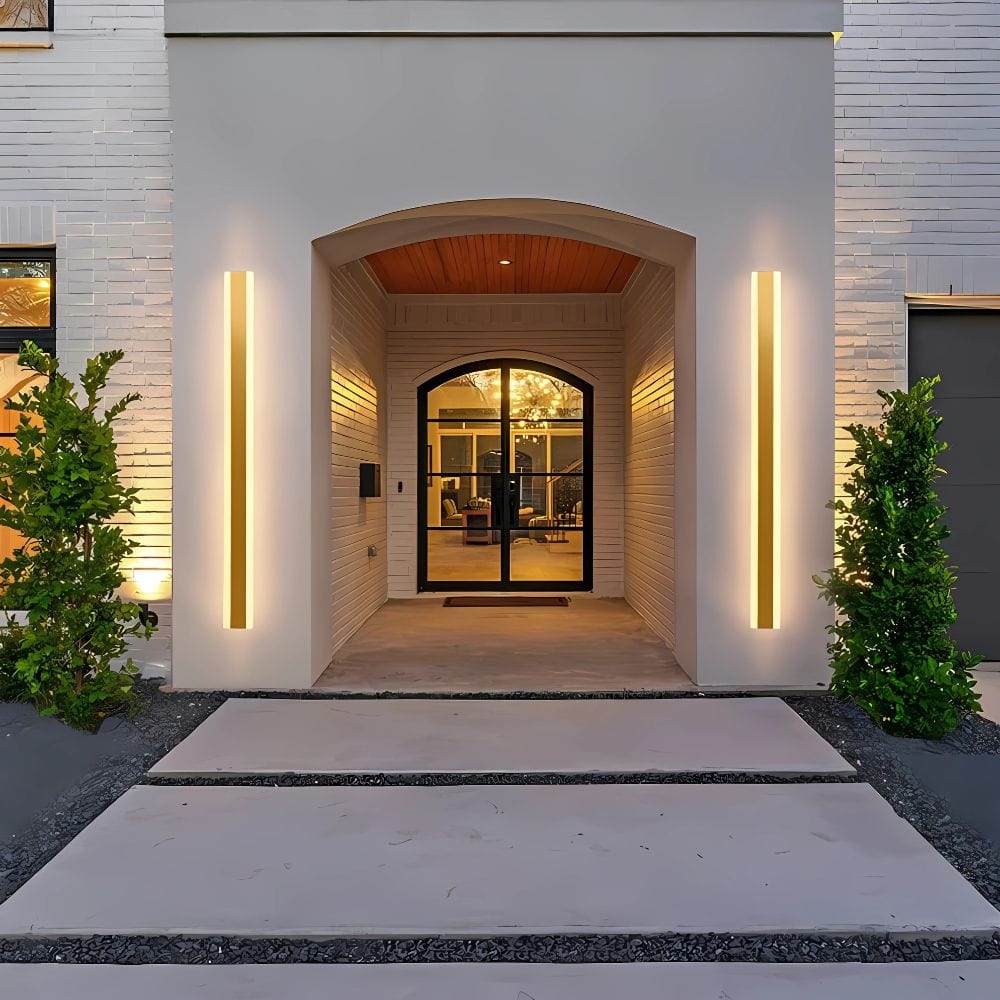
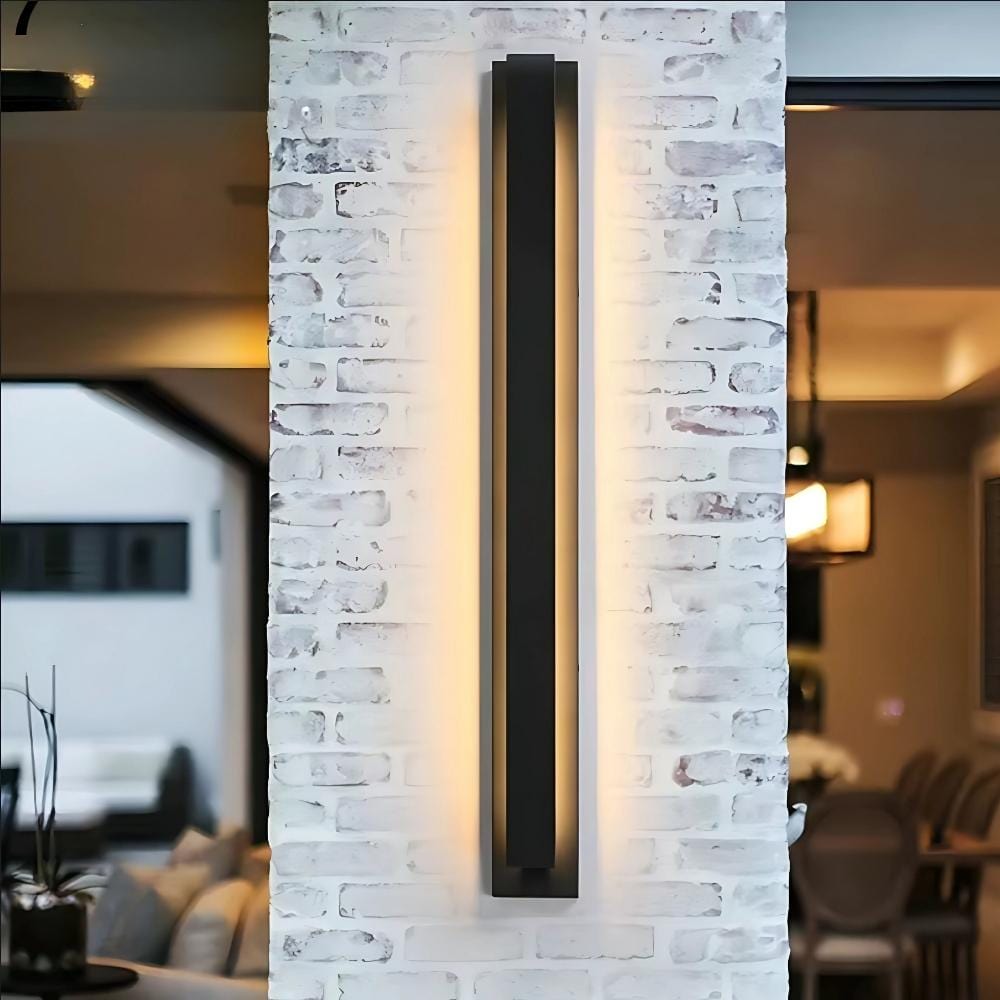
3Glacia Long Outdoor Wall Sconce
Linear Bar · Grazing WashLinear bars mounted close to a wall graze it, which is what reveals brick coursing and stone texture rather than flatly washing over them. Eight sizes lets a run be proportioned to the wall it sits on — a 60 in bar on a broad facade reads correctly where a compact fixture would look lost.
Effect: Grazing wash reveals surface texture
Mount: Close to the wall for the grazing angle
Sizes: Eight — proportion to the wall
Finishes: Gold, black, white
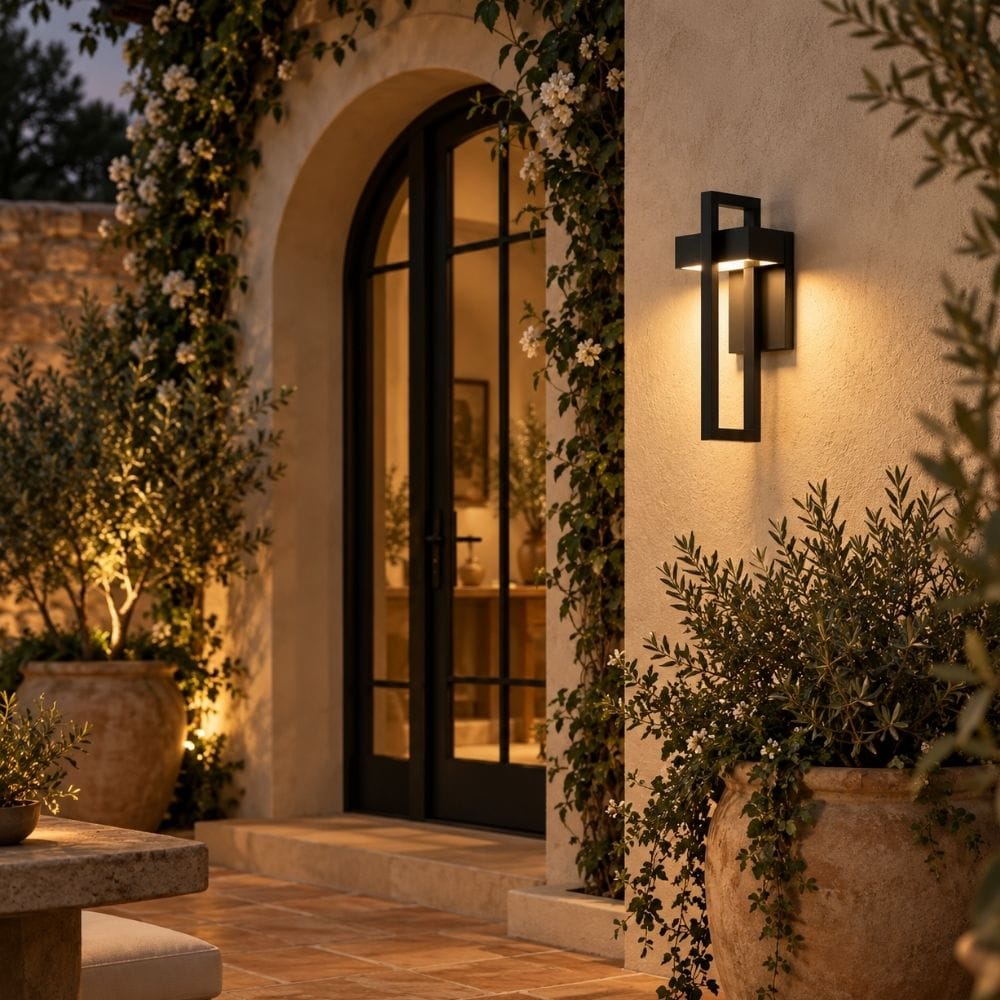
4Tivaro Modern Black Outdoor Wall Light
One Finish Family · Repeats Across ZonesThe practical answer to the one-finish rule. A compact matte black design at 13.8 in works at the entry, on the facade, beside the garage and on a patio wall — which lets a whole house share one visual language without every position getting the same fixture size. Matte black also hides handling marks and dust better than any other exterior finish.
Why it matters: One finish family, read in one glance
Height: H13.8" (35 cm), two sizes
Finish: Matte black — most forgiving outdoors
Related: Outdoor lighting
4. Garage and Driveway
The garage is a function zone, and the place where security lighting belongs if it belongs anywhere. It is also where the most common exterior lighting mistake happens: a floodlight so bright it defeats its own purpose.
Flank the garage door with a matched pair mounted at 66-72 in (168-183 cm) to centre, sized slightly smaller than the entry fixtures so the garage supports the entry rather than competing with it. On a double garage, one either side of the door reads balanced; on a wide multi-bay garage, one between each pair of doors.
Motion sensing earns its keep here more than anywhere on the house. It gives full output when someone approaches and nothing the rest of the night, which suits how a driveway is used. Two things to get right at installation: the detection arc should cover the driveway and approach rather than the road, and the sensitivity should not trigger on passing cars or animals — a light that comes on all night is worse than one that never does.
5. Side Paths and Back Door
The least glamorous zone and frequently the most useful. Side paths, service doors and the route to bins are used in the dark by residents rather than seen by visitors, which changes the priority entirely: this is safety lighting, and it does not need to be attractive.
Motion sensing suits these positions for the same reason it suits the garage — they are used briefly and unpredictably. A wall fixture at standard height with a sensor is usually enough, at 400-800 lumens. Where the path is narrow, choose a low-projection fixture: anything that sticks out from the wall in a passage becomes something to catch a shoulder on when carrying things.
One planning point: side paths are where houses most often have no exterior box at all, since the original build did not anticipate the route being used. Adding one is an electrician's job, and worth pricing at the same time as any other exterior work rather than as a separate visit.
6. Patio, Deck and Garden
The only exterior zone people sit in, which changes every specification. Here the goal is an outdoor room rather than illumination, and the biggest single decision is to keep everything below and behind the eye line.
- Drop the mounting height to 60-66 in on seating walls, lower than anywhere else on the house, and use shielded or downward designs. A visible source at seated eye level is glare, not atmosphere.
- Keep output low — 200-500 lumens per fixture. A patio needs far less light than people assume, and lower levels are what make an outdoor space feel like an evening room rather than a work area.
- Layer, do not centralise. Several small sources around a seating area produce a better result than one bright fixture above it, for the same reason interior rooms are layered.
- A covered patio or pergola takes a hanging fixture, treated like an interior dining room: centred on the table, 30-36 in above a dining surface, damp or wet rated per the exposure.
- Put it on a dimmer if the circuit allows. An outdoor room used for dinner and for sitting afterwards needs two different levels.
Security and Patio Picks (4 Designs)
Motion sensing where output should be occasional, shielded low-mount designs where people sit. Keep the finish consistent with the front of the house.
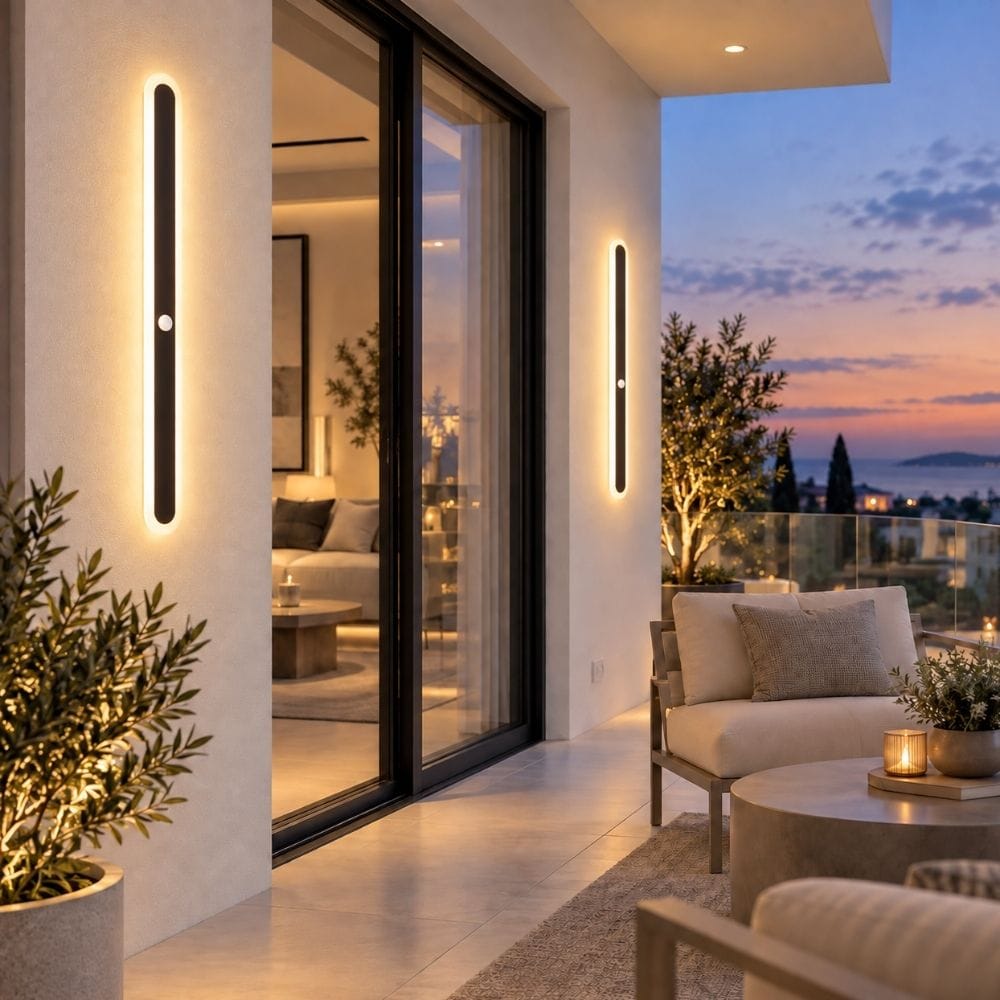
5Kavero Motion Sensor Outdoor Wall Light
Zones 4 & 5 · Output When NeededMotion sensing is the right answer for driveways, side paths and back doors — positions used briefly and unpredictably. Built-in sensing also avoids a separate device to wire and weatherproof. Aim the detection arc at the approach rather than the road, or passing traffic runs it all night.
Mount at: 66-72 in on garage walls
Aim the arc at: The approach, not the road
Finishes: Black, gold, white, grey
Six sizes available

6Blaze Black Outdoor Wall Lamp
Zone 6 · Shielded at Seated HeightPatio walls take the lowest mounting height on the property, 60-66 in, and shielding matters most here because people are seated with the fixture in their field of view for hours rather than passing it in seconds. Seven sizes lets the same design scale from a compact balcony to a wide terrace wall.
Mount at: 60-66 in — lowest on the property
Why shielded: Hours in the field of view, not seconds
Output: Keep low, 200-500 lm
Sizes: Seven
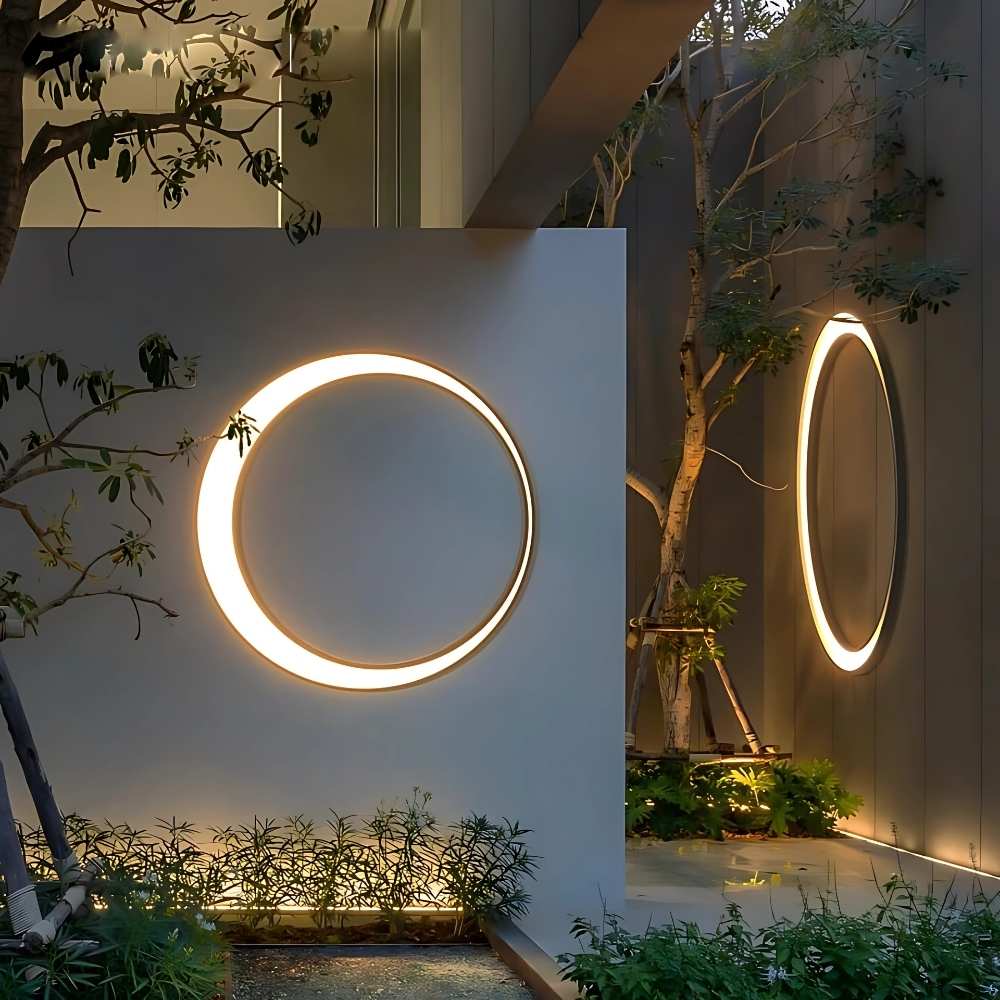
7Pinna Round Outdoor Wall Light
One Statement PositionMost exterior plans benefit from one position where the fixture is the point rather than the light — a courtyard wall, a feature entry, a garden focal point seen from inside the house. A round form has no orientation, which suits positions approached from several directions. Keep the rest of the property quieter around it.
Suits: Courtyards, feature walls, garden focal points
Form: Round — no orientation, works from any side
Size: 13.78" (35 cm), five sizes
Rule: Keep surrounding fixtures quieter

8Aeris Modern Exterior Light Fixture
Repeated Positions · Budget ScalingWhere a plan needs six or eight fixtures rather than two, per-unit cost decides whether the plan happens. A design available across three sizes at accessible pricing lets a whole-house scheme be completed at once in one finish family — which produces a better result than two expensive fixtures and four positions still dark.
Why it matters: One finish family completed at once
Sizes: Three, from 12" (30 cm)
Colour: Warm white 3000K
Related: Outdoor wall lights
Browse exterior lighting
Entry, facade, security and patio fixtures in matched finishes.
Outdoor Wall Lights → Outdoor Lighting →Where to Start on a Budget
A full six-zone plan is rarely done at once. In order of return per pound spent:
| Priority | Zone | Why first |
|---|---|---|
| 1 | Entry | Most used, most seen, and the zone that sets the house's register |
| 2 | Steps and level changes | The genuine safety issue — a dark step is the common trip hazard |
| 3 | Garage and driveway | Daily function; motion sensing keeps running cost near zero |
| 4 | Patio | Extends usable hours of a space you already have |
| 5 | Facade | Highest visual return, lowest practical need — do it when the rest works |
| 6 | Side paths | Add when other exterior electrical work is happening |
One planning note that saves money: if any exterior electrical work is happening, price adding boxes for future zones at the same time. The labour of a second visit usually exceeds the cost of the extra boxes, and a box installed now costs a fraction of one added after the wall is finished.
Common Mistakes
- Relying on a floodlight. It makes everything outside its pool darker to a person standing in it. Distributed low-level lighting produces better visibility at a fraction of the output.
- Mixing finishes across the house. An exterior is read in one glance. One finish family throughout.
- Cool white outdoors. Above 4000K reads commercial on a residence. 2700-3000K everywhere.
- Path lights too bright. 50-150 lumens is the range. Brighter at ankle height is glare that makes the path harder to read.
- Lighting the whole facade. Contrast is what makes lit features read. Light what is worth showing, leave the rest dark.
- One facade fixture instead of a run. A single unit reads as an accident. Repetition at one height is the effect.
- Patio fixtures at standard height. Drop to 60-66 in with shielded designs — seated eye level is the reference.
- Motion sensors aimed at the road. Passing traffic runs them all night, which is worse than no sensor.
- Leaving steps dark. The most common outdoor trip hazard, and one fixture fixes it.
- Light spilling into neighbours' windows. Shielded, downward-aimed fixtures solve it, and dark-sky ordinances increasingly require it.
Frequently Asked Questions
How should I plan outdoor lighting for my home?
Work in six zones in the order a visitor experiences them: approach and path, entry, facade, garage and driveway, side paths, then patio and garden. Each has a different job and a different brightness. Planning in sequence is what stops an exterior looking like fixtures added one at a time.
How bright should outdoor lights be?
Less than most people expect. Path lights 50-150 lumens, entry fixtures 400-800, facade fixtures 200-500, garage 600-1,000, patio 200-500. Several modest sources produce better visibility than one bright one.
Do outdoor lights need to match?
They should share one finish family across the whole house. An exterior is read in a single glance from the street, unlike an interior read room by room, so mixed finishes read as accumulation rather than design. Fixture sizes and formats can vary.
What colour temperature is best for outdoor lighting?
Warm white at 2700-3000K throughout. It flatters brick, timber and render and reads welcoming. Cool white above 4000K reads commercial or security-grade, and the difference is more visible outdoors than indoors.
Are floodlights good for home security?
Less than people assume. The eye adapts to the brightest thing in view, so everything outside the flood's pool becomes darker to someone standing in it. Distributed low-level lighting with motion sensing at the driveway and side paths gives better real visibility.
How do I light a front path?
Low fixtures at 50-150 lumens, spaced 6-8 ft apart and staggered rather than paired, which avoids a runway effect. Light steps and level changes specifically — a dark step is the most common outdoor trip hazard.
How high should outdoor wall lights be?
66 in to centre beside a front door, 66-72 in on garage walls, 60-66 in on patio and seating walls. Facade runs should all sit at one identical height measured from a level line, not from the ground beneath each fixture.
What is facade lighting and do I need it?
Wall fixtures that graze a surface to reveal texture and rhythm after dark — brick coursing, stone, render depth. It is the highest visual return and lowest practical need of any zone, so it belongs after the functional zones work.
Where should I start if I can only do one thing?
The entry. It is the most used and most seen zone, and it sets the register for the whole house. After that, light any steps or level changes, which is the genuine safety issue.
Should outdoor lights be on a timer or motion sensor?
Motion sensing suits driveways, side paths and back doors — positions used briefly and unpredictably. Dusk-to-dawn or timers suit entries and facades, which should read as lit rather than switching on when approached.
How do I avoid annoying my neighbours with outdoor lighting?
Shielded, downward-aimed fixtures at modest output. Light that travels sideways into windows is the complaint; light aimed at the house and ground rarely is. A growing number of US municipalities also have dark-sky ordinances requiring it.
Can I use the same fixtures front and back?
Yes, and it is the easiest way to keep one finish family. The back may need different types — motion sensing at the door, shielded low-mount on the patio — but keeping them in the same finish and design language ties the property together.
Six Zones, One Finish, Warm and Low
Plan the house in the order it is experienced rather than fixture by fixture, keep every position in one finish family, and use less light in more places than instinct suggests. An exterior lit that way reads as designed from the street and works better underfoot than any floodlight does.
Browse the range: outdoor wall lights, outdoor lighting.