Three formats, three depths. Flush mounts sit tight to the ceiling at 4-8 in. Semi-flush hang a few inches below at 8-14 in. Short-drop fixtures — shallow rings, drums and compact pendants — run 10-20 in and work wherever nobody walks beneath.
Semi-flush is the format most people should be looking at and the one least understood. It gives the shadow line and dimensionality a flush mount cannot, while still clearing an 8 ft ceiling over a walkway.
The measurement that matters is depth, not diameter — and it is the one product listings bury. Diameter is always stated; depth or "height" is where the answer lives.
Buy wide. Low-profile fixtures earn presence horizontally. A 24 in flush mount reads deliberate; a 12 in one in the same room reads like a builder's fitting.
Low profile is a category defined by a number rather than a style, which is why shopping for it is harder than it should be. Two fixtures described the same way can differ by eight inches of depth, and depth is the only specification that decides whether either one fits. This guide sets out what separates the three formats, what depth each actually needs, where each belongs room by room, and why the most common low-ceiling purchase — a small flush mount — is usually the wrong one.
On this page
What Is a Low Profile Light Fixture?
| Format | Depth | Clears 8 ft over a walkway? | Reads as |
|---|---|---|---|
| Flush mount | 4-8 in | Always | Part of the ceiling |
| Semi-flush | 8-14 in | Usually — check the number | A fixture, not a fitting |
| Shallow ring | 4-12 in | Usually | An architectural line |
| Drum shade | 10-16 in | Marginal — over surfaces yes | A soft horizontal mass |
| Short-drop pendant | 10-20 in | No — over surfaces only | A hanging fixture |
| Compact linear | 8-18 in | Over surfaces only | A line above a table |
Flush or Semi-Flush: Which Is Better for a Low Ceiling?
Semi-flush is the format people skip on the way from "I want a chandelier" to "I have a low ceiling, so I need a flush mount." It should be where most of those searches end.
At 8-14 in deep, a semi-flush clears an 84 in walkway on a standard 8 ft ceiling with room to spare in most cases. What it buys over a flush mount is disproportionate to the few inches involved: the fixture reads three-dimensionally, light escapes upward as well as down so the ceiling itself is lit, and the form can have shape rather than being a disc pressed against plaster.
The upward light is the underrated part. A flush mount lights the room and leaves the ceiling dark, which makes the ceiling read lower. A semi-flush that throws some output upward makes the ceiling surface visible — and a visible ceiling reads further away. The format that appears to take more vertical space actually makes the room feel taller.
Reading Depth From a Listing
Diameter is always stated. Depth is the one that decides whether a fixture works, and it hides under several different labels.
- Look for "height", "H", "depth" or "extension". These all mean the same thing on a ceiling fixture: how far it comes down from the mounting surface.
- Check whether the figure includes the canopy. Some listings measure the body only, which understates the installed depth by an inch or two.
- On adjustable fixtures, find the minimum. Rod-hung designs often quote a maximum drop; the number you need is the shortest configuration.
- Where only diameter appears, ask. Suppliers answer this routinely even when the page omits it, and it is a faster route than measuring after delivery.
- Add the ceiling's variation. On a textured or slightly bowed ceiling, allow an extra inch of margin rather than working to the exact figure.
Buy Wide, Not Small
The instinct in a low room is to choose a small fixture, on the reasoning that a low ceiling calls for restraint. It is the wrong instinct and it produces the most common bad outcome in this category.
A small flush mount in a normal-sized room does not read as tasteful restraint. It reads as a builder's fitting that nobody got around to replacing — because that is usually what a small flush mount is. The fixture's job is to look chosen, and at 12 in in a 14 x 16 ft room it cannot.
Run the standard sizing formula and take the upper end. Room length plus width in feet, read as inches: a 12 x 14 ft room gives 26 in, and on a low ceiling 26-30 in is the right range rather than 20-24. At the far end of the category, a 60 in wide fixture only 12 in deep still leaves the full 84 in of walkway clearance — width and depth really are independent. The horizontal dimension is the one available, so spend it. Full calculations are in our chandelier size chart.
Low Profile Picks (8 Designs)
Shallow bodies with real diameter, ordered from the flattest upward. Check the depth figure against your ceiling before ordering — it is the specification that decides, and the one listings bury.
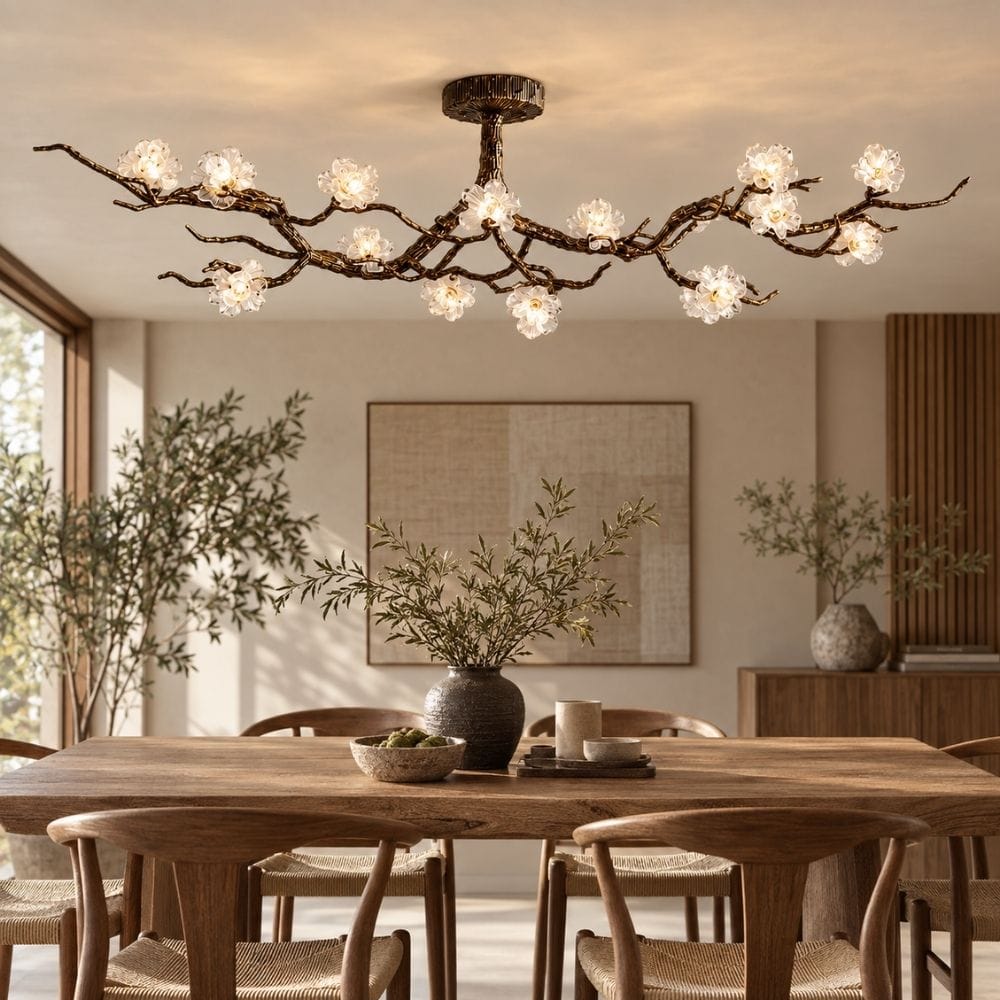
1Atita Flush Mount Branch Chandelier
60 in Wide · 12 in DeepThe buy-wide argument at its clearest. At 60 in (152 cm) across and only 12 in (30 cm) deep, it delivers more horizontal presence than almost any suspended fixture while leaving the full 84 in of walkway clearance on an 8 ft ceiling. This is what a low ceiling is actually asking for — and the opposite of the small flush mount most people buy.
Clearance at 8 ft: 84" — clears walkways
Output: 18 blooms, ~3,600-4,000 lm
Needs: Rooms 12 ft wide and up
Related: Branch chandeliers

2Heidi LED Modern Chandelier
Integrated LED · The Slimmest BodiesIntegrated LED produces the shallowest fixtures in any catalog, for a structural reason: there are no lamp holders to accommodate, so the emitter sits inside a channel a fraction of the depth a socket needs. Where every inch of vertical space is contested, that is the format to look at first. Check the dimming depth before buying, since the source cannot be swapped later.
Check first: Dimming depth and driver access
Bonus: No lamp changes at close quarters
Confirm: Total depth figure before ordering
Related: Modern chandeliers
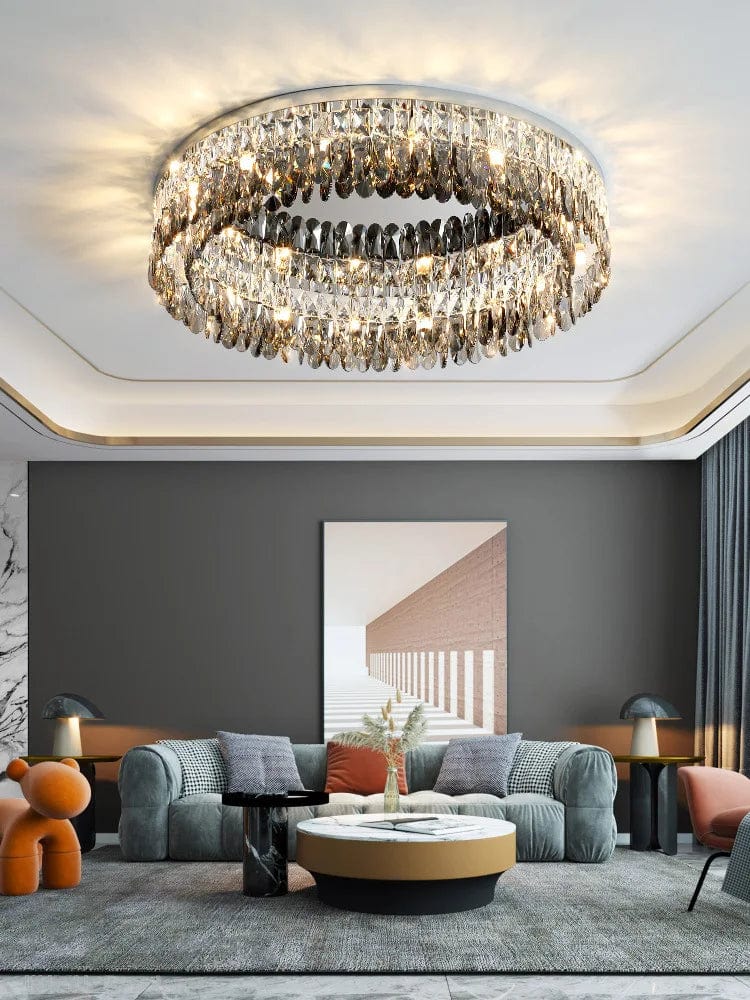
3Cara Crystal Flush Mount Chandelier
True Flush · Decorative, Not a FittingThe argument that low profile need not mean plain. Crystal held tight to the ceiling gives a room the decorative register of a chandelier at flush depth — and refraction moves light sideways across the ceiling plane, which does more for a low room than a downward-only fixture of the same depth would.
Why crystal helps: Moves light sideways, not only down
Suits: Entries, hallways, bedrooms, low dining
Buy: Wider than instinct suggests
Related: Flush mount chandeliers

4Vita Crystal Flush Mount Chandelier
Linear to 47 in · Six SizesLow profile in the long direction. Linear configurations run to 47.24 in (120 cm) at flush depth, which is how a corridor or a rectangular table gets a fixture proportioned to it rather than a compact disc in the middle. Six sizes across linear and round means landing on the right number instead of rounding down.
Solves: Corridors and rectangular tables
Sizes: Six — land on the number
Finishes: Gold or silver
Related: Linear chandeliers

5Ivora Modern White Glass Chandelier
White Glass · Output Without DepthLow-profile fixtures have less room for diffusion, which usually forces a choice between glare and reduced output. White and opal glass resolves both — it conceals the lamps completely while transmitting most of their light, so a shallow body can still carry a room. This matters most where the fixture is the only light in the space.
Best where: The fixture is the room's only light
Glare: None — lamps concealed
Colour: Warm white 2700-3000K on a dimmer
Related: Glass chandeliers

6Aurelia Natural Alabaster Chandelier
Stone · No Glare at Close RangeGlare control is the specification that matters most below 9 ft, because the fixture sits closer to eye level and stays in the field of view. Natural stone is the gentlest diffuser available — no visible source from any angle, and a warmth to the transmitted light that glass does not reproduce. The trade is output: stone absorbs a substantial share, so plan other layers alongside it.
Diffusion: Stone — the gentlest available
Trade: Lower output — pair with lamps or recessed
Bonus: Reads as material when switched off
Related: Alabaster & marble
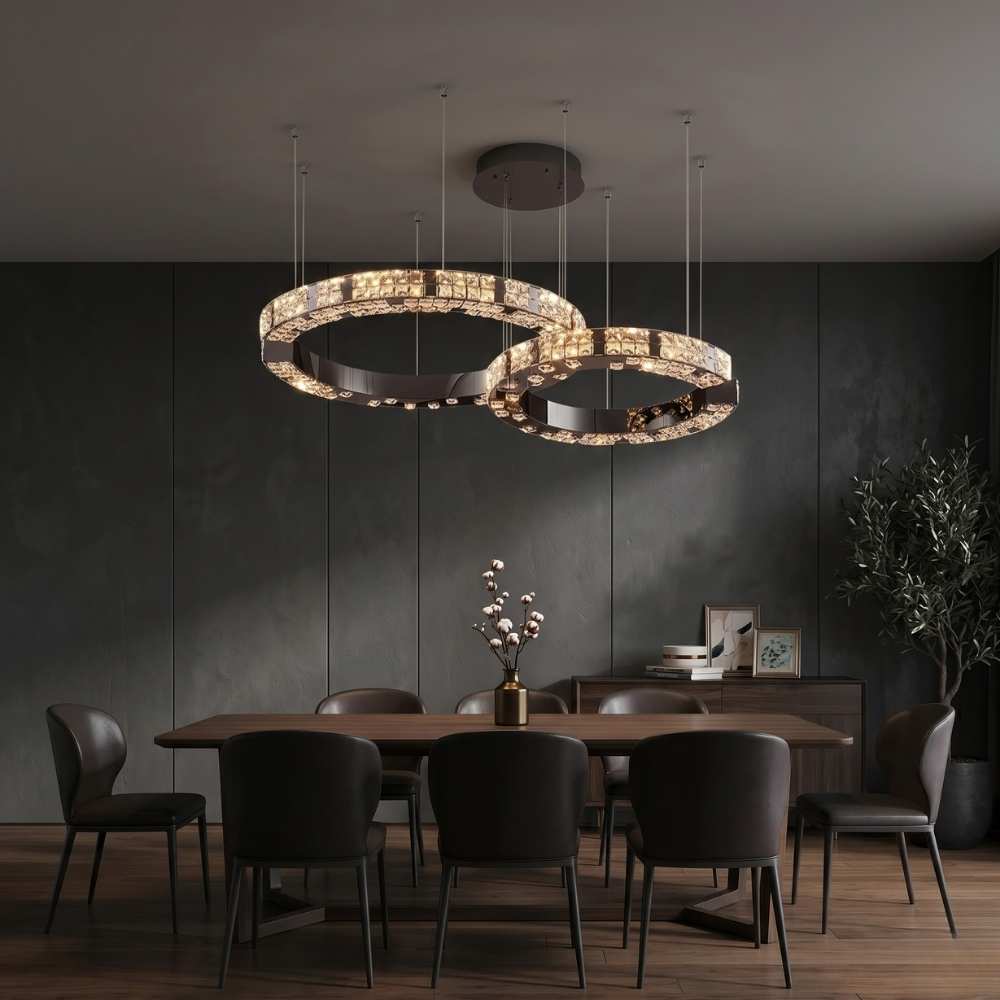
7Arven Modern Crystal Ring Chandelier
Open Ring · The Ceiling Shows ThroughA ring frame carrying crystal keeps the shallow geometry while adding the quality low-profile fixtures usually lack: movement. The open centre also means the ceiling remains visible through the fixture, which presses down far less than a solid disc of the same diameter — worth more in a low room than a couple of inches of depth.
Adds: Refracted movement to a shallow form
Best at: 30-60% dimmer output
Suits: Low dining rooms and entries
Related: Ring chandeliers

8Dove Glass Bubble Light Fixture
Clear Glass · Visually WeightlessClear glass adds the least visual weight of any material per inch of diameter, because you see through it to the ceiling beyond. That is what lets a low room take a generously scaled fixture without reading crowded — resolving the tension between buying wide enough and not overwhelming the space. Three sizes, and tinted versions warm the output.
Resolves: Going wide without crowding
Sizes: Three, from 23.62" (60 cm)
Check: Overall drop before ordering
Related: Bubble chandeliers
Browse low profile fixtures
Flush, semi-flush and shallow-body designs.
Flush Mount → Ring → All Fixtures →Room by Room
| Room | Format | Why |
|---|---|---|
| Dining, over the table | Short drop, ring, drum | No walkway beneath — more depth available |
| Kitchen, over an island | Short drop or compact pendant | Same — measure from the counter |
| Kitchen, walking areas | Flush or semi-flush | 84 in rule applies throughout |
| Bedroom | Semi-flush | Diffused, no visible lamps from a pillow |
| Hallway | Flush or semi-flush | Narrow, and everyone walks the full length |
| Entry at 8 ft | Semi-flush, as wide as fits | First fixture seen — width does the work |
| Bathroom | Flush, damp-rated | Rating governs before depth does |
| Closet | Flush | Code requires clearance from shelving |
The Glare Problem at Close Range
A fixture closer to the head is a fixture more often in the field of view, and that changes which designs are comfortable.
Exposed lamps are the specific problem. At 10 ft a bare decorative bulb is a point of interest; at 8 ft in a hallway it is at the top of the visual field every time someone walks through. The rule that avoids most of it: below 9 ft, prefer diffused, shaded or upward-facing designs, and treat exposed-lamp fixtures as requiring both a dimmer and low-output decorative lamps.
Upward-facing semi-flush designs are the strongest answer where glare is a concern. Light reaches the room after bouncing off the ceiling, which removes the direct source from view entirely and lights the ceiling surface at the same time — the two things a low room benefits from most.
Common Mistakes
- Buying small because the ceiling is low. Small reads as a builder's fitting, not as restraint. Take the upper end of the size range.
- Choosing flush when semi-flush would clear. A few inches of separation buys a shadow line, dimensionality and upward light.
- Shopping by diameter alone. Depth is the specification that decides. Find it, or ask.
- Missing the canopy in the depth figure. Some listings measure the body only, understating installed depth.
- Quoting maximum drop on adjustable fixtures. The number you need is the shortest configuration.
- Exposed lamps below 9 ft. Comfortable higher up, uncomfortable at head height in a hallway.
- Solid discs where an open frame would work. A ceiling visible through the fixture presses down far less.
- Tiered configurations of a ring design. They reintroduce exactly the depth the format exists to avoid.
Frequently Asked Questions
What is a low profile light fixture?
One with a shallow body relative to its diameter. Flush mounts run 4-8 in deep, semi-flush 8-14 in, and shallow rings and drums 4-16 in. The defining characteristic is achieving presence horizontally rather than vertically.
What is the difference between flush and semi-flush?
Flush mounts sit tight against the ceiling and read as part of it. Semi-flush hang a few inches below, which creates a shadow line, lets light escape upward and makes the fixture read as a designed object rather than a fitting.
Which is better for a low ceiling?
Semi-flush, in most cases. At 8-14 in it still clears an 84 in walkway on a standard 8 ft ceiling, and the upward light makes the ceiling surface visible — which makes the room read taller, not shorter.
How deep can a fixture be on an 8 ft ceiling?
Over a walkway, roughly 12 in. Over a table or island, where nobody walks beneath, roughly 36 in — measured as 30-36 in above the surface rather than from the floor.
How do I find a fixture's depth on a product page?
Look for "height", "H", "depth" or "extension". Check whether the figure includes the canopy, and on adjustable fixtures find the minimum rather than the maximum. Where only diameter appears, ask — suppliers answer this routinely.
What size low profile fixture do I need?
Add the room's length and width in feet and read the total in inches, then take the upper end. A 12 x 14 ft room points to 26-30 in rather than 20-24 — on a low ceiling, width is the dimension available.
Can a low profile fixture look like a chandelier?
Yes. Close-mount crystal designs and shallow ring chandeliers both deliver a decorative register at low depth. What a low ceiling rules out is vertical composition, not decorative quality.
Are low profile fixtures bright enough?
They can be, but diffusion matters more because there is less room for it. Opal glass is the material that resolves it — it hides the lamps while transmitting most of their output, so a shallow body can still carry a room.
Do low profile fixtures work in kitchens?
Flush and semi-flush suit the walking areas of a kitchen where the 84 in rule applies throughout. Over an island, where nobody walks beneath, short-drop pendants and compact linear fixtures become available.
Should I avoid exposed bulbs in a low room?
Below 9 ft, prefer diffused, shaded or upward-facing designs. A bare decorative bulb at 8 ft in a hallway sits at the top of the visual field every time someone walks through. With a dimmer and low-output lamps, exposed designs become workable.
Can a semi-flush go in a hallway with an 8 ft ceiling?
Usually. A 10 in deep semi-flush leaves 86 in of clearance on a 96 in ceiling, comfortably above the 84 in standard. Check the depth figure rather than assuming, and allow an inch for ceiling variation.
Does a low profile fixture make a room feel bigger or smaller?
Wide and open ones make it feel larger; small and solid ones make it feel smaller. A horizontal element draws the eye across, and an open frame lets the ceiling remain visible — both read as more space rather than less.
Check the Depth, Then Buy Wide
Depth is the specification that decides whether a fixture is possible, and diameter is the one that decides whether it looks chosen. Find the first on the listing, then spend generously on the second — a wide shallow fixture is what a low ceiling is actually asking for.
Browse the range: flush mount chandeliers, ring chandeliers, modern light fixtures.