Quick Answer
An alabaster chandelier and a glass chandelier soften light by different physics. Frosted glass scatters light at its surface, producing an even lit panel. Alabaster lets light travel through the stone, past mineral layers of varying density, so the glow arrives warmed and unevenly softened — depth rather than flatness.
Glass chandeliers give more light; alabaster gives more atmosphere. Opal glass transmits considerably more of the lamp's output, which makes it the better task-adjacent choice. Stone reduces output while removing glare almost entirely.
The unlit hours decide more than people expect. A fixture is switched off for most of the day. Glass reads as an empty shade; stone reads as material, with veining visible in daylight.
Weight and care split them too: a 30 in alabaster chandelier commonly runs three times the weight of a glass equivalent, and stone takes dry dusting only where glass tolerates a damp cloth.
Alabaster chandeliers and glass chandeliers are sold on the same promise — soft, comfortable light without glare — and buyers routinely shortlist one of each without a clear way to choose between them. The difference is not preference: the two materials diffuse light through genuinely different mechanisms, which changes how much output reaches the room, how the fixture reads when it is off, what it weighs on your ceiling, and how it is cleaned. This guide compares alabaster against glass on each of those, then gives a room-by-room decision.
On this page
How Alabaster and Glass Diffuse Light Differently
The distinction sounds academic and is entirely practical: one material scatters light at its face, the other transmits light through its body.
Frosted and opal glass work at the surface. The glass is etched, sandblasted or made with an opal layer, creating a micro-texture that scatters incoming light in many directions at once. The lamp behind it disappears and the surface lights evenly. Because the scattering happens in a thin layer, the result is uniform — a lit panel, bright and consistent across its face.
Alabaster works through its volume. Light enters the stone and travels several millimetres through mineral layers of varying density before leaving. Denser bands slow and warm it; thinner ones let more through. The result is uneven by nature — brighter where the stone is thin, deeper where it is not — which the eye reads as depth rather than as a defect.
Glass scatters in a thin surface layer; stone transmits through several millimetres of varying density
The Unlit Hours
This is the comparison people make after installation rather than before, and it may be the most consequential one. A ceiling fixture is switched off for roughly two-thirds of the day. What it looks like during those hours is not a footnote.
Frosted glass unlit is a white or pale shade. It reads as an object waiting to be used — perfectly acceptable, but contributing form rather than material. Clear glass unlit at least shows structure; frosted reads flat.
Alabaster unlit is stone. Veining, tonal variation and surface depth are all visible in daylight, so the fixture works as material in the room whether or not it is on. In a dining room used mostly in the evening this matters less; in a living room or entry seen constantly in daylight, it is a real difference.
There is a second-order effect worth naming. Alabaster near a window does something glass cannot: daylight entering the room passes into the stone and warms it slightly from outside, so the fixture appears faintly lit during the day. That is the argument for stone in entries and stairwells with windows.
Output: Glass Gives You More
Neither material is a task light, but they are not equal. Opal glass transmits a large share of the lamp's output; alabaster absorbs considerably more before releasing what remains. In practice a stone fixture reads noticeably dimmer than a glass fixture with the same lamps.
| Priority | Better answer | Why |
|---|---|---|
| Usable brightness | Glass | Transmits more of the lamp's output; opal is the most efficient diffuser here |
| Glare elimination | Both, stone slightly ahead | Neither shows a filament; stone's lower output helps further at close range |
| Warmth of the light | Stone | Mineral layers warm the light as it passes; glass stays neutral to the lamp |
| Evenness | Glass | Surface scatter produces uniform brightness; stone is deliberately uneven |
| Character at low output | Stone | Veining reads strongest when dimmed; glass just gets dimmer |
Two lamp notes follow. With stone, 2700K is the standard — warmer than the 3000K used elsewhere, since the material already contributes amber and matching it avoids a muddy result. With opal glass, 2700-3000K both work, and 3000K is the safer choice over a kitchen surface. Either way, a dimmer matters: stone reaches its best register at partial output, and glass at full output can be brighter than a decorative fixture needs to be.
Weight and Mounting
The practical difference that catches people out. Stone is dense, and the weight arrives well before the visual scale suggests it.
The consequence extends to installation. A heavy stone fixture is a two-person job, harder to level, and in a stairwell or high entry it changes the access equipment needed. Where a fixture is going somewhere genuinely difficult to reach, weight belongs in the shortlist criteria alongside appearance — our staircase installation guide covers the thresholds in full.
Care and Longevity
- Glass tolerates moisture. A barely damp cloth, applied to the cloth rather than the fixture and kept away from sockets, is fine. That makes glass the more practical choice in kitchens, where airborne grease combines with dust into a film that dry cloths do not lift.
- Stone does not. Dry microfiber only. Unsealed alabaster is soft enough to mark and porous enough to stain, and water is the specific thing to keep off it.
- Glass can chip; stone can scratch. Different failure modes, similar practical outcome — both need care during cleaning and installation.
- Stone is moisture-sensitive as a location question too. Bathrooms and steamy spaces suit glass; alabaster belongs in dry rooms unless the design is specifically damp-rated.
- Neither takes polish. Polish removes surface rather than cleaning it, on both materials.
Stone Picks (4 Designs)
Where warmth, depth and the unlit appearance matter more than maximum brightness. Target 2700K on a dimmer, and check the listed weight against your junction box's marked rating before ordering.
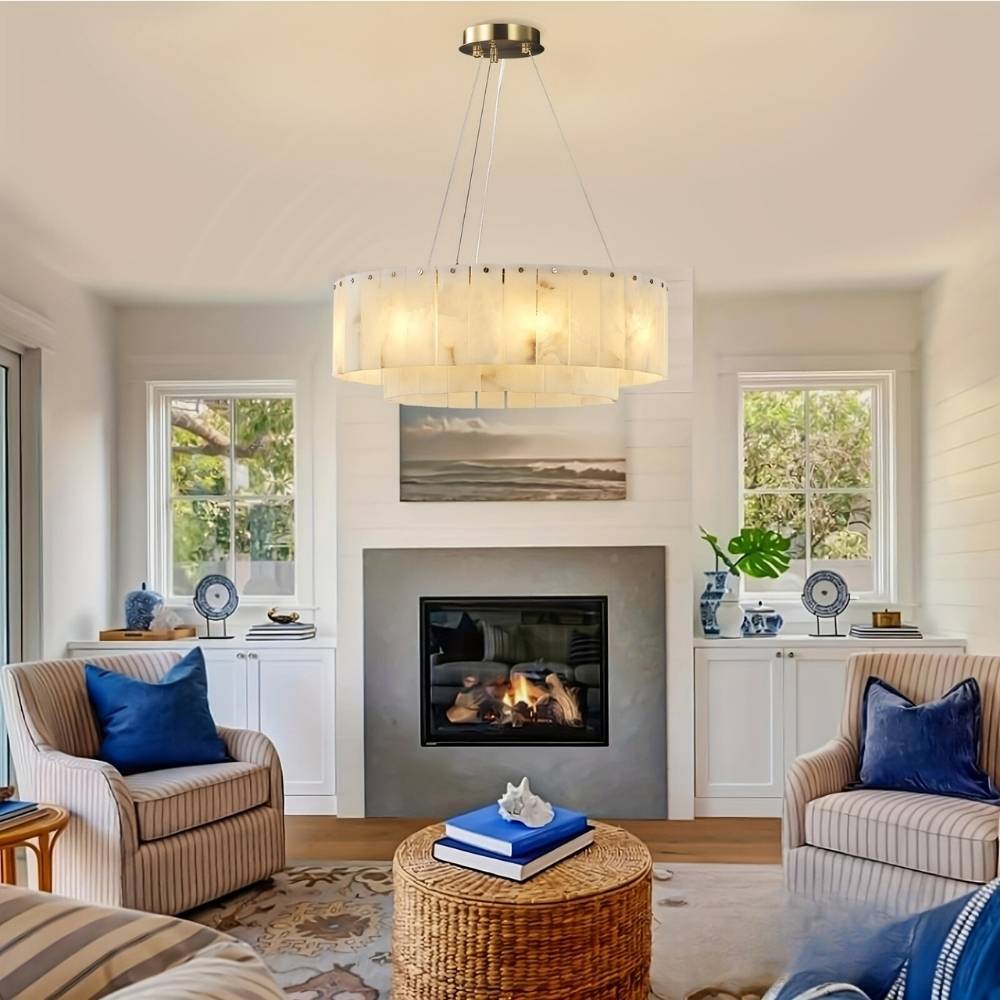
1Angie Alabaster Round Chandelier
Alabaster · Volume TransmissionThe mechanism at its clearest: light travels through the stone rather than scattering at a surface, so the glow varies across the piece and the veining emerges when the fixture is switched on. Round forms also read identically from every approach, which suits rooms entered from more than one direction.
Unlit: Reads as stone, veining visible in daylight
Colour target: 2700K on a dimmer
Check first: Listed weight against your box rating
Related: Alabaster & marble chandeliers
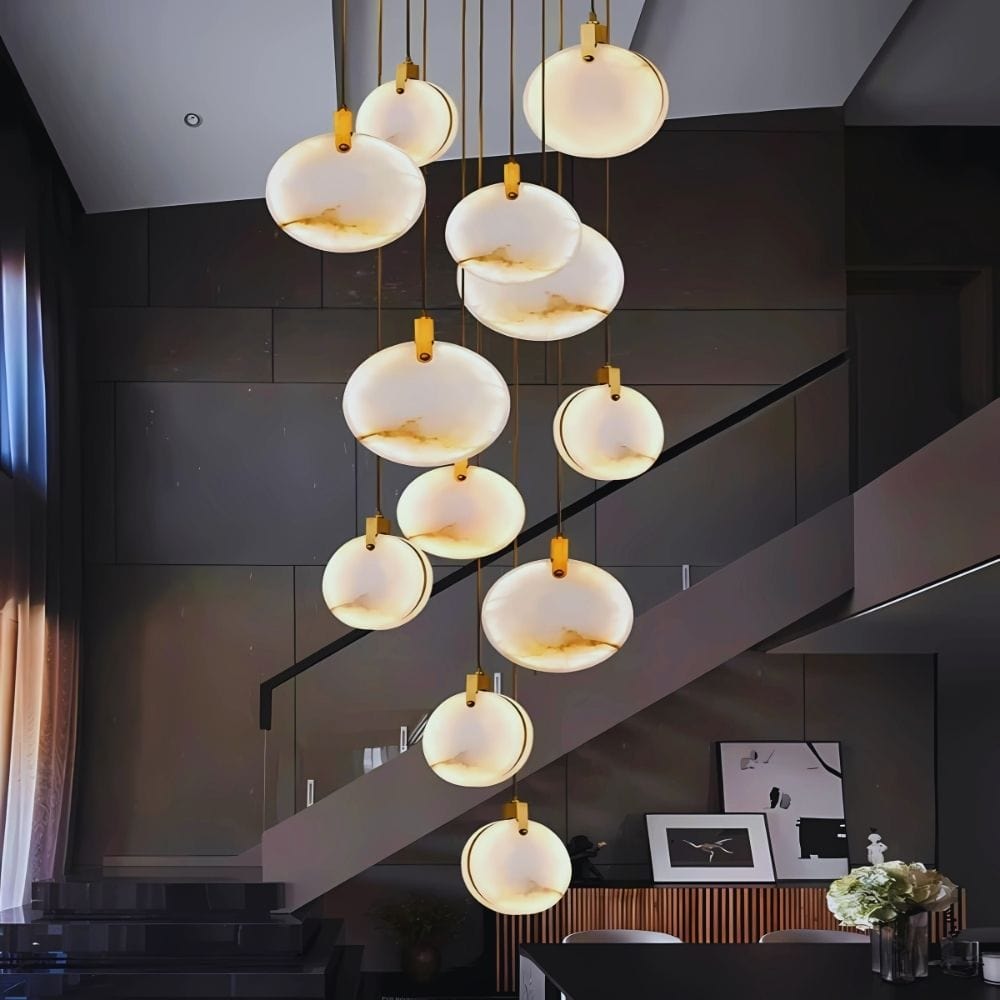
2Gaia Marble Staircase Chandelier
Stone in a Stairwell · Low GlareStairwells are where stone's lower output becomes an advantage rather than a compromise: a bright fixture in the field of view while descending reduces contrast on the treads. Low-glare material lets the chandelier decorate the volume without competing with the light that keeps the steps readable.
Daylight bonus: Warms from a stairwell window when unlit
Pair with: Sconces or step lighting for the treads
Access note: Heavier than glass — plan the install
Related: Staircase chandeliers

3Yale White Marble Pendant Light
Bedside Scale · Softest OutputAt bedside distance the output question inverts: less light is the requirement, not the compromise. Stone's absorption produces the gentlest source available for a fixture hanging beside a reclining head, and there is no filament to see from any angle.
Why stone wins here: Lower output is the requirement
Height: 18-24 in above the nightstand
Pair note: Order both sides together — stone varies by batch
Related: Bedside pendant guide

4Elori Natural Stone Flower Brass Chandelier
Stone + Brass · Warm on WarmWarm metal and warm stone sit in the same amber band, which is why brass is the most common frame for this material — the two read as one story rather than two decisions. It also demonstrates the batch point: natural stone differs between pieces, so matched pairs need ordering together.
Variation: Veining differs unit to unit
Sizes: Five, from L47.24" (120 cm)
Care: Dry dusting only
Related: Gold chandeliers
Glass Picks (4 Designs)
Where brightness, even output and practical maintenance matter more than material depth. Opal transmits most; frosted sits in the middle. 2700-3000K, with 3000K over a working kitchen surface.
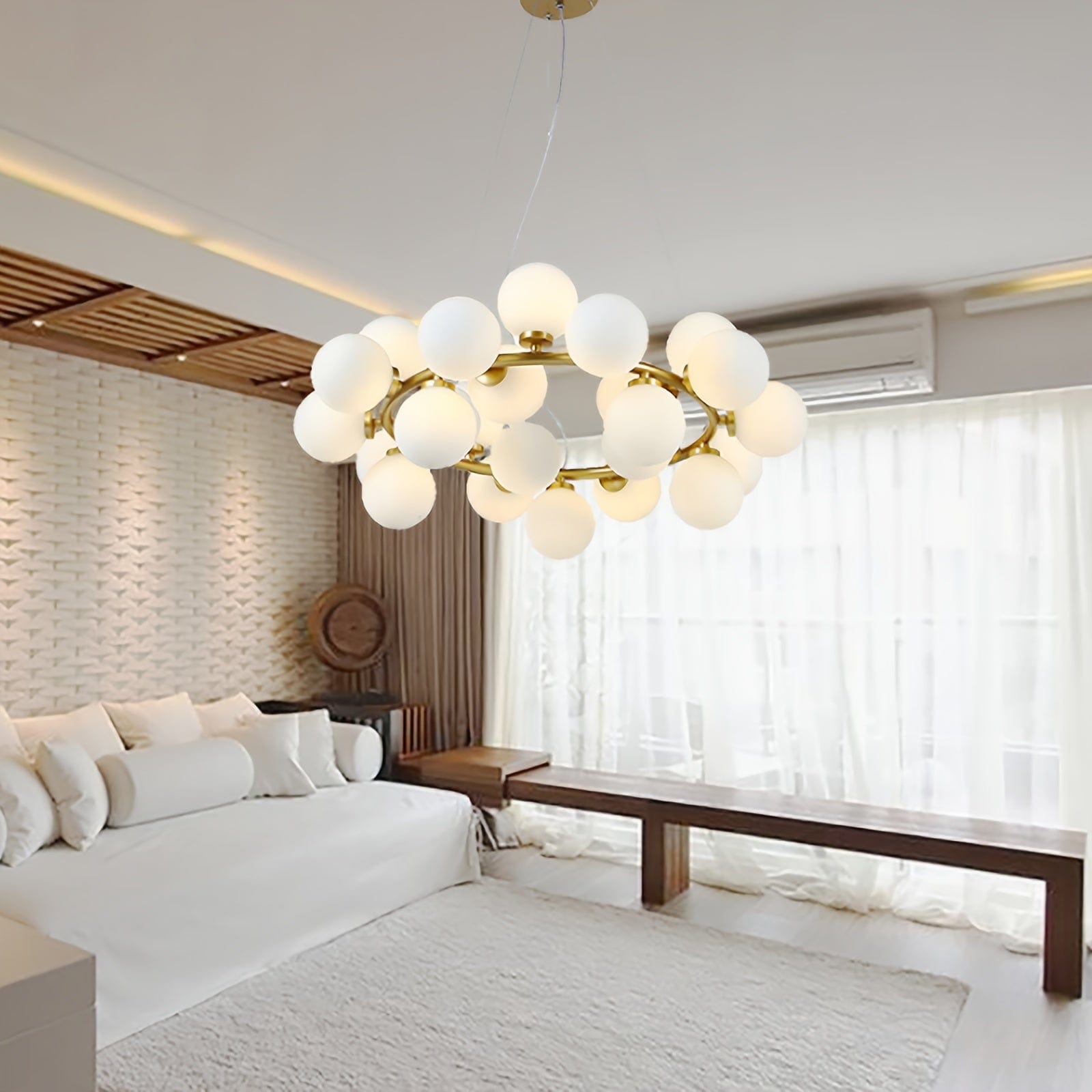
5Holly Milk Glass Chandelier
Opal · Most Efficient DiffuserMilk glass is the efficiency benchmark: the source disappears completely while a large share of its output still reaches the room. Where a fixture has to be both glare-free and genuinely bright — a family dining room, a room without much other lighting — this is the material that does both.
Best where: Glare-free brightness is needed together
Unlit: Reads as a pale shade rather than material
Care: Damp cloth acceptable, away from sockets
Related: Glass chandeliers

6Neve Glass Bubble Chandelier
Glass at Scale · Weight AdvantageWhere glass wins decisively: a clustered composition at statement scale stays within standard mounting territory, while the same volume in stone would need structural work. Large fixtures are the case where the material decision is made by the ceiling rather than by taste.
Compare: Same volume in stone needs a brace box
Best rooms: Entries, stairwells, open plans
Finishes: Clear, frosted and smoked options
Related: Bubble chandeliers

7Verona Glass Dome Pendant Light
Directed Glass · Task-AdjacentA domed glass body directs output downward onto the surface rather than spreading it into the room, which is the configuration a work area needs. Stone cannot match this — its absorption means a stone pendant over a counter is a decorative decision, not a functional one.
Why glass here: Stone absorbs too much for task work
Best rooms: Kitchens, islands, reading positions
Colour: 3000K over a working surface
Care: Damp cloth — practical in kitchens

8Dove Glass Bubble Light Fixture
Tinted Glass · Warmth Without StoneThe middle route. Brown and amber tinting warms the output beyond what a clear or opal body gives, closing part of the gap to stone while keeping glass's weight, price and cleaning advantages. It does not replicate the unlit material presence, but it does deliver the warm register.
Gains: Warmer output, easier mounting and care
Does not gain: Material presence when unlit
Sizes: Three, from 23.62" (60 cm)
Related: Glass bubble guide
Browse both materials
Stone for warmth and depth, glass for brightness and practicality.
Alabaster & Marble → Glass Chandeliers → All Chandeliers →Room by Room: Which Wins
| Room | Stronger choice | Reason |
|---|---|---|
| Dining room | Stone | Evening use, close viewing distance, warmth on faces and food |
| Kitchen island | Glass | Output matters, and grease film needs a damp cloth stone cannot take |
| Bedroom, bedside | Stone | Lower output is the requirement; no filament visible at any angle |
| Living room | Either — stone if daylight-heavy | The unlit appearance matters most in rooms used all day |
| Entry with a window | Stone | Daylight warms the material; the fixture works while switched off |
| Stairwell | Stone for glare, glass for weight | Access difficulty pushes toward the lighter material |
| Bathroom | Glass | Alabaster is moisture-sensitive; damp-rated glass is the safe answer |
| Large statement position | Glass | Scale in stone frequently exceeds standard mounting |
Using Both in One Room
They coexist well, and in a layered scheme the combination is often better than committing to one. The usual arrangement: stone where the fixture is decorative and seen closely — the dining chandelier, bedside pendants — and glass where output is doing work, such as an island run or a kitchen ceiling fixture.
Two rules keep it from reading accidental. Match the colour temperature across every fixture in one sightline, since mixed materials with mixed Kelvin is what makes a room feel unsettled without an obvious cause. And let one material lead: two stone fixtures and one glass reads intentional, whereas an even split reads undecided. Some designs resolve the question inside one fixture, combining stone panels with glass or metal elements.
Price and What It Reflects
Stone generally costs more, and the reasons are material rather than positioning. Natural stone has to be quarried, cut thin enough to transmit light without breaking, and finished by hand — a slower process with more waste than glass production. Weight also raises shipping cost on every unit.
What that means for a buyer: a stone fixture at a suspiciously accessible price is usually resin. Real stone varies between pieces, weighs considerably more than its size suggests, and stays cool to the touch. Glass at a low price is simply moulded rather than hand-blown, which is a lesser gap. The wider build-quality question is covered in our designer-grade guide.
Common Mistakes
- Expecting stone to light a room. It absorbs a great deal before releasing what remains. Excellent atmosphere layer, weak primary source.
- Ignoring the unlit hours. Two-thirds of the day the fixture is off. Glass reads as an empty shade; stone reads as material.
- Buying stone before checking the box rating. A 30 in stone fixture at 40 lb or more may exceed what your ceiling box is marked for.
- A damp cloth on unsealed stone. Water is the specific thing to keep off alabaster. Dry microfiber only.
- Stone in a bathroom. Moisture-sensitive by nature. Glass, damp-rated, is the correct answer there.
- Stone over a kitchen island. Grease film needs a damp cloth, and output matters over a work surface. Glass on both counts.
- Mixing colour temperatures across materials. Stone at 2700K beside glass at 3000K in one sightline reads unsettled.
- Assuming a cheap stone fixture is stone. Real material varies between units, weighs more than expected and stays cool. Resin does none of those.
Frequently Asked Questions
What is the difference between an alabaster and a glass chandelier?
Frosted glass scatters light at its surface, producing an even lit panel. Alabaster transmits light through several millimetres of stone with varying density, so the glow is warmed and deliberately uneven — depth rather than flatness.
Which gives more light, an alabaster or a glass chandelier?
Glass, clearly. Opal glass transmits a large share of the lamp's output while stone absorbs considerably more. A stone fixture reads noticeably dimmer with the same lamps.
Does an alabaster chandelier work as a room's only light?
Rarely. It is an atmosphere and decorative layer. In a room that needs working brightness, plan recessed lighting, sconces or lamps alongside it.
Which looks better when switched off?
Stone. Veining and tonal variation are visible in daylight, so the fixture reads as material during the two-thirds of the day it is off. Frosted glass reads as a pale shade.
How much heavier is stone?
Roughly three times at the same diameter. A 30 in glass fixture commonly runs 15-20 lb where a stone equivalent runs 40 lb (18 kg) or more, which changes the mounting requirement.
Can I clean alabaster the way I clean glass?
No. Glass tolerates a barely damp cloth; unsealed stone does not. Alabaster is soft enough to mark and porous enough to stain, so dry microfiber is the whole routine.
Which suits a kitchen?
Glass, on two counts. Output matters over a work surface, and airborne grease forms a film that needs a damp cloth stone cannot take.
Which suits a dining room?
Stone, usually. Dining is evening use at close viewing distance, where warmth and low glare matter more than brightness and the veining is actually seen.
Is stone worth the extra cost?
Where the fixture is seen closely and in daylight — dining rooms, bedsides, entries — the material presence justifies it. Where the fixture is high, far or doing real lighting work, glass delivers more for less.
Can I use both materials in one room?
Yes, and in a layered scheme it often works better than committing to one. Keep the colour temperature matched across every fixture in a sightline, and let one material clearly lead.
What colour temperature should each use?
Stone at 2700K, since the material already contributes amber. Glass at 2700-3000K, with 3000K the safer choice over a kitchen surface. Both on a dimmer.
Does tinted glass replace stone?
Partly. Amber and brown glass warms the output beyond a clear or opal body, closing part of the gap while keeping glass's weight, price and cleaning advantages. It does not replicate the unlit material presence.
Brightness or Depth
The decision reduces to one question: does this fixture need to deliver light, or atmosphere? Glass transmits more, cleans easier, weighs less and scales further. Stone gives warmth the lamp alone cannot produce, works as material during the hours it is off, and removes glare almost entirely. Neither is better — they answer different priorities, and in most houses both belong, in different rooms.
Browse the range: alabaster & marble chandeliers, glass chandeliers, all chandeliers.