Quick Answer
Three specifications decide whether a stairwell installation is straightforward or a project: the fixture's weight against the junction box rating, how the ceiling will be reached safely, and how the fixture will be cleaned once the access equipment is gone.
Weight thresholds: under 35 lb takes a standard listed box; 35-50 lb needs a box rated for the load; 50-90 lb requires a listed heavy-fixture brace box; above 90 lb the mounting should tie into structural blocking.
Access: an extension ladder standing on stair treads is not a safe option. Two-story stairwell work needs scaffolding, a stair-adjustable platform, or a lift — which is why professional installation is the norm rather than the exception in this category.
Cleaning: decide before the fixture goes up. A motorized or manual lowering system is inexpensive at installation and expensive afterward. The alternative is choosing a smooth-surfaced, integrated-LED design that needs fewer visits.
A staircase chandelier is the most demanding fixture installation in a house, and the reasons have nothing to do with wiring. The junction box sits at the ceiling of a two-story volume, the floor beneath it is a staircase rather than a flat surface, and the fixture frequently weighs more than the box was designed to carry. Then, eighteen months later, it needs dusting. This guide covers the weight and mounting requirements, how the ceiling gets reached safely, what installation actually costs, and how to plan for the cleaning and bulb changes that follow.
On this page
- The Three Questions
- Weight and Box Rating
- Mounting Hardware by Threshold
- Reaching the Ceiling Safely
- Who Should Install It
- The Installation Sequence
- What It Costs
- Cleaning at Height
- Lowering Systems
- Low-Maintenance Picks
- Statement Picks and Their Requirements
- Common Mistakes
- Frequently Asked Questions
The Three Questions
Every stairwell installation reduces to three questions, and answering them before ordering rather than after is the difference between a scheduled afternoon and an improvised week.
Can the ceiling hold it? Junction boxes carry a marked weight rating, and stairwell fixtures routinely exceed it. Retrofitting a stronger box means opening the ceiling of a two-story volume — which means scaffolding, drywall repair and repainting at height.
How will anyone reach the ceiling? The floor beneath a stairwell junction box is a staircase. An extension ladder cannot be safely footed on treads, and the working height is often 18 ft or more.
What happens in two years? The fixture will need dusting, and possibly a bulb. Whatever access method the installation required will be required again — unless the fixture or the mounting was chosen to avoid it.
Weight and Box Rating
Weight is the specification most often discovered after delivery, and the only one that turns a fixture swap into ceiling work. Stairwell fixtures vary enormously: a slim modular cascade might weigh 20 lb, while a crystal composition of similar visual size passes 70 lb, because crystal and solid components add mass without adding apparent scale.
Four weight bands and the mounting each requires, from a standard listed box to structural blocking
Two practical notes. Standard ceiling boxes carry a marked rating, usually 35 or 50 lb — read it rather than assuming, since boxes installed before current standards are frequently rated lower. And a fan-rated box, common in bedrooms, is built for the dynamic load of a spinning fan; it is a reasonable indicator of strength but is not automatically equivalent to a listed heavy-fixture box for a static 60 lb chandelier. Check the marking.
Mounting Hardware by Threshold
- Standard listed box, under 35 lb. Screwed directly to framing or carried on a bar hanger. Adequate for compact stairwell fixtures and landing installations.
- Rated box, 35-50 lb. Same principle, but the marked rating has to cover the fixture. Two people for the lift, since the fixture must be supported while the connections are made.
- Heavy-fixture brace box, 50-90 lb. An expanding bar spanning between joists, carrying the load across both and marked for fixture support. This is the standard solution for most substantial stairwell chandeliers.
- Structural blocking, above 90 lb. Timber blocking installed between joists specifically to carry the fixture and tied into the framing. Requires access from above or an opened ceiling, which is why it belongs in a renovation sequence.
- Safety cable. A secondary support independent of the electrical connection, common on heavy and two-story installations. Ask whether the design includes provision for one, particularly on cascades where elements hang below the main body.
- Sloped-ceiling adapter. Stairwell ceilings frequently follow the stair's angle. A swivel canopy keeps the fixture plumb from an angled surface — check the maximum slope it accommodates against your ceiling's pitch.
The wiring itself is the least demanding part of the job and follows standard practice; our installation and electrical safety guide covers the connection sequence in full.
Reaching the Ceiling Safely
Here is the constraint that makes this category different from every other fixture in the house: the floor beneath the junction box is a staircase. A ladder needs a level base, and treads are neither level nor wide enough to foot one safely. Improvising with a ladder on the stairs is the single most dangerous shortcut in home lighting work.
| Access method | Suits | Notes |
|---|---|---|
| Step ladder from a landing | Landing fixtures, low single flights | Only where the base sits on a genuinely level surface |
| Stair-adjustable platform ladder | Stairwells to roughly 14 ft | Legs adjust to the tread rise; the safe entry-level option |
| Scaffold tower | Two-story volumes, 14-22 ft | Assembled on the stairs with adjustable base; the professional standard |
| Lift or raised platform | Very tall or wide entry volumes | Needs floor clearance and access; rental plus operator |
| Extension ladder on treads | Not an option | No safe footing; the cause of most stairwell injuries |
Assess the access before the fixture arrives, not on installation day. Two questions decide it: what is the vertical distance from the highest tread to the junction box, and is there a level surface anywhere beneath the box large enough to take a scaffold base? Where the answer to the second is no, a lift or a suspended platform becomes the route, and that changes both scheduling and cost.
Who Should Install It
Three categories, with a clear line between them.
Homeowner-appropriate: a landing fixture or a single-flight installation at normal ceiling height, under about 35 lb, with a level surface to work from and an existing box of adequate rating. This is a standard ceiling fixture swap with the power off at the breaker.
Electrician: anything involving a box upgrade, new wiring, a relocated junction point, or a fixture between 35 and 90 lb. Also any installation where the existing wiring's age or condition is unclear.
Electrician plus rigging, or a specialist installer: two-story volumes above roughly 14 ft, fixtures above 90 lb, cascades assembled in place, and anything requiring scaffold or lift access. Some fixtures in this class are assembled element by element at height, which is a two-person job measured in hours rather than minutes.
The Installation Sequence
Knowing the order helps in scheduling and in judging a quote.
- 1. Measure and confirm. Ceiling-to-target drop, fixture body height, maximum suspension length, weight, box rating. Any mismatch here stops the job before it starts.
- 2. Establish access. Scaffold assembled and stable, or platform positioned, with the stairs protected from tools and debris.
- 3. Power off and verified. Breaker off, confirmed with a non-contact tester at the box.
- 4. Box work. Existing box assessed and, where necessary, replaced with a rated or brace box before anything is hung.
- 5. Canopy and suspension. Mounted and set to the calculated drop, with excess cable or rod shortened rather than coiled in the canopy.
- 6. Assembly at height. On cascades and crystal designs, elements are added after the frame is hung — a loaded fixture is heavier, more fragile and harder to level.
- 7. Level, orient and test. Check plumb, check the fixture's facing from the entry below and from the landing, then restore power.
- 8. Final check from outside. Where a stairwell window faces the street, confirm the fixture's position in the window before the access equipment is removed.
What It Costs
Installation cost in this category tracks height, weight and access rather than the fixture's price. The bands below are relative rather than absolute, since rates vary regionally.
| Scenario | What drives the cost |
|---|---|
| Landing swap, existing box adequate | Ladder access, one technician, under an hour — the lowest band |
| Single flight with box upgrade | Brace box retrofit through the existing opening; adds an hour or two |
| Two-story, existing box adequate | Scaffold or platform rental, two technicians, longer assembly at height |
| Two-story with box upgrade | The above plus drywall repair and painting at height |
| Two-story with lowering system | Winch hardware and ceiling access work, offset by lifetime service savings |
The pattern worth noticing: the expensive variable is almost always access, not labor on the fixture itself. That is why bundling work — box upgrade, fixture installation, and a lowering system if wanted — into a single visit costs far less than three separate ones. Broader pricing detail is in our chandelier installation cost guide.
Cleaning at Height
A stairwell chandelier collects dust exactly like every other fixture, and the same access problem applies. Plan the answer at purchase.
Frequency depends on the design. Crystal and multi-element compositions show dust soonest, because dust dulls refraction directly — a crystal fixture at 40% brightness is often just dusty. Smooth glass and sealed metal bodies tolerate far longer intervals.
Method, when the fixture is reachable. Power off at the breaker and let lamps cool. Protect the stairs beneath with a drop cloth. Dust with a soft microfiber cloth or a long-handled duster; for crystal, a cloth lightly dampened with a mix of one part isopropyl alcohol to four parts distilled water, wiped element by element, then dried. Keep moisture away from sockets and connections entirely. The full care routine is in our chandelier care guide.
Method, when it is not. Above roughly 14 ft, the honest options are a lowering system, a professional cleaning visit, or a fixture chosen not to need either.
Lowering Systems
A motorized winch or manual lift mechanism installed above the ceiling lets the fixture descend to working height on demand. It is standard in commercial and heritage buildings and increasingly specified in tall residential entries.
The economics are the point: installed alongside the fixture, while the ceiling is already open and the scaffold already up, it is a modest addition. Installed afterward, it means opening the ceiling again and re-establishing access — frequently costing several times more for the same hardware. Any stairwell fixture above roughly 14 ft with detailed elements is a candidate, and the decision belongs at the same moment as the fixture choice.
Where a lowering system is not wanted, the alternative is to design the problem away: smooth-surfaced bodies, sealed forms, and integrated LED rather than replaceable bulbs. An integrated-LED fixture rated 30,000-50,000 hours will not need a lamp change for decades, which removes the second reason anyone would need to reach it.
Low-Maintenance Picks (4 Designs)
Designs chosen for what happens after installation — lighter compositions, smooth surfaces and integrated or long-life light sources that reduce how often the fixture needs reaching. Confirm the listed weight against your box's marked rating before ordering.
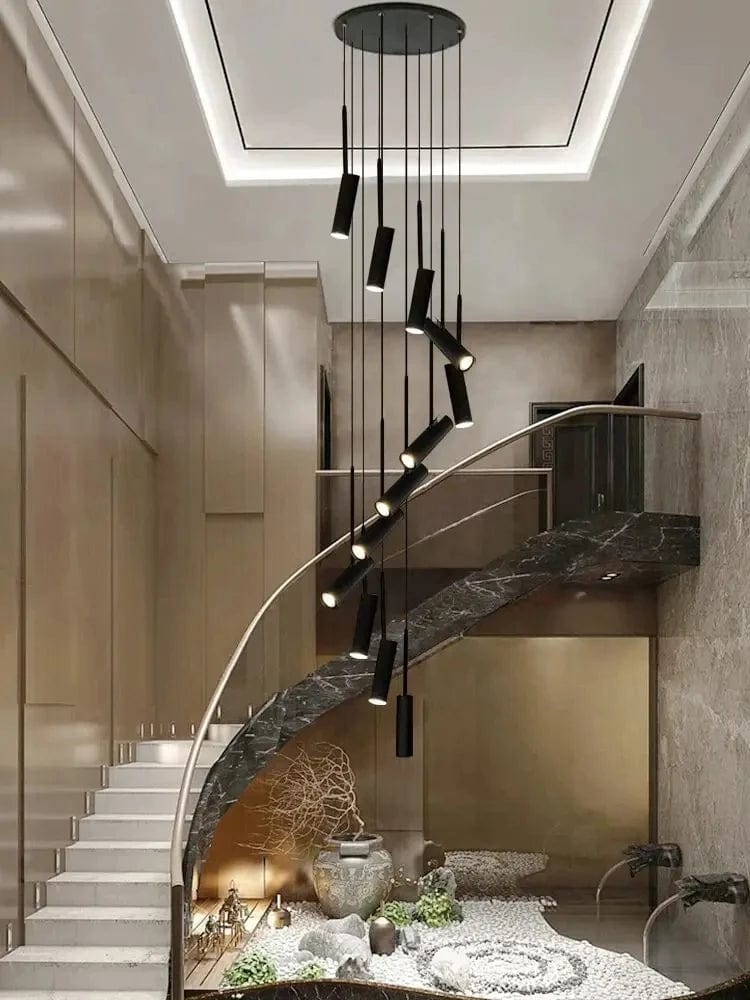
1Contemporary Staircase Long Chandelier
Modular · Lightest ClassModular slim elements keep the total weight in the standard-box band even at substantial drops, which is what makes this class the most straightforward two-story installation available. The drop is also built to the measured height rather than chosen from fixed lengths — no compromise between fit and mounting requirements.
Drop: Built to measured height
Surfaces: Smooth — low dust retention
Install: Simplest two-story option
Finishes: Black, gold, white and more

2Asty Modern Ring LED Chandelier
Integrated LED · No Bulb Changes Access-FriendlyIntegrated LED removes the second reason anyone needs to reach a stairwell fixture. Quality integrated designs are rated 30,000-50,000 hours, which at typical stairwell use is decades rather than years — so the only remaining maintenance is dusting, and ring forms present the least surface area to collect it.
Rated: 30,000-50,000 hours in quality designs
Surfaces: Ring forms, minimal dust catchment
Check: Whether the driver is serviceable
Finishes: Black, gold, brown
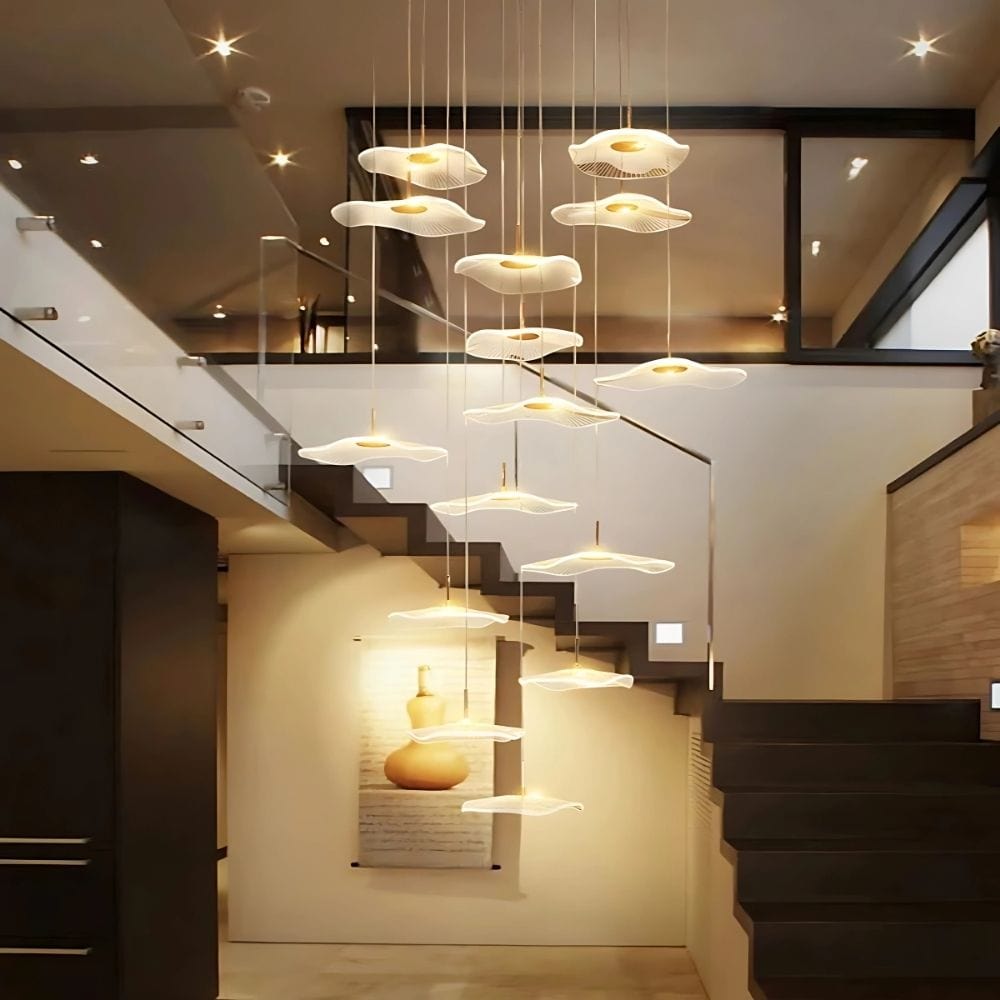
3Fleur Contemporary Staircase Chandelier
Compact · Simple MountingCompact stairwell compositions sit comfortably inside standard box ratings, which keeps the installation in electrician territory rather than requiring rigging. For single flights and landings, this is the class where a homeowner with a level working surface and the breaker off can reasonably do the work.
Suits: Landings, single flights, modest wells
Install: Homeowner-feasible with level access
Access: Step ladder from a landing
Clearance: 84 in above the tread beneath
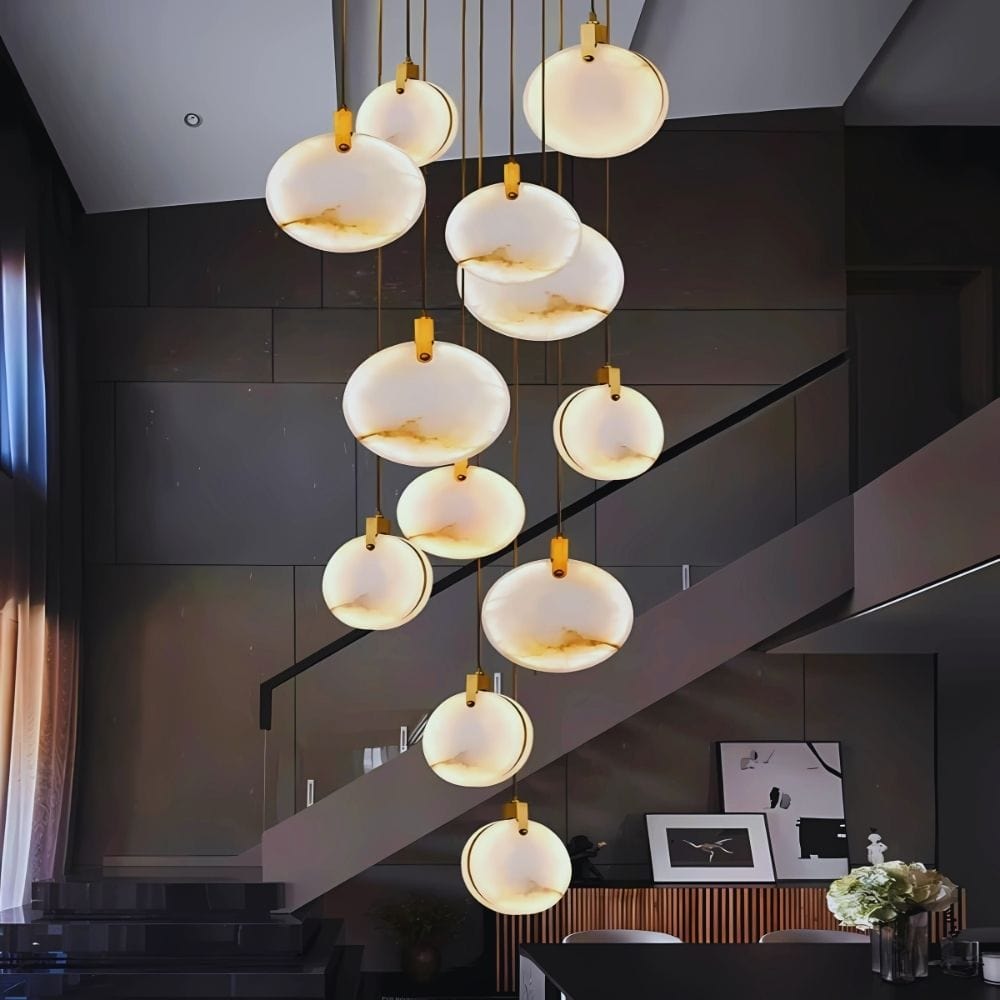
4Gaia Marble Staircase Chandelier
Smooth Surfaces · Long IntervalsSmooth stone and metal surfaces hold far less dust than faceted or multi-element compositions, and dust on a solid surface does not dim the fixture the way dust on crystal does. Where cleaning access is genuinely difficult, that difference translates directly into how often anyone has to go up there.
Dust impact: Does not dim output the way crystal does
Cleaning: Long intervals, simple wipe
Avoid: Liquid cleaners on stone — dry dusting
Best where: Access is difficult
Statement Picks and Their Requirements (4 Designs)
Larger compositions worth the extra planning — with the mounting and access requirements each brings. For these, confirm the box rating first and settle the cleaning plan before the access equipment comes down.
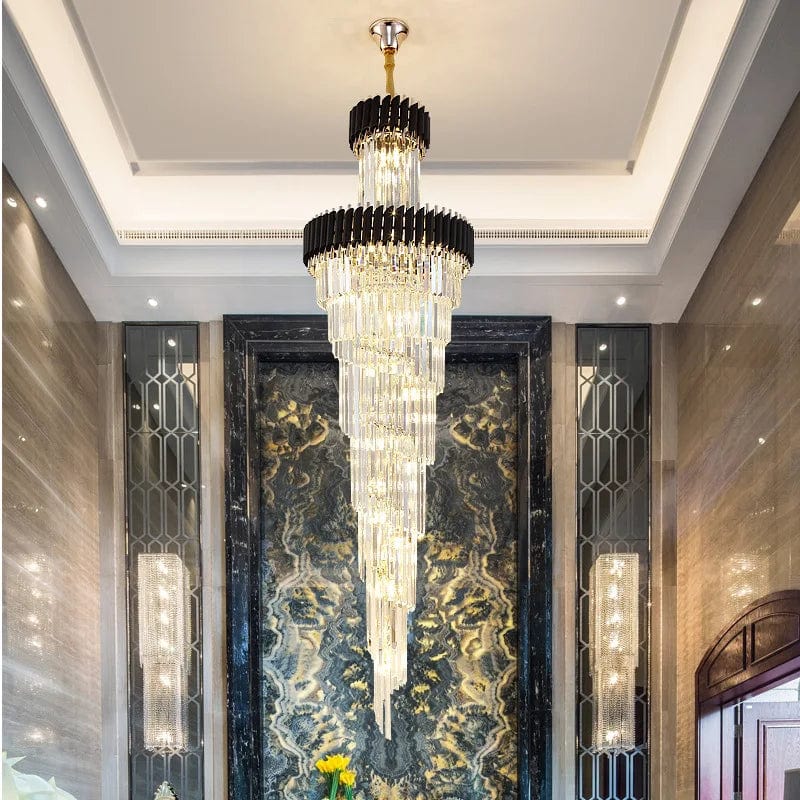
5Beth Extra Large Crystal Chandelier
Crystal Statement · Brace Box ClassCrystal at 59.06 in (150 cm) is where the weight conversation becomes unavoidable: crystal adds mass without adding apparent size, so compositions in this class routinely need a listed heavy-fixture brace box rather than a standard one. Plan the cleaning access at the same time — dust dulls refraction directly.
Mounting: Verify against brace-box thresholds
Install: Two people minimum, professional advised
Cleaning: Crystal shows dust soonest — plan access
Assembly: Add crystal after the frame is hung

6Aureli Crystal Spiral Chandelier
Spiral Crystal · Assembled at HeightSpiral crystal compositions are assembled element by element once the frame is hung — a two-person job measured in hours, and the reason quotes for this class look different from a fixture swap. Budget the time in the installation window rather than discovering it on the day.
Labor: Two people, hours rather than minutes
Geometry: Spiral — suits curved stairwells
Mounting: Brace box or blocking by size
Plan: Lowering system while the scaffold is up
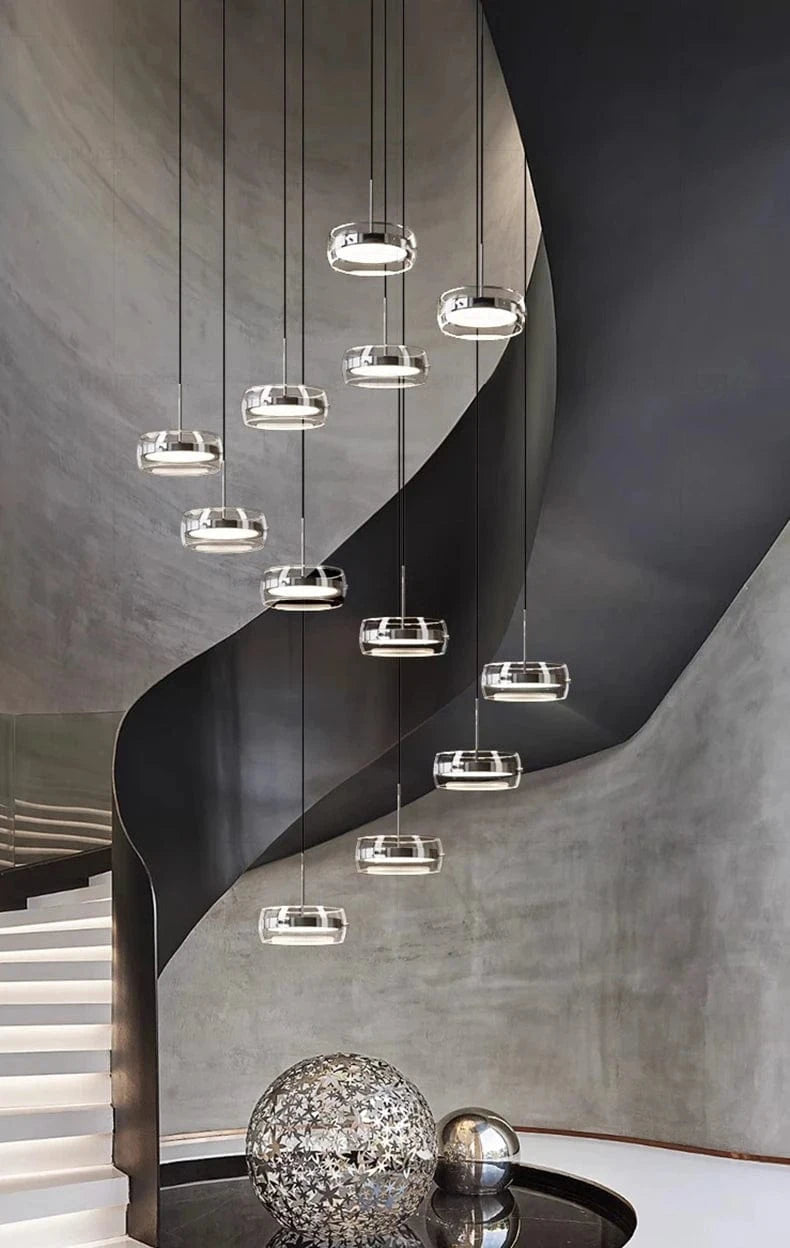
712-Light Modern Staircase Chandelier
Cascade · Scaffold AccessA twelve-light cascade is a two-story fixture by definition, which means scaffold or platform access is part of the job rather than an option. The upside for maintenance: individual elements on a modern cascade are usually smooth and sealed, so cleaning intervals are long even though access is demanding.
Install: Professional, two technicians
Elements: Smooth and sealed — long cleaning intervals
Mounting: Verify box rating before ordering
Safety cable: Ask whether provision is included
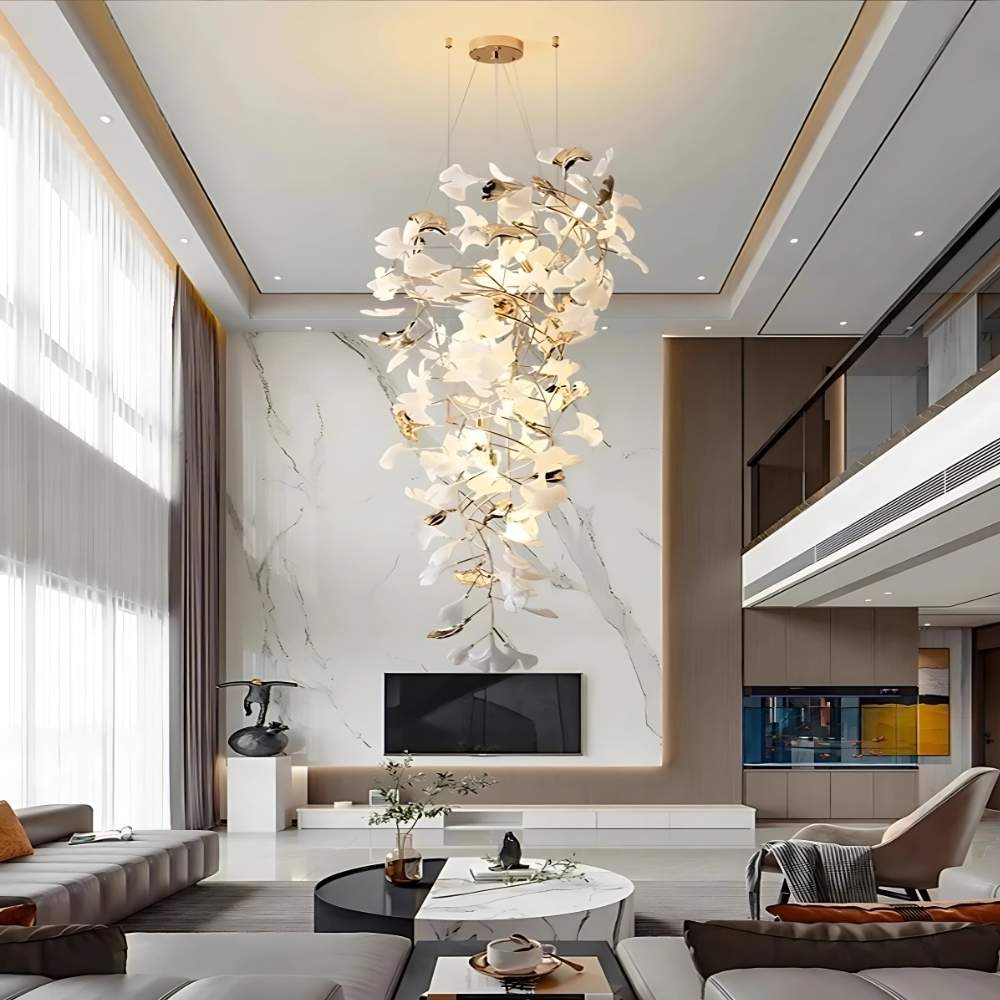
8Alba Branch Staircase Chandelier
Branch Form · Orientation MattersBranch compositions add a step to the installation sequence that symmetric fixtures do not: orientation. Hang loosely, check the fixture's facing from the entry below and from the landing, then tighten — once the canopy is secured and the wiring folded, rotating means undoing the installation at height.
Check from: Entry below and the landing
Sizes: Four, from 23.62" (60 cm)
Why it matters: Rotating later means re-access at height
Related: Branch chandeliers
Browse stairwell lighting
From landing-scale fixtures to two-story cascades.
Staircase Chandeliers → Crystal → Wall Sconces →Common Mistakes
- Ordering before checking the box rating. Boxes carry a marked figure, and older ones are frequently lower than assumed. Retrofitting one in a two-story ceiling is a scaffolded, patch-and-paint job.
- Judging weight by photograph. Crystal adds mass without adding apparent size. A fixture that looks lighter than a modern cascade can weigh three times as much.
- Footing a ladder on the treads. There is no safe way to do it. Use a stair-adjustable platform, a scaffold, or a professional.
- Assembling the fixture before hanging it. A loaded composition is heavier, more fragile and considerably harder to level. Hang the frame, then add the elements.
- Coiling excess cable in the canopy. Suspension should be shortened to the calculated drop. Coiled excess makes the canopy sit proud and the fixture hang unevenly.
- Skipping the lowering system while the scaffold is up. The hardware costs a fraction installed alongside the fixture, and several times more installed afterward.
- Replaceable bulbs at 18 ft. Every lamp change repeats the access problem. Integrated LED at 30,000-50,000 hours removes it for decades.
- Not checking orientation before tightening. On asymmetric and branch compositions, rotating later means re-establishing access at height.
- Liquid cleaners near sockets. Damp cloth only, applied to the cloth rather than the fixture, with the breaker off and lamps cool.
Frequently Asked Questions
How much does a staircase chandelier weigh?
It varies enormously with construction: a slim modular cascade might be 20 lb while a crystal composition of similar visual size passes 70 lb. Crystal and solid components add mass without adding apparent scale, so read the listed figure rather than judging by photograph.
Do I need a special junction box?
Under 35 lb, a standard listed box. From 35-50 lb, a box whose marked rating covers the load. From 50-90 lb, a listed heavy-fixture brace box. Above 90 lb, the mounting should tie into structural blocking.
Can I install a staircase chandelier myself?
A landing fixture or single-flight installation under about 35 lb, with a level working surface and an adequate existing box, is reasonable with the breaker off. Two-story installations are not — height, weight and scaffold access make them professional work.
How do you reach a chandelier over a staircase?
A stair-adjustable platform ladder for wells to roughly 14 ft, or a scaffold tower assembled on the stairs with an adjustable base above that. An extension ladder footed on treads is not a safe option.
How do you clean a chandelier over stairs?
Power off at the breaker, let lamps cool, protect the stairs with a drop cloth, and dust with microfiber. For crystal, use a cloth lightly dampened with one part isopropyl alcohol to four parts distilled water, element by element, keeping moisture away from sockets. Above roughly 14 ft, use a lowering system or a professional service.
What is a chandelier lowering system?
A motorized winch or manual lift installed above the ceiling that lets the fixture descend to working height on demand. Installed alongside the fixture it is a modest addition; installed afterward it means opening the ceiling again.
How often does a stairwell chandelier need cleaning?
Depends on the design. Crystal and multi-element compositions show dust soonest, because dust dulls refraction directly — a crystal fixture that looks dim is often just dusty. Smooth glass and sealed metal tolerate much longer intervals.
What does installation cost?
It tracks height, weight and access rather than the fixture's price. A landing swap with an adequate box is the lowest band; a two-story installation with a box upgrade is the highest, since it adds scaffold time plus drywall repair and painting at height.
Should I choose integrated LED for a stairwell?
It is the strongest argument for the technology anywhere in the house. Quality integrated designs run 30,000-50,000 hours, which removes bulb changes at height for decades. Check that the driver is serviceable.
What is a safety cable and do I need one?
A secondary support independent of the electrical connection, common on heavy and two-story installations. Ask whether the design includes provision for one, particularly on cascades where elements hang below the main body.
My stairwell ceiling is sloped — is that a problem?
No, but it needs a sloped-ceiling adapter, or swivel canopy, so the fixture hangs plumb from an angled surface. Check the maximum slope the adapter accommodates against your ceiling's pitch.
Should the fixture be assembled before or after hanging?
After. A fully loaded composition is heavier, more fragile and harder to level. Hang and secure the frame first, then add crystal, glass or other elements at height.
Plan the Access, Not Just the Fixture
Confirm the weight against the box's marked rating before ordering, settle the access method before scheduling, and decide the cleaning plan before the scaffold comes down. Handled in that sequence, a stairwell installation is a scheduled afternoon. Handled afterward, each of those decisions costs several times as much — which is why the fixture that looks right and the fixture that installs well are worth checking as one question rather than two.
Browse the range: staircase chandeliers, crystal chandeliers, foyer & entryway chandeliers, all chandeliers.