Quick Answer
Three cool finishes, three different jobs. Chrome is a mirror — it multiplies whatever surrounds it and reads brightest. Brushed nickel and satin silver are the same family softened: less reflection, and they hide fingerprints in a way chrome cannot. Gray and graphite are the quietest, sitting between black's contrast and silver's shine.
Gray is the one most people are actually looking for. It adds form to a ceiling without competing — which makes it the right answer in rooms that already carry pattern, colour or busy materials, where black would darken and chrome would shout.
Cool metal follows the room's palette, not the fixture. Grey-washed floors, cool-toned stone, white and blue-grey walls, chrome or nickel hardware — those rooms want cool. Walnut, brass hardware, warm neutrals and terracotta want warm metal instead.
Chrome is not finished, it is narrower. As a whole-house default it has been replaced by warm metals and matte black, but in monochrome, glass-heavy, mid-century and bathroom contexts it still does something no other finish does.
Warm metals have dominated design coverage for three years, which has left the cool side of the palette under-explained — and a lot of rooms genuinely want it. Grey-toned flooring, cool stone, blue and green palettes, and existing chrome hardware all pull a fixture toward silver rather than brass, and the three cool finishes behave differently enough that choosing between them matters. This guide covers what chrome, nickel and gray each do to a room, when cool beats warm, where chrome is still exactly right, and how the maintenance differs.
On this page
- Three Cool Finishes, Three Jobs
- Gray: The Quietest Choice
- Chrome: Narrower, Not Finished
- Nickel and Satin Silver
- Warm or Cool: How the Room Decides
- Gray and Graphite Picks
- Chrome and Silver Picks
- Mixing Metals Without It Reading Accidental
- Light, Bulbs and How Cool Metal Reflects
- Maintenance: The Real Difference
- Common Mistakes
- Frequently Asked Questions
Three Cool Finishes, Three Jobs
They get grouped together as "silver," which hides the fact that they solve different problems. The distinction is how much light each returns and how much attention it asks for.
Chrome returns the most light and asks the most attention; gray returns the least of both
Gray: The Quietest Choice
Gray and graphite finishes are the least discussed and the most useful, because they solve a problem the other two create. Black gives a ceiling maximum contrast; chrome gives it maximum brightness. Both are decisions. Gray is the finish that lets the fixture's form be the decision while the finish stays out of the argument.
It also behaves better than either against cool-toned architecture. Grey-washed oak floors, concrete, pale limestone and blue-grey paint all sit in the same tonal family, so a graphite fixture reads as part of the scheme rather than an object dropped into it. And it is the most forgiving of the three in daily ownership: matte and satin grays hide dust shadows and handling marks better than chrome or black, both of which show everything.
One caution. Gray needs enough contrast against the ceiling to register at all. Against a mid-grey painted ceiling the fixture can disappear entirely — which is occasionally the goal, but rarely what someone spending on a chandelier wants.
Chrome: Narrower, Not Finished
Current design coverage, including our own 2026 direction report, describes polished chrome as having lost its position as the residential default. That is accurate and worth restating precisely, because "no longer the default" is not the same as "no longer correct."
What changed is breadth. From roughly 2000 to 2015, chrome was specified almost everywhere by reflex — living rooms with warm timber floors, dining rooms with brass hardware, bedrooms in cream and beige. In those rooms warm metals do work chrome cannot, and the shift makes sense. What did not change is what chrome does in the rooms built for it.
- Monochrome and grey-scale interiors. Where the palette is black, white and grey, warm metal introduces a colour the room does not otherwise have. Chrome belongs to the scheme.
- Glass-heavy rooms. Chrome and glass multiply each other — mirrored surfaces, glass tables, large windows. It is the only finish that participates in that instead of interrupting it.
- Mid-century interiors. Chrome is period-correct in a way brass is only sometimes. In a room built around genuine mid-century pieces, it is the historically honest choice.
- Bathrooms. Chrome fixtures dominate bath hardware, and matching the ceiling fixture to taps and towel rails is the cleanest result available in that room.
- Rooms with existing chrome hardware. Where door handles, taps and rails are already chrome, changing the ceiling fixture to brass introduces a second metal without removing the first.
Nickel and Satin Silver
Brushed nickel is chrome with the volume turned down: the same cool tone, a diffuse sheen instead of a mirror. That difference solves chrome's main practical weakness — fingerprints and water spots, which show on polished surfaces and disappear on brushed ones.
It is also the most transitional cool finish, meaning it sits comfortably in rooms that are neither strictly modern nor traditional. Where chrome can read sharp against classical mouldings and gray can read too contemporary, satin nickel usually just reads correct. That makes it the safe choice when the room's direction is not fully settled — and the reason it dominates kitchens and family rooms, where the fixture is handled and lives among a lot of other hardware.
Warm or Cool: How the Room Decides
This decision belongs to the room, not the fixture. Three signals settle it in under a minute.
| Signal | Points to cool metal | Points to warm metal |
|---|---|---|
| Wood tone | Grey-wash, ash, pale or cool-stained oak | Walnut, cherry, natural oak, teak |
| Stone and surfaces | Concrete, grey marble, pale limestone, white quartz | Travertine, warm marble, terracotta, brick |
| Wall palette | White, grey, blue, blue-green | Cream, beige, greige, warm white, deep green |
| Existing hardware | Chrome or nickel handles, taps, rails | Brass, bronze, unlacquered gold |
| Textiles | Cool greys, indigo, cool linen | Wool, leather, camel, rust |
Where the signals split — cool floors with brass hardware, for instance — follow the hardware. It is the element the fixture is seen alongside most directly, and the one people rarely replace. The warm side of this decision is covered in our gold, brass and copper guide, and the graphic alternative in our black chandelier guide.
Gray and Graphite Picks (4 Designs)
Quiet cool finishes for rooms that already carry pattern, colour or busy material. Check the fixture has enough tonal contrast against your ceiling — gray against a grey ceiling disappears.
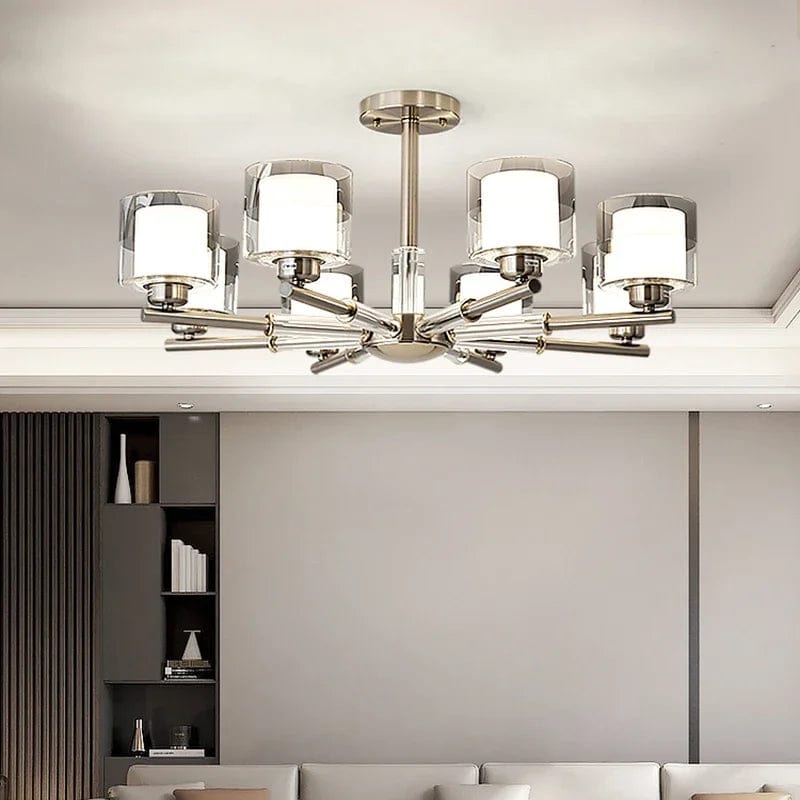
1Amanda Modern Silver Chandelier
Silver · Linear and RoundSilver in a linear format is the cool-metal answer to a long table — the finish stays quiet while the geometry does the work, which is exactly the division of labour cool metals are best at. Offered in linear and round configurations, so the same finish can serve a rectangular dining table and a seating group in one house.
Formats: Linear and round
Best rooms: Dining, living, open plans
Pairs with: Grey-wash floors, concrete, cool stone
Light: Warm white 3000K to offset the cool finish
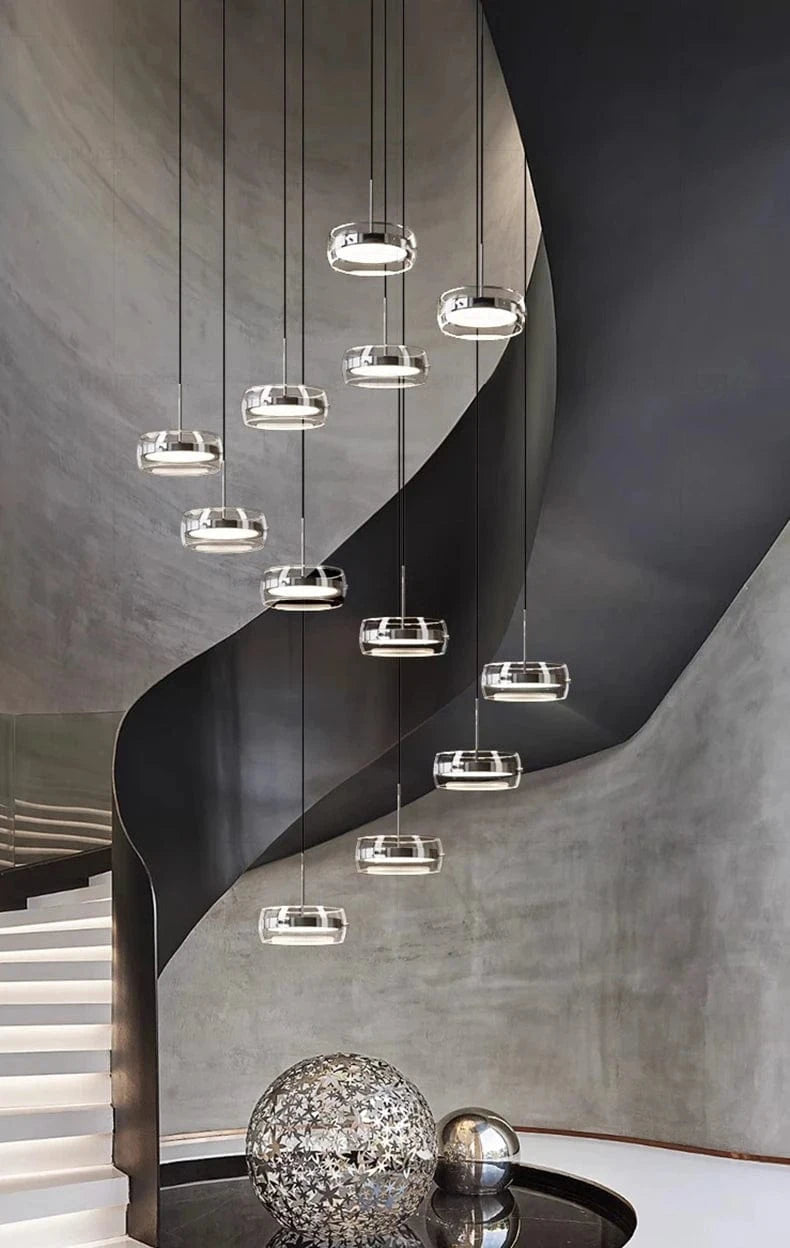
212-Light Modern Staircase Chandelier
Silver or Black · CascadeStairwells are where cool metal earns its keep in a way warm metal cannot: a silver cascade in a tall volume reads as architecture rather than ornament, which suits the concrete, glass and pale plaster surfaces most two-story entries actually have. The same design in black gives the graphic alternative if the walls are pale enough to carry it.
Format: 12-light vertical cascade
Suits: Two-story entries, stairwells, 16 ft and above
Why cool here: Reads architectural against concrete and plaster
Related: Staircase chandeliers
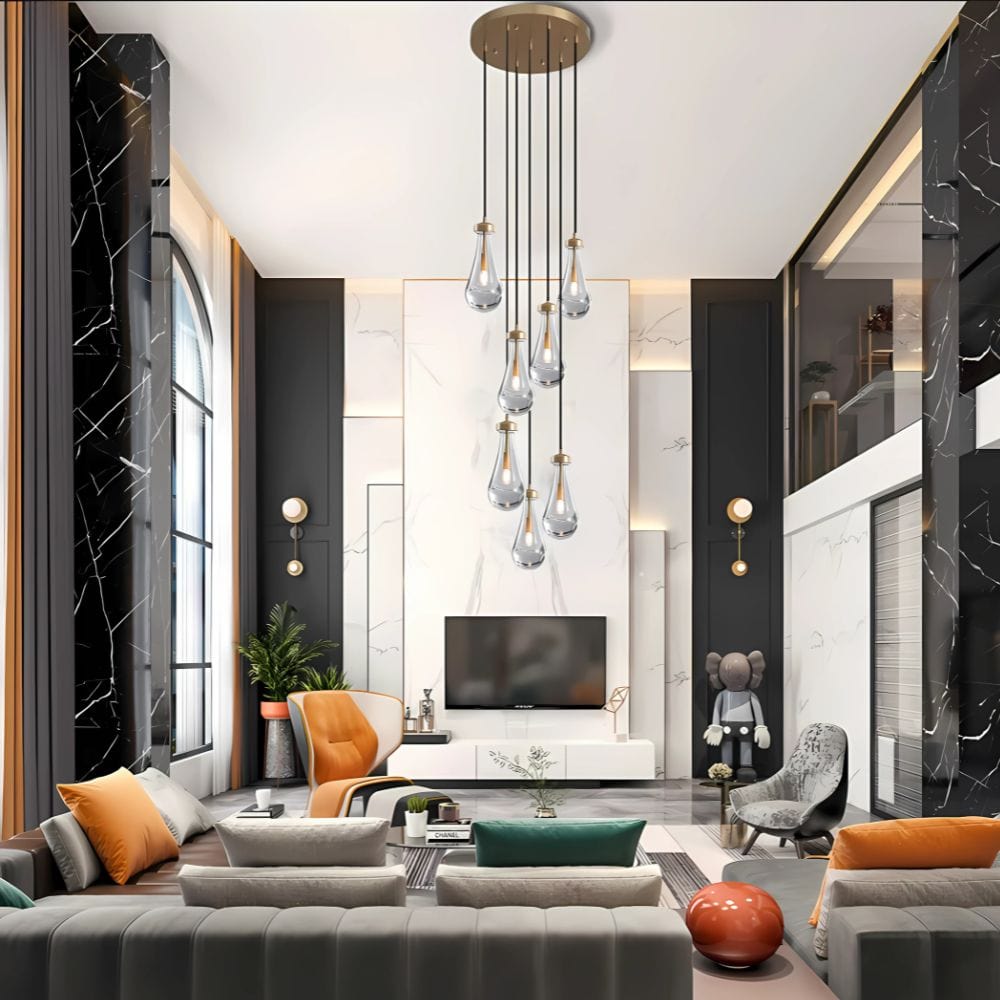
3Aura Modern Copper Chandelier
Chrome, Brass or Black · Same FormThe most useful design in this guide, because it offers the same silhouette in chrome, brass and black. If the warm-versus-cool decision is genuinely close, a fixture available across both sides lets the room decide rather than the shortlist — and it demonstrates the point directly: one form, three completely different results.
Use for: Rooms where warm-vs-cool is undecided
Demonstrates: One form, three different results
Best rooms: Dining, living, entry
Check: Room's dominant hardware before choosing
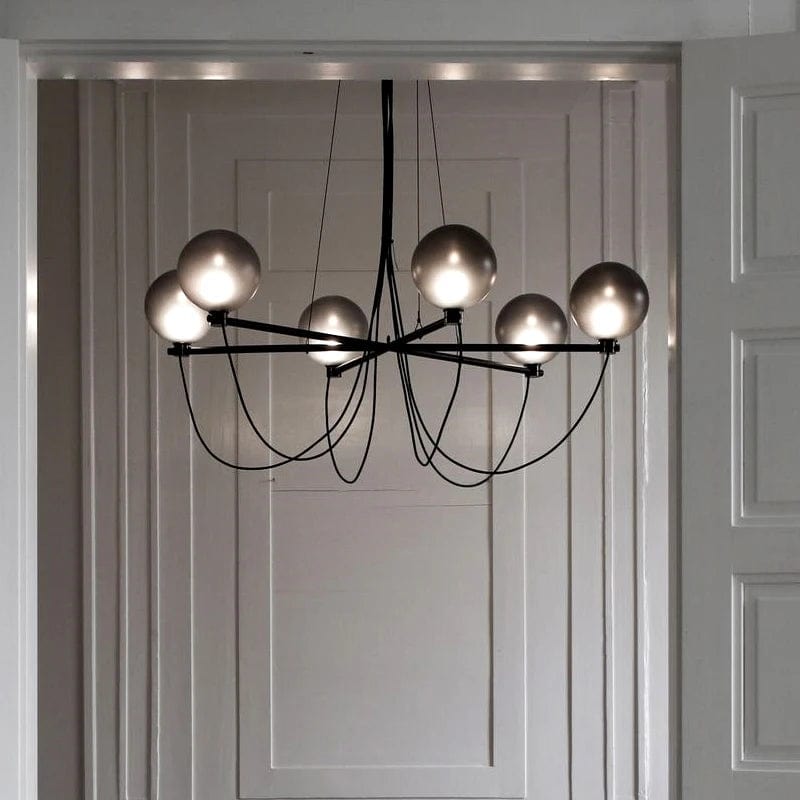
4Arc Modern Black Chandelier
Matte Black · The Graphic AlternativeIncluded as the comparison point. Where gray adds form quietly, black adds it emphatically — the same fixture reads as a drawn line against a pale ceiling rather than a soft shape. Choose black when the room is quiet and the ceiling should be the event; choose gray when the room is already busy.
Choose when: The room is quiet and the ceiling should lead
Choose gray instead when: The room already carries pattern
Sizes: Two, from 31.50" (80 cm)
Related: Black chandeliers
Chrome and Bright Silver Picks (4 Designs)
For monochrome schemes, glass-heavy rooms, mid-century interiors and spaces where chrome hardware is already installed. Plan on more frequent wiping than a brushed finish needs.
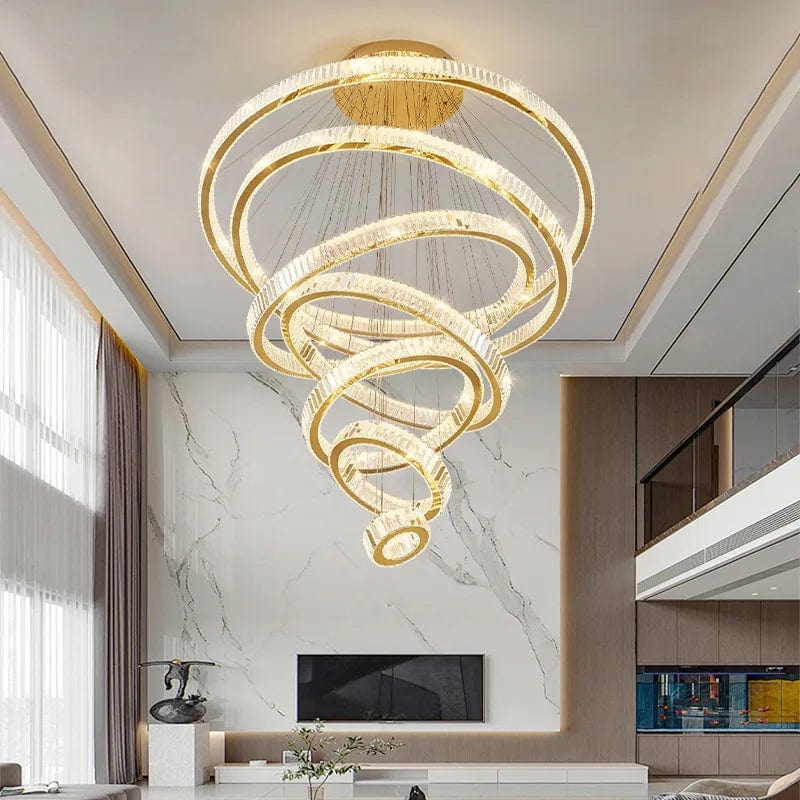
5Bily LED Crystal Ring Chandelier
Chrome + Crystal · Multiplied ReflectionChrome and crystal together are the strongest case for the finish: the metal mirrors what the crystal refracts, so the two multiply rather than compete. In a monochrome or glass-heavy room this combination produces more visible light movement than any warm-metal equivalent. Gold is offered for the opposite palette.
Why chrome works here: Mirrors what the crystal refracts
Best rooms: Monochrome, glass-heavy, formal dining
Source: Integrated LED ring
Dimmer: Essential — crystal reads best at 30-60%
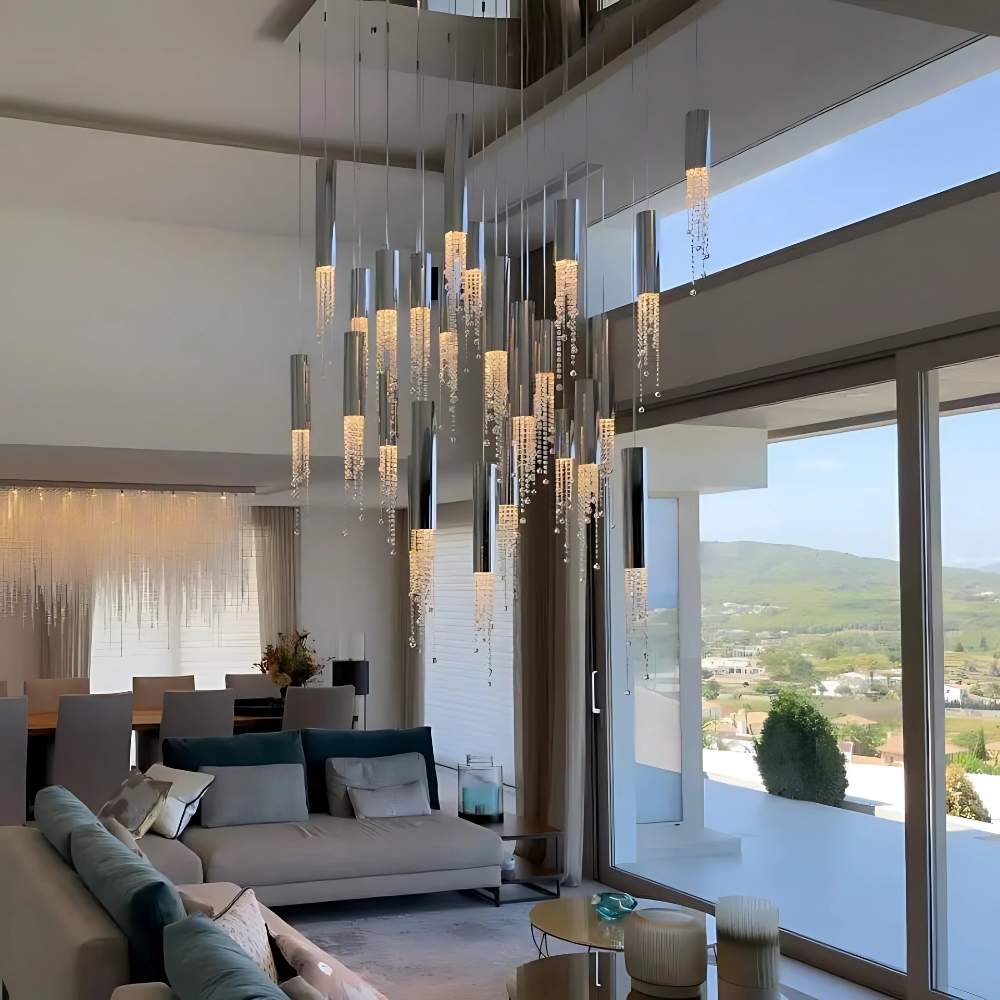
6Dash Crystal Staircase Chandelier
Chrome · Daylight MultiplierIn a stairwell with a window, chrome does something warm metal cannot: daylight entering the volume bounces off the metal and through the crystal simultaneously, so the fixture works during the hours it is switched off. Worth weighing against the access question — chrome shows dust more visibly than a brushed finish at height.
Advantage: Multiplies window daylight in tall volumes
Trade: Shows dust more than brushed finishes
Suits: Stairwells and two-story entries with windows
Access: Plan cleaning before hanging at height
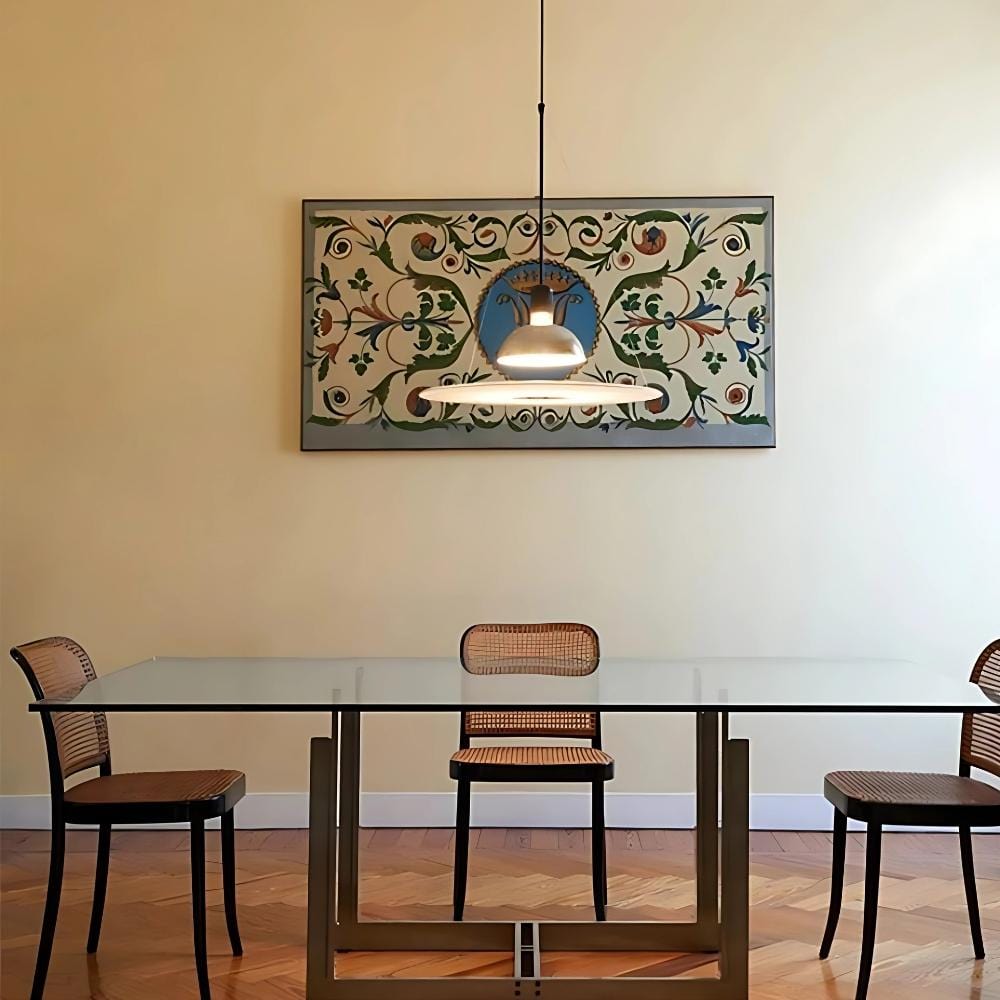
7Chiara Scandinavian Pendant Light
Silver · Scandinavian PaletteScandinavian interiors are cool-metal territory by construction: pale wood, white walls, grey textiles and restrained colour. A silver pendant belongs to that palette in a way brass has to work to justify. Also the class that repeats well over an island, since low visual weight per fixture keeps a run reading as a line.
Palette fit: Pale wood, white walls, grey textiles
Repeats well: Low visual weight per fixture
Best rooms: Kitchens, breakfast areas, Nordic interiors
Related: Pendant lights
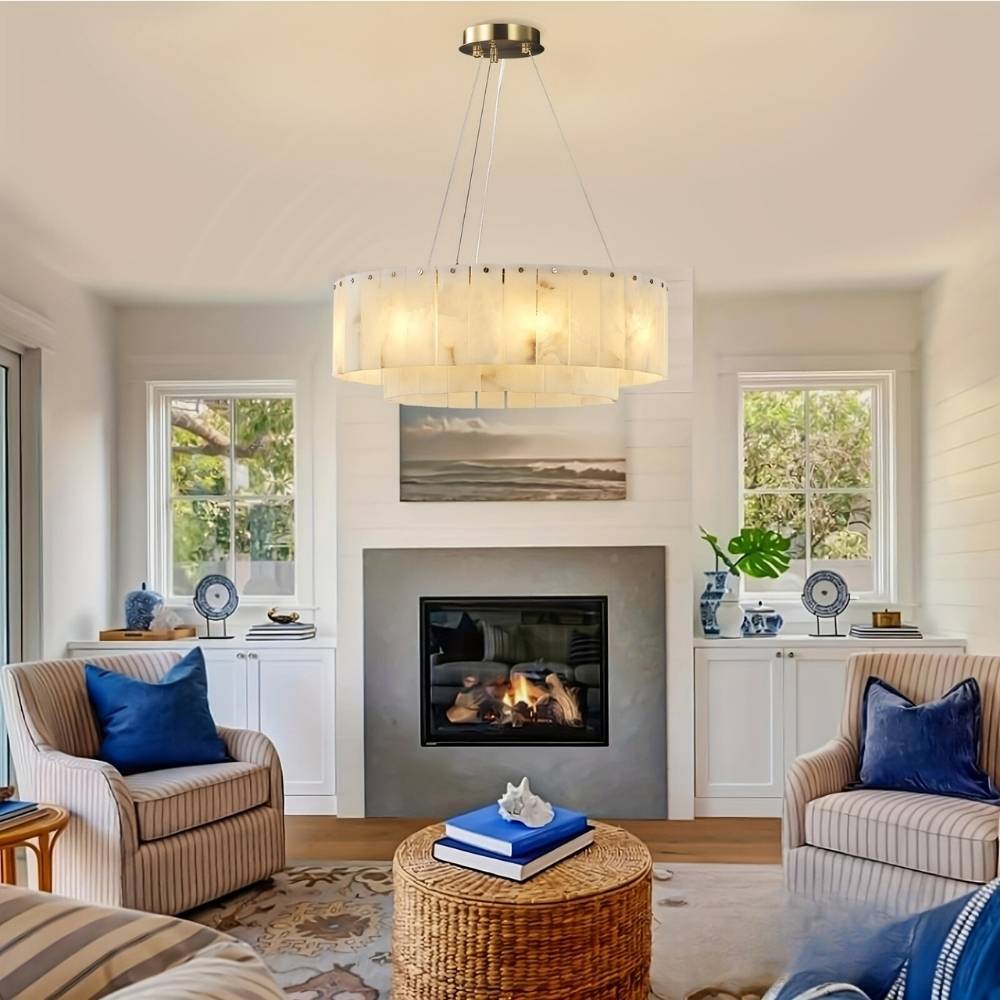
8Angie Alabaster Round Chandelier
Alabaster · Cool Without MetalThe route people miss: a cool-toned room does not have to reach for metal at all. Pale alabaster and stone give the same tonal family with a softness no polished surface produces, and they sidestep the fingerprint problem entirely. Strongest where the room is cool but the light should still feel warm.
Advantage: No polished surface, no fingerprints
Best rooms: Bedrooms, dining, cool-toned interiors
Light: Softest output in this guide
Care: Dry dusting only — no liquid on stone
Browse by finish
Cool, warm and graphic directions across the catalog.
Contemporary Chandeliers → Black → Gold →Mixing Metals Without It Reading Accidental
Mixing is fine and frequently better than matching everything. What separates deliberate from accidental is proportion: one metal should clearly lead and the other should clearly support, at roughly a two-to-one presence in the room.
- Two metals maximum in a single sightline. Three reads unresolved regardless of how good each one is.
- Give the fixture the leading metal or the supporting one, deliberately. A chrome chandelier in a brass-hardware room can work as the deliberate accent — but only if nothing else in the room is also chrome.
- Keep the same finish level. Brushed with brushed, polished with polished. Mixing tone is easier than mixing sheen.
- Black is neutral in this equation. It reads as a line rather than a metal, which is why it pairs with both warm and cool without counting as the second metal.
- Match within a fixture first. A two-tone fixture already contains a mix; adding a third metal to the room around it rarely resolves.
Light, Bulbs and How Cool Metal Reflects
Cool finishes reflect light without warming it, which means the lamp is doing all the temperature work. That makes the bulb choice more consequential here than with brass, where the metal itself contributes amber.
Warm white at 2700-3000K is the correction: it keeps a chrome or graphite fixture from reading clinical, and it is what stops a cool-metal room feeling like an office. Cool white at 4000K and above compounds the effect in exactly the wrong direction — chrome plus cool light is the combination that makes people describe a room as sterile without being able to say why. Add a dimmer, since chrome in particular reads very differently at 40% output than at full.
Maintenance: The Real Difference
| Finish | Shows | Cleaning |
|---|---|---|
| Polished chrome | Fingerprints, water spots, dust shadows | Microfiber, more often; damp cloth for spots, dried immediately |
| Brushed nickel | Very little — the brush pattern hides marks | Dry microfiber, occasional wipe along the grain |
| Gray and graphite | Least of the three | Dry microfiber; matte surfaces need no polish |
| Alabaster and stone | Dust only | Dry dusting; never liquid on unsealed stone |
Two notes. Never use abrasive cleaners or metal polish on brushed or matte finishes — polish is formulated to remove a surface layer, which on a brushed finish removes the brush pattern. And on any fixture hung high, choose the finish partly for how rarely it will need attention: a polished chrome fixture at 18 ft looks dull far sooner than a graphite one in the same position. Full technique is in our chandelier care guide.
Common Mistakes
- Choosing the finish before reading the room. Wood tone, stone, wall palette and existing hardware settle it. The fixture follows.
- Cool metal against warm timber. Chrome over walnut is the pairing that reads accidental most often. Warm floors want warm metal.
- Gray on a grey ceiling. The fixture disappears. Gray needs tonal contrast to register at all.
- Chrome plus cool white LED. The combination that makes a room read clinical. 2700-3000K corrects it.
- Three metals in one sightline. Two is a decision; three is an accident. Black does not count as the second.
- Polish on a brushed finish. Polish removes a surface layer, which removes the brush pattern. Dry microfiber only.
- Polished chrome at 18 ft. It dulls with dust faster than matte finishes and is harder to reach. Choose finish partly for access.
- Assuming chrome is over. It has narrowed, not ended. In monochrome, glass-heavy, mid-century and bathroom contexts it still does what nothing else does.
Frequently Asked Questions
What is the difference between chrome, nickel and gray finishes?
Chrome is a mirror — brightest, most reflective, most attention. Brushed nickel is the same cool tone with a diffuse sheen, which hides fingerprints. Gray and graphite are the quietest, sitting between black's contrast and silver's shine.
Is chrome out of style?
It has narrowed rather than ended. As a whole-house default it has been replaced by warm metals and matte black, but it remains the correct choice in monochrome schemes, glass-heavy rooms, mid-century interiors and bathrooms where chrome hardware is already installed.
When should I choose a gray chandelier?
When the room already carries pattern, colour or busy material. Black adds weight to a space that has enough, and chrome adds a bright spot that pulls the eye. Gray adds form and stops there.
How do I know whether my room wants warm or cool metal?
Check four signals: wood tone, stone and surfaces, wall palette, and existing hardware. Grey-wash floors, concrete, cool greys and chrome handles point cool; walnut, travertine, cream walls and brass handles point warm. Where signals split, follow the hardware.
Can I mix chrome and brass in one room?
Yes, if one clearly leads at roughly a two-to-one presence and the other supports. Keep to two metals in a single sightline, match the finish level (brushed with brushed), and remember black reads as a line rather than a metal, so it does not count as the second.
Does chrome show fingerprints?
More than any other finish here. Brushed nickel hides marks in the brush pattern, and matte gray hides them best of the three. For a fixture that is handled or hung where it is seen closely, brushed or matte is the practical choice.
What bulb colour suits a cool metal chandelier?
Warm white 2700-3000K. Cool finishes reflect light without warming it, so the lamp does all the temperature work. Chrome plus cool white at 4000K and above is what makes a room read clinical.
Is brushed nickel the same as chrome?
Same cool tone, different surface. Chrome is polished to a mirror; nickel is brushed to a diffuse sheen. Nickel is the more transitional of the two and considerably easier to live with.
Does gray work in a small room?
Well, because it adds form without adding visual weight — which is the specific problem black creates in a compact space. Just confirm there is enough contrast against the ceiling for the fixture to register.
What about alabaster or stone instead of metal?
A genuine alternative in cool-toned rooms. Pale alabaster sits in the same tonal family with a softness no polished surface produces, and it avoids the fingerprint question entirely while keeping the light itself warm.
How do I clean a chrome chandelier?
Power off, let lamps cool, then dry microfiber. For water spots, a barely damp cloth applied to the cloth rather than the fixture and dried immediately. Never use metal polish on brushed or matte finishes — it removes the surface pattern.
Which cool finish suits a stairwell or high ceiling?
Graphite or brushed, for maintenance reasons: polished chrome dulls with dust faster and is harder to reach. Where a stairwell window brings daylight in, chrome does multiply it — worth the trade only if cleaning access is genuinely solved.
Read the Room, Then the Finish
Wood tone, stone, wall palette and existing hardware decide warm against cool before any fixture is shortlisted. Within cool, the choice is about how much attention the finish should ask for: chrome the most, brushed nickel in the middle, gray the least — with gray being the right answer more often than its share of coverage suggests, because most rooms already have enough going on.
Browse the range: contemporary chandeliers, black chandeliers, gold chandeliers, all chandeliers.