Quick Answer
The glass decides everything. Clear globes give maximum sparkle with visible bulbs; frosted and opal hide the source behind an even glow; smoked grey reads moody and restrained; colored and iridescent glass turns the fixture into the room's color event. Mixed compositions — clear and frosted spheres alternating — give a cluster depth that a single finish cannot.
Judging quality: hand-blown globes carry slight irregularities in wall and curve that catch light with a liveliness molded acrylic never fakes. Check wall thickness at the rim, and confirm the material is glass rather than acrylic — glass runs heavier and colder in the hand.
Five forms: clusters (staggered globes, the classic), cascades and waterfalls (vertical, for stairwells), branching (spheres on sculptural arms), linear (a row, for rectangular tables and islands), and flush mount (the cluster held tight to the ceiling for 8 ft rooms).
A bubble chandelier is a glass decision wearing a metal frame. Two fixtures with identical globe counts and identical diameters can produce entirely different rooms depending on whether the glass is clear, frosted, smoked or colored — and whether those globes hang in a cluster, cascade down a stairwell, or ride sculptural arms. This guide covers what each glass treatment does to the light, how to tell hand-blown from molded at a glance, the five form families and where each belongs, and eight designs across the range.
On this page
Why the Glass Comes First
In most fixtures the frame is the design and the glass is a shade. In this form the relationship inverts: the frame is a delivery system for a composition of glowing spheres, and every quality judgment a viewer makes lands on the glass.
That matters practically because glass is the one component you cannot change later. A frame finish can be lived with, a bulb can be swapped, a dimmer can be added — but a fixture bought in clear glass that turns out to glare above a seating area stays a clear-glass fixture. Deciding the treatment before the shortlist saves the most common regret in the category.
Five Glass Treatments
Five treatments, five different results from the same globe and the same lamp
| Treatment | Light behavior | Bulb choice | Best placements |
|---|---|---|---|
| Clear | Maximum output, visible source | Decorative filament LED — the bulb is part of the design | Entries, stairwells, hallways, high ceilings |
| Frosted | Source softened to a haze | Any warm LED; shape still reads through | Dining tables, living rooms, islands with seating |
| Opal / milk | Source fully hidden, softest glow | Any — nothing is visible | Bedrooms, baths, close-range positions |
| Smoked grey | Output reduced, mood raised | Warm LED at higher lumens to compensate | Dining rooms, lounges, moody interiors |
| Colored / iridescent | Tints the light and the room | Warm white; cool light fights the tint | Statement rooms, entries, collectible interiors |
Mixed Compositions
The detail that separates designer clusters from catalog ones: alternating treatments within a single fixture. A composition of clear and frosted spheres reads with depth that neither finish achieves alone — the clear globes catch highlights and give the cluster sparkle, while the frosted ones supply the even body of light and stop the whole thing from glaring.
The same logic applies to color. A cluster of smoked grey globes with two or three clear ones reads intentional; twenty identical smoked globes read heavy. Where a fixture offers a mixed option, it is usually the more considered composition, and it photographs less well than it lives — which is exactly backwards from most lighting decisions.
Telling Hand-Blown from Molded
Three checks, all of which work in a showroom and none of which work in a photograph.
- Look for irregularity. Hand-blown and mouth-blown globes vary slightly in wall thickness and curve. That variation is what catches light with liveliness — a molded globe is uniform, and uniformity reads flat in person even when it photographs cleanly.
- Check the rim. Wall thickness shows where the globe meets its fitting. Substantial glass reads as substance; thin glass reads as fragile, and usually is.
- Weigh it in the hand. Glass runs heavier and colder to the touch than acrylic. Acrylic globes also show mold seams — a faint line running around the sphere — and scratch far more easily over a decade of cleaning.
The Five Form Families
Once the glass is settled, form decides where the fixture belongs. Each family solves a different room geometry.
| Form | What it looks like | Where it belongs |
|---|---|---|
| Cluster | Globes staggered at varied drops around a center | Round and square rooms, over round tables, entries |
| Cascade / waterfall | Vertical fall of globes through open volume | Stairwells, two-story foyers, double-height spaces |
| Branching | Spheres carried on sculptural arms | Organic and biophilic interiors, wide rooms |
| Linear | Globes in a row along an axis | Rectangular dining tables, kitchen islands |
| Flush / semi-flush | The cluster held tight to the ceiling | 8-9 ft ceilings, bedrooms, hallways, baths |
Two families cross into neighboring categories, and it is worth knowing where the lines sit. Branching designs share vocabulary with the branch chandeliers collection, where sculptural arms carry other elements as well as glass. Linear bubble designs share the format logic of the linear chandeliers collection — size to the table's length rather than the room.
Picks by Glass Treatment (4 Designs)
Fixtures chosen for what the glass does — clear, milk, smoked and colored compositions. Warm white 2700-3000K on a dimmer suits every one of them; clear designs additionally deserve decorative filament lamps, since the bulb is part of the composition.

1Dove Glass Bubble Light Fixture
Clear or Brown Glass · Three SizesThe treatment decision made visible: the same composition in transparent glass for maximum sparkle and visible lamps, or brown-tinted for a warmer, quieter register. Offered across three diameters, which makes it one of the easier designs to size correctly rather than settling for what exists.
Sizes: Three diameters, from 23.62" (60 cm)
Light: Warm white 3000K
Best for: Dining rooms, entries, living spaces
Bulb note: Clear version suits decorative filament lamps
2Holly Milk Glass Chandelier
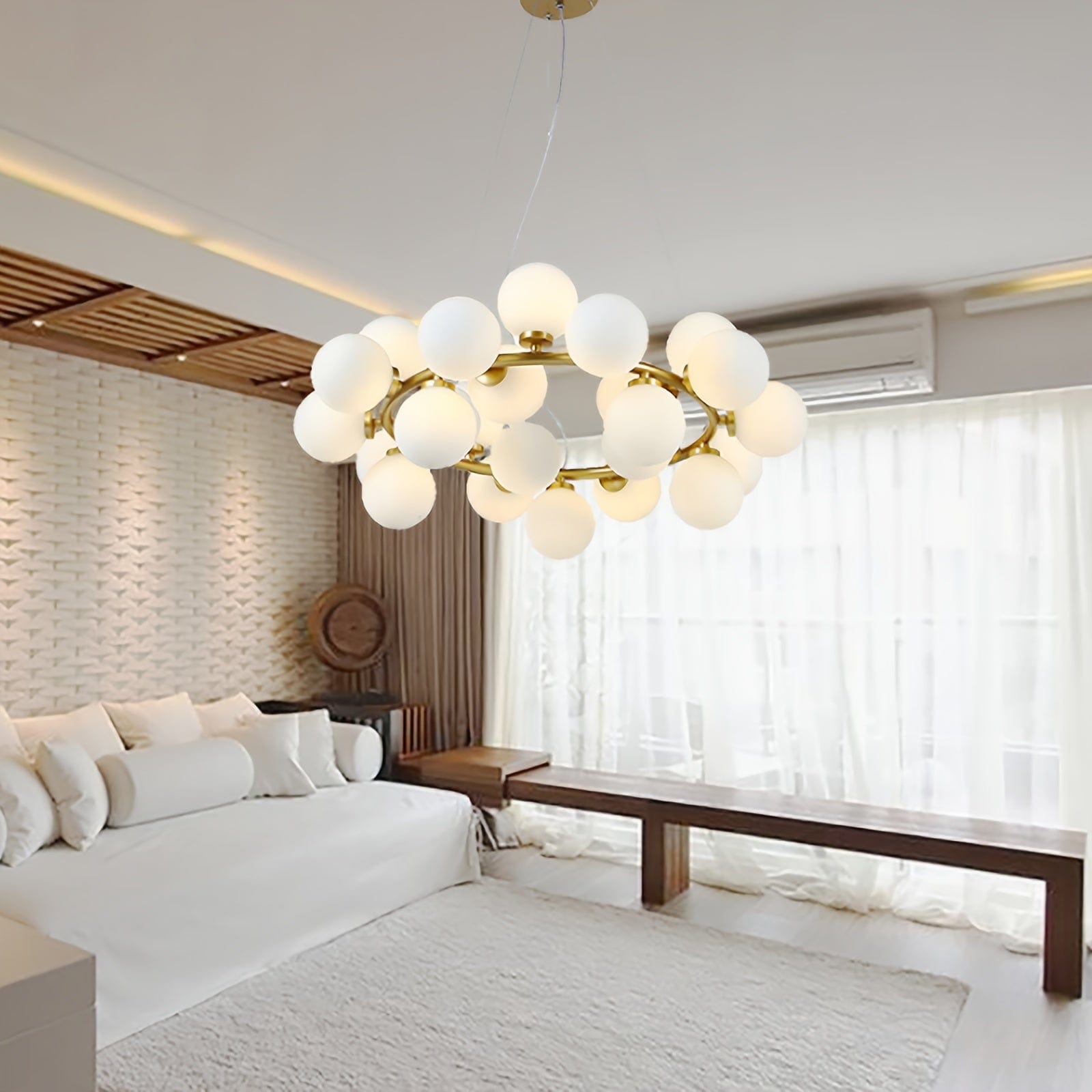
Milk Glass · Softest OutputMilk glass hides the source completely, producing the softest output in the category and the one treatment that is comfortable at any viewing angle. This is the answer for bedrooms, baths and any position where people look toward the fixture rather than past it — and the safest choice when the room's use may change.
Glare: None at any viewing angle
Best for: Bedrooms, baths, seating areas
Bulb: Any warm LED — nothing is visible
Related: Glass pendant lights
3Elise Sputnik Bubble Chandelier
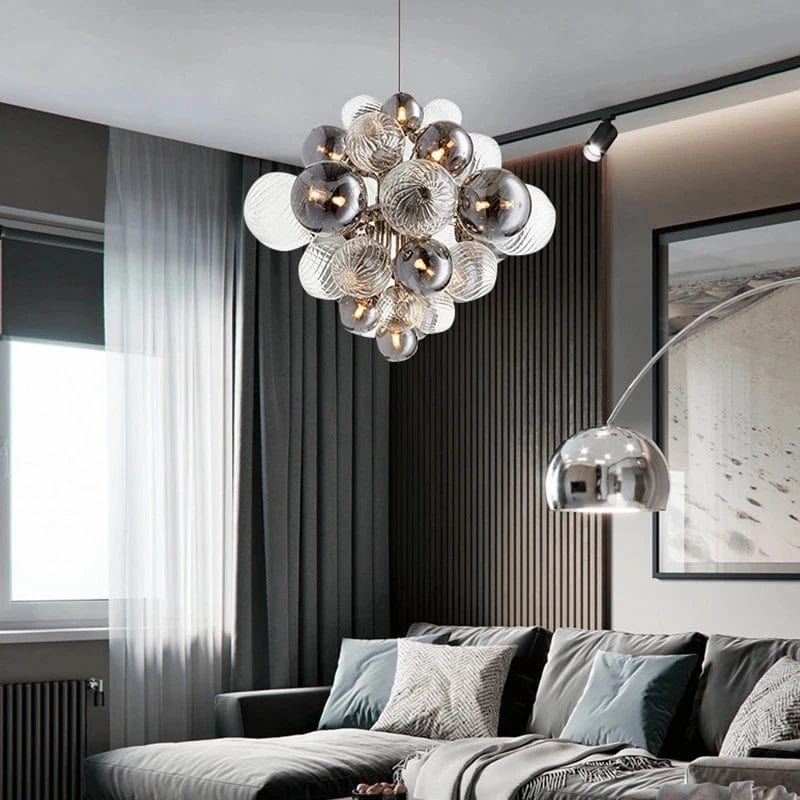
Smoke Grey · Radial HybridSmoked glass on a radial frame — the moody register crossed with mid-century geometry. Smoked treatments reduce output, so plan on higher-lumen lamps or a second light layer in a working room; in a dining room, that reduction is the point, and the fixture reads restrained rather than dim.
Frame: Radial, sputnik-adjacent geometry
Plan for: Higher lumens or a second layer in working rooms
Best for: Dining rooms, lounges, moody interiors
Related: Sputnik chandeliers
4Glo Modern Glass Grape Chandelier
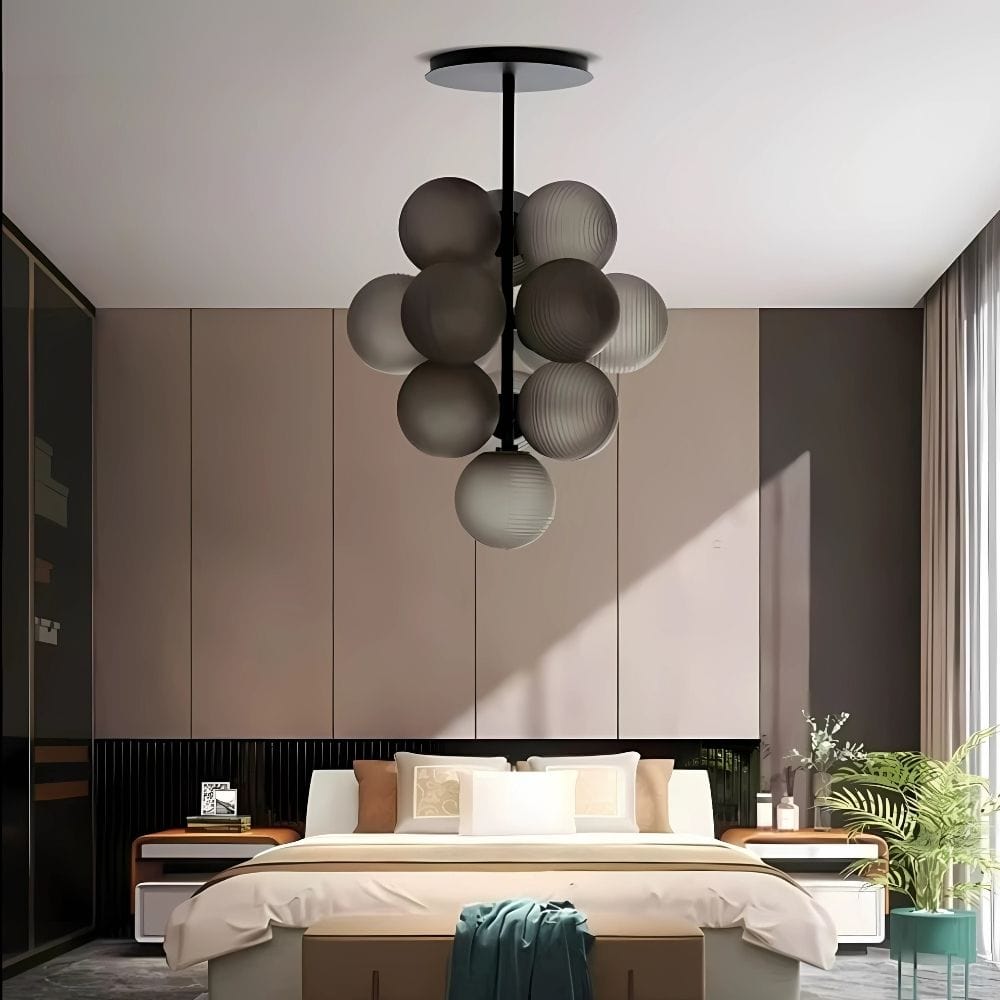
Colored Glass · Grape ClusterColored glass turns the fixture into the room's color event rather than its light source — available across purple, smoke grey, brown and white, which is a wider palette than most of the category offers. Keep the frame quiet when the glass leads; a sculptural frame plus colored glass is one decision too many.
Composition: Tight grape-cluster grouping
Pairing rule: Colored glass takes a quiet frame
Light: Warm white — cool light fights the tint
Best for: Statement dining rooms, entries
Picks by Form (4 Designs)
Fixtures chosen for the geometry they solve — branching, linear, flush and colored-statement compositions. Match the form to the room's shape before comparing finishes, since form decides fit and finish decides mood.
5Carol Branch Bubble Chandelier
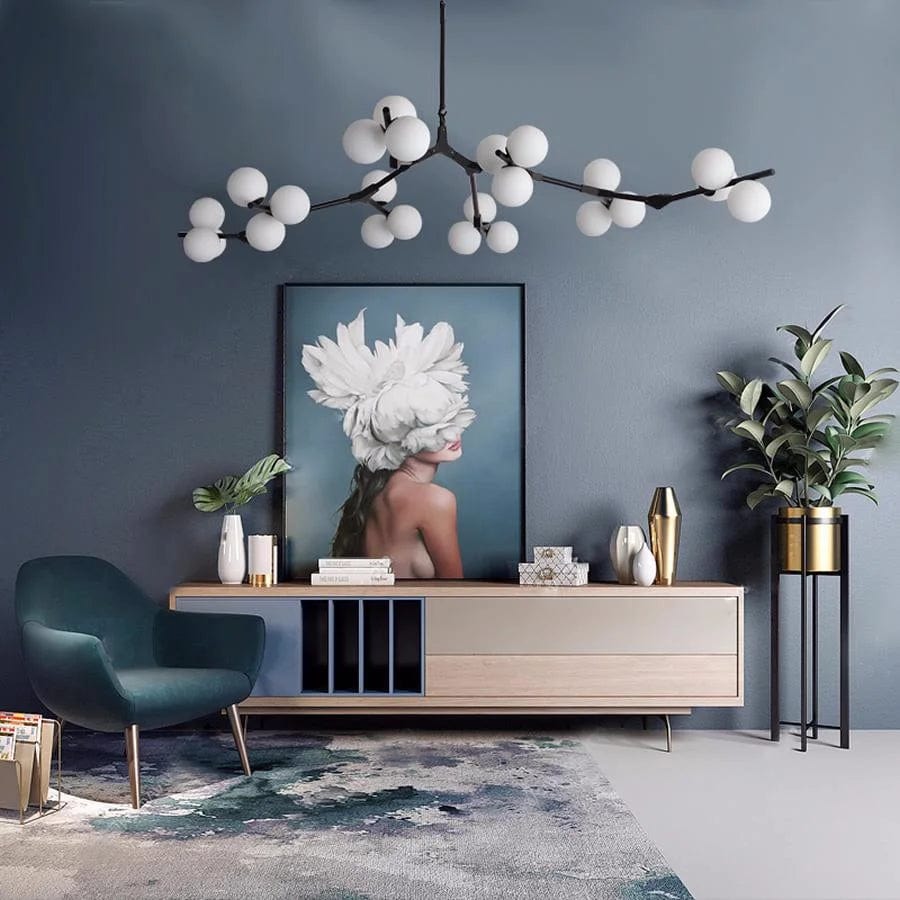
Branching · Black or GoldThe branching family in its clearest form: globes carried outward on sculptural arms rather than hanging on staggered cables. The spread covers width from a single ceiling point, which makes it an alternative to two fixtures where only one junction box exists. Black frames read graphic against pale ceilings; gold reads warm.
Advantage: Covers width from one ceiling point
Finishes: Black or gold frame
Best for: Dining rooms, organic and biophilic interiors
Related: Branch chandeliers
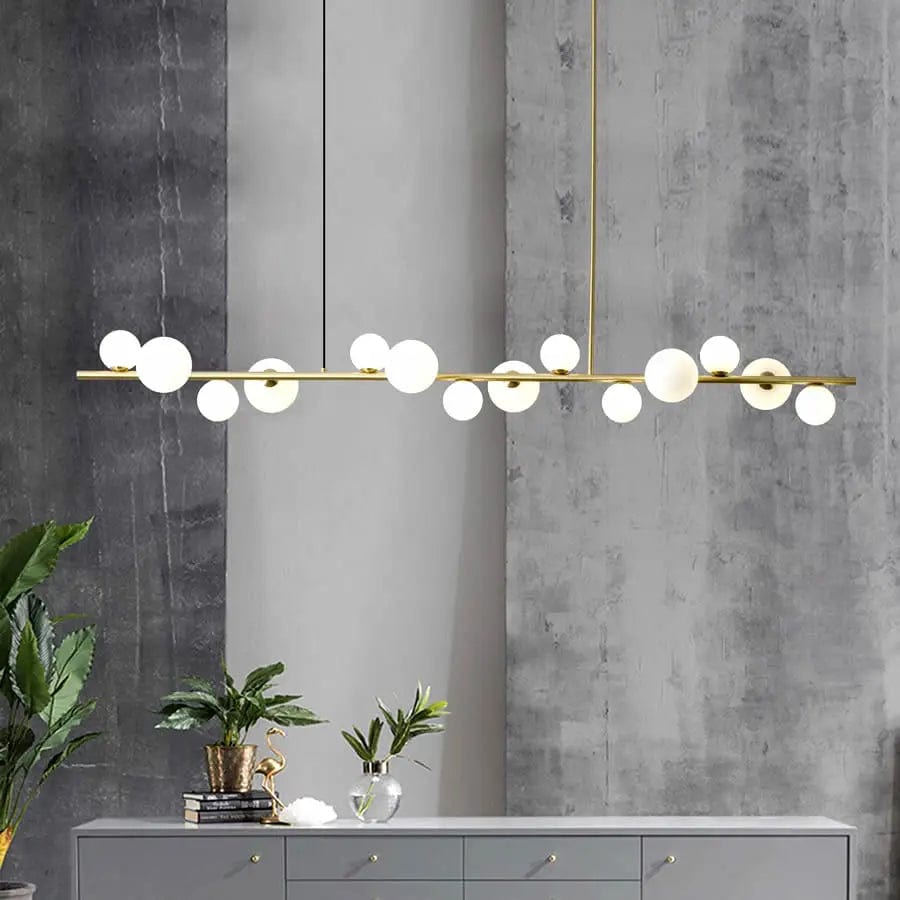
6Haven Linear Bubble Chandelier
Linear · Rectangular TablesThe format that solves rectangular geometry: globes aligned along an axis so every seat sits in the same light, rather than a round cluster illuminating the middle two. Size to the table's length — one-half to two-thirds — and hang 30-36" (76-91 cm) above the top. Available at 47.24" (120 cm) among other lengths.
Size to: ½ to ⅔ of the table's length
Length: 47.24" (120 cm) and other options
Height: 30-36" above the tabletop
Related: Linear chandeliers
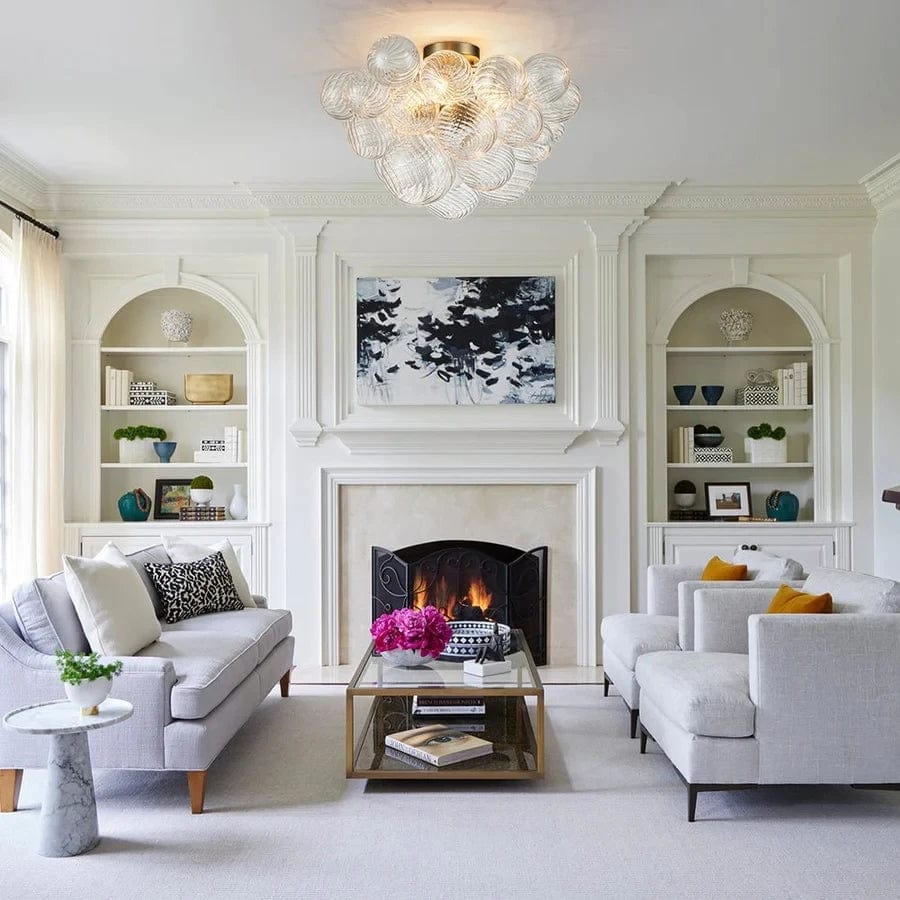
7Alya Flush Mount Bubble Chandelier
Flush Mount · 8 ft CeilingsThe cluster held tight to the ceiling, for rooms where suspension would eat the 12 in of clearance an 8 ft ceiling allows over walking areas. The same design language as a full cluster, engineered flat — which is how bedrooms, hallways and baths get the form without the drop.
Suits: 8-9 ft ceilings, walking zones
Clearance math: 96 in ceiling minus 84 in clearance = 12 in budget
Best for: Bedrooms, hallways, baths, compact entries
Related: Flush mount chandeliers
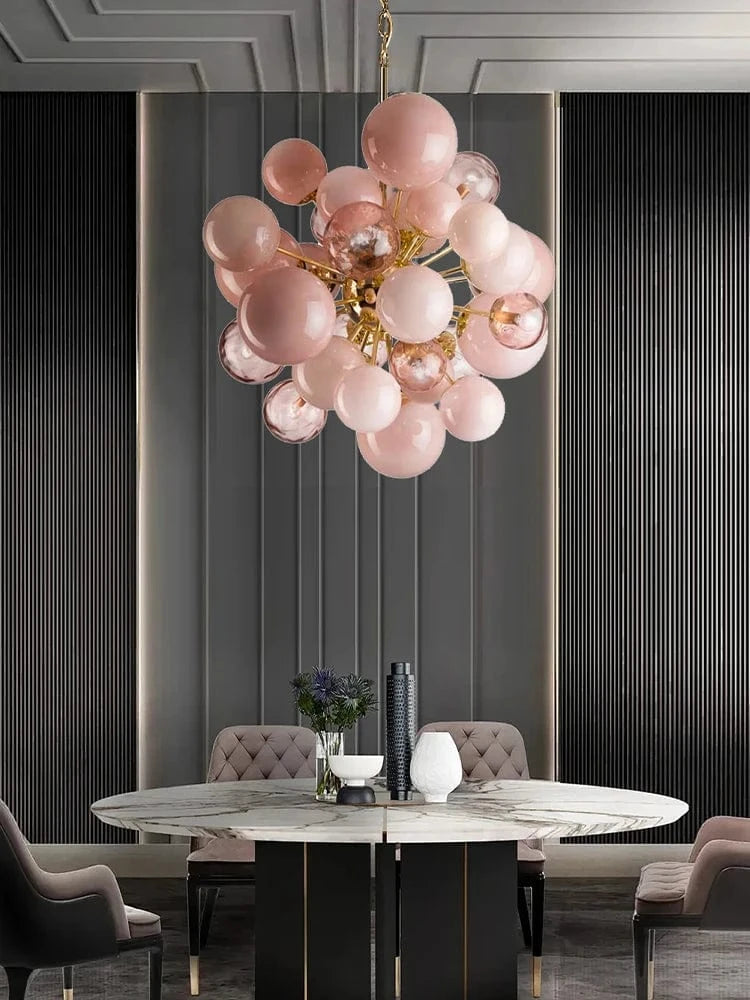
8Art Modern Pink Bubble Chandelier
Colored Statement · Collectible EndThe collectible register: colored glass at statement scale, where the fixture is the room's designed event rather than one element among several. Rooms that take this well are the ones with restraint elsewhere — quiet walls, simple furniture, and nothing else competing overhead.
Scale: Statement composition
Room needs: Restraint elsewhere in the palette
Light: Warm white to support the tint
Best for: Designed dining rooms, entries, feature spaces
Browse the bubble range
Every treatment and form above is represented across the collection.
Bubble Chandeliers → Glass Chandeliers → Branch →Frame Finishes and Pairing
Frames run brass and gold, matte black, chrome and satin nickel. The pairing rule is one sentence: let one element lead. A colored or heavily figured glass composition takes a quiet frame; a sculptural or unusually finished frame takes clear or frosted spheres. When both compete, the fixture reads busy at exactly the moment it should read composed.
Beyond the fixture, match the frame to the room's other metal rather than to the wall — brass beside brass hardware, black beside black window frames. The broader glass material story, across every fixture type rather than the bubble form specifically, is in our glass chandelier guide.
Bulbs, Dimming and Color
Warm white at 2700-3000K is the band where glass glows warmest; cooler light makes clear glass read clinical and fights colored tints outright. A dimmer is effectively mandatory, since a multi-globe composition at full output is a great deal of light — most rooms settle between 30% and 60%.
Two treatment-specific notes. Clear glass shows whatever lamp is fitted, so decorative filament LEDs earn their price here and bare utility bulbs undo an expensive fixture. Smoked glass reduces output, so a smoked composition in a working room needs either higher-lumen lamps or a second lighting layer — a fact worth knowing before, rather than after, installation.
Common Mistakes
- Clear glass above seating. The most common regret in the category. At a dining table or an island with stools, a visible filament sits in the field of view for the length of a meal.
- Judging glass from a photograph. Hand-blown irregularity, rim thickness and the glass-versus-acrylic difference are all in-person checks. A screen flatters uniformity.
- Utility bulbs in clear globes. If the lamp is visible, it is part of the design. Decorative filament LEDs cost little next to the fixture.
- Smoked glass in a working room without a second layer. The tint reduces output by design. Lovely over a dining table, insufficient over a prep counter alone.
- A busy frame under colored glass. Two statements in one fixture. Let one lead and keep the other quiet.
- Cool white LEDs. 4000K and above makes glass read clinical and clashes with every colored treatment.
- Ignoring weight on large glass clusters. Real glass in quantity passes 50 lb quickly, which requires a listed heavy-fixture brace box rather than a standard one.
- Assuming all globes are glass. Acrylic exists in the category for weight reasons and is a legitimate trade — but it should be a decision rather than a surprise.
Frequently Asked Questions
Should I choose clear or frosted glass bubbles?
Clear for entries, stairwells and hallways where maximum sparkle helps and nobody sits facing the fixture. Frosted or opal wherever people sit facing it — dining tables, living rooms, islands with stools — because a visible filament at eye level becomes the brightest thing in view.
How do I tell hand-blown glass from molded?
Look for slight irregularity in wall thickness and curve, which catches light with liveliness a uniform molded globe cannot. Check the rim for wall thickness, and note that molded acrylic shows faint seam lines around the sphere.
Is glass or acrylic better in a bubble chandelier?
Glass looks better; acrylic weighs less. A large real-glass cluster can pass 50 lb and need a heavy-fixture brace box, which is why acrylic exists in big compositions. The difference is most visible in clear finishes, where the material is on show.
What does smoked glass do to the light?
It reduces output and raises mood — the fixture reads restrained rather than bright. Plan higher-lumen lamps or a second lighting layer if the room does real work; over a dining table the reduction is the point.
What is a branching bubble chandelier?
A design carrying its globes on sculptural arms rather than staggered cables. The arms spread width from a single ceiling point, which suits rooms with one junction box and interiors leaning organic.
Which form works over a rectangular dining table?
Linear. Globes aligned along an axis light every seat, where a round cluster lights the middle two. Size to one-half to two-thirds of the table's length and hang 30-36" above the top.
Can I fit a bubble chandelier on an 8 ft ceiling?
Yes, in flush or semi-flush form. An 8 ft ceiling leaves a 12 in budget over walking areas after the 84 in clearance rule, which is exactly what flush cluster designs are built for.
What color light suits glass bubble fixtures?
Warm white, 2700-3000K, on a dimmer. Cooler light makes clear glass read clinical and fights colored and smoked tints. Most rooms settle between 30% and 60% output.
Do colored glass fixtures date quickly?
Less than expected, provided the room supports them. Colored glass reads as a deliberate design event in a restrained interior; it reads as excess when the rest of the room is also competing.
Are mixed clear-and-frosted compositions better?
Usually, yes. Clear globes supply highlights and frosted ones supply even body, giving the cluster depth a single finish cannot. They tend to photograph less well than they live — the opposite of most lighting decisions.
Glass First, Then Form
Decide the treatment before the shortlist: clear where nobody sits facing it, frosted or opal where they do, smoked for mood, colored where the room can carry an event. Then choose the form that matches the room's geometry — cluster for round spaces, cascade for vertical volume, linear for rectangular tables, flush for standard ceilings. Frame finish comes last, and it should stay quiet whenever the glass is doing the talking.
Browse the range: bubble chandeliers, glass chandeliers, branch chandeliers, all chandeliers.