Quick Answer
There is no single best chandelier — there is a best one for a given room. Five constraints narrow the field before style enters: ceiling height, what sits beneath the fixture, room size, existing hardware finish, and how much light the room needs from it.
Work in that order. Ceiling height decides the format (flush, pendant or suspended). What is beneath decides the sizing rule. Room dimensions give the diameter. Hardware gives the finish. Only then does style matter, and by that point the shortlist is short.
The formula: add the room's length and width in feet; the sum in inches is the target diameter. Over a table, size to the table instead — one-half to two-thirds of its width.
Spend where the fixture is seen closely or hard to reach. Over a dining table, at a bedside, in an entry people pass within arm's reach, and anything above 14 ft. Spend less where scale matters more than craft.
"What is the best chandelier" is the most common question in this category and the one with no useful answer, because the fixture that makes one room work looks wrong in the next. What does have an answer is the sequence: a set of constraints that narrow thousands of options to a handful, in an order that stops you falling in love with something that cannot physically work. This guide covers those constraints, the sizing math, what different budgets actually buy, and eight designs that illustrate each decision point.
On this page
The Five-Step Sequence
Most people start with style and work toward constraints, which produces a shortlist of fixtures that will not fit. Reversing it takes about fifteen minutes and leaves a genuinely short list of things that all work — at which point choosing between them is enjoyable rather than overwhelming.
| Step | Question | What it rules out |
|---|---|---|
| 1 | How high is the ceiling? | Format — flush, semi-flush or suspended |
| 2 | What sits beneath it? | Which sizing rule applies |
| 3 | What are the dimensions? | Diameter range, usually a 6-8 in window |
| 4 | What is the hardware finish? | Warm, cool or graphic direction |
| 5 | What else lights this room? | Output needed, diffused or exposed |
Step 1: Ceiling Height
The one measurement that cannot be worked around, and the reason many purchases get returned.
The rule underneath it: 84 in (213 cm) of clearance anywhere people walk. On an 8 ft ceiling that leaves roughly 12 in for the fixture, which rules out most suspended designs and points to flush and semi-flush mounts. At 9 ft the budget rises to about 24 in and suspended chandeliers become viable. At 10 ft and above, the format opens fully.
Two exceptions change the arithmetic. Over a table or island, nobody walks beneath, so the fixture hangs 30-36 in (76-91 cm) above the surface regardless of ceiling height. Over a bed, measure clearance from the mattress top rather than the floor, since a mattress and base raise the effective floor by 20-25 in.
Step 2: What Is Beneath It
This decides which sizing rule applies, and getting it wrong is the most visible error in the category.
- A round or square table: size to the table — one-half to two-thirds of its width. A 48 in table takes 24-32 in. The room's dimensions do not apply.
- A long table or island: a rectangular or linear fixture spanning one-half to two-thirds of the table's length, kept under one-third of its width.
- Open floor: the room formula applies — length plus width in feet, read as inches.
- A bed: the room formula, then rounded down, with the diameter kept narrower than the bed.
- A seating group in an open plan: size to the group, not the whole floor plate. A 20 x 30 ft great room with a 16 x 18 ft seating area calls for roughly 34 in, not 50.
Step 3: Size
With the rule chosen, the number follows. Add the room's length and width in feet and read the sum in inches: a 12 x 14 ft room points to 26 in, a 16 x 20 ft room to 36 in. Above 9 ft ceilings, add roughly 3 in of diameter per additional foot.
Then adjust for visual density, which is the correction most guides skip. Open forms read close to their measurement — a slim ring, an airy branch composition, a widely spaced globe cluster. Dense forms read larger — solid timber, multi-arm iron, tightly packed crystal, and anything in a dark finish. Round up on the first group, down on the second. Full tables are in our chandelier size chart.
Step 4: Finish
Match the fixture to the room's dominant hardware — door handles, cabinet pulls, taps — rather than to the walls or floor. Hardware is what the fixture is seen alongside, and it is the element people rarely replace.
- Warm hardware (brass, bronze, unlacquered gold) with walnut, travertine or cream walls points to warm metal fixtures.
- Cool hardware (chrome, nickel) with grey-wash floors, concrete or blue-grey walls points to cool metal or gray.
- Mixed or undecided hardware points to black, which reads as a line rather than a metal and therefore does not count as a second metal in the room.
- Rooms already carrying pattern or colour want the quietest option — gray, graphite, or a material finish like stone rather than a strong metal.
Step 5: Light Output
The final constraint and the one that decides whether a fixture is decorative or functional in that position.
If the chandelier is the room's main light, it needs real output and diffusion — opal glass, shaded designs, or a high lamp count. A stone or heavily crystal fixture will not carry a room alone. If it sits alongside recessed lighting or lamps, it can be purely decorative, and the exposed-lamp and low-output designs become options.
Two specifications regardless: 2700-3000K for living spaces, up to 3500K over a kitchen work surface, and a dimmer on anything decorative. Crystal reads best between 30% and 60% output; most decorative fixtures are uncomfortable at full brightness in the evening.
Picks by Room (4 Designs)
Each of these illustrates a different constraint from the sequence above — ceiling height, table sizing, output requirement, and finish matching.
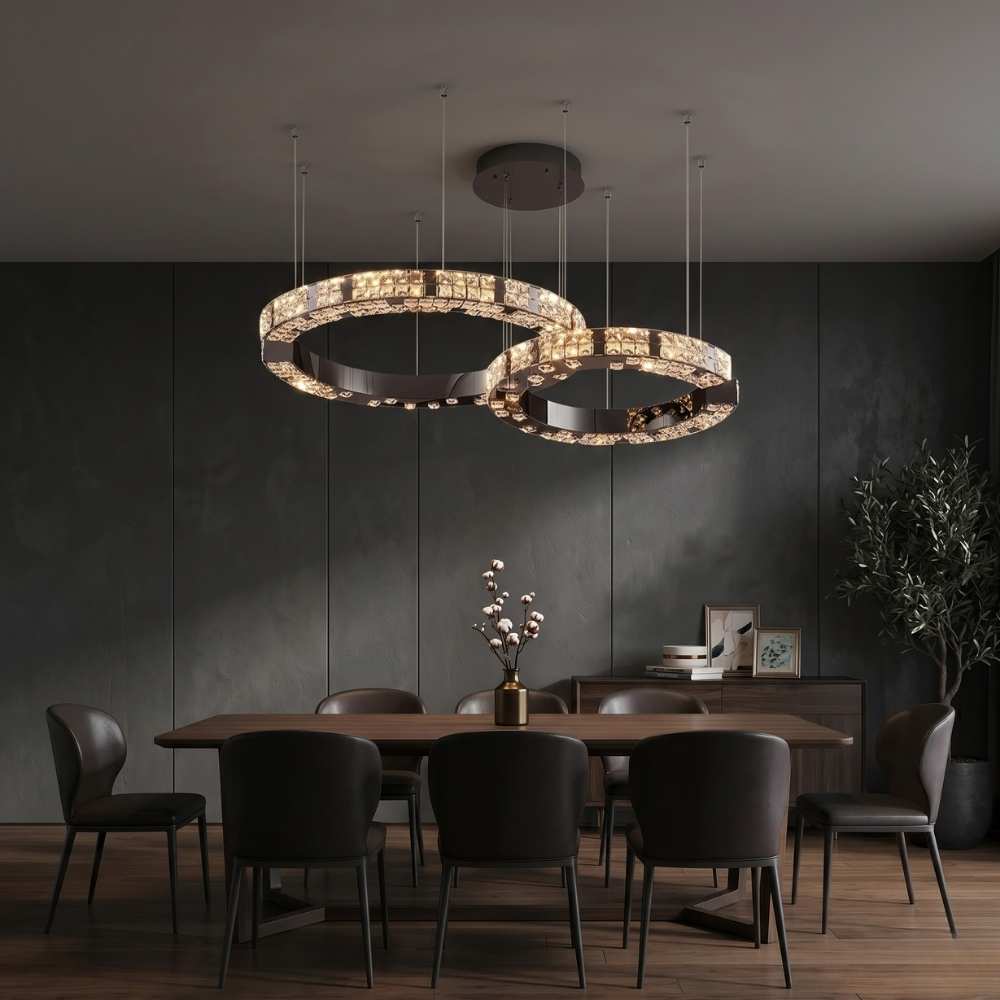
1Arven Modern Crystal Ring Chandelier
Dining Rooms · Table SizingDining is where the table-sizing rule replaces the room formula entirely. A ring form suits round and square tables, sized at one-half to two-thirds of the table's width and hung 30-36 in above the surface. Crystal at close viewing distance is also where the material earns its price — the refraction is seen directly rather than glimpsed overhead.
Size to: ½ to ⅔ of the table's width
Height: 30-36 in above the tabletop
Colour: Warm white 2700K, dimmer essential
Related: Dining room chandeliers
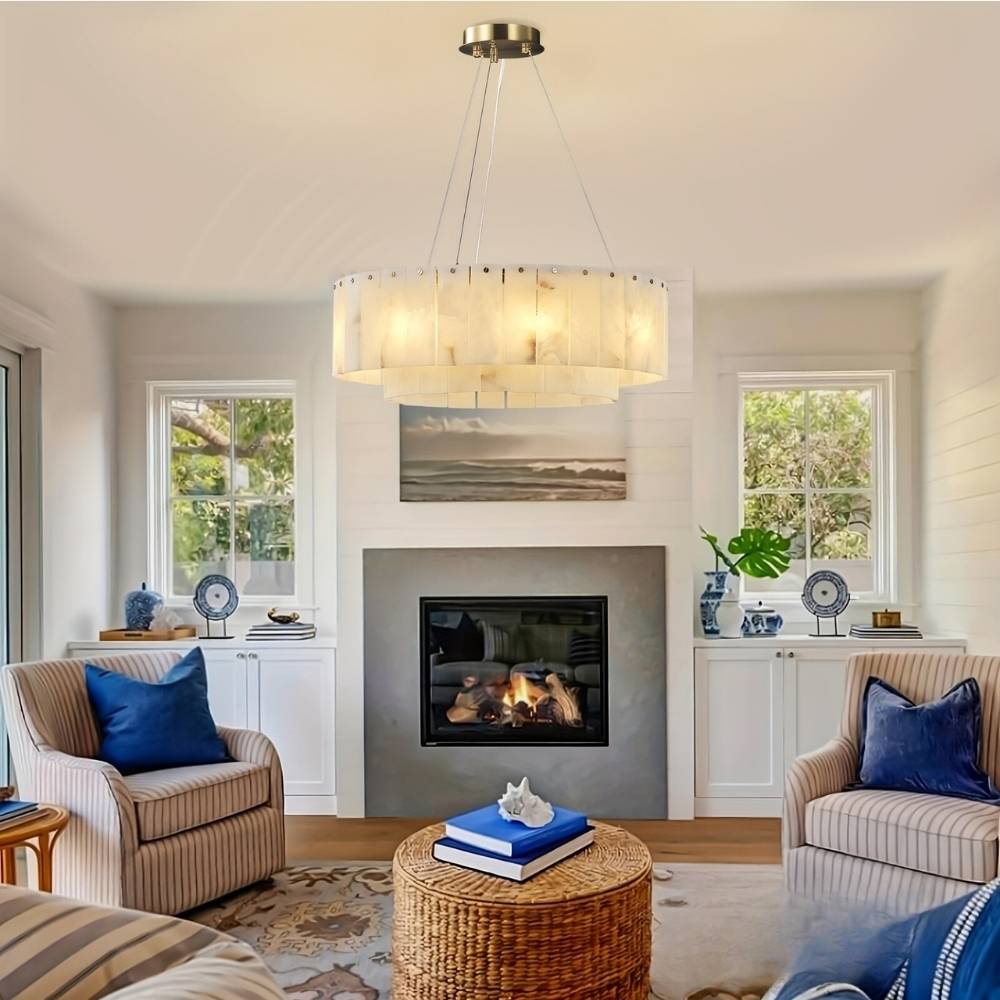
2Angie Alabaster Round Chandelier
Bedrooms · The Output QuestionStep 5 applied. Stone absorbs a substantial share of the lamp's output, which makes it a poor primary source and an excellent atmosphere layer — exactly the requirement in a bedroom. It also hides the lamps completely, which matters more here than anywhere: a fixture over a bed is looked at from directly beneath.
Why bedrooms: No visible lamps from below
Pair with: Bedside lamps or sconces for reading
Colour: 2700K — warmer than the rest of the house
Related: Bedroom lighting

3Aureli Crystal Spiral Chandelier
Two-Story Entries · Vertical FillStep 1 at the far end. Above roughly 18 ft, diameter stops being the useful measurement — the volume needs vertical fill, and a wide flat fixture leaves the height empty. Vertical compositions distribute elements down the drop instead. Position the centre at or just below the second-floor line, and check the weight before ordering.
Format: Vertical — fills height, not width
Position: Centre at or below the second-floor line
Check first: Weight against the box rating
Related: Foyer & entryway
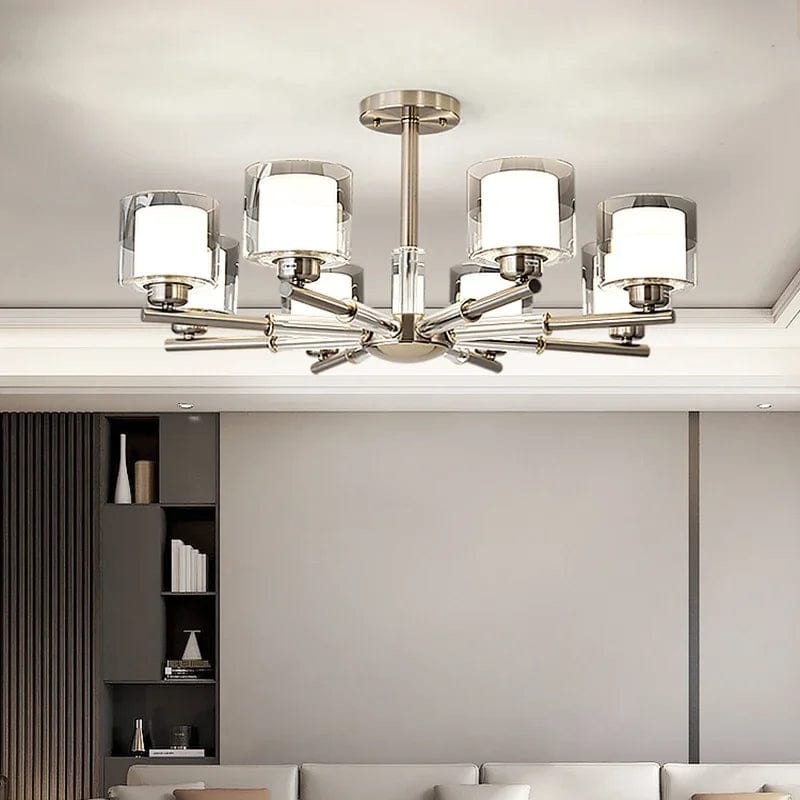
4Amanda Modern Silver Chandelier
Long Tables · Linear SizingStep 2 in its second form. A round fixture above a long table lights the middle seats and leaves the ends dim; a linear composition distributes light along the axis so every place setting sits under it. Size to one-half to two-thirds of the table's length. Available in round as well, which lets one finish serve both a rectangular table and a seating group.
Size to: ½ to ⅔ of the table's length
Width rule: Under ⅓ of the table's width
Formats: Linear and round
Related: Linear chandeliers
Picks by Priority (4 Designs)
Where the constraint is budget, finish matching, or a fixture that has to fit an awkward dimension rather than a room type.
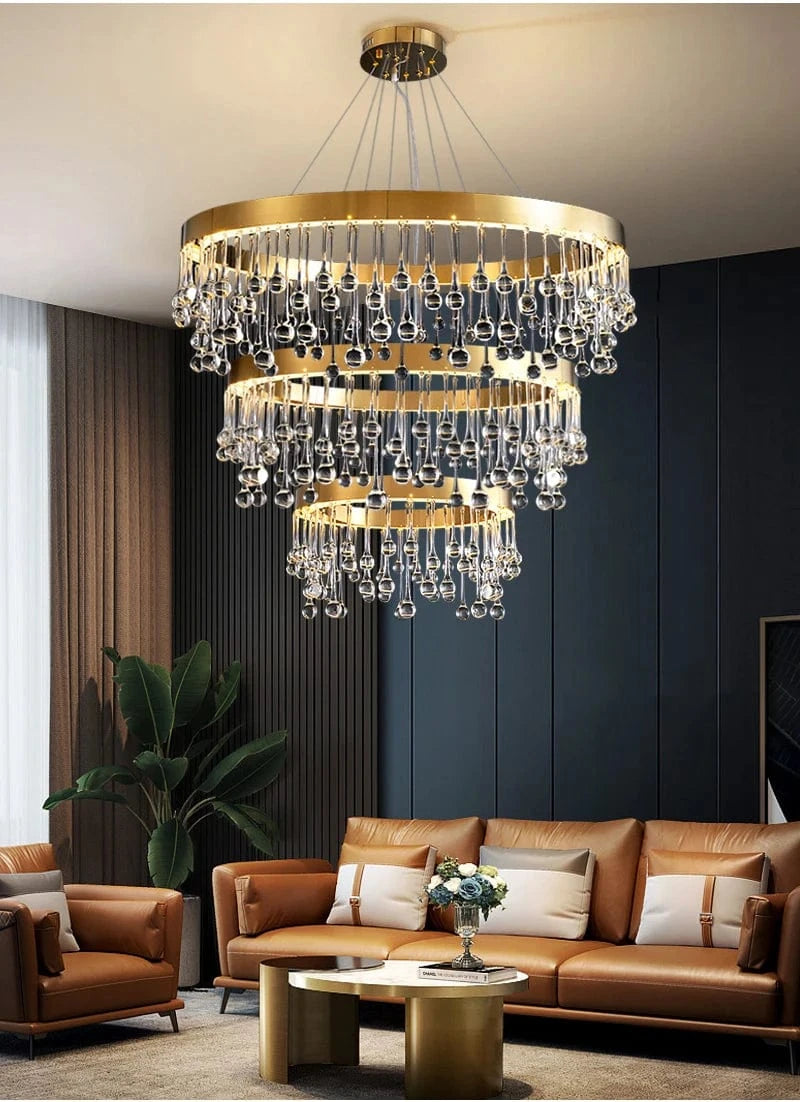
5Alvin Gold Ring Chandelier
Six Sizes · Buy the FitThe most underrated value signal in any listing: a design offered across six sizes lets you buy the fixture that fits rather than adapting the room to what exists. Wrong scale is the most common reason a room reads off, and it has nothing to do with build quality — a correctly sized mid-tier fixture beats an incorrectly sized expensive one every time.
Sizes: Six, one to three rings
Finish: Warm gold — for brass-hardware rooms
Principle: Correct scale beats build quality on impact
Related: Gold chandeliers
6Arc Modern Black Chandelier
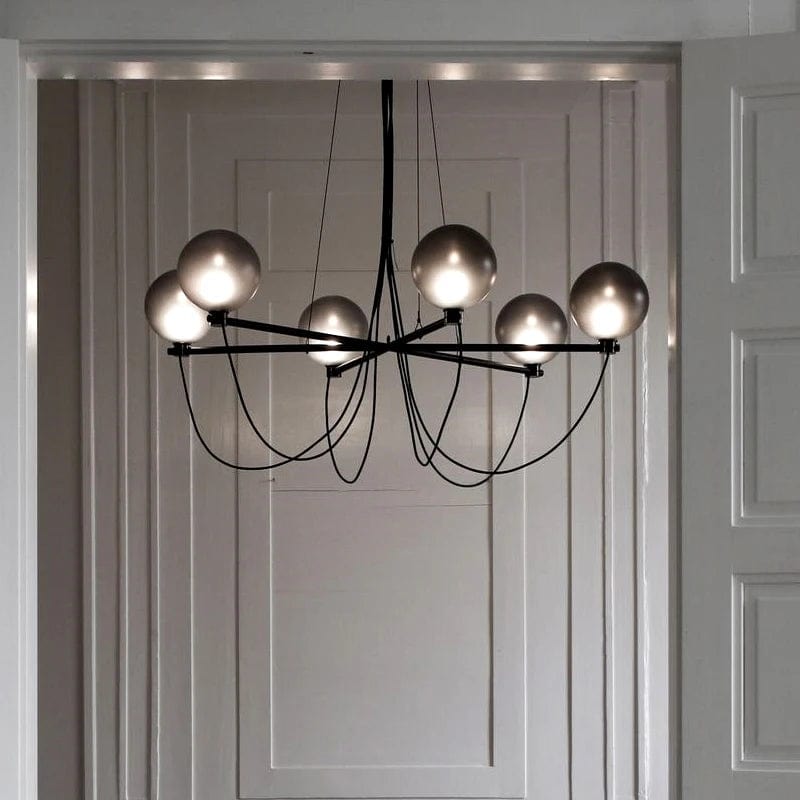
Mixed Hardware · The Safe FinishStep 4's answer when the room will not give one. Black reads as a line rather than as a metal, so it does not count as the second metal in a space — which makes it correct where hardware is mixed, where it may change, or where the room already carries enough colour. The one caution: black needs contrast, so it disappears against a dark ceiling.
Why it works: Reads as a line, not a metal
Caution: Needs a pale ceiling to register
Sizing note: Black reads larger — round down
Related: Black chandeliers

7Asty Modern Ring LED Chandelier
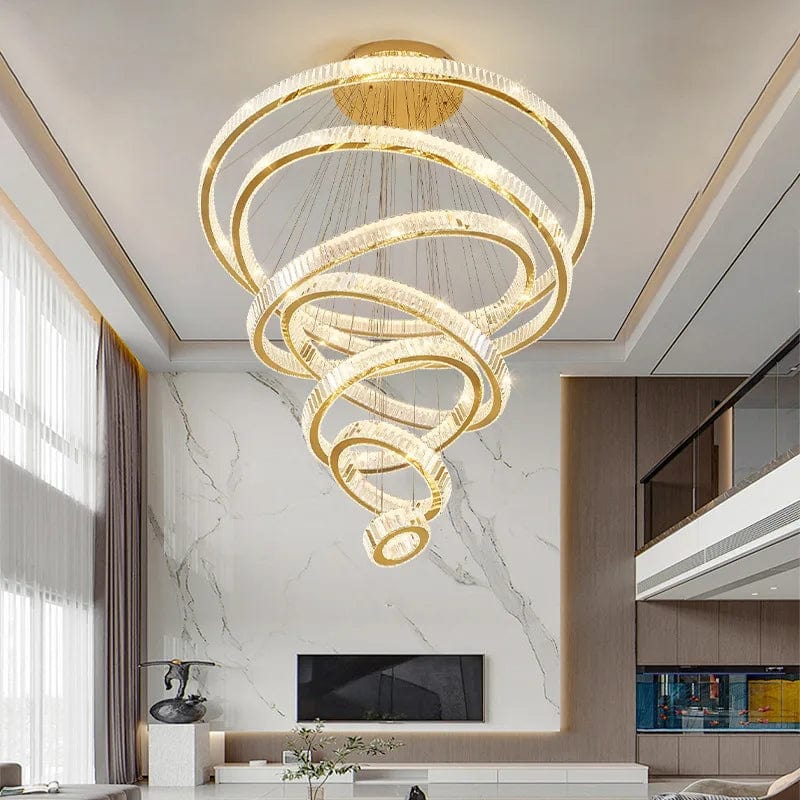
Integrated LED · Hard-to-Reach PositionsWhere access is the real constraint. Integrated LED designs are rated for decades with no lamps to change, which removes the maintenance problem in stairwells, double-height entries and above staircases — positions where a bulb change is scaffolded work. The trade is that the light source is fixed for the fixture's life, so dimming quality has to be right at purchase.
Advantage: No lamp changes for decades
Trade: Source fixed — check dimming depth first
Also check: Whether the driver is serviceable
Related: Integrated LED guide
8Bily LED Crystal Ring Chandelier
Two Finishes · One Form, Either DirectionUseful when step 4 is genuinely close. A design offered in both chrome and gold lets the room decide rather than the shortlist — and it demonstrates the point directly: the same form reads cool and architectural in one finish, warm and dressier in the other. Crystal paired with an integrated LED ring also keeps the refraction without exposed lamps.
Finishes: Chrome or gold, same form
Source: Integrated LED ring, no visible lamps
Dimmer: Essential — crystal reads best at 30-60%
Related: Crystal chandeliers
Start browsing
The full catalog, or narrow by room and style.
All Chandeliers → Modern → Contemporary →What Each Budget Buys
| Tier | Typically | Right for |
|---|---|---|
| Entry | Acrylic or thin glass, cast repeated elements, sprayed finish | Rentals, secondary rooms, short-horizon spaces |
| Mid | Real glass or partial crystal, decent driver, published specs | Most rooms — the tier where value is highest |
| Upper-mid | Full real materials, formed metalwork, finish depth | Primary rooms, fixtures meant to stay |
| Designer | Hand-work throughout, specialty materials, replaceable parts | Statement positions, high ceilings, long horizons |
The value curve is not linear. The step from entry to mid buys more visible improvement than any other, because it is where real materials replace substitutes. The step from upper-mid to designer buys refinement — proportion, hand-work, materials that age well — which matters most where the fixture is examined closely or expected to last decades. Full detail in our designer chandeliers guide.
Style Comes Last
By this point the constraints have done most of the work, and style is choosing between options that all fit. Three questions settle it.
Does the room want the ceiling to be an event or to stay quiet? Sculptural and statement fixtures suit rooms with restraint elsewhere; quieter forms suit rooms already carrying pattern, colour or busy material. Is the architecture period or current? Panelled walls and mouldings point to traditional or transitional silhouettes; flat plaster and large glazing point to modern or contemporary. Will this room change within five years? If yes, favour a fixture that reads neutral rather than one committed to a specific direction.
Common Mistakes
- Choosing style first. It produces a shortlist of fixtures that will not fit. Constraints first, style last.
- Using the room formula over a table. The table overrides the room. Size to the surface directly beneath.
- Ignoring ceiling height. On 8 ft, the 84 in clearance rule leaves about 12 in of fixture. Semi-flush or flush.
- Rounding up on dense or dark fixtures. They read larger than their measurement. Round up only on open forms.
- Matching the fixture to the walls. Match the hardware — it is what the fixture is seen alongside and what rarely changes.
- Expecting a decorative fixture to light a room. Stone and heavily crystal designs are atmosphere layers. Plan other lighting alongside.
- Skipping the dimmer. Most decorative fixtures are uncomfortable at full output in the evening.
- Not checking the weight against the box. Above 50 lb a listed heavy-fixture brace box is required, and retrofitting one is ceiling work.
- Buying before the room is settled. A fixture chosen ahead of the furniture and palette has a real chance of being wrong regardless of quality.
- Paying for close-range quality in a far-range position. Hand-work in a high hallway contributes less than correct scale does.
Frequently Asked Questions
What is the best chandelier?
There is no single answer — the right fixture depends on ceiling height, what sits beneath it, room dimensions, existing hardware and how much light the room needs. Work through those five constraints in order and the shortlist narrows to a handful of options that all fit.
How do I choose the right chandelier size?
Add the room's length and width in feet; the sum in inches is the target diameter. Over a table, size to the table instead at one-half to two-thirds of its width. Above 9 ft ceilings, add roughly 3 in per additional foot.
How high should a chandelier hang?
Keep 84 in of clearance anywhere people walk. Over a table or island, 30-36 in above the surface regardless of ceiling height. Over a bed, measure from the mattress top rather than the floor.
What chandelier works with an 8 ft ceiling?
Flush or semi-flush mounts. The 84 in clearance rule leaves roughly 12 in of vertical space, which rules out most suspended designs. Over a table, where nobody walks beneath, a compact pendant becomes possible.
How much should I spend on a chandelier?
Mid tier suits most rooms and is where the value curve is steepest, since it is where real materials replace substitutes. Spend more where the fixture is seen closely — a dining table, a bedside, an entry — or where replacing it later is expensive, meaning anything above about 14 ft.
What finish should I choose?
Match the room's dominant hardware — door handles, cabinet pulls, taps — rather than the walls or floor. Where hardware is mixed or may change, black is the safe answer, since it reads as a line rather than as a second metal.
Can a chandelier be the only light in a room?
Only if it produces real output and diffuses it — opal glass, shaded designs or a high lamp count. Stone and heavily crystal fixtures are atmosphere layers and need recessed lighting or lamps alongside them.
Should I buy the biggest chandelier that fits?
No. The formula gives a target, not a maximum, and dense or dark fixtures read larger than their measurement. Round up only on open forms; round down on solid timber, multi-arm iron, packed crystal and anything black.
What is the most versatile chandelier style?
A simple ring or geometric form in black or a neutral metal. It reads as structure rather than as a period statement, which means it survives a room changing around it — the right choice where the space may be redecorated within a few years.
Does the chandelier need to match other fixtures in the house?
Related, not identical. Keeping the same metal family across a floor ties rooms together, while different formats keep each room readable as its own space. What does need to match is colour temperature — mixed Kelvin between adjoining rooms is unusually visible.
What size chandelier for a dining table?
One-half to two-thirds of the table's width for a round or square table, or of its length for a linear fixture over a long one. A 48 in round table takes 24-32 in. Hang it 30-36 in above the surface.
When should I hire an electrician?
When the fixture exceeds the box's marked rating, when the box needs moving, when the ceiling is above roughly 14 ft, or when the existing wiring is unknown. A fixture under 35 lb replacing a like-for-like on an accessible ceiling is within reach of a confident homeowner with the power off at the breaker.
Constraints First, Preference Last
Ceiling height, what sits beneath, room dimensions, hardware finish, output needed — five questions, fifteen minutes, and the field narrows from thousands to a handful. Every option left will physically work in the room, which turns the final choice into the enjoyable part rather than the risky one.
Browse the range: all chandeliers, modern, contemporary, crystal.