

Quick Answer
Forged and cast iron look similar in photographs and behave differently in a room. Forged work is shaped by hand, so no two arms match exactly and the metal tapers where it should. Cast work repeats one mould, which the eye reads as pattern rather than as craft.
The test takes ten seconds: count how many elements share an identical shape. Genuine forged work has none. Four identical arms at even intervals means a cast frame — which can still be a good fixture, but should be priced as one.
Black wrought iron is the most forgiving finish in daily ownership. Forge marks and tonal variation absorb fingerprints and scuffs that would show immediately on a uniform powder coat.
Iron is heavy. A 36 in wrought iron chandelier commonly passes 35 lb and larger designs reach 50 lb or more — the threshold where a listed heavy-fixture brace box replaces a standard junction box.
Iron is the oldest chandelier material still in mainstream production, and the word "wrought" gets applied to almost everything dark and metal regardless of how it was made. The distinction is worth understanding because it changes what you are buying: forged ironwork is shaped individually and shows it, while cast work reproduces one form repeatedly. This guide covers how to tell them apart before ordering, what black iron does to a room's silhouette, the weight and mounting reality, and eight designs across both approaches.
On this page
Forged Against Cast
Two manufacturing routes produce most of what is sold as wrought iron, and the difference is process rather than material.
Forged work is shaped by force. Metal is heated and worked — hammered, bent, drawn out — which thins it where it is stretched and leaves tool marks where it was struck. Every piece comes out slightly different because a hand made it. Arms taper toward their tips because drawing metal out is how the shape was achieved.
Cast work is poured into a mould. One master form is reproduced as many times as needed, identically. Cast elements have uniform thickness, no tool marks, and often a faint seam where the mould halves met. The result is consistent, cheaper at volume, and structurally fine — it simply is not hand-worked, and the eye registers that at close range.
Four Checks Before You Buy
- 1. Count identical elements. Zoom into the product images and compare arms against each other. Genuine forged work has no two the same — curves differ slightly, thickness varies, tips sit at marginally different angles. Perfect repetition is casting.
- 2. Look for taper. Forged arms narrow toward their ends because drawing metal out is how they were formed. Uniform tube thickness from base to tip is either cast or bent tubing, both of which are different products.
- 3. Check the joints. Forge-welded and ground joints read continuous; the arm appears to grow from the body. Bolted collars, slip-on sleeves and visible fasteners interrupt the line — on an open iron frame there is nowhere for that to hide.
- 4. Read the listed weight. Iron is dense. A 36 in fixture at 35 lb or more is consistent with solid iron; the same size at 12-15 lb is thin tube or a lighter alloy finished to look like iron.
One qualification worth stating plainly: cast iron is not a defect. It keeps large compositions affordable and it holds fine detail that forging cannot. What matters is that the price reflects the process — the wider build-quality question is covered in our designer-grade guide.
What Black Iron Does to a Room
Iron in lighting is almost always dark, and dark finishes work differently from every other material in a catalog: they absorb rather than reflect, which turns the fixture into an outline instead of a source of shine.
That has three consequences. The silhouette carries the whole design, so shape quality is fully exposed — there is no reflection to distract from a weak form. Detail stays legible: the taper of an arm, the spacing between elements, the exact curve where a frame turns. And the fixture reads larger than its measurement, because a dark outline against a pale ceiling has maximum contrast and the eye registers the whole shape at once.
The sizing consequence follows: when between two sizes in an iron fixture, take the smaller. Add the room's length and width in feet for a target diameter in inches, then round down rather than up. Fuller calculations sit in our chandelier size chart.
Finishes Within Black
- Matte black powder coat: the most uniform and the most contemporary. Flat, graphic, no highlight to break the silhouette. Hides dust shadows well; shows fingerprints on smooth surfaces.
- Textured and hammered: scatters light unevenly at close range and reads as material rather than coating. The most forgiving finish in daily use, since handling marks disappear into existing variation.
- Oil-rubbed and aged: tonal variation across the piece, with lighter areas where a hand would naturally wear it. Reads warmer than matte black and suits traditional and transitional forms.
- Distressed with warm highlights: gold, bronze or rust tones showing through dark base. Bridges to warm-metal rooms without committing to brass.
- Gloss black: keeps a highlight along curves, which restores dimensionality. Less common in iron, since gloss works against the material's character.
Forged and Hand-Worked Picks (4 Designs)
Where the ironwork itself is the argument. Check the listed weight against your junction box's marked rating before ordering — iron passes standard box limits sooner than most materials.
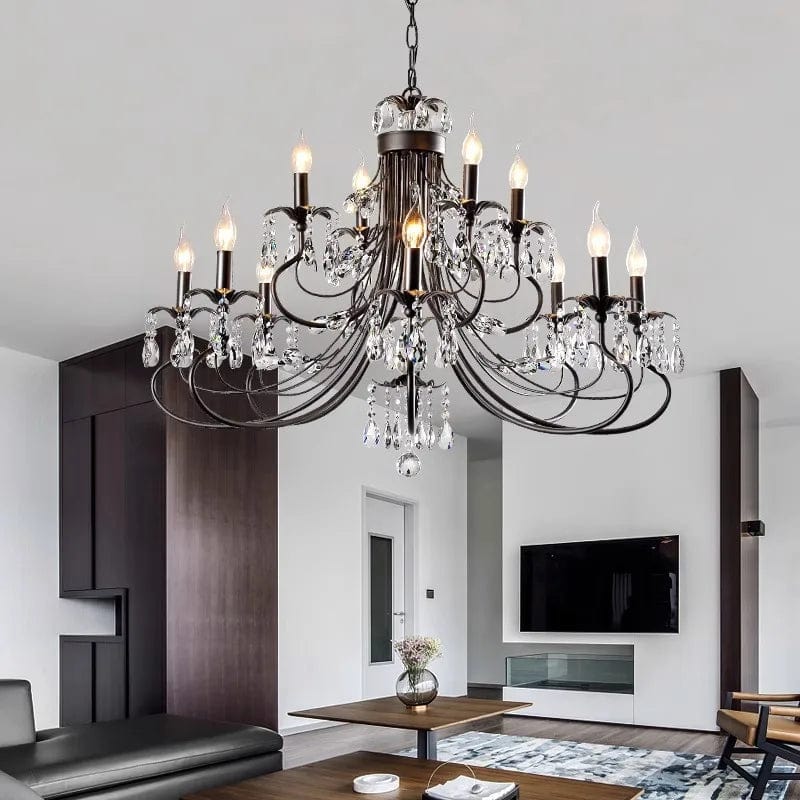
1Black Wrought Iron Chandelier
Forge-Marked · Candle ArmsThe category's reference point. Forge marks and tonal variation across the frame are what separate genuine ironwork from powder-coated tube, and they are visible in close product images if you look for them. Candle-style arms give the most traditional reading available in black, which is the combination that suits both period and renovated dining rooms.
Form: Candle arms, traditional silhouette
Advantage: Marks absorb into the finish in daily use
Check: Listed weight against your box rating
Related: Iron chandeliers
2Lissa Rustic Iron Chandelier
Aged Iron · Black or GoldAged finishes are the practical end of iron ownership: tonal variation is built into the surface, so handling marks and dust shadows disappear into it rather than showing against a uniform coat. Offered in black and a warmer gold-toned aged finish, which is the bridge for rooms whose hardware is already warm.
Why aged: Variation hides marks by design
Never: Metal polish — it removes the patina
Best rooms: Dining, entry, transitional interiors
Light: Warm white 3000K on a dimmer
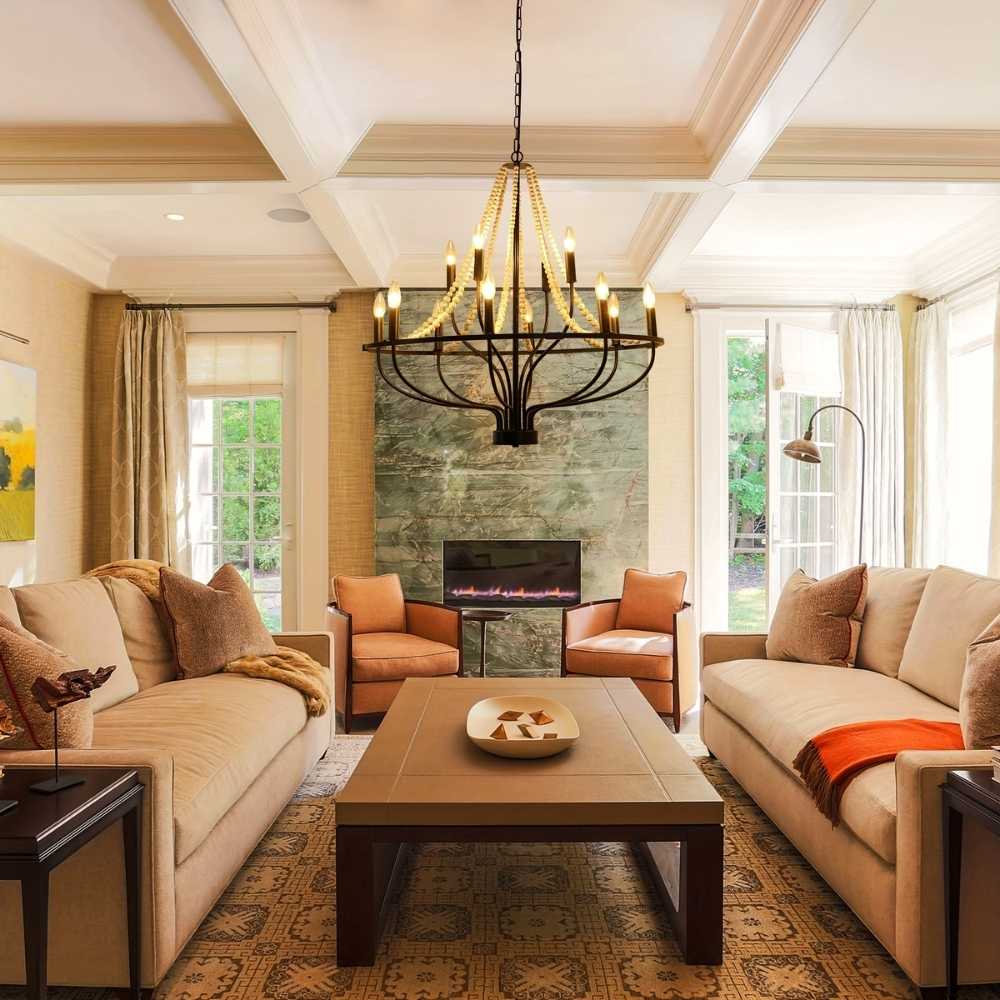
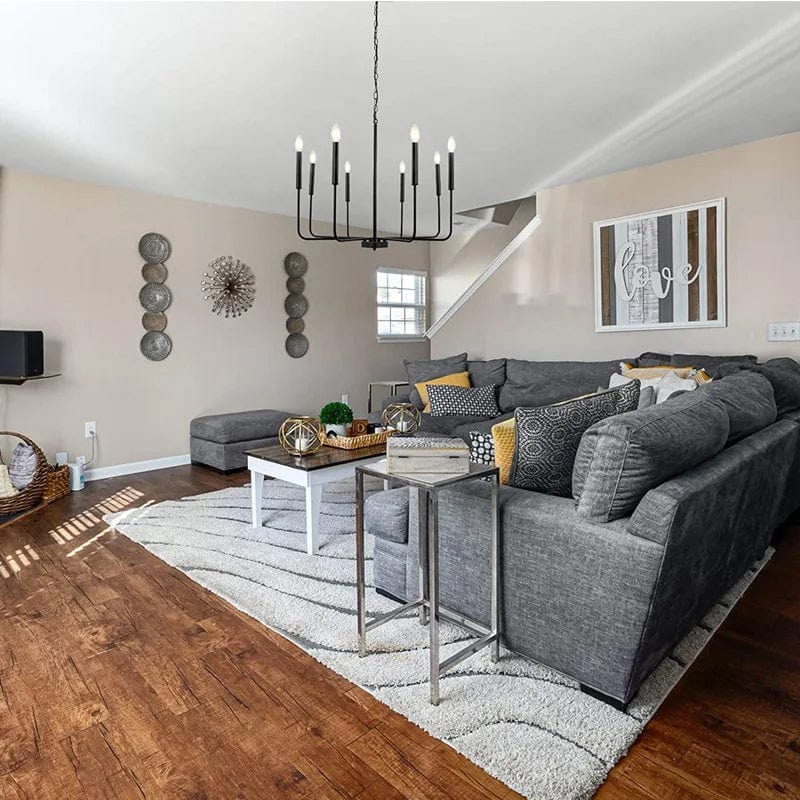
312-Light Black Iron Chandelier
12 Lights · Scale Without DensityTwelve arms on an open frame is how iron achieves presence without visual weight — the light count fills the diameter while the frame itself stays airy. Candle-style designs add one maintenance item the rest of the category does not have: check the sleeves annually for slipping or heat discolouration, and use LED lamps, which run cool enough to leave them unaffected.
Reads: Presence without density
Extra check: Candle sleeves, annually
Lamps: LED — cooler, protects the sleeves
Mounting: Verify against brace-box thresholds
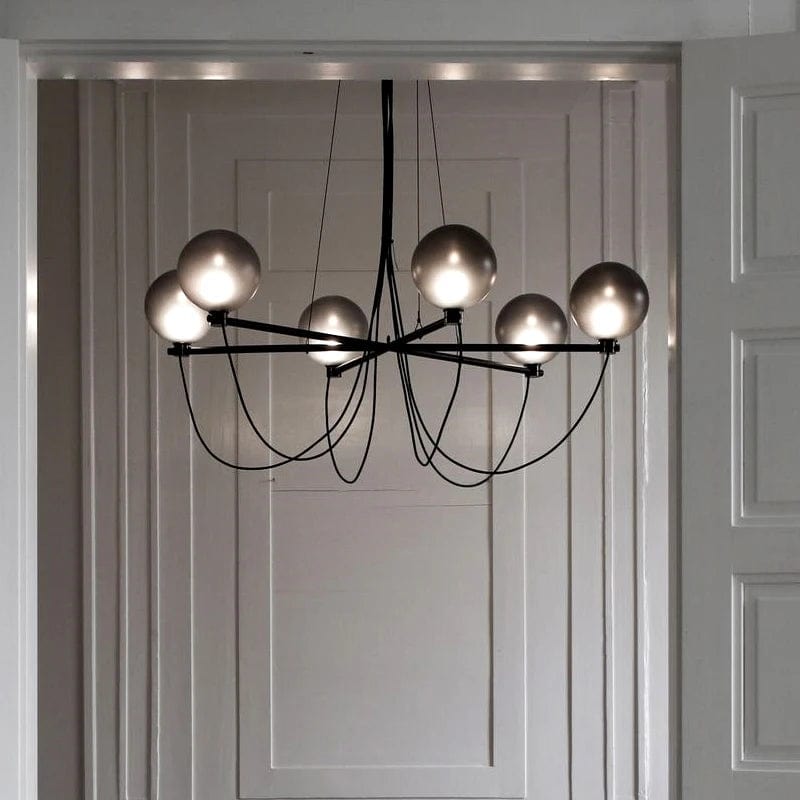
4Arc Modern Black Chandelier
Contemporary · Iron Without the PeriodIron's contemporary direction: the same dark graphic quality with none of the traditional vocabulary. Where a forged candle frame signals a period, a clean geometric one signals only structure — which makes this the route for modern rooms that want iron's contrast without its historical associations.
Finish: Matte black — maximum contrast
Sizes: Two, from 31.50" (80 cm)
Sizing note: Black reads larger — round down
Related: Black chandeliers
Mixed Material and Value Picks (4 Designs)
Iron paired with timber, and cast-frame designs where the process is a reasonable trade for the price. Dry cleaning throughout — on mixed fixtures, follow the more demanding material.
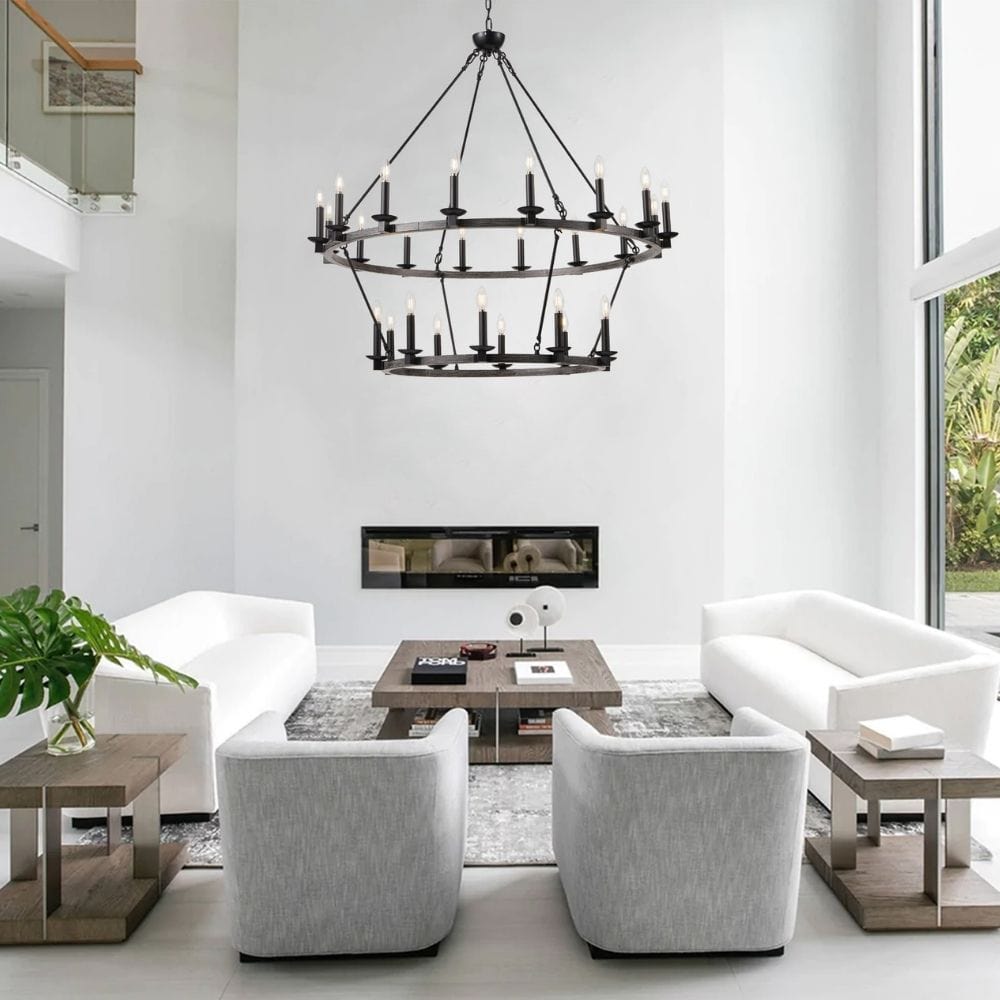
5Jen 2 Tier Wagon Wheel Chandelier
Iron and Wood · Two TierThe classic pairing: iron carries the structure, timber carries the warmth. Two-tier construction needs ceiling height — the second ring adds vertical presence that presses down in a standard-height room. It also doubles the horizontal surfaces that collect dust, so a long-handled duster earns its place.
Needs: Ceiling height for the second tier
Cleaning: Dry only — follow the wood
Dust note: Two tiers collect faster than one
Related: Wood chandeliers
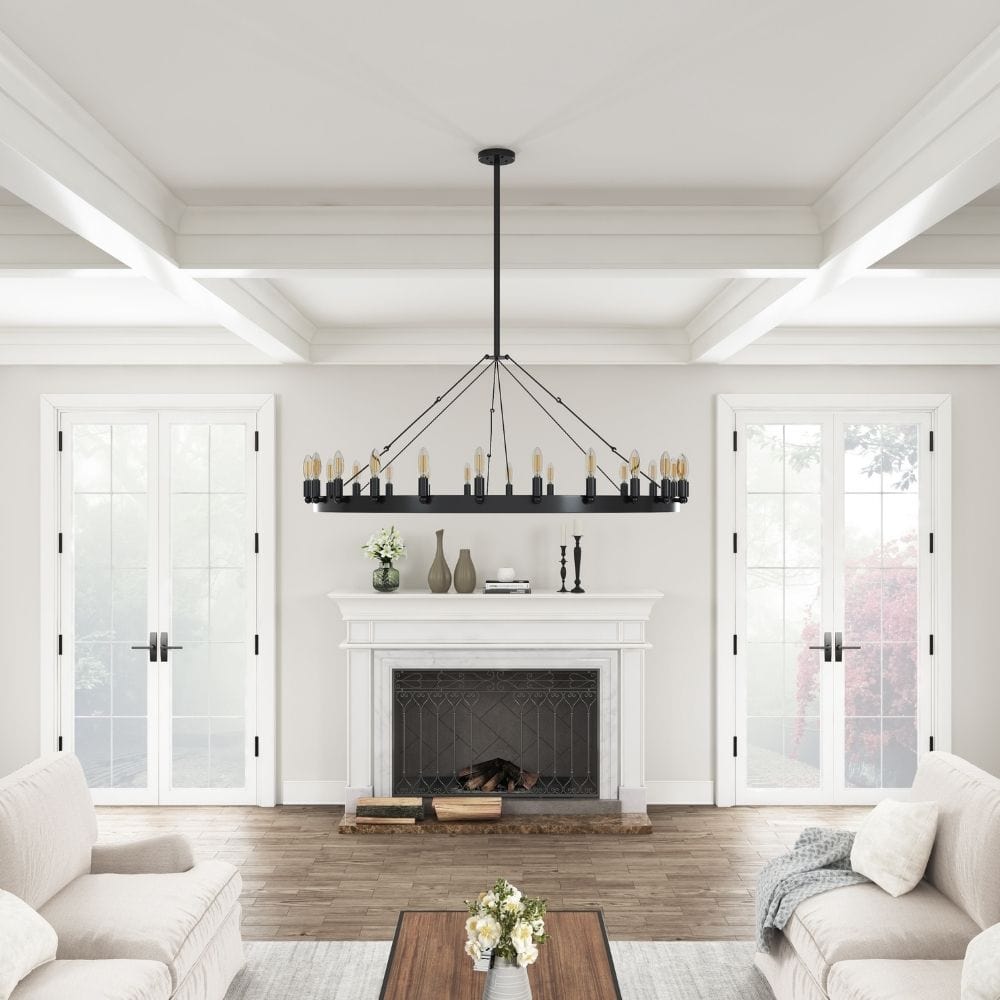
6Pam Rustic Wagon Wheel Chandelier
Single Tier · Standard CeilingsSingle-tier wheel frames present the least surface area in this category, which translates directly into longer intervals between cleanings and a shallower body that suits 8-9 ft ceilings. For a fixture hung where access is awkward, simplicity of form is a maintenance specification as much as a style one.
Suits: 8-9 ft ceilings where depth is limited
Intervals: Longest between cleanings here
Annual check: Spoke joints and hardware
Light: Warm white 2700-3000K

7Lana Rustic Vintage Chandelier
Vintage Finish · Marks Blend InVintage-finished iron is the practical end of ownership: tonal variation is part of the finish, so scuffs and fingerprints disappear into it rather than showing against a uniform coat. The rule that protects it is the same one that protects every aged surface — no polish, ever, since restoring shine removes the finish itself.
Advantage: Marks blend rather than show
Never: Metal polish or abrasive cleaners
Best rooms: Farmhouse, transitional, country
Related: Rustic chandeliers
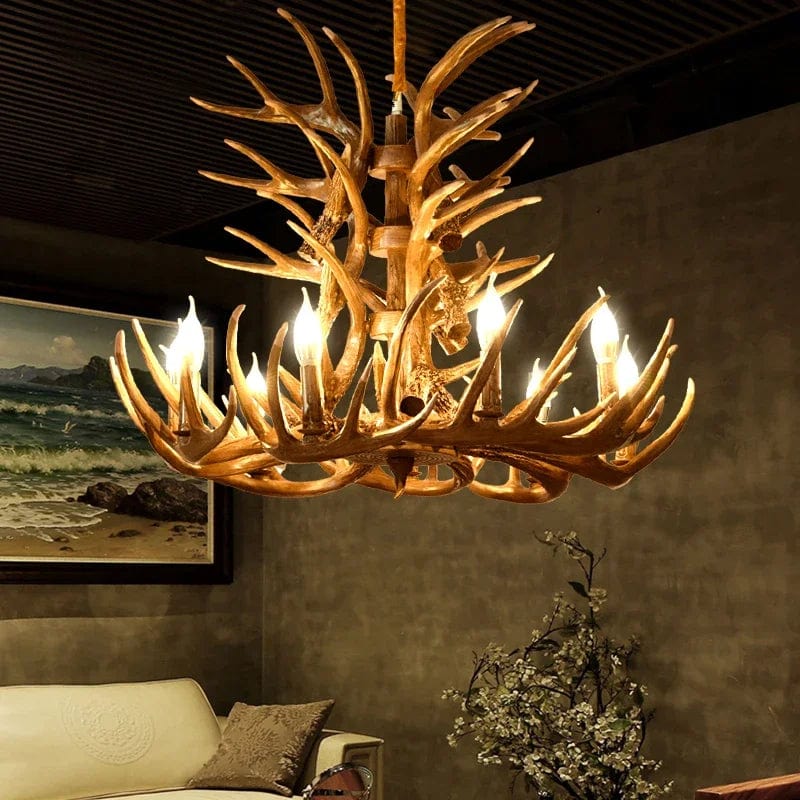
8Dennis Faux Antler Chandelier
Resin and Metal · Lodge DirectionIncluded as the honest counterpoint. Resin and composite elements do not respond to humidity, will not crack in dry winter air, and tolerate a damp cloth — genuine advantages in a cabin or seasonal property. The trade is that the finish is the material rather than a coating, so surface damage cannot be refinished.
Advantage: Humidity-indifferent, no cracking
Limitation: Cannot be refinished if damaged
Best for: Cabins, lodges, seasonal properties
Sizes: Five, brown and white
Browse iron and black lighting
Forged, aged and contemporary dark-finish fixtures.
Iron Chandeliers → Black → Rustic →Weight and Mounting
| Fixture | Typical weight | Mounting |
|---|---|---|
| Under 24 in, open frame | Under 20 lb | Standard listed box |
| 24-36 in, solid iron | 20-35 lb | Standard box — read the marked rating |
| 36-48 in, multi-arm | 35-50 lb | Box rated for the load; verify before ordering |
| Two-tier and large | 50-90 lb | Listed heavy-fixture brace box |
| Lodge scale | 90 lb and up | Structural blocking, professional install |
Iron reaches these thresholds sooner than glass or acrylic at the same diameter, which is the practical difference the material makes. Read the box's marked rating rather than assuming — boxes installed before current standards frequently rate lower than expected, and retrofitting one means drywall repair. Where a composition arrives in parts, hang and secure the frame first and add the ironwork afterwards: a loaded fixture is heavier, harder to level and easier to damage.
Where Iron Belongs
Dining rooms are iron's strongest application. The fixture hangs at close viewing distance against a ceiling, which gives maximum silhouette definition, and the dark frame defines the table zone within a larger room. Size to the table — one-half to two-thirds of its width — hung 30-36 in (76-91 cm) above the surface.
Entries and stairwells take iron for immediate definition; a dark silhouette against a bright entry ceiling establishes the house's register in one glance. Living rooms want the fixture centred on the seating group rather than the room outline. Kitchens take iron over islands in linear and wheel forms, though a matte finish handles airborne grease better than a textured one, which traps it.
Iron is the wrong material in two places: bathrooms, where humidity above roughly 60% risks corrosion unless the fixture is specifically damp-rated, and unconditioned porches, where humidity cycling defeats interior finishes within a season or two.
Care and Corrosion
Dry microfiber is the whole routine for aged, matte and textured iron. Two things to avoid: polish, which removes the surface layer that constitutes an aged finish and leaves a bright patch that cannot be matched, and liquid cleaners on matte black, which can leave residue visible against a uniform dark surface.
On corrosion, distinguish two things. A light orange-brown bloom that wipes away with a dry cloth is surface oxidation, common in humid rooms and harmless. Rust that flakes or pits the metal is active corrosion: with the power off, remove loose material with a soft brass brush or fine abrasive pad, wipe clean, and apply matching touch-up finish — worth requesting from the manufacturer at purchase rather than years later, since finishes vary between production batches. Keeping the room below roughly 60% relative humidity prevents nearly all of it.
Common Mistakes
- Assuming "wrought" means forged. The word is applied to almost everything dark and metal. Count identical elements and check for taper.
- Ignoring the listed weight. Iron passes standard box limits sooner than other materials at the same diameter.
- Rounding up on size. Black reads larger than its measurement. Between two sizes, take the smaller.
- Polishing an aged finish. Polish removes the patina that constitutes the finish, leaving a patch that will never match.
- Liquid cleaners on matte black. Residue shows against a uniform dark surface far more than on a reflective one.
- Iron in a bathroom without a damp rating. Sustained humidity above 60% is what starts corrosion.
- A two-tier fixture on a standard ceiling. The second ring adds vertical presence that presses down in an 8-9 ft room.
- Loading a fixture before hanging it. Assemble the frame on the ceiling first, then add the ironwork.
- Requesting touch-up finish years later. Ask at purchase — batches vary and the original may no longer exist.
Frequently Asked Questions
What is the difference between wrought and cast iron chandeliers?
Wrought means the metal was shaped by force — hammered, bent and drawn out — so every piece differs slightly and arms taper toward their tips. Cast iron is poured into a mould and reproduced identically, with uniform thickness and sometimes a faint seam. Both are structurally sound; only one is hand-worked.
How can I tell if a chandelier is genuinely forged?
Count how many elements share an identical shape — genuine forged work has none. Look for taper along the arms, continuous ground joints rather than bolted collars, and a listed weight consistent with solid iron: a 36 in fixture at 35 lb or above rather than 12-15 lb.
How much does a wrought iron chandelier weigh?
A 24-36 in fixture typically runs 20-35 lb, 36-48 in multi-arm designs 35-50 lb, and two-tier or large compositions 50-90 lb. Above 50 lb a listed heavy-fixture brace box replaces a standard junction box.
Do black iron chandeliers make a room feel smaller?
They read larger than their measurement, because a dark outline against a pale ceiling has maximum contrast. The room itself is not darkened — brightness comes from the lamps — but the fixture occupies more visual space, so take the smaller size when between two.
Does wrought iron rust indoors?
Rarely in normal conditions. A light bloom that wipes away is harmless surface oxidation. Rust that flakes or pits indicates active corrosion, usually from sustained humidity above roughly 60% — treat it with a brass brush and matching touch-up finish.
How do you clean an iron chandelier?
Dry microfiber, top down, with the power off at the breaker. Avoid polish, which removes the surface layer that constitutes an aged finish, and avoid liquid cleaners on matte black, where residue shows against the uniform surface.
Are iron chandeliers only for rustic or farmhouse rooms?
No. Candle arms and scrolled frames signal a period, but clean geometric iron frames signal only structure — which suits contemporary rooms wanting the contrast without the historical association.
Can an iron chandelier go in a bathroom?
Only a damp-rated one, clear of shower zones per code. Sustained humidity is what starts corrosion, which makes bathrooms and unconditioned porches the two places iron needs specific construction rather than a standard interior finish.
What size iron chandelier do I need?
Add the room's length and width in feet for a target diameter in inches, then round down — dark finishes read larger than their measurement. Over a dining table, size to the table instead at one-half to two-thirds of its width.
What bulbs suit an iron chandelier?
Warm white LED at 2700-3000K on a dimmer. Where candle sleeves leave lamps visible, decorative filament LEDs are part of the composition — and they run cool enough to leave the sleeves unaffected over years, which incandescent does not.
Should I match iron to my other metal hardware?
Black reads as a line rather than as a metal, so it does not count as the second metal in a room. An iron chandelier in a brass-hardware room is not a mixed-metal decision, which makes it the safe answer where existing hardware is mixed or may change.
Is a cast iron chandelier worth buying?
Yes, provided the price reflects the process. Casting keeps large compositions affordable and holds fine detail that forging cannot. What to avoid is paying forged prices for cast work — which is what the four checks above are for.
Count the Arms, Read the Weight
Two checks settle most of this category. Count how many elements share an identical shape — variation is craft, repetition is casting. Then read the listed weight, which tells you both whether the material is what it claims and whether your ceiling box can carry it. Everything after that is form and finish, which are the enjoyable decisions.
Browse the range: iron chandeliers, black chandeliers, rustic chandeliers.


