Quick Answer
Start with the room formula: add the room's length and width in feet, and the sum in inches gives target diameter. A 20 x 24 ft great room calls for roughly 44 in; a 24 x 30 ft lodge volume calls for 54 in.
Then apply the rustic correction. Timber and forged iron read visually heavier than glass or open metal at the same measurement, so the formula result behaves as a ceiling rather than a floor. In tall, generously proportioned volumes round up; in a normal-height room with a low beam, take the smaller option.
Height changes the answer as much as floor area. Above 12 ft, add roughly 3 in of diameter for every additional foot of ceiling — a fixture correctly sized for an 9 ft room disappears in a vaulted one.
Weight is the constraint people meet last: solid timber and iron compositions above 40 in routinely pass 50 lb, which requires a listed heavy-fixture brace box rather than a standard junction box. Check the listed figure before ordering.
Rustic architecture runs big — great rooms with vaulted ceilings, lodges built around a stone fireplace, open plans where the living area has no walls to contain it. Sizing a fixture for those spaces is not simply the standard formula scaled up, because rustic materials behave differently from glass and polished metal: they carry more visual weight per inch, they suit volume rather than floor area, and they weigh considerably more on the ceiling. This guide covers the formula and its rustic correction, sizing by ceiling height, rectangular and linear formats for long tables, when two fixtures beat one, and the mounting requirements that come with scale.
On this page
- The Formula and Its Rustic Correction
- Sizing by Ceiling Height
- Great Rooms and Lodge Volumes
- Long Tables: Rectangular and Linear
- One Large Fixture or Two Smaller?
- Picks for Round and Open Volumes
- Picks for Long Tables and Vertical Spaces
- Weight and Mounting at Scale
- Vaulted and Sloped Ceilings
- Output Across a Big Room
- Common Sizing Mistakes
- Frequently Asked Questions
The Formula and Its Rustic Correction
The standard rule applies here as everywhere: add the room's length and width in feet, and the sum in inches is the target diameter. A 16 x 20 ft room wants roughly 36 in; a 20 x 24 ft great room wants 44 in; a 24 x 30 ft lodge volume wants 54 in.
What changes is how the result behaves. In most categories the formula is a floor — a cluster of glass spheres or an open metal frame reads lighter than its measurement, so rounding up is safe. Rustic inverts that. Solid timber, forged iron and dense compositions read visually heavier than their diameter suggests, because there is less air in them and the materials themselves carry weight in the eye.
One qualification worth stating, because it points the other way: in genuinely large timber-framed volumes, the undersized fixture is the far more visible mistake. Rustic materials carry scale more gracefully than any other style, since weight is native to the look rather than something the fixture has to overcome. The correction is about proportion to the room's height, not timidity about size.
Sizing by Ceiling Height
Floor area gives a starting diameter; ceiling height decides whether it is right. A fixture sized for a 20 x 24 ft room with a 9 ft ceiling will look lost in the same footprint under an 18 ft vault.
Four ceiling bands, the diameter adjustment each calls for, and the fixture format that suits it
| Ceiling height | Diameter adjustment | Format | Available body depth |
|---|---|---|---|
| 8-9 ft | Formula, or one size down | Shallow or flush bodies | 12-24 in |
| 10-12 ft | Formula as written | Suspended, tiered opens up | 30-54 in |
| 14-18 ft | Formula plus 6-18 in | Two-tier and multi-tier | 60-96 in |
| 20 ft and above | Formula plus 24 in, or vertical | Vertical compositions filling height | 96 in and up |
The clearance rule holds at every height: 84 in of open space beneath the fixture wherever people walk. In a 9 ft room that leaves a 24 in budget for the fixture's body, which is why the tall multi-tier compositions the style is known for belong in tall rooms rather than being scaled down for standard ones.
Great Rooms and Lodge Volumes
Great rooms complicate the formula in a way rectangular dining rooms do not: they frequently have no single center. The room may run 20 x 30 ft with a seating group at one end, a dining area at the other, and a stone fireplace anchoring one wall.
The working approach is to size to the zone rather than the room. Center the fixture on the seating group and calculate its diameter from that area's dimensions rather than the whole floor plate. A 20 x 30 ft great room whose seating group occupies 16 x 18 ft calls for roughly a 34 in fixture over that group — not the 50 in the whole-room formula would produce.
Two supporting notes. In vaulted volumes, the fixture should relate to the ridge line and the beam structure rather than being centered on the floor: a fixture hung off the geometry of a timber frame reads misplaced regardless of its size. And where the room genuinely has two zones in use, two fixtures sized to each is almost always better than one oversized fixture attempting to serve both.
Long Tables: Rectangular and Linear
When a table is involved, it overrides the room entirely. Rustic dining tables in these spaces tend to be long — eight to twelve seats — and a round fixture over a long table lights the middle seats while leaving the ends dim.
Size to the table's length, not the room. A rectangular or linear fixture should span one-half to two-thirds of the table's length. A 96 in table therefore takes a 48-64 in fixture; a 120 in table takes 60-80 in. Keep the fixture visually narrower than the table — roughly one-third of the table's width or less — and hang it 30-36 in above the surface.
Where a single long fixture is unavailable in the right style, two matched round fixtures spaced along the table's axis is the standard alternative — spaced so each serves roughly half the length, with the outer edges kept inside the table's ends. The straight-line format range continues in the linear chandeliers collection.
One Large Fixture or Two Smaller?
Big rooms raise a question small ones do not. Three situations point toward two fixtures rather than one.
- The room has two genuine zones. A seating group and a dining area in one open plan want two fixtures, each sized to its own zone. One oversized fixture centered between them serves neither and belongs to neither.
- The table is longer than about 96 in. Two matched fixtures often read better than one very long linear composition, particularly in rustic, where a single fixture at that length can dominate.
- Only modest ceiling height is available. Two fixtures of moderate diameter distribute presence across a wide room without any single body needing the depth a tall composition would require.
Against that, one situation strongly favors a single fixture: a room with a genuine architectural center — a stone fireplace on axis, a ridge beam running the length, a symmetric plan. Symmetric architecture wants a symmetric answer, and one well-scaled fixture on the axis beats two competing for the eye.
Picks for Round and Open Volumes (4 Designs)
Compositions for great rooms, lodge volumes and open seating areas — sized by the zone rather than the whole floor plate. Keep 84 in of clearance in walking areas, and verify the listed weight against your junction box's marked rating.

1Glitz Tree Branch Ceiling Light
Eleven Sizes · Zone-MatchedEleven sizes is the widest range in the collection, which matters more in large rooms than small ones: great room zones rarely land on standard dimensions, and buying the size that fits beats compromising to the nearest available. Round layouts also remove the orientation question in rooms approached from several directions.
Use for: Zones that fall between standard sizes
Layout: Round — no orientation decision
Sizing: Zone length + width in feet = diameter in inches
Light: Warm white 3000K on a dimmer

2Nadia Rustic Branch Chandelier
Eight Sizes · Round or LinearAvailable in both round and linear layouts across eight sizes, which makes it one of the few designs that can serve a seating group and a long table in the same house without a style break. Round 25.59" (65 cm) upward covers most zone calculations; the linear versions start at 39.37" (100 cm).
Sizes: Eight, round from 25.59" (65 cm)
Advantage: One design language across two room types
Finish: Rustic naturalistic tones
Height: 30-36 in above a tabletop

3Solis Rustic Flower Branch Chandelier
22 Lights · Canopy DensityTwenty-two lights produces the canopy density tall volumes need — the compositions that read as an afterthought in a 20 ft room are the sparse ones, not the large ones. Compositions at this count belong at 14 ft and above; under a standard ceiling the same fixture presses down on the space rather than crowning it.
Ceiling: 14 ft and above
Why density: Sparse compositions read thin in tall volumes
Mounting: Verify against brace-box thresholds
Best rooms: Great rooms, lodge volumes, two-story spaces

4Velar Handmade Brass Branch Chandelier
Handmade · Warm Metal at ScaleAt large scale, execution quality becomes fully visible — limbs that taper and vary read as growth, while repeated identical elements read as pattern. Hand-formed work earns its place most in big rooms for exactly that reason. Warm brass also holds its own against stone and timber where cooler metals go flat.
Finish: Brass — holds against stone and timber
Why it matters here: Large fixtures magnify build quality
Best rooms: Great rooms, lodge dining, entries
Related: Branch chandeliers
Picks for Long Tables and Vertical Spaces (4 Designs)
Linear formats sized to table length, and vertical compositions for double-height volumes. Over a table, span one-half to two-thirds of its length and hang 30-36 in above the surface.
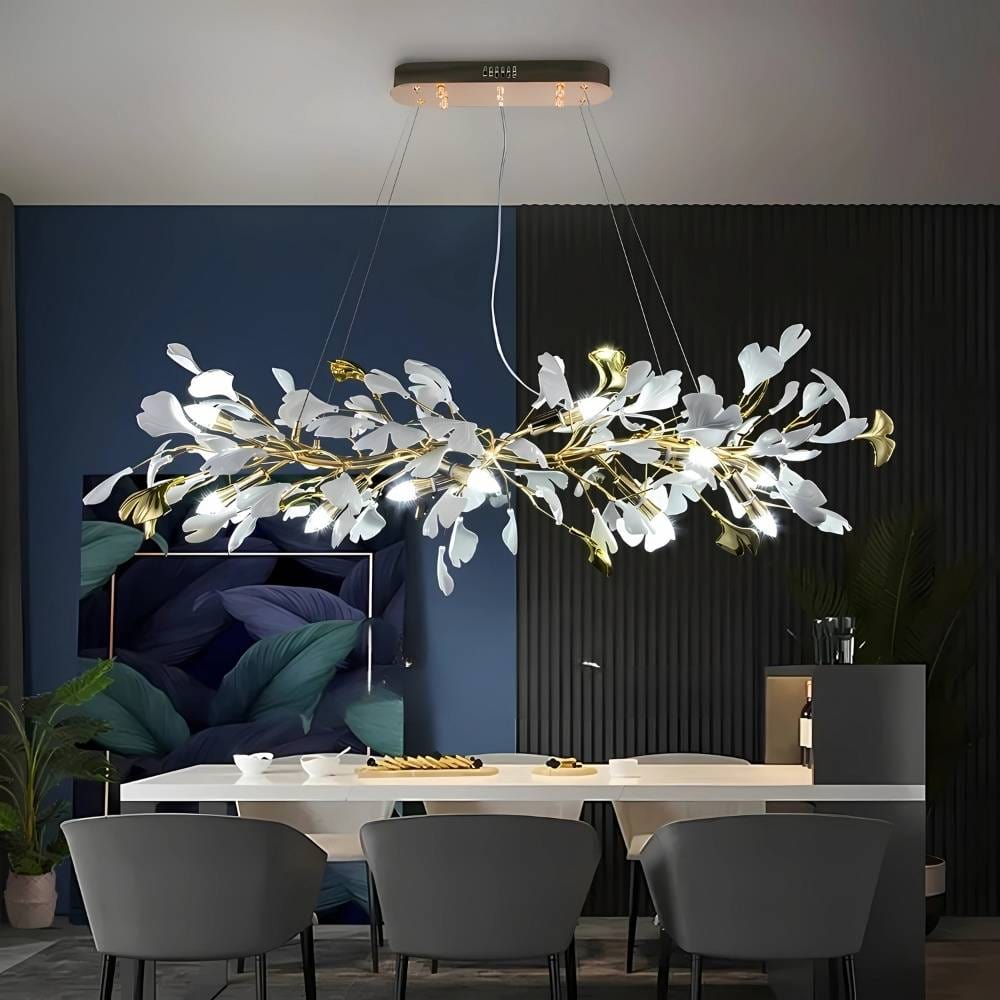
5Keira Tree Branch Chandelier
Rectangular · Six SizesRectangular layouts distribute light along an axis, which is what a long rustic table needs — every seat sits under light rather than the middle four. Six sizes from 39.37" (100 cm) upward covers tables from six seats to twelve; size to one-half to two-thirds of the table's length rather than the room.
Sizes: Six, from 39.37" (100 cm)
Size to: ½ to ⅔ of the table's length
Width rule: Keep under ⅓ of table width
Height: 30-36 in above the tabletop

6Zeal Wood Linear Chandelier
Timber Linear · Beam LanguageTimber in linear form is the most literal rustic answer to a long table — the fixture reads as a beam above the surface, echoing the structure overhead in a timber-framed room. Solid wood also carries the visual weight discussion directly: check the fixture's depth as well as its length, since a deep timber body eats clearance faster than an open frame.
Reads as: A beam echoing the structure above
Check: Body depth against your clearance budget
Size to: ½ to ⅔ of the table's length
Related: Wood chandeliers

7Nyra Modern Tree Branch Chandelier
47.24 in and Up · Statement ScaleStatement scale for rooms whose dimensions genuinely call for it: 47.24 in (120 cm) and larger across four sizes and five finishes. At this size the fixture is the room's architectural gesture rather than one element among several, which is the correct role in a great room with a stone fireplace and little else competing overhead.
Finishes: Black, gold, copper, silver, custom
Role: The room's architectural gesture
Mounting: Check weight against the box rating
Best rooms: Great rooms, long tables, open plans
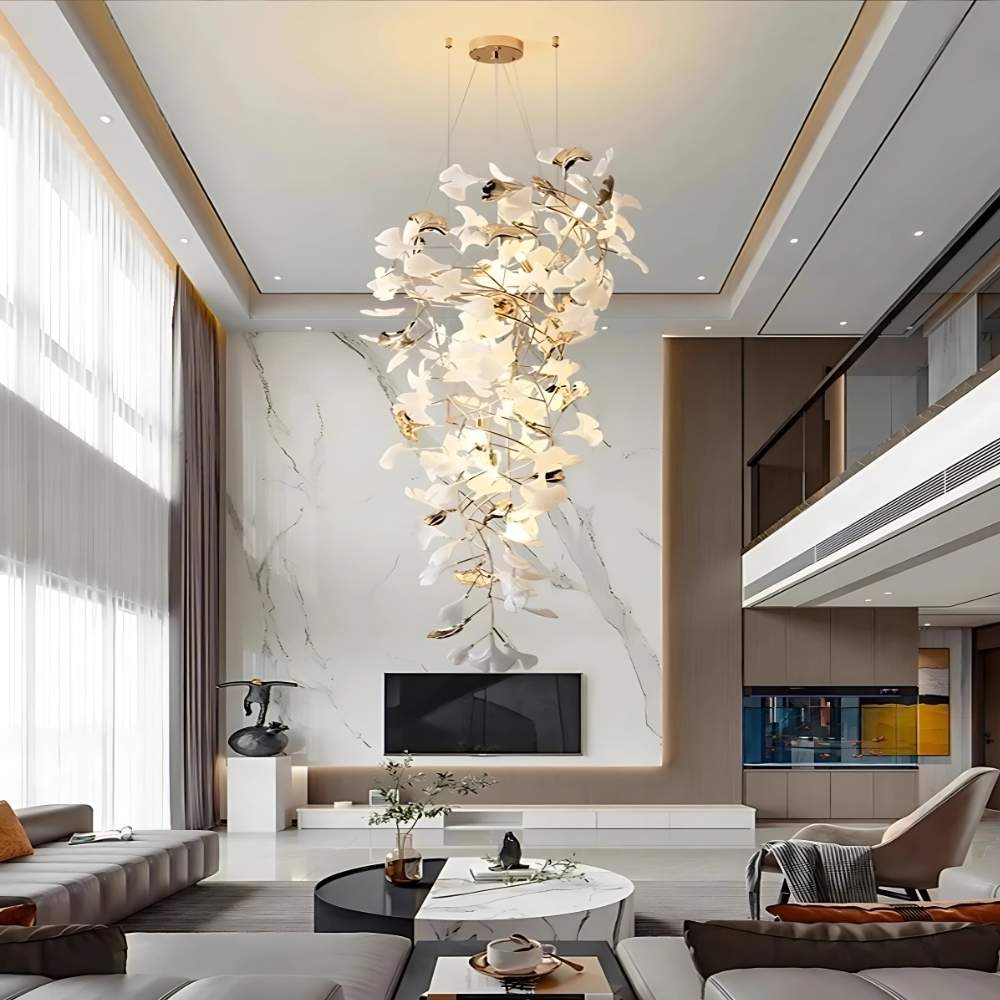
8Alba Branch Staircase Chandelier
Vertical · Double-Height VolumesAbove roughly 18 ft, diameter stops being the useful measurement: the volume needs vertical fill, and a wide flat fixture in a tall void leaves the height empty. Vertical compositions distribute elements down the drop instead, which is the correct answer for lodge entries and two-story great rooms.
Suits: 18 ft and above, lodge entries, stairwells
Sizes: Four, from 23.62" (60 cm)
Position: Center at or below the second-floor line
Install: Professional — scaffold access
Browse rustic lighting by scale
From compact entries to extra large statements for great rooms.
Rustic Chandeliers → Wood → Iron →Weight and Mounting at Scale
Weight is where large rustic fixtures differ most from large fixtures in other styles. Solid timber and forged iron are dense materials, and a composition that reads as an open frame in a photograph can weigh three times what a glass cluster of the same diameter does.
| Fixture | Typical weight | Mounting requirement |
|---|---|---|
| Under 30 in, mixed materials | Under 35 lb | Standard listed box |
| 30-40 in, wood and iron | 35-50 lb | Box rated for the load — read the label |
| 40-54 in, solid timber or iron | 50-90 lb | Listed heavy-fixture brace box |
| Multi-tier and extra large | 90 lb and up | Structural blocking, professional install |
Two notes that save trouble. Read the box's marked rating rather than assuming — boxes installed before current standards frequently rate lower than expected, and retrofitting one in a vaulted ceiling means scaffolding plus drywall repair at height. And where the composition is assembled from separate elements, hang and secure the frame first, then add the timber or ironwork: a loaded fixture is heavier, more fragile and considerably harder to level.
Vaulted and Sloped Ceilings
Rustic architecture and vaulted ceilings arrive together often enough that the mounting question deserves its own note. A fixture hung from an angled surface needs a sloped-ceiling adapter, or swivel canopy, so the body hangs plumb rather than following the pitch. Check the maximum slope the adapter accommodates against your ceiling's actual angle before ordering — steep vaults exceed some adapters' range.
Beam structures add a second consideration. Where exposed beams cross the ceiling, the fixture's position is frequently decided by where a box can be mounted rather than by the room's center. Plan around that constraint early: a fixture centered between beams reads deliberate, while one crowding a beam reads accidental regardless of its size.
Output Across a Big Room
Large rooms need more light than one fixture provides, and rustic compositions in particular spread output sideways rather than concentrating it downward. Treat a large rustic chandelier as the room's ambient and decorative layer, and plan recessed lighting, sconces or lamps for the areas where real work happens.
Warm white at 2700-3000K throughout, on a dimmer. Rustic materials are firelight materials — timber grain, aged iron and seeded glass all read best in the warm band, and cool white at 4000K and above strips the character from every one of them. Where limb tips or candle sleeves carry visible lamps, decorative filament LEDs are part of the composition rather than a hidden consumable.
Common Sizing Mistakes
- Sizing to the whole great room instead of the zone. A 20 x 30 ft room with a 16 x 18 ft seating group wants a fixture sized to the group, not the floor plate.
- Ignoring ceiling height. The same footprint at 9 ft and at 18 ft calls for different fixtures. Above 12 ft, add roughly 3 in of diameter per additional foot.
- Treating the formula as a floor in a low room. Timber and iron read heavier than their measurement. In a wide but not tall room, take the smaller option.
- Under-sizing in a genuine lodge volume. The opposite error, and the more visible one. Rustic materials carry scale gracefully; timidity shows.
- A round fixture over a long table. It lights the middle seats. Long tables want rectangular or linear compositions sized to length.
- Sizing to the extended table. Use the everyday length; the leaf comes out a few days a year.
- Checking diameter but not depth. A deep timber body eats the clearance budget faster than an open frame of the same width.
- Skipping the weight check. Large solid-material fixtures pass 50 lb easily, and retrofitting a brace box in a vaulted ceiling is scaffolded work.
- Fighting the beam structure. In a timber-framed room, the fixture should relate to the beams rather than to the floor's center point.
Frequently Asked Questions
What size rustic chandelier do I need for a great room?
Add the length and width in feet of the zone the fixture will serve — usually the seating group rather than the whole floor plate — and the sum in inches gives the target diameter. A 16 x 18 ft seating area calls for roughly 34 in.
How does ceiling height change the size?
Above 12 ft, add roughly 3 in of diameter for every additional foot. At 8-9 ft, take the formula result or one size down; at 20 ft and above, switch to a vertical composition that fills height rather than a wider flat one.
Should I round up or down with rustic fixtures?
It depends on height. Timber and iron read visually heavier than glass at the same measurement, so in a wide but standard-height room take the smaller option. In a tall timber-framed volume, round up — undersizing is the more visible mistake there.
What size chandelier over a long rustic dining table?
Size to the table rather than the room: a rectangular or linear fixture spanning one-half to two-thirds of the table's length, kept under one-third of its width, hung 30-36 in above the surface.
When should I use two fixtures instead of one?
When the room has two genuine zones, when the table exceeds about 96 in, or when ceiling height is modest and two moderate fixtures distribute presence better than one deep composition.
How much do large rustic chandeliers weigh?
Solid timber and iron compositions between 40 and 54 in commonly run 50-90 lb, and multi-tier designs exceed 90 lb. Read the listed figure rather than judging by appearance, since dense materials weigh far more than open glass forms of the same diameter.
Do I need a special ceiling box?
Under 35 lb a standard listed box is adequate. From 50-90 lb, a listed heavy-fixture brace box is required, and above 90 lb the mounting should tie into structural blocking.
Can a large rustic chandelier hang from a vaulted ceiling?
Yes, with a sloped-ceiling adapter so the fixture hangs plumb rather than following the pitch. Check the maximum slope the adapter accommodates against your ceiling's angle, since steep vaults exceed some adapters' range.
How high should it hang in a great room?
Keep at least 84 in of clearance beneath it wherever people walk. Over a dining table, 30-36 in above the tabletop. In two-story volumes, position the composition's center at or just below the second-floor line.
Will one chandelier light a great room?
Not alone. Treat it as the ambient and decorative layer and plan recessed lighting, sconces or lamps for the areas where real work happens. Rustic compositions in particular spread output sideways rather than concentrating it downward.
What about rooms with exposed beams?
The beams frequently decide the position, since a box has to be mounted where the structure allows. A fixture centered between beams reads deliberate; one crowding a beam reads accidental regardless of size.
What color temperature suits large rustic fixtures?
Warm white 2700-3000K on a dimmer. Rustic materials are firelight materials — timber grain, aged iron and seeded glass all read best in the warm band, and cool white strips character from all three.
Zone, Height, Then Weight
Size to the zone the fixture actually serves rather than the whole floor plate, adjust the result for ceiling height, and apply the rustic correction — heavier materials in a standard-height room, generous scale in a genuine timber volume. Then check the weight against the box before ordering, because that is the constraint that turns a straightforward installation into ceiling work.
Browse the range: rustic chandeliers, wood chandeliers, iron chandeliers, linear chandeliers.